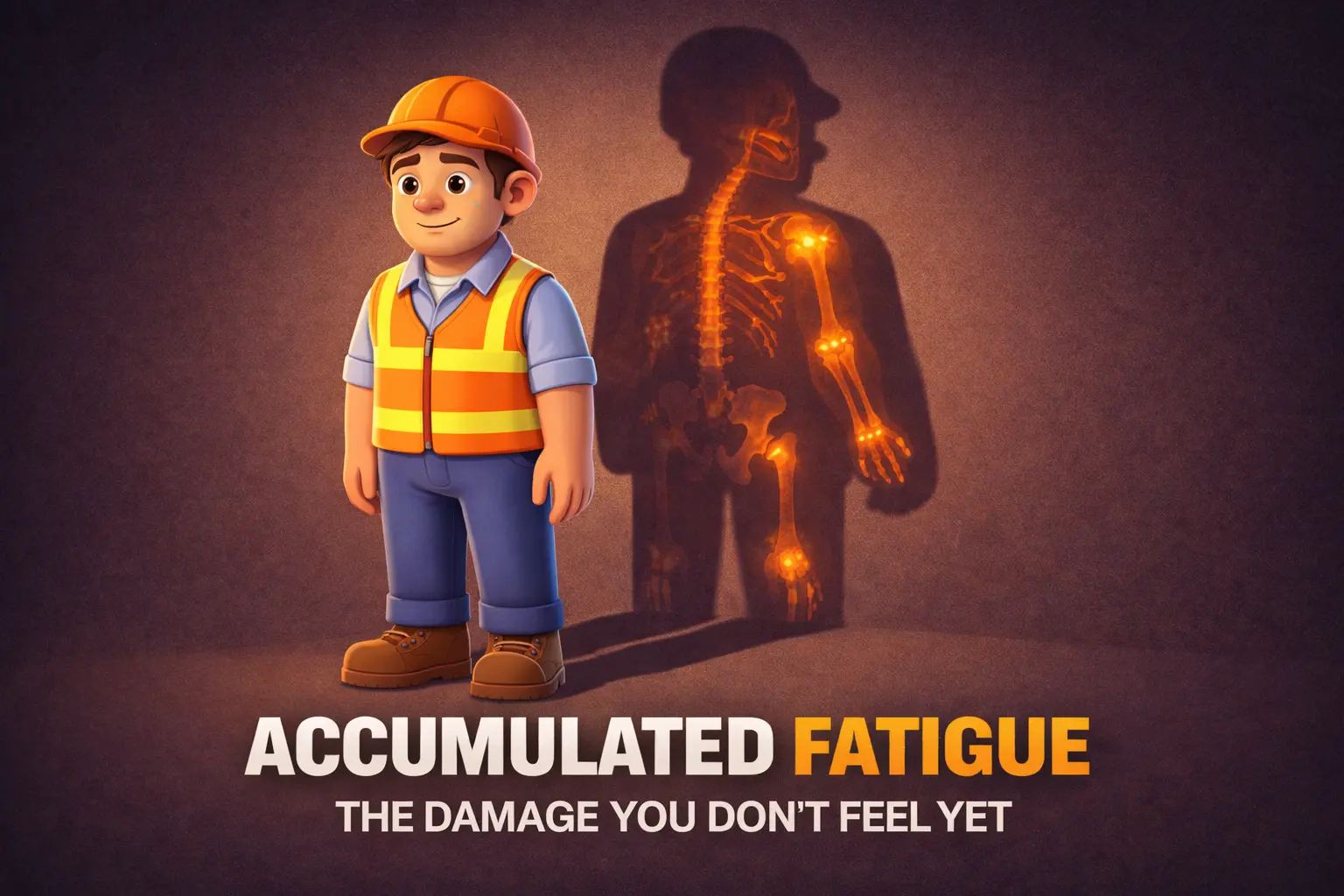
You’re not injured. You’re adapting — until your body can’t anymore.
Most physical damage doesn’t start with pain.
There is no crack. No snap. No single bad lift you can point to.
You just notice small changes: your body warms up slower, certain movements feel heavier, recovery takes longer than it used to. Nothing feels “wrong,” but nothing feels sharp anymore either.
This is accumulated fatigue — the slow, silent buildup of stress your body hasn’t recovered from.
It’s the damage you don’t feel yet, but carry every day.
This article explains how accumulated fatigue forms, why it hides so well, how it quietly changes the body, and why most physical workers only notice it when it’s already limiting them.
Table of Contents
- What accumulated fatigue actually is
- Why accumulated fatigue stays invisible
- Adaptation: the body’s greatest strength and weakness
- Fatigue is a system-wide problem
- Micro-damage and unfinished healing
- Why performance drops before pain appears
- Compensation: how fatigue spreads pain
- Why weekends don’t reset accumulated fatigue
- The tipping point nobody feels coming
- Who accumulates fatigue fastest
- Ignoring fatigue vs recovering from it
- The blunt truth
What accumulated fatigue actually is
Accumulated fatigue is not tiredness.
Tiredness disappears after rest. Accumulated fatigue does not.
It’s the leftover stress your body never fully clears. The residue from thousands of repetitions, long shifts, static positions, and constant tension.
Every workday leaves behind small amounts of unresolved load:
- Muscles that never fully relax
- Joints that stay slightly compressed
- Connective tissue that heals incompletely
- A nervous system that stays partially “on”
Individually, none of these matter. Collectively, they change how your body functions.
Accumulated fatigue is not about how hard one day was — it’s about how many days never fully ended.
Why accumulated fatigue stays invisible
The most dangerous part of accumulated fatigue is how quiet it is.
There’s no warning alarm. No sudden failure. Just subtle shifts that feel normal because they happen slowly.
Your body doesn’t signal danger immediately because pain is a last resort. Pain only shows up when compensation and adaptation can’t handle the load anymore.
This is why people say:
- “I don’t know when this started”
- “It just crept up on me”
- “I woke up one day and everything hurt”
Accumulated fatigue hides behind normalcy.
Adaptation: the body’s greatest strength and weakness
Your body is designed to adapt. That’s how humans survive hard work.
When stress increases slowly, the body adjusts instead of resisting. Muscles stiffen to protect joints. Movement patterns change to avoid discomfort. The nervous system raises baseline tension.
At first, this works.
You stay productive. You avoid pain. You feel capable.
But adaptation has a cost.
Every adaptation trades long-term efficiency for short-term survival.
The body doesn’t ask whether a strategy is sustainable — only whether it keeps you moving today.
Fatigue is a system-wide problem
Accumulated fatigue doesn’t live in one muscle or joint. It spreads across systems.
| System | What fatigue does over time |
|---|---|
| Muscular | Loss of elasticity, quicker burnout |
| Joint | Reduced range, increased compression |
| Connective tissue | Slower repair, higher injury risk |
| Nervous system | Constant background tension |
This is why fatigue often feels vague and full-body rather than sharp and local.
Micro-damage and unfinished healing
Most physical damage isn’t dramatic. It’s repetitive.
Every lift, grip, twist, reach, and brace creates tiny amounts of tissue stress. Normally, these heal overnight.
But when recovery is incomplete, healing pauses mid-process.
The tissue isn’t injured — it’s unfinished.
Over time, unfinished healing becomes fragile tissue. That’s when “normal” movements start causing problems.
This is why injuries often happen on easy days, not hard ones.
Why performance drops before pain appears
The body reduces output before it creates pain.
Early signs of accumulated fatigue are performance-related, not painful:
- Slower reaction time
- Weaker grip late in shifts
- More mistakes under fatigue
- Longer warm-ups
Most people ignore these because pain hasn’t arrived yet.
By the time pain appears, performance has already been compromised for a long time.
Compensation: how fatigue spreads pain
When one area becomes fatigued, the body shifts load elsewhere.
This creates compensation patterns:
- Hips pick up for the back
- Shoulders pick up for the spine
- Wrists pick up for tired grip
Compensation keeps you working — but it spreads fatigue.
This is why pain moves around the body over years instead of staying in one place.
Why weekends don’t reset accumulated fatigue
Two days off feel like recovery. They usually aren’t.
Especially when weekends involve:
- Minimal movement
- Poor sleep timing
- No decompression or mobility
Weekends stop new damage. They don’t reverse old damage.
That’s why Monday stiffness often feels worse than Friday fatigue.
The tipping point nobody feels coming
Accumulated fatigue doesn’t grow forever.
It reaches a threshold.
Beyond that point:
- Aches stop disappearing
- Recovery takes days instead of hours
- Minor issues escalate quickly
People mistake this for sudden aging or bad luck.
In reality, it’s delayed payment.
Who accumulates fatigue fastest
Accumulated fatigue builds fastest in:
- Physically consistent jobs (warehouse, construction, trades)
- Workers who never miss work but skip recovery
- People who rely on toughness instead of systems
Strength delays fatigue signals. It doesn’t prevent accumulation.
Ignoring fatigue vs recovering from it
Ignoring accumulated fatigue doesn’t remove it.
It pushes the cost into the future.
Recovery doesn’t erase fatigue instantly, but it:
- Reduces carryover
- Restores lost movement
- Resets nervous system tone
- Extends work lifespan
This is the difference between working until you choose to stop — and stopping because you’re forced to.
The blunt truth
The most dangerous fatigue is the fatigue you can still work through.
Accumulated fatigue doesn’t scream. It waits.
And when it finally speaks, it doesn’t ask permission.
This article is general recovery education, not a diagnosis or a substitute for care from a qualified clinician. Stop and get medical help for severe pain, numbness, weakness, chest pain, sudden swelling, fever, or symptoms that keep worsening.
Log in to leave a comment.