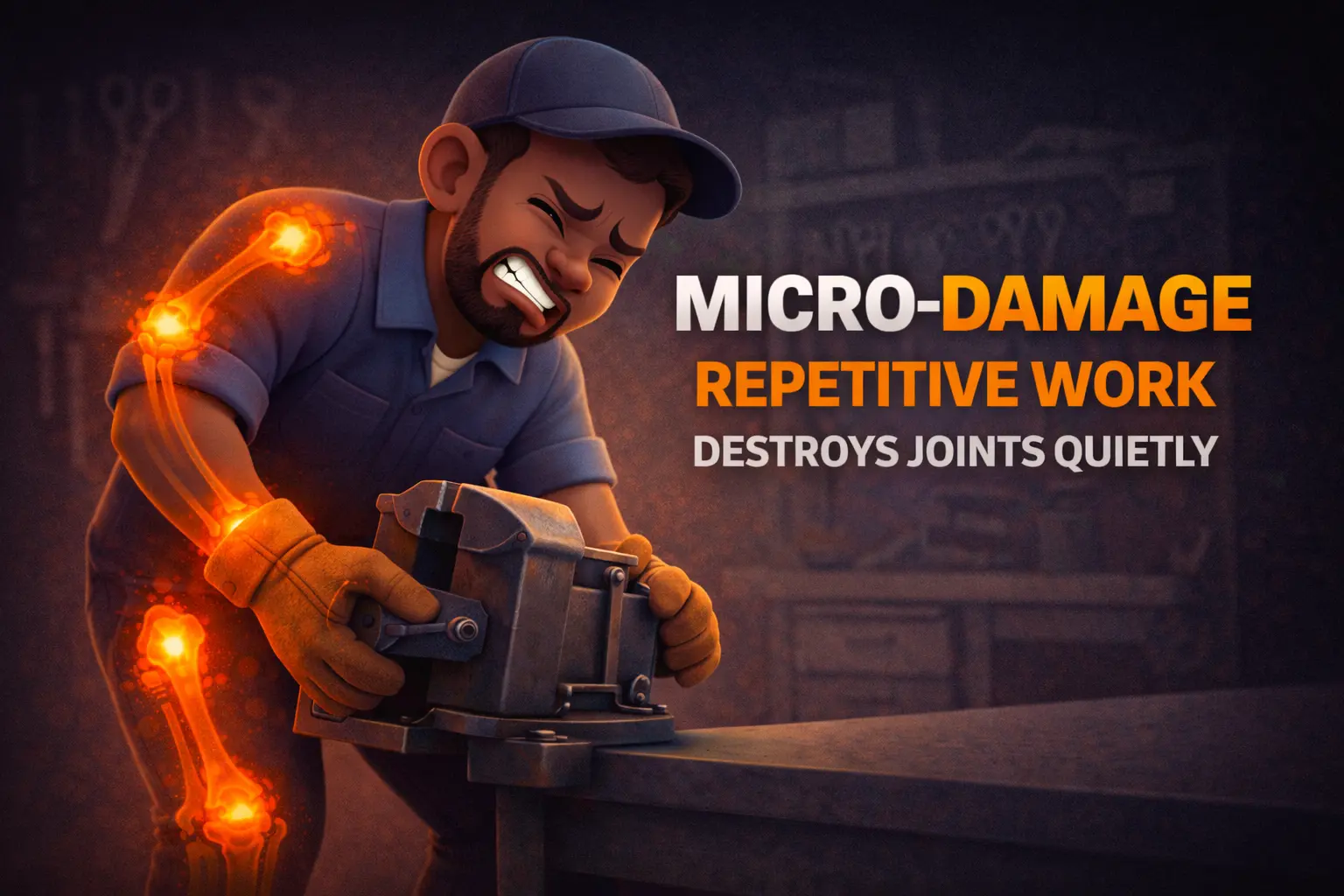
No injury. No warning. Just damage stacking until your joints stop cooperating.
Most joint damage doesn’t happen in accidents.
It doesn’t happen on the day you lift something wrong. It doesn’t happen when you feel a sharp pain. It doesn’t happen during one bad shift.
It happens quietly. Repetitively. Invisibly.
This is micro-damage — the slow destruction of joints caused by repetitive work that never feels dangerous enough to stop.
This article explains what micro-damage is, how it forms, why you don’t feel it early, and how it quietly turns “normal work pain” into long-term joint problems.
Table of Contents
- What micro-damage actually is
- Why repetition is worse than heavy lifting
- Why joints suffer before muscles
- Why micro-damage doesn’t hurt at first
- How micro-damage fuels accumulated fatigue
- Jobs most vulnerable to micro-damage
- Movement quality vs movement quantity
- Why rest days don’t fix joint damage
- Early warning signs people miss
- Preventing micro-damage before it becomes injury
- Q & A: micro-damage explained
- The blunt truth
What micro-damage actually is
Micro-damage is small, repeated stress applied to the same tissues over and over again without full recovery.
Each individual movement is harmless. The danger is repetition without resolution.
Examples:
- Thousands of identical lifts per shift
- Repeated twisting under load
- Static gripping for hours
- Standing or kneeling in fixed positions
Nothing breaks. Nothing tears dramatically. Tissue quality simply degrades.
This is why micro-damage is ignored — it doesn’t feel urgent.
Why repetition is worse than heavy lifting
Heavy lifting looks dangerous. Repetition looks safe.
That’s the trap.
Heavy loads create obvious fatigue. Repetitive loads create silent wear.
| Heavy Load | Repetitive Load |
|---|---|
| Triggers caution | Feels routine |
| Limits reps | Thousands of reps |
| Clear fatigue | Hidden damage |
Repetition wins through volume.
Why joints suffer before muscles
Muscles adapt quickly. Joints do not.
Muscles get blood flow, oxygen, and repair signals. Joints rely on movement quality, alignment, and spacing.
When repetition happens with even slight misalignment, joints absorb stress they cannot dissipate.
This is why people feel “joint stiffness” long before muscle pain.
Why micro-damage doesn’t hurt at first
Pain is a late signal.
Early micro-damage causes:
- Reduced lubrication
- Minor cartilage stress
- Subtle inflammation
None of this hurts immediately.
That’s why people keep working normally — and why damage stacks unnoticed.
How micro-damage fuels accumulated fatigue
Micro-damage is the physical foundation of accumulated fatigue.
Unresolved joint stress forces compensations elsewhere, accelerating whole-body fatigue.
This directly connects to:
Micro-damage is the quiet engine behind long-term breakdown.
Jobs most vulnerable to micro-damage
| Job Type | Primary Joint Risk |
|---|---|
| Warehouse picking | Shoulders, wrists, knees |
| Construction | Spine, hips, elbows |
| Assembly lines | Wrists, fingers, neck |
| Logistics & loading | Lower back, hips |
Movement quality vs movement quantity
Most people count how much they lift.
Almost nobody evaluates how they move on repetition 600.
As fatigue increases, movement quality degrades. Micro-damage accelerates.
Bad reps matter more than heavy reps.
Why rest days don’t fix joint damage
Rest stops loading. It doesn’t restore joint mechanics.
Without active recovery:
- Joint compression remains
- Inflammation lingers
- Movement restrictions persist
This explains why joints feel worse on Mondays.
This also connects directly to:
Early warning signs people miss
- Clicking or grinding joints
- Stiffness that takes longer to disappear
- Loss of comfortable range
- Needing longer warm-ups
These are not “normal work pain.”
They are early joint distress.
Preventing micro-damage before it becomes injury
You don’t prevent micro-damage by working less.
You prevent it by:
- Restoring joint space
- Maintaining range of motion
- Breaking repetitive patterns
- Recovering daily, not weekly
Prevention is invisible — which is why it’s ignored.
Q & A: Micro-Damage Explained
Is micro-damage the same as injury?
No. Injury is the result. Micro-damage is the process.
Why doesn’t micro-damage show on scans early?
Because tissue quality degrades before structural failure occurs.
Can strength training prevent micro-damage?
It delays symptoms. It does not remove joint stress.
Is soreness a sign of micro-damage?
Soreness alone isn’t. Persistent stiffness is.
The blunt truth
Micro-damage is not dramatic enough to fear — until it is.
By the time joints hurt constantly, damage has been accumulating for years.
Repetitive work doesn’t destroy joints suddenly.
It destroys them quietly.
This article is general recovery education, not a diagnosis or a substitute for care from a qualified clinician. Stop and get medical help for severe pain, numbness, weakness, chest pain, sudden swelling, fever, or symptoms that keep worsening.
Keep Reading

Log in to leave a comment.