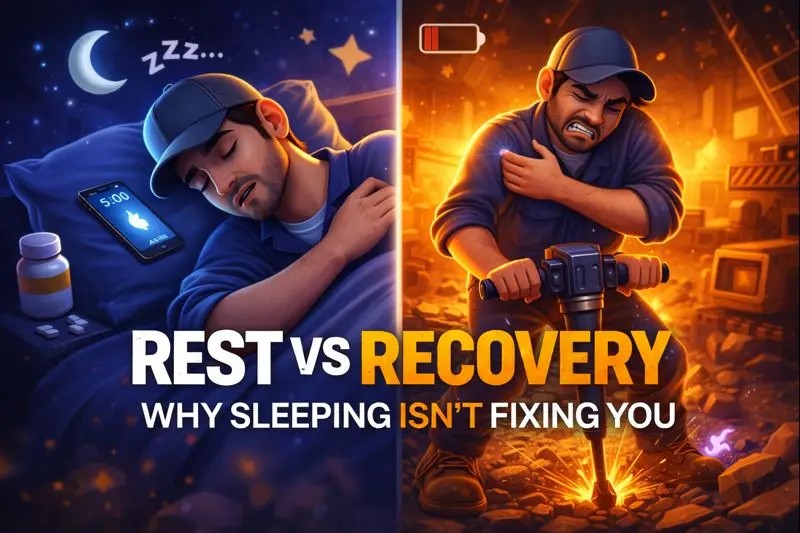
You’re resting every night. You’re still broken every morning. Here’s why.
You are resting. You are not recovering.
This is one of the most damaging misconceptions in physical work culture: the belief that sleep alone fixes the body. You finish a long shift, your legs feel heavy, your back feels compressed, your grip feels weak — so you go home and sleep, assuming the body will “reset.”
But you wake up stiff. Slow. Sore in places that didn’t hurt yesterday. And every year, that stiffness starts earlier and lasts longer.
If sleep alone fixed physical damage, long-term warehouse workers, construction laborers, mechanics, and tradespeople would feel better with experience. Instead, most feel worse — not because they are lazy, weak, or aging poorly, but because they are confusing rest with recovery.
This article explains the real difference, why sleeping isn’t fixing you, and what recovery actually requires after physical labor.
Table of Contents
- Rest vs Recovery: the difference no one explains
- Why sleep alone fails for physical workers
- The accumulation problem: damage doesn’t reset overnight
- Why “just rest” slowly makes things worse
- The nervous system problem nobody talks about
- What real recovery actually looks like
- The minimum recovery most workers actually need
- Why recovery becomes more important every year
- The blunt truth
Rest vs Recovery: the difference no one explains
Rest and recovery are treated like synonyms. They are not.
Rest means stopping activity. Sitting down. Lying down. Sleeping. It prevents additional damage, but it does not actively reverse what already happened.
Recovery is an active process. It restores range of motion, clears residual inflammation, resets the nervous system, and brings the body closer to baseline.
| Rest | Recovery |
|---|---|
| Stops effort | Reverses stress |
| Passive | Intentional |
| Prevents more damage | Reduces accumulated damage |
| Sleep, sitting | Movement, decompression, regulation |
Sleep belongs to recovery — but only as a support tool. Without addressing physical and neurological load while awake, sleep becomes a band-aid.
Why sleep alone fails for physical workers
Sleep evolved to repair normal daily stress: walking, light lifting, short bursts of effort. Physical labor is not normal stress.
Manual work creates:
- Repeated joint compression
- Micro-tears that never fully heal
- Low-grade inflammation that becomes chronic
- Protective muscle tension that never switches off
Sleep helps with hormones, memory, and general tissue repair. It does not restore joint space, undo movement restrictions, or calm an overstimulated nervous system.
| Sleep helps with | Sleep does NOT fix |
|---|---|
| Hormonal balance | Chronic stiffness |
| Energy restoration | Compressed spine & hips |
| General muscle repair | Restricted movement patterns |
| Mental reset | Nervous system stuck “on” |
This is why sleeping longer often makes no difference — or sometimes makes you feel worse.
The accumulation problem: damage doesn’t reset overnight
Physical fatigue is not linear. It accumulates.
Every shift leaves behind residue:
- Muscle fibers that didn’t fully re-lengthen
- Joints that stayed slightly compressed
- Inflammation that never fully cleared
- Movement patterns adjusted to pain
Sleep pauses this process. It does not erase it.
Over months and years, this leftover stress stacks until:
- Pain starts earlier in the shift
- Warm-ups get longer
- “Good days” become rare
This is not aging. It is unresolved load.
Why “just rest” slowly makes things worse
When people feel exhausted, they instinctively do nothing. That feels safe — and it is the wrong move.
Complete inactivity causes:
- Blood flow to drop
- Stiff tissue to stiffen further
- Inflammation to stagnate
- The nervous system to stay alert
| Hard shift | → | No movement | → | Stiff morning | → | Harder shift |
Rest without recovery is how temporary soreness becomes permanent pain.
The nervous system problem nobody talks about
Physical labor keeps your nervous system in survival mode for hours.
Grip stays tight. Breathing stays shallow. Muscles never fully relax.
If the nervous system does not downshift, the body cannot repair efficiently — even during sleep.
This is why people say, “I slept all night and still feel tense.” The system never received a signal that the workday ended.
What real recovery actually looks like
Real recovery is simple — but deliberate.
It targets four systems:
| System | What it needs |
|---|---|
| Muscular | Movement, blood flow, lengthening |
| Joints | Decompression, range of motion |
| Nervous system | Down-regulation, calm input |
| Inflammation | Circulation, not stagnation |
Sleep works best after these are addressed.
The minimum recovery most workers actually need
You don’t need expensive tools or influencer routines.
You need consistency:
- 5–10 minutes of decompression post-shift
- Basic mobility for spine, hips, shoulders
- Breathing that signals “work is over”
Small daily recovery beats occasional extreme recovery every time.
Why recovery becomes more important every year
At 20, sleep covers mistakes.
At 30, it hides them.
At 40, it can’t anymore.
Recovery is not about comfort. It’s about durability.
People who last in physical work don’t work less — they recover better.
The blunt truth
If sleep was enough, you wouldn’t feel like this.
Rest stops damage. Recovery reverses it.
Most people rest. Almost nobody recovers.
That’s why the pain stays.
Log in to leave a comment.