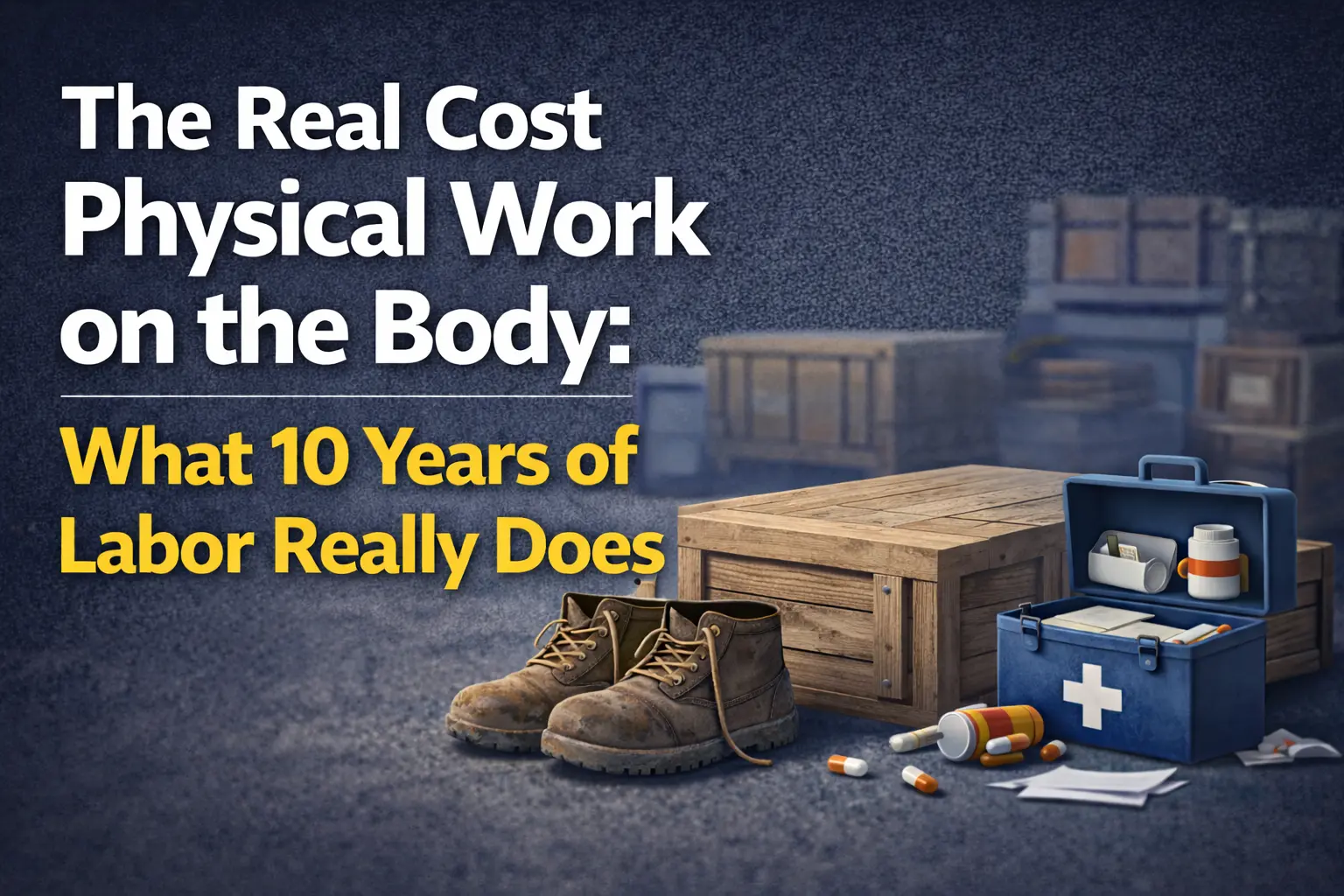
What repetitive labor really does to your joints, nerves, sleep, and recovery — year by year.
If you work a physical job, your body is paying a cost every single day. Not all at once. Not in dramatic injuries. But slowly, quietly, and consistently.
This is the part nobody explains.
Most people think the cost of physical work shows up as accidents or obvious injuries. In reality, the real damage comes from accumulated physical stress: repetition, load, awkward positions, vibration, concrete floors, poor sleep, and incomplete recovery.
This article breaks down what 10 years of physical work actually does to the body. Not motivational content. Not gym advice. Just how the damage builds — and why pain shows up earlier every year.
The Damage You Don’t Feel at First
Early on, physical work feels manageable. Sometimes it even feels good.
You get stronger. Your endurance improves. You adapt.
That adaptation is real — but it’s incomplete.
Muscles adapt fast. Tendons, cartilage, nerves, and connective tissue do not. They absorb stress without immediate feedback. That stress doesn’t disappear. It accumulates.
This is why so many physical workers say, “I was fine for years, then suddenly everything hurt.” It wasn’t sudden. It was delayed.
Related: Why pain shows up earlier every year
Years 1–2: Adaptation Masks Damage
In the first couple of years, soreness fades quickly. Recovery feels fast. Pain comes and goes.
This phase creates a false sense of safety.
- You assume your body is built for this
- You ignore early warning signs
- You normalize end-of-shift pain
What’s actually happening is micro-damage forming faster than it can be repaired. Tendons experience tiny tears. Joints experience repeated compression. Nerves experience constant low-grade irritation.
None of this is disabling — yet.
This is where the long-term trajectory gets set.
Years 3–4: Compensation Replaces Recovery
By year three or four, the body stops fixing problems and starts working around them.
You don’t lift worse. You lift differently.
- One side takes more load
- Grip tires faster than before
- A knee, shoulder, or wrist feels “off”
Pain usually shows up after shifts, not during. That makes it easy to dismiss.
This is when compensation patterns lock in. Movement becomes less efficient. Stress concentrates instead of distributing evenly.
Related: Why repetitive work damages joints quietly
Years 5–6: Accumulated Fatigue Takes Over
This is the point where most physical workers notice something has changed.
Recovery slows. Sleep doesn’t fully reset you. Days off feel shorter.
Common signs include:
- Morning stiffness that lasts longer
- Lingering joint or back pain
- Lower tolerance for long shifts
- Increased reliance on caffeine or painkillers
This is not aging. It’s exposure.
The body now carries more damage than it can fully repair between shifts. Fatigue becomes cumulative instead of temporary.
Related: Rest vs recovery: why sleep isn’t fixing you
Years 7–8: Structural Wear Becomes Obvious
At this stage, damage becomes harder to ignore.
- Cartilage thins under constant load
- Tendons stiffen and lose elasticity
- Nerve irritation causes numbness or tingling
- Sleep becomes lighter and fragmented
Pain becomes predictable. Certain movements always hurt. Certain mornings are always worse.
This is when people say, “Everyone hurts.”
That belief keeps people working through damage instead of managing it.
Related: Work pain vs injury: why the difference matters
Years 9–10: Early Breakdown Phase
By year ten, the body has less margin.
Not everyone is broken — but almost everyone is limited.
- Chronic back, knee, or shoulder pain
- Reduced grip strength and endurance
- Slower reaction times
- Sleep that no longer feels deep
Small problems now limit performance. Tasks take more effort. Recovery requires more planning.
The job hasn’t changed. The body has.
Why Physical Work Hits More Than Muscles
Physical labor doesn’t just damage muscles. It stresses entire systems.
- Joints: repetitive compression and rotation
- Tendons: constant low-grade strain
- Nervous system: vibration, stress, disrupted sleep
- Sleep system: fatigue without full recovery
This is why stretching alone doesn’t solve the problem. The issue isn’t flexibility — it’s load management and recovery quality.
Related: Why most recovery advice fails physical workers
10-Year Cost of Physical Work: Summary
| Years Worked | What You Notice | What’s Really Happening |
|---|---|---|
| 1–2 | Soreness fades quickly | Micro-damage accumulates |
| 3–4 | Intermittent pain | Compensation patterns form |
| 5–6 | Slower recovery | Fatigue exceeds repair |
| 7–8 | Predictable pain | Structural wear develops |
| 9–10 | Persistent limits | Early breakdown phase |
What This Means for Physical Workers
The real cost of physical work isn’t pain.
It’s lost margin.
Less recovery. Less tolerance. Less resilience — earlier every year.
AfterTheShift exists because this process is predictable. And predictable damage can be managed.
This isn’t about quitting work. It’s about lasting longer without breaking down early.
Next: Why pain shows up earlier every year — and what actually accelerates it.
This article is general recovery education, not a diagnosis or a substitute for care from a qualified clinician. Stop and get medical help for severe pain, numbness, weakness, chest pain, sudden swelling, fever, or symptoms that keep worsening.
Log in to leave a comment.