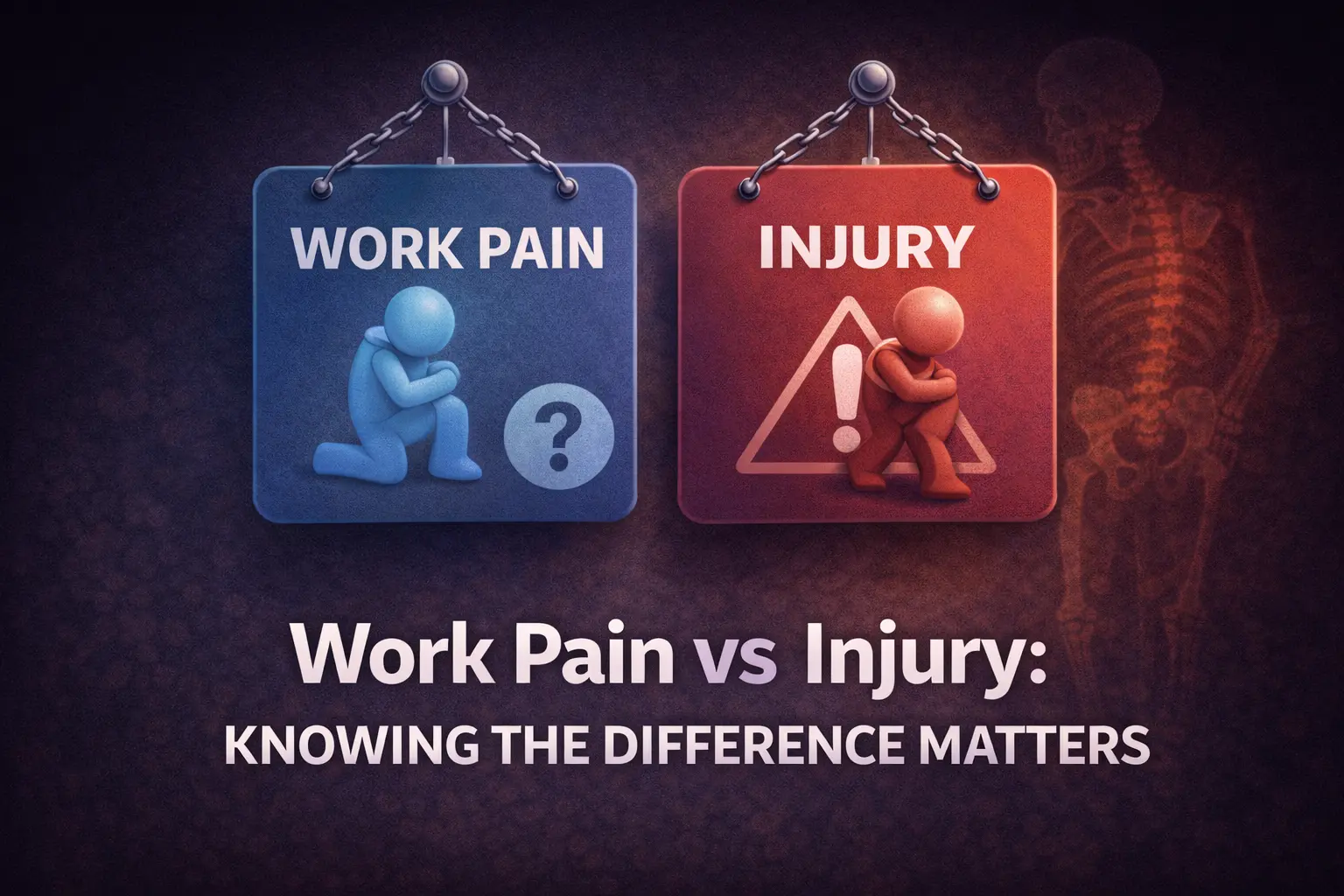
One is a signal. The other is damage. Confusing them ruins careers.
Not all pain means injury.
And not all pain is harmless.
This confusion is one of the biggest reasons physical workers either ignore serious damage for too long — or panic over normal stress and stop trusting their bodies.
Knowing the difference between work pain and injury matters more than toughness, motivation, or experience.
This article breaks down the difference clearly, explains why the line gets blurry in physical work, and shows how misunderstanding pain accelerates long-term damage.
Table of Contents
- Why work pain and injury get confused
- What work pain actually is
- What an injury actually is
- Key differences that matter
- How pain turns into injury over time
- Micro-damage: the bridge between pain and injury
- How accumulated fatigue blurs the line
- Pain zones you should never ignore
- When to stop vs when to keep working
- Q & A: common confusion explained
- The blunt truth
Why work pain and injury get confused
Physical work creates discomfort by default.
Soreness, stiffness, tightness, and fatigue are part of loading the body. Because of that, pain becomes normalised very quickly.
This connects directly to:
When pain is expected, people stop asking what kind of pain they’re feeling.
That’s where the trouble starts.
What work pain actually is
Work pain is a stress response.
It comes from:
- Temporary muscle fatigue
- Tissue tightness after load
- Short-term inflammation
Work pain has characteristics:
- Appears after effort
- Improves with movement or warm-up
- Reduces after recovery
Work pain is information, not damage.
It tells you load exists — not that something is broken.
What an injury actually is
An injury is structural or functional damage.
It involves:
- Tissue breakdown
- Failed adaptation
- Loss of capacity
Injury pain behaves differently:
- Persists regardless of warm-up
- Returns immediately after rest
- Changes how you move
Injuries don’t just hurt — they reduce function.
Key differences that matter
| Work Pain | Injury |
|---|---|
| Temporary | Persistent |
| Improves with movement | Worsens or stays the same |
| Does not alter movement | Forces compensation |
| Responds to recovery | Requires intervention |
Confusing these leads to two mistakes:
- Ignoring injury
- Fear-avoiding normal work pain
How pain turns into injury over time
Injury rarely appears suddenly in physical work.
More often, the timeline looks like this:
| Normal work pain | → | Persistent stiffness | → | Movement compensation | → | Injury |
The transition is gradual, which is why people miss it.
This is where micro-damage plays its role.
Micro-damage: the bridge between pain and injury
Micro-damage is small, repeated tissue stress that never fully heals.
It sits between pain and injury.
Detailed here:
Micro-damage doesn’t hurt sharply — but it lowers tolerance until injury becomes inevitable.
How accumulated fatigue blurs the line
Accumulated fatigue makes everything hurt — even before injury exists.
This makes workers assume pain is normal when it isn’t.
Related reading:
Fatigue hides injury and exaggerates pain at the same time.
Pain zones you should never ignore
Some pain locations are higher risk:
- Spine (especially sharp or deep pain)
- Joints with locking or catching
- Loss of grip strength
- Pain that wakes you up at night
These are not “work pain”.
When to stop vs when to keep working
Keep working when pain:
- Reduces with movement
- Feels muscular
- Disappears after recovery
Stop or modify work when pain:
- Changes your movement
- Persists across days
- Feels sharp, deep, or unstable
This distinction protects both health and income.
Q & A: Pain vs Injury
Can work pain exist without injury?
Yes — most of the time.
Can injury exist without severe pain?
Yes — especially early.
Does soreness mean injury?
No. Persistence does.
Is pushing through pain always bad?
Pushing through injury is. Pushing through normal fatigue is not.
The blunt truth
Ignoring injury destroys bodies.
Fearing normal pain destroys confidence.
The difference between the two is what keeps physical workers functional long-term.
Knowing the difference matters.
This article is general recovery education, not a diagnosis or a substitute for care from a qualified clinician. Stop and get medical help for severe pain, numbness, weakness, chest pain, sudden swelling, fever, or symptoms that keep worsening.


Log in to leave a comment.