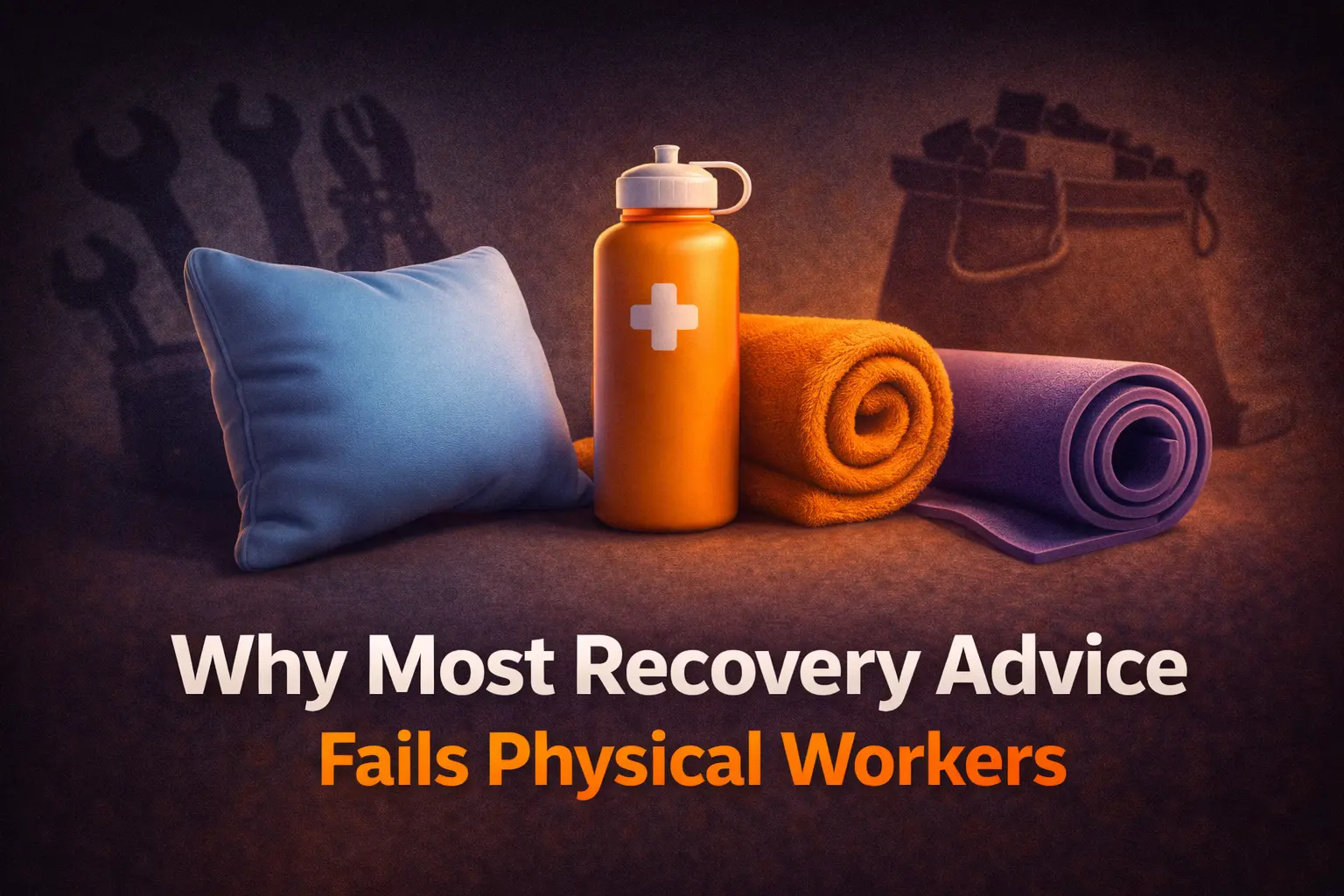
Because it’s written for people who sit — not for bodies that carry load every day.
Most recovery advice sounds good.
Sleep more. Stretch daily. Drink water. Take rest days.
And yet physical workers keep getting worse.
Not tired — damaged. Stiffer every year. Slower to recover. Aching earlier in the shift.
The problem isn’t effort. It’s that most recovery advice was never designed for physical work.
This article explains why mainstream recovery advice fails people who work with their bodies, what it ignores, and what recovery actually needs to look like for physical labor.
Table of Contents
- Who most recovery advice is written for
- Why “just sleep more” doesn’t work
- Why stretching alone fails
- Why rest days don’t reset physical damage
- Fatigue vs damage: the mismatch
- Micro-damage: what advice ignores
- How recovery advice ignores accumulation
- The nervous system problem nobody addresses
- Why one-size-fits-all recovery fails
- What recovery actually needs for physical workers
- Q & A: recovery myths vs reality
- The blunt truth
Who most recovery advice is written for
Most recovery advice is written for people who are:
- Sedentary
- Office-based
- Training voluntarily (gym, sports)
That matters.
Gym fatigue is optional. Physical work fatigue is compulsory.
Office workers recover from short bursts of stress. Physical workers recover from daily load accumulation.
Applying office recovery advice to physical labor is like using sports rehab for factory wear — it misses the mechanism.
Why “just sleep more” doesn’t work
Sleep is essential. It is not sufficient.
Sleep helps:
- Hormonal balance
- Mental clarity
- General repair
Sleep does NOT fix:
- Joint compression
- Movement restrictions
- Micro-damage accumulation
This directly connects to:
Sleep pauses damage. It does not reverse it.
Why stretching alone fails
Stretching feels productive. That’s why it’s popular.
The problem is that most stretching:
- Does not decompress joints
- Does not restore joint mechanics
- Does not calm the nervous system
Stretching lengthens tissue temporarily — it doesn’t fix the conditions that made it tight.
This is why stretching feels good for 10 minutes and useless by morning.
Why rest days don’t reset physical damage
Rest days stop new damage. They do not undo existing damage.
Especially when rest days involve:
- Minimal movement
- No decompression
- No mobility restoration
This explains why many workers feel worse after weekends.
Damage doesn’t disappear because you stopped working.
Fatigue vs damage: the mismatch
Most recovery advice treats pain as fatigue.
That’s a mistake.
| Fatigue | Damage |
|---|---|
| Temporary | Accumulative |
| Resolves with rest | Requires active recovery |
| Doesn’t change movement | Forces compensation |
This misunderstanding is why advice sounds right but fails in practice.
Micro-damage: what advice ignores
Most recovery advice ignores micro-damage completely.
Repetitive work slowly degrades joints without obvious pain.
This is explained in detail here:
You can’t stretch or sleep away tissue degradation.
How recovery advice ignores accumulation
Recovery advice assumes stress resets daily.
Physical work does not reset.
Unresolved stress stacks — which leads to:
Recovery advice that ignores accumulation fails by design.
The nervous system problem nobody addresses
Physical work keeps the nervous system activated for hours.
Grip tension. Balance control. Load awareness.
Sleep restores alertness — not regulation.
If recovery never downshifts the nervous system, physical healing remains incomplete.
Why one-size-fits-all recovery fails
Recovery advice assumes everyone has:
- Energy after work
- Time for long routines
- Control over workload
Physical workers usually have none of these.
Recovery must fit reality — not ideals.
What recovery actually needs for physical workers
Effective recovery for physical workers must:
- Reduce joint compression
- Restore movement quality
- Interrupt repetitive patterns
- Downshift the nervous system
It must be short, repeatable, and daily.
Not perfect. Consistent.
Q & A: Recovery Myths vs Reality
Is sleep useless?
No. It’s foundational — just incomplete.
Is stretching bad?
No. It’s insufficient alone.
Are rest days pointless?
No. They stop damage — they don’t undo it.
Why does recovery advice work for others?
Because they don’t accumulate physical damage daily.
The blunt truth
Most recovery advice fails because it wasn’t written for you.
Physical work creates damage that requires physical solutions.
Recovery that ignores load, repetition, and accumulation is comfort — not repair.
This article is general recovery education, not a diagnosis or a substitute for care from a qualified clinician. Stop and get medical help for severe pain, numbness, weakness, chest pain, sudden swelling, fever, or symptoms that keep worsening.
Log in to leave a comment.