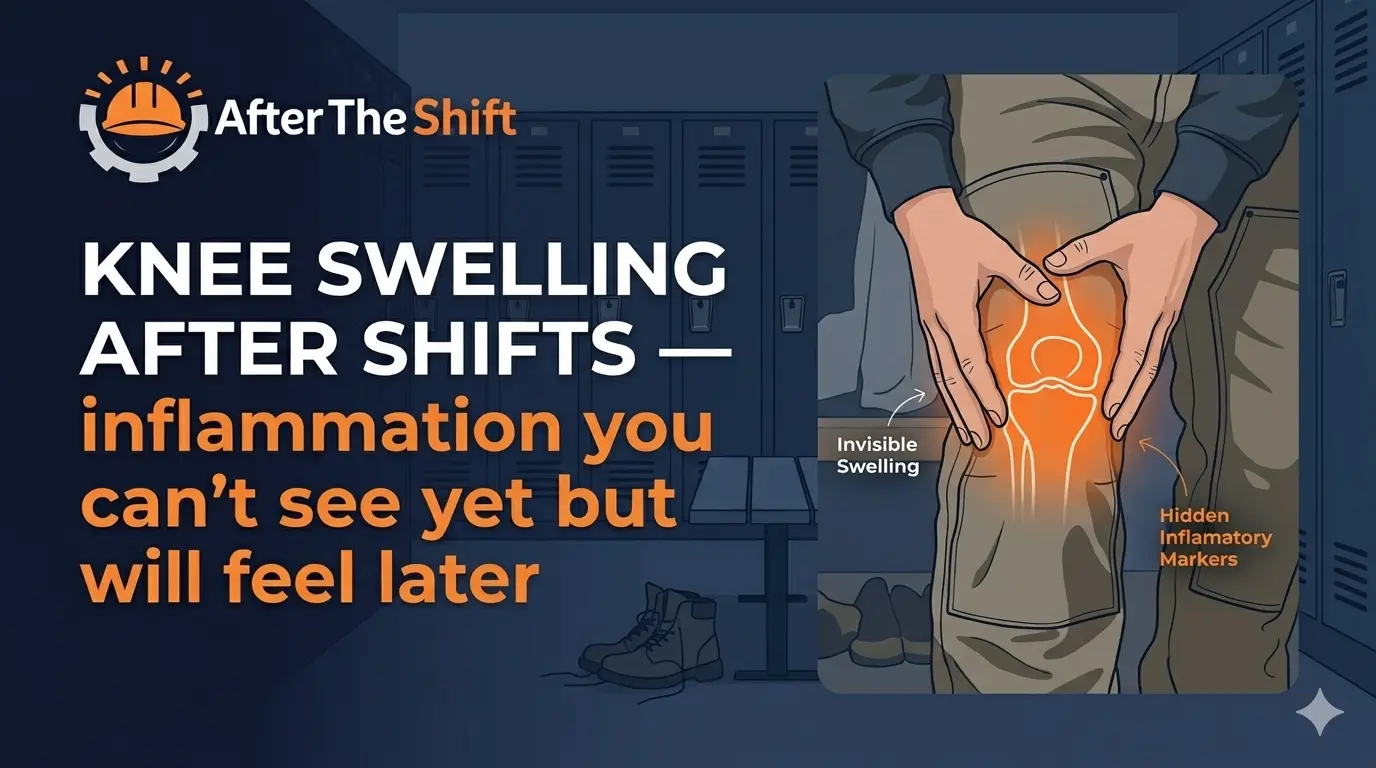
Why your knee feels full, tight, or stiff after work before it looks obviously swollen — and what to do before it turns into a bigger problem
Long shift. Normal-looking knee. Then later: stiffness, fullness, tightness on stairs, or that dull pressure when you bend it. That is often the stage where inflammation is building before the knee looks obviously swollen.
This guide is for workers who stand, squat, carry, climb, kneel, or pivot all day and want to know what to do tonight, what to change tomorrow, and when to stop guessing.
Blunt rule: If your knee is hot, red, badly swollen, locked, gives way, looks deformed, or you cannot bear weight, stop self-managing and get medical help instead of trying to “recover through it.”
Quick answer
Knee swelling after shifts usually means the joint or the tissue around it is reacting to repeated load, kneeling, deep bending, twisting, or too much standing without enough recovery. Most mild cases improve fastest when you reduce load early, use cold therapy, add the right support, and stop feeding the irritation for 24 to 72 hours.
- Do: cool the knee for 15–20 minutes, elevate it, and cut down extra stairs, squats, and kneeling that evening.
- Do: use light compression or support if the knee feels puffy, unstable, or “full.”
- Do: track whether the reaction settles by the next day or keeps stacking shift after shift.
- Avoid: heat first if the knee feels freshly irritated, hot, or more swollen after work.
- Avoid: wearing a super-tight wrap that makes the lower leg or foot swell.
- Buy if needed: a cold knee wrap for after-shift swelling, a support brace for repeated standing and walking, and knee pads if the job includes frequent kneeling.
- Skip: random “miracle” sleeves if you have not matched the product to the actual problem.
Table of contents
Fast decision table
| If you... | Most likely bucket | Do first | Skip for now |
|---|---|---|---|
| Feel fullness, tightness, or stiffness a few hours after standing, walking, or stairs | Load-reaction swelling | Cold therapy, elevation, reduced load | Extra training, long walks “to loosen it up” |
| Get swelling after kneeling on hard surfaces | Front-of-knee irritation / bursitis pattern | Stop direct kneeling, use pads, cool it early | Bare-knee work tomorrow |
| Feel swelling with wobble, insecurity, or mild instability | Irritated knee that also needs support | Compression/support plus load reduction | Ignoring it because it is not “real pain” yet |
| Have heat, redness, severe swelling, locking, deformity, or cannot bear weight | Medical assessment bucket | Get urgent medical help | Self-diagnosing from social media |
Why you feel it later, not during the shift
Plenty of workers expect an injury to hurt during the hard part. Knee irritation often does the opposite. During the shift, you are warm, moving, and distracted. Later, the tissues that handled all that repeated bending, stepping, pivoting, braking, and loading start reacting.
The usual pattern is not dramatic. It is subtle at first:
- the knee feels full, not just sore
- stairs feel worse going down than up
- bending the knee feels tighter at night
- the second or third workday feels worse than the first
- the joint looks mostly normal, but feels different
That is the trap. Workers often wait for visible swelling before taking it seriously. By then, the pattern is usually more established.
Works for: mild to moderate swelling that shows up after repetitive work. Not for: a major twist, pop, fall, gross swelling, infection signs, or a knee that locks or gives way.
Decision tree: what kind of swelling pattern do you have?
Start here:
- Did this start after a twist, pop, fall, or direct hit?
Yes → Do not treat this like “normal work soreness.” Get assessed.
No → Go to 2. - Is the knee hot, red, badly swollen, or are you unable to bear weight?
Yes → Urgent medical help.
No → Go to 3. - Is the swelling worst after kneeling or pressure on the front of the knee?
Yes → Think kneeling irritation / bursitis pattern. Remove pressure first.
No → Go to 4. - Is the knee mostly puffy, stiff, or tight after long standing, walking, carrying, or stairs?
Yes → Think load-reaction swelling. Cool it, elevate it, reduce extra load for 24–72 hours.
No → Go to 5. - Does it also feel wobbly, unsupported, or like it needs a sleeve to feel safe?
Yes → Add support/compression and cut the aggravating volume.
No → Track the next 3 shifts. If it keeps returning, stop calling it random.
Symptom → likely cause → first fix
| Symptom you notice | Likely cause bucket | Best first fix |
|---|---|---|
| Tightness or pressure later in the evening | Workload reaction inside or around the joint | Cold wrap + elevation + less stair volume tonight |
| Swelling after kneeling, crawling, or floor-level work | Front-of-knee irritation from pressure and friction | Knee pads, less direct pressure, cool early |
| Puffy knee plus mild instability or “needs support” feeling | Irritation plus poor tolerance to repeated load | Structured support brace during work, recovery after |
| Looks normal but stairs feel worse the next morning | Inflammation that built after the shift | Reduce next-day aggravators before it becomes visible swelling |
| Swelling that keeps returning every week | Repeated unresolved overload pattern | Fix the work pattern, not just the evening symptoms |
Best affiliate picks for this exact problem
These are not ranked as “best knee products on earth.” They are ranked for this article’s problem: swelling that builds after shifts, especially from repeated load or kneeling. The method is simple: direct fit to swelling control, support during work, kneeling protection, and how easy the item is to use in real blue-collar routines.
| Product | Best for | Who should buy | Who should skip |
|---|---|---|---|
| NEWGO Ice Knee Sleeve with Cold Gel | After-shift swelling, puffiness, and tightness | Workers who need fast cold therapy without balancing loose ice packs | Anyone looking for all-day work support instead of recovery use |
| BAUERFEIND Knee Support with Silicone Ring | During-shift support for repeated standing, walking, and stair use | Workers whose knee feels puffy and under-supported before it becomes real pain | People expecting a brace to fix a knee they are still overloading every day |
| NoCry Professional Hard-Cap Knee Pads | Kneeling trades: construction, flooring, mechanics, installers | Anyone whose swelling pattern is clearly worse after kneeling | Workers whose issue comes mostly from standing/walking rather than floor contact |
Best pick: after-shift swelling control
Best when the knee feels full, tight, or irritated later in the day and you want a clean, repeatable recovery step instead of guessing with random frozen bags.
Best upgrade: support during the shift
Best when swelling is part of a larger pattern: long standing, repeated walking, stairs, and a knee that feels like it needs guidance, not just rest.
Best for kneeling jobs
Best when the pattern is obvious: kneeling on hard ground, front-of-knee swelling, and a job that punishes you for putting the joint directly on the surface.
Weighted scoring rubric
| Product | Swelling relief (40%) | On-shift support (30%) | Kneeling protection (20%) | Ease of use (10%) | Total fit for this post |
|---|---|---|---|---|---|
| NEWGO | 10/10 | 3/10 | 1/10 | 8/10 | 6.2/10 |
| BAUERFEIND | 6/10 | 10/10 | 2/10 | 8/10 | 6.8/10 |
| NoCry | 2/10 | 4/10 | 10/10 | 7/10 | 4.7/10 |
How to read this: BAUERFEIND wins as the most rounded option for workers still doing shifts. NEWGO wins if your main goal is calming the reaction after work. NoCry is the specialist pick if kneeling is the clear trigger.
2-minute after-shift knee check
Score 1 point for each “yes.”
- Does the knee feel fuller or tighter at night than during the shift?
- Do stairs feel worse the morning after work?
- Does kneeling, squatting, or getting off the floor feel more stiff than painful?
- Have you noticed the same pattern for 2 or more weeks?
- Does the knee feel better with cooling and load reduction, then flare again when work resumes?
- Do you avoid bending it fully because it feels pressured or puffy?
0–1: probably a short-term reaction. Watch it.
2–3: the pattern is real. Start treating the cause, not just the symptom.
4–6: you are likely stacking irritation week after week. Change your recovery and work setup now, and get assessed if it is not improving.
What to do tonight, tomorrow, and this week
Tonight
- Cool the knee for 15–20 minutes.
- Elevate it above heart level if you can.
- Skip extra stairs, deep squats, lunges, and “testing it.”
- If the knee feels unsupported, use light compression or a brace that does not make the lower leg swell.
Soft CTA: If your main problem is the evening puffiness/tightness cycle, the NEWGO cold knee sleeve is the cleanest first buy because it matches the recovery step you actually need.
Tomorrow
- Reduce unnecessary stair trips and repeated deep bends.
- Break up long static standing when possible.
- If the knee feels loose, irritated, or unstable under load, use a support like the BAUERFEIND knee support.
- If kneeling is part of the job, do not go back to bare-knee contact. Use protection such as the NoCry knee pads.
This week
- Track whether swelling is driven most by standing, stairs, carrying, kneeling, or deep bending.
- Look for repeated trigger days, not random pain stories.
- If it is lasting more than a few weeks, getting worse, or showing red flags, get assessed.
Copy-paste checklist: what workers miss
- □ I can tell what trigger makes the swelling worse: standing, stairs, kneeling, squatting, or carrying.
- □ I am not waiting for visible swelling before acting.
- □ I have one recovery tool for after work and one protection tool for the shift.
- □ I am not using a brace as permission to overload the knee.
- □ I know the red flags that mean this is not a home-care situation.
- □ I have reduced the exact work pattern that keeps feeding the reaction.
The common mistakes that keep swelling around
- Waiting for visible swelling: the knee often feels bad before it looks bad.
- Using support with no workload change: a brace helps, but it does not erase bad load management.
- Going straight to heat: that can feel good, but it is often the wrong first move after a fresh flare.
- Ignoring kneeling pressure: if your work involves direct contact on hard surfaces, protection is not optional.
- Treating it only at night: the work pattern usually needs fixing too.
What to read next on After The Shift
- Physical work recovery guide — the pillar page for building a recovery system that actually fits labor jobs.
- Why your knees hurt going down stairs after work, not up — the next read if stairs expose the problem faster than walking does.
- Knee pain that only shows up on your second day back — for delayed knee reactions that stack across the week.
- Knee pain from squatting and standing all day — for workers whose knee gets worse with repeated bending cycles.
- The kneeling tasks that cause the most long-term damage in construction — essential if floor-level work is your obvious trigger.
Next steps
If your issue is after-shift swelling, start with recovery control. If your issue is swelling plus unsupported movement during work, add structured support. If your issue is kneeling pressure, protect the knee before you try anything else.
- Choose the bucket that matches your real trigger.
- Use the right product for that bucket.
- Track the next three shifts instead of guessing from one bad day.
Save this post so you can run the check again after your next heavy shift.
Hard CTA: If you want one practical setup, use the NEWGO cold sleeve for the after-work flare, the BAUERFEIND knee support for repeated standing and walking, and the NoCry knee pads if kneeling is the real culprit.
FAQ
Why does my knee swell after work instead of during the shift?
Because the tissues often react after the repeated load is over. While you are moving, warm, and distracted, the knee may feel manageable. Later, the joint and surrounding tissues start showing the consequences: tightness, fullness, pressure, and stiffness.
Is knee swelling without major pain still a problem?
Yes. Swelling is not harmless just because the pain is low. A knee that keeps getting puffy, full, or tight after shifts is telling you the workload is exceeding what it currently tolerates.
Should I use ice or heat for knee swelling after shifts?
For a fresh after-shift flare with puffiness, heat, or irritation, cold is usually the better first move. Heat can be useful later for stiffness in some cases, but it is often not the best starting choice when the knee feels actively inflamed.
How long should work-related knee swelling last before I worry?
A mild flare can settle within days, especially if you reduce load early. If it keeps returning for weeks, is getting worse, or is not improving with sensible changes, stop treating it as random soreness and get it assessed.
Can kneeling at work cause swelling even if I am young?
Yes. Age does not protect you from pressure and friction on the front of the knee. Repeated kneeling on hard surfaces can irritate the structures in front of the kneecap and create a swelling pattern long before someone thinks of themselves as “old enough” for knee problems.
Are knee pads enough if my job involves lots of kneeling?
They help a lot if kneeling pressure is the main trigger, but they are not magic. You still need to reduce unnecessary kneeling time, change positions when possible, and calm down any flare that is already active.
Can I keep working through a swollen knee if it is not that bad?
Sometimes you can keep working with smart modifications, but “not that bad” is where chronic patterns usually start. If the knee is repeatedly swelling, feels unstable, or the reaction lasts beyond 24 hours after the shift, you need to change the pattern instead of normalizing it.
When is a swollen knee an emergency?
Urgent medical review matters if the knee is hot, red, badly swollen, deformed, locked, giving way, or you cannot bear weight. The same applies if you feel unwell or have fever with a swollen knee.
Is a brace better than cold therapy?
They do different jobs. Cold therapy is better for calming the flare after work. A brace or support is better for helping the knee tolerate load during work when the joint feels puffy, irritated, or under-supported.
What is the most common mistake people make with knee swelling?
Using products without changing the actual trigger. If you keep feeding the knee the same kneeling, squatting, stair volume, or standing load, the product becomes a bandage on a pattern that is still alive.
This article is general recovery education, not a diagnosis or a substitute for care from a qualified clinician. Stop and get medical help for severe pain, numbness, weakness, chest pain, sudden swelling, fever, or symptoms that keep worsening.
Log in to leave a comment.