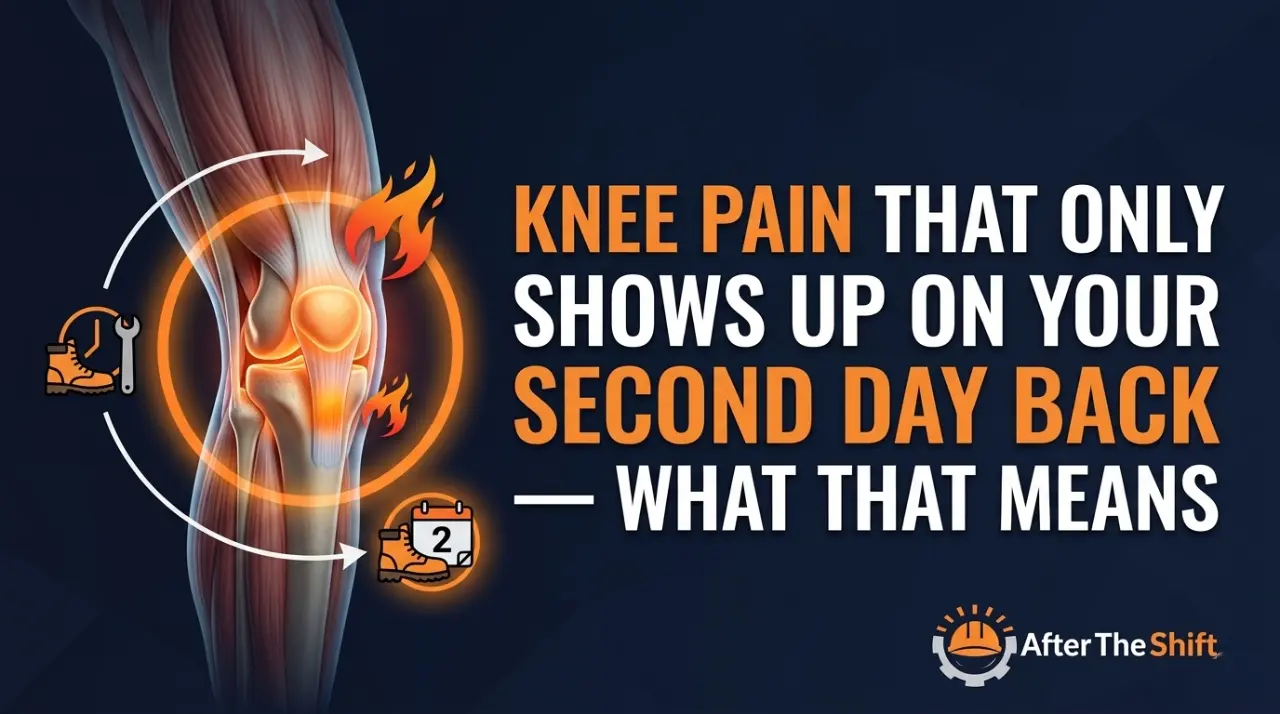
Your knees felt fine yesterday. Now they're killing you. Here's the exact mechanism, what it's diagnosing, and what to do before it compounds.
Your knees felt fine yesterday. Now they're killing you. You got through the shift, went home, slept, and woke up barely able to walk down stairs. Today's supposed to be easier — and yet here you are. That specific pattern — fine on day one, wrecked on day two — is one of the most misread signals in physical work. Most people blame the mattress, age, or just bad luck. None of those are it.
Second-day knee pain after physical work is your body's damage-reporting system operating on a 24–48 hour delay. It's telling you something specific about what's failing inside the joint, and depending on which type you have, the fix is completely different. This post breaks down every cause, how to identify yours in under 5 minutes, and what to actually do about it.
The blunt rule: If your knee pain peaks on day two and not during the work itself, the problem is almost never the work you did — it's how your body recovered overnight (or didn't). Fix the recovery, and the pain drops before you touch the workload.
Quick Answer
Second-day knee pain after physical work is caused by a delayed inflammatory response peaking 24–48 hours after joint loading — not during it. It's most common after returning from time off and means your knee's load-tolerance dropped during rest.
- Do: Ice 20 min after work on return days, elevate overnight, light movement in the morning
- Do: Identify your cause (muscle DOMS vs joint inflammation vs cartilage) using the test below
- Do: Strengthen the VMO (inner quad) — it protects the knee from compression forces
- Avoid: Pushing through joint-line swelling or heat
- Avoid: Taking NSAIDs daily without addressing the root cause
- Avoid: Complete rest — it delays adaptation and makes day-two crashes worse
- Watch for: Locking, giving way, grinding — these are not soreness
- See a physio if: Pain repeats every single return-to-work cycle for 3+ weeks
Table of Contents
- Why the Second Day Hits Harder Than the First
- The Three Mechanisms Behind Delayed Knee Pain
- The Second-Day Knee Test — Identify Your Cause in 5 Minutes
- Symptom → Cause → Fix Matrix
- Why It's Worse After Days Off — The Return-to-Work Multiplier
- Fix Protocol by Cause
- When Second-Day Knee Pain Is a Red Flag, Not Soreness
- Soreness vs Inflammation vs Structural: Comparison Table
- FAQ
- Next Steps
Why the Second Day Hits Harder Than the First
This isn't a coincidence and it's not weakness. The 24–48 hour delay in pain onset after tissue loading is well-documented — it's the same window that produces delayed onset muscle soreness (DOMS) in muscles. But in knees, the picture is more complicated, because joints aren't just muscle.
Here's what's happening in the timeline:
- During the shift: Your body releases cortisol, adrenaline, and natural inflammatory dampeners. Core temperature rises. Blood flow increases. Pain signals are partially suppressed. You feel tired but functional.
- Hours after work: Cortisol drops. Your body begins its damage assessment. Inflammatory cytokines — the chemical messengers that signal "repair needed here" — start accumulating in loaded tissues.
- Overnight: You're horizontal and still. Blood flow to the joint slows. Synovial fluid thickens. Accumulated inflammatory fluid has nowhere to go. Tissues that were just warm and moving are now cold, compressed, and saturated with repair signals.
- Day two morning: Inflammatory response peaks. The joint capsule is stiff. The first steps of the day are brutal because you're moving a joint that spent 8 hours marinating in its own inflammatory output.
The work didn't destroy your knee on day two. Day two is when your body's receipt for what happened on day one finally arrived.
Key distinction: Pain during work = the joint is failing under current load. Pain on day two only = the joint handled the load but couldn't fully recover overnight. Different problem, different fix.
The Three Mechanisms Behind Delayed Knee Pain
Not all second-day knee pain is the same. There are three distinct mechanisms, and identifying which one you have is the most important step before doing anything else.
Mechanism 1: Periarticular DOMS (Muscle-Driven)
The muscles that stabilise and power the knee — the quadriceps, hamstrings, and calves — absorb enormous force during physical work. Squatting to pick up stock, climbing stairs with loaded carts, walking on inclines, kneeling and rising repeatedly. Each eccentric contraction (lowering, descending, decelerating) creates microscopic damage in muscle fibres. That damage triggers an inflammatory response in the muscle belly, which peaks at 24–48 hours.
Because these muscles attach close to or around the knee, the soreness radiates to the joint. It feels like it's in the knee, but it's in the tissue surrounding it. This is the most benign type of second-day knee pain and the most common in workers returning from rest.
Mechanism 2: Synovial Inflammation (Joint-Driven)
The synovium is the membrane lining your knee joint. Its job is to produce synovial fluid, which lubricates the joint and feeds the cartilage. Under repeated mechanical stress — kneeling on concrete, repetitive squatting, extended periods of static knee flexion — the synovium becomes irritated. It overproduces fluid. The joint swells.
This inflammation typically peaks 12–36 hours after the provocative activity. When you wake up on day two, the joint is full, stiff, warm, and painful in a way that's distinctly inside the knee, not around it. Moving warms it slightly, but it doesn't resolve the way muscle soreness does — it just stays elevated until the inflammation subsides.
Mechanism 3: Cartilage Dehydration and Load Residue (Structural)
Knee cartilage is essentially a sponge. During loading (standing, walking, squatting), it compresses and fluid is squeezed out. During rest, it reabsorbs fluid and springs back. This cycle requires adequate recovery time. If you worked a full shift without enough breaks, or if you came back from days off and did a full load on day one, the cartilage didn't have time to rehydrate between compressions.
Dehydrated cartilage is thinner, less shock-absorbent, and more prone to painful bone-on-bone sensation. The day-two ache in this case is the cartilage reporting that it's still compressed — particularly in the medial (inner) or patellofemoral (kneecap) compartment where load concentrates most in warehouse and construction workers.
See more on this in our breakdown of the cartilage math behind squatting and standing all day.
The Second-Day Knee Test — Identify Your Cause in 5 Minutes
Do this the morning of your second day, before you start moving around. It takes 5 minutes and it tells you which mechanism is active so you can apply the right fix.
Step 1 — Location check
Press firmly on the following areas. Note where the pain lives:
- Front of the thigh (quad belly) — → points to Mechanism 1 (DOMS)
- Back of the thigh (hamstring) — → points to Mechanism 1 (DOMS)
- Inside or outside of the knee joint line (the crease where the joint hinges) — → points to Mechanism 2 (synovial)
- Under the kneecap or around it — → points to Mechanism 2 or 3
- A dull ache deep inside that's hard to pinpoint — → points to Mechanism 3 (cartilage)
Step 2 — Movement test
Walk slowly for 5–10 minutes. Observe:
- Pain eases significantly after 10 minutes of walking — → Mechanism 1 (muscles warm up and soreness reduces)
- Pain eases slightly but the joint still feels full or stiff — → Mechanism 2 (synovial — movement helps but inflammation persists)
- Pain stays constant or slightly worsens with more steps — → Mechanism 3 (cartilage — loading on dehydrated tissue)
Step 3 — Visual check
- Compare both knees. Is one visibly larger or puffier? — → Mechanism 2 (joint effusion)
- Is there warmth when you touch the joint? — → Mechanism 2
- No visual difference, just pain and stiffness? — → Mechanism 1 or 3
Score your result:
| Your answers | Likely mechanism | Urgency |
|---|---|---|
| Pain in muscle belly, eases with walking, no swelling | Mechanism 1 — DOMS | Low — self-manage |
| Pain on joint line, swelling, warmth, eases partially with movement | Mechanism 2 — Synovial inflammation | Moderate — reduce load, monitor |
| Deep ache, hard to locate, worsens with prolonged loading | Mechanism 3 — Cartilage | Moderate — load management critical |
| Grinding, locking, giving way, or sharp stabbing | Possible structural (meniscus/ligament) | High — see a physio |
Symptom → Cause → Fix Matrix
| Symptom | What it signals | Root cause | Immediate fix | Long-term fix |
|---|---|---|---|---|
| Aching quads and hamstrings, mild knee soreness, eases in 20 min of walking | Periarticular DOMS | Deconditioned muscles hit heavy load | Gentle movement, warm shower, light stretch | Progressive re-loading, quad and hamstring strengthening |
| Swollen knee, warmth, stiffness, pain on joint line | Synovial inflammation / effusion | Excessive knee flexion, kneeling on hard surfaces, impact loading | Ice 20 min, elevate, rest the joint, NSAIDs if needed | Knee pads, kneeling limits, anti-inflammatory protocol |
| Deep ache, worse after prolonged standing or walking, slightly better after short rest | Cartilage load residue | No recovery between compression cycles, insufficient breaks | Sit 10 min every 2 hours at work, elevate legs overnight | Cartilage loading protocol (Spanish squat, pool walking), weight management |
| Pain under kneecap, worse on stairs or squatting, better with straight-leg rest | Patellofemoral syndrome (runner's knee variant) | VMO weakness, poor tracking, hard flooring | Kinesio taping, avoid full squatting range, insoles | VMO strengthening (TKEs), footwear upgrade, surface matting |
| Inner knee pain after return from days off, aches going downstairs | Medial compartment overload | Flat foot / overpronation causing medial knee stress | Arch support insoles immediately | Orthotics assessment, hip abductor strengthening |
| Grinding sound on movement, catching or locking | Possible meniscus or cartilage damage | Accumulated wear, acute injury that wasn't treated | Stop loading the joint today | Physio assessment, imaging referral |
Why It's Worse After Days Off — The Return-to-Work Multiplier
This is the pattern that gets most workers: the two-day break that's supposed to help actually makes the second-day crash worse. Here's why.
During days off, several things happen simultaneously that reduce your knee's capacity to absorb work:
- Synovial fluid circulation drops. Movement is what keeps synovial fluid warm, distributed, and viscous. Two days of relative inactivity makes it thicker and less effective as a lubricant.
- Muscle strength drops faster than you expect. Maximal strength begins declining within 48–72 hours of inactivity. The muscles that take load off the knee — the quads especially — lose some of their protective capacity over a weekend.
- Cartilage load-tolerance resets. Cartilage adapts to regular loading. When loading stops, some of that adaptation reverses. The cartilage on day one back is slightly less prepared for compression than it was on the last day of your previous work week.
- You haven't recalibrated your movement patterns. After time off, workers often lift, step, and squat slightly differently — minor biomechanical shifts that the body corrects within a day but that place asymmetric load on the joint in the meantime.
The result: day one back, you push through on adrenaline and force of habit. Day two is when all four of those deficits combine with the delayed inflammatory response from day one's load. That's the second-day crash.
The fix for the return-to-work multiplier isn't rest before you go back — it's active preparation. A 15-minute walk the evening before returning, plus a warm-up at the start of your first shift, reduces day-two severity significantly. Cold, static joints hit with full load is the setup for the crash.
For context on how cumulative days of standing change the equation over months and years, read the concrete damage timeline from month 1 to year 5.
Fix Protocol by Cause
If it's Mechanism 1 (DOMS — muscle-driven)
What helps:
- Gentle movement — don't stay in bed. Walking at a slow pace for 10–15 minutes warms the muscle belly and reduces soreness faster than rest.
- Warm shower or heat pack on the thighs before work
- Protein within 30 minutes of returning home (muscle repair requires amino acid availability)
- Compression garments during the shift on return days
Prevention going forward:
- Don't go from zero to full load. On your first shift back, take 1–2 extra 5-minute sitting breaks in the first 4 hours.
- Do a 5-minute leg warm-up before the shift starts: 10 bodyweight squats, 10 leg swings per side, 20 calf raises.
- Build quad and hamstring strength with 3×15 terminal knee extensions (TKEs) 3x per week.
If it's Mechanism 2 (Synovial inflammation)
Acute management:
- Ice the joint for 20 minutes as soon as you get home. Compression bandage overnight if the joint feels full.
- Elevate the leg above hip height for 30 minutes before sleep.
- NSAIDs (ibuprofen) for 2–3 days during the acute phase only, with food. Not as a long-term strategy.
- Reduce kneeling and deep squatting on day two. Modify the task if possible.
Prevention going forward:
- Knee pads — not optional if you're on hard flooring or kneeling for any part of the job
- Limit sustained knee flexion beyond 90°. Kneeling at 90° is low risk; going below that on hard surfaces repeatedly is where synovial irritation starts.
- Anti-inflammatory diet baseline: omega-3s, reduced ultra-processed food, adequate hydration (dehydration thickens synovial fluid)
If it's Mechanism 3 (Cartilage load residue)
Acute management:
- Sit every 2 hours, even for 10 minutes. This allows cartilage to rehydrate during the shift rather than accumulating compression.
- Elevate legs overnight — particularly effective when cartilage dehydration is the driver.
- Pool walking or cycling (zero impact): keeps the joint mobile without adding compression.
Prevention going forward:
- Spanish squats (3×30 seconds, 3x/week) — loads cartilage in a controlled way that promotes adaptation without spikes
- Weight management — every kilogram above healthy range adds approximately 4–6kg of force across the knee joint in walking
- Footwear with shock absorption — the cartilage doesn't care if you have good boots until you're on hard concrete for 8 hours, then it matters enormously
Read more on how knee mechanics during stairs connects to this pattern: why knees hurt going downstairs after work but not up.
When Second-Day Knee Pain Is a Red Flag, Not Soreness
Most second-day knee pain in physical workers is painful but manageable. These signals are different — they mean stop waiting and see someone:
- Locking: The knee gets stuck at a certain angle and won't fully straighten or bend. This is a meniscus red flag.
- Giving way: The knee buckles unexpectedly mid-step. Ligament instability or significant cartilage loss.
- Marked swelling after rest: Knee visibly larger than the other side every single morning after work. Consistent effusion needs imaging.
- Sharp, stabbing pain: Distinct from the dull ache of DOMS or inflammation. Sharp mechanical pain = something is catching or impinging.
- Night pain waking you up: Inflammatory pain that's bad enough to break sleep is not normal soreness.
- Pain pattern worsening week over week: If it's worse after week 2 than it was after week 1, it's accumulating — not healing.
- Unilateral swelling with heat plus redness: Could be septic arthritis (infection in joint) — rare but a medical emergency. Go to A&E.
This connects to a broader truth: if you ignore pain until it becomes background noise, you've moved into a dangerous category. Read about why pain that becomes background noise is the most dangerous kind of normal.
Soreness vs Inflammation vs Structural: How to Tell Them Apart
| Factor | Muscle Soreness (DOMS) | Joint Inflammation | Structural Issue |
|---|---|---|---|
| Where you feel it | Muscle belly (quad, hamstring, calf) | Joint line, inside/outside of knee, under kneecap | Deep inside joint, unpredictable location |
| Timing | 24–48h after loading, resolves by 72h | 12–36h, lingers 3–5 days | Persistent, may be present during work too |
| Effect of gentle movement | Significantly improves | Mild improvement, doesn't resolve | May worsen or cause catching |
| Visible swelling | Rare | Common — one knee larger | Variable |
| Warmth to touch | No | Yes — joint feels warm | Sometimes |
| Responds to ice | Helpful but not necessary | Yes — reduces swelling and pain | Partial |
| Self-manage or see someone? | Self-manage | Self-manage 1–2 cycles; physio if recurring | See a physio |
FAQ
Why does my knee hurt more on the second day after working than the first?
The inflammatory response in your knee joint peaks 24–48 hours after loading, not immediately. During the shift, cortisol and adrenaline partially suppress pain signals. Overnight, inflammatory cytokines accumulate in loaded tissues and synovial fluid thickens. By day two, your body's damage report is at full volume. The work happened on day one — day two is when the receipt arrives.
Is second-day knee pain after work normal or a sign of injury?
Occasional second-day muscle soreness around the knee after heavy loading is normal, especially when returning from rest. But second-day pain inside the joint — with swelling, warmth, grinding, or locking — is a red flag. Pain that repeats every single return-to-work cycle without improving over 3+ weeks is accumulating damage, not normal adaptation.
Why is second-day knee pain worse when I come back after days off?
During rest, your joints lose their load-tolerance adaptation: synovial fluid thickens, cartilage rehydration cycles slow, and the muscles that protect the knee weaken slightly. When you return to full-load work, the joint takes more stress than it can handle. The inflammatory response amplifies — hence the second-day crash being worst after the longest breaks.
What's the difference between DOMS and joint inflammation in the knee?
DOMS lives in the muscle belly — you feel it when you squeeze the quad or hamstring. Joint inflammation lives inside the knee — pain on joint line palpation, swelling, morning stiffness. DOMS resolves fully in 48–72 hours and improves with movement. Joint inflammation stiffens after rest and doesn't clear with a warm-up the way muscle soreness does.
Can I work through second-day knee pain or should I rest?
Depends on the cause. Muscle soreness around the knee: active movement helps, light work is fine. Joint-line pain or swelling: reduce load, take extra breaks, ice when you get home. Grinding, locking, or giving way: stop work and get assessed. Pushing through joint inflammation accelerates cartilage wear and can convert a short-term problem into a long-term one.
How long should it take for second-day knee pain to go away?
Muscle-driven second-day pain: 48–72 hours. Synovial inflammation: 3–5 days. Cartilage-related aching may persist and recur until the loading pattern is fixed. If the pain takes longer than 7 days to resolve or returns at the same intensity the following week, get assessed. Time doesn't fix the underlying issue — it just pauses it.
Will taking anti-inflammatories fix second-day knee pain from work?
NSAIDs reduce the inflammatory signal temporarily, which masks pain but doesn't fix what caused it. Using them regularly to stay functional at work borrows against long-term joint health. They're useful for managing an acute flare (2–3 days), but if you need them every week, you have a loading or recovery problem — not a painkiller deficiency.
What exercises actually help prevent second-day knee pain from physical work?
Three that move the needle: terminal knee extensions (VMO activation, 3×15 daily) — the VMO is the inner-quad muscle that directly controls kneecap tracking; Spanish squats or wall sits (cartilage loading without impact) — done 3x/week, they build cartilage tolerance; hip hinge strengthening (Romanian deadlifts, hip thrusts) — building the posterior chain takes load off the knee entirely by improving force distribution through the hips.
Next Steps
Now that you've identified your cause, here's where to go next:
- For the full picture of how knees degrade in physical work: Knee pain from squatting and standing all day — the cartilage math
- If your knee hurts specifically going downstairs: Why your knees hurt going downstairs after work but not up
- If the pain starts after your shift, not during: Knee pain that starts after work — not during
- For the complete recovery system (knees, back, feet, fatigue): The physical work recovery guide
Save this for your next return-to-work day. The second-day knee crash is predictable — which means it's preventable. Bookmark this and run the 5-minute test the next time you wake up and your knees are talking to you. The sooner you identify the mechanism, the sooner you can treat it right instead of just pushing through and letting it compound.
This article is general recovery education, not a diagnosis or a substitute for care from a qualified clinician. Stop and get medical help for severe pain, numbness, weakness, chest pain, sudden swelling, fever, or symptoms that keep worsening.
Log in to leave a comment.