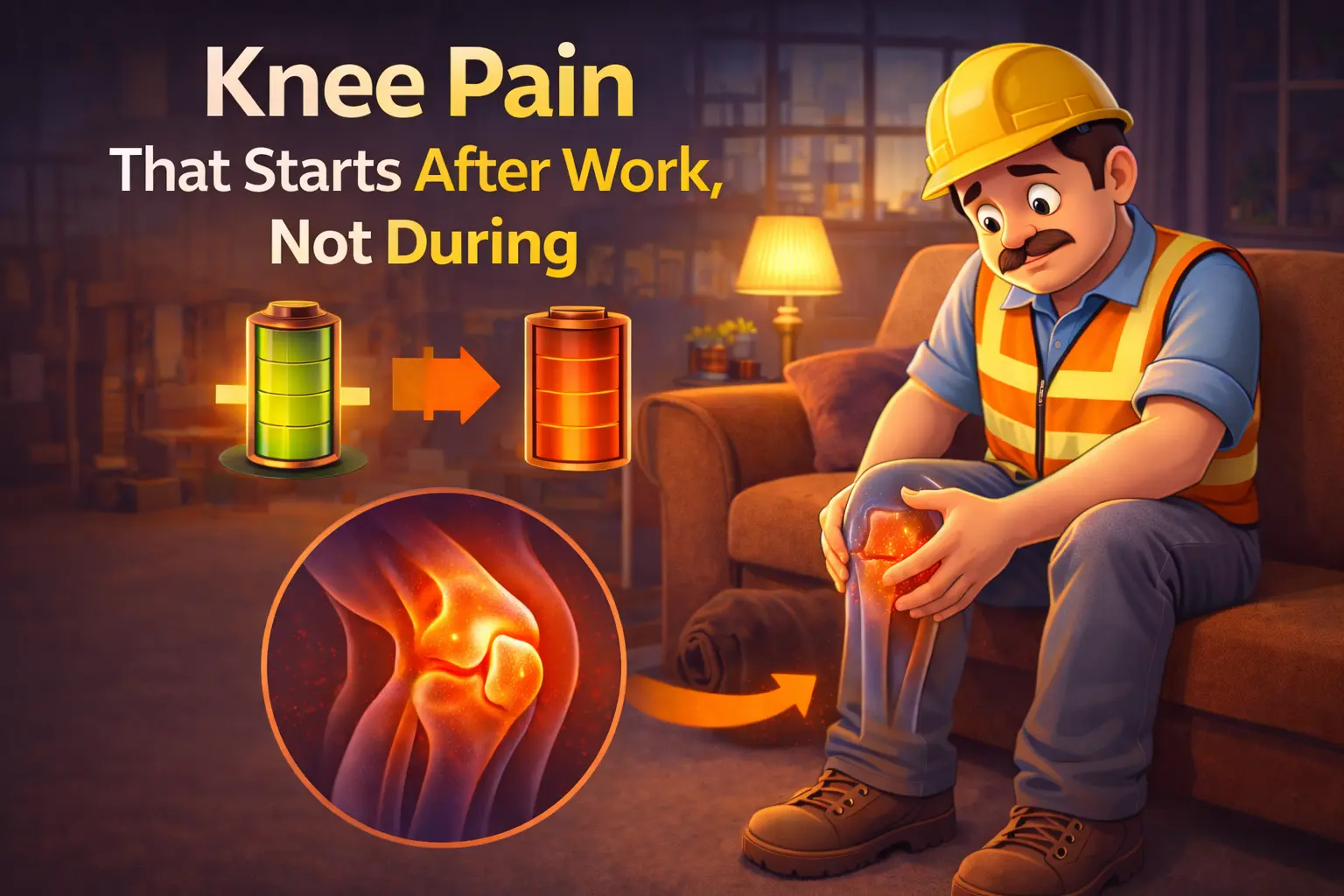
Why your knees feel fine on shift — then hurt hours later — and how to stop the cycle
Knee Pain After Work (Not During): The Delayed-Load Fix for Physical Jobs
If you get knee pain after work but feel fine during the shift, you’re dealing with delayed load. In warehouses, construction, trades, and any standing-heavy job, the knee can “hold together” while you’re moving, then ache later when your body cools down and irritation peaks.
This is not a motivation issue and it’s not always “damage.” Most of the time it’s overuse + fatigue + recovery mismatch: the shift loads the system, then your evening routine (or lack of one) turns that load into stiffness, swelling, and pain.
Table of Contents
- Quick definition (featured snippet)
- Why pain shows up after work
- What delayed knee pain usually means
- Where it hurts: the knee location map
- Common patterns by job task
- Work pain vs injury (table)
- Root causes that keep the cycle alive
- Fast triage: 60-second self-check
- What to do tonight (10–15 minutes)
- Next-day plan (so it doesn’t repeat)
- Two-week plan: rebuild knee tolerance
- Strength menu (pick your level)
- Mobility + tissue menu (pick your limiter)
- Heat vs ice (pros/cons)
- Sleeves vs braces vs taping (pros/cons)
- Work tweaks that reduce knee load
- Shoes, insoles, floors: what matters
- Sleep + recovery: the hidden amplifier
- Red flags: when to get checked
- Related AfterTheShift reads
- FAQ
Quick definition (featured snippet)
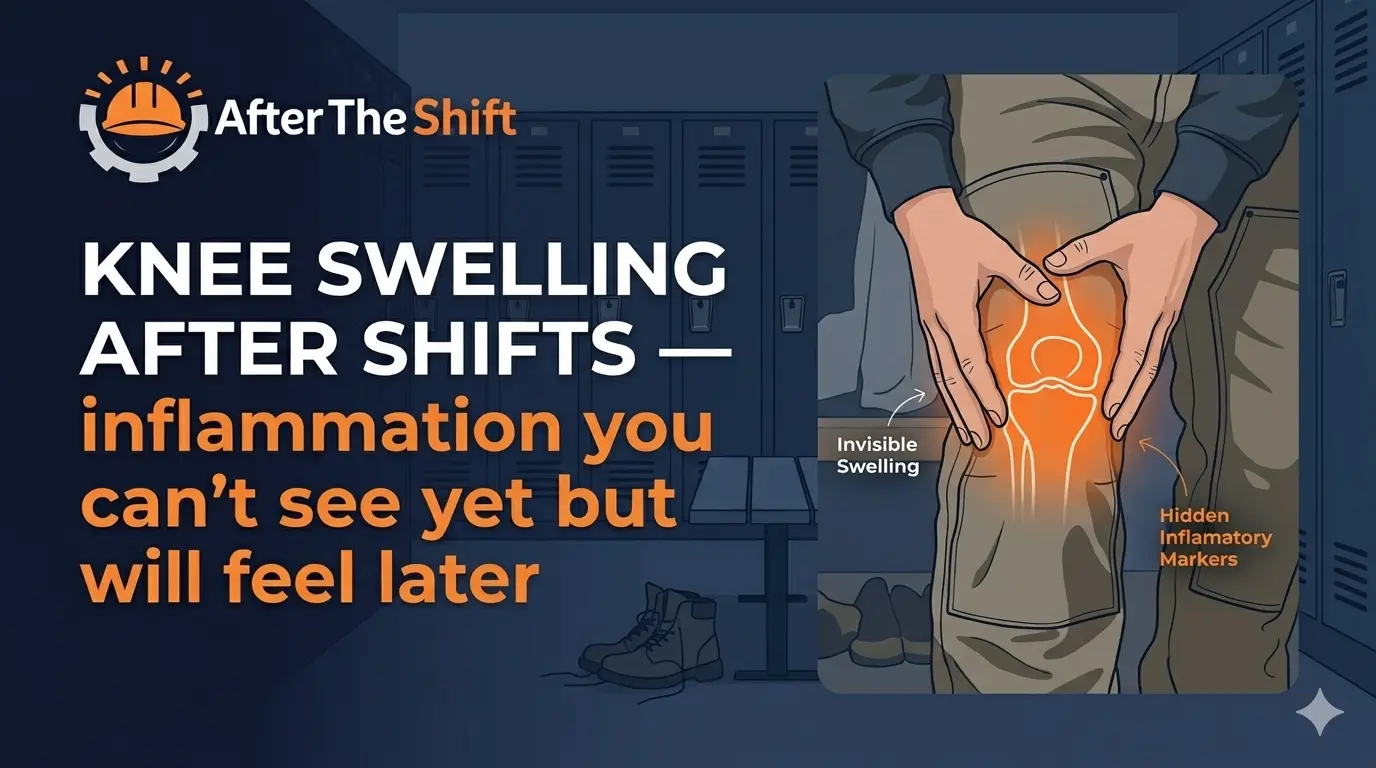
Knee pain that starts after work is commonly a delayed response to repetitive load (standing, squatting, stairs, carrying). Symptoms show up later because irritation and swelling often peak hours after the shift, once movement stops and tissues cool down.
Why pain shows up after work
During your shift, your body is running on support systems that hide problems:
- Adrenaline masks discomfort, so you don’t feel small signals.
- Warm tissues tolerate load better, so irritated structures stay quiet.
- Movement keeps fluid moving through the knee, reducing pressure spikes.
Then the shift ends. You stop moving. You sit. Your joints cool. The tissues that were “just coping” tighten up. That’s when the ache arrives.
Translation: your knee wasn’t fine — it was performing under load. After work, it reports the cost.
What delayed knee pain usually means
Most after-shift knee pain is not catastrophic. It tends to be one of these buckets:
- Patellofemoral overload (kneecap area sensitivity from tracking + repetition)
- Tendon irritation (patellar or quad tendon gets cranky with repeated bending)
- Joint irritation (compressed all day, stiff and sore once you stop)
- Upstream weakness (hips fail → knee takes steering)
- Downstream collapse (foot/ankle control fails → knee tracks poorly)
You don’t fix these by “resting harder.” You fix them by improving load distribution and recovery.
Where it hurts: the knee location map
This isn’t a diagnosis, but it’s a strong directional signal.
| Where it hurts | What it often feels like | Most common driver | First move to try |
|---|---|---|---|
| Front / behind kneecap | Dull ache, stairs aggravate it | Patellofemoral overload + hip weakness | Glute bridges + short split squats |
| Below kneecap (tendon) | Sharp-ish after squats/kneeling | Patellar tendon irritation | Reduce deep bends + slow calf raises |
| Inside knee | Sore after carrying/turning | Load + poor foot/hip control | Foot tripod + controlled step-downs |
| Outside knee | Tight/burny after long walking | Hip control deficit + stride habits | Side-steps + shorter stride |
| Back of knee | Tightness after standing | Hamstring/calf tension + stiffness | Calf stretch + easy walk flush |
If your pain pattern is weird, revisit the bigger framework: Work Pain vs Injury: Knowing the Difference Matters.
Common patterns by job task
Warehouse picking / low shelves
- Repeated partial squats accumulate fast.
- Twisting with load turns knees into steering joints.
Fix priority: reduce twisting, alternate stance, strengthen hips, stop collapsing feet.
Construction / kneeling / uneven ground
- Direct pressure + deep bends irritate tendon and front-of-knee structures.
- Uneven ground demands more knee stabilization.
Fix priority: knee pads, better shoes, calf + hip strength, controlled tempo work.
Standing-heavy roles (cashier, line work, stations)
- Static standing spikes stiffness more than walking.
- Knee locking shifts load into joint surfaces.
Fix priority: micro-bend knees, micro-movement breaks, calf endurance.
Stairs, ladders, step-ups
- Stairs punish the kneecap area if hips aren’t helping.
- Descending is often worse than ascending.
Fix priority: step-down practice, glute strength, shorter step strategy.
Work pain vs injury (table)
This decides whether you optimize or seek assessment.
| Signal | Typical “work pain” | Possible injury |
|---|---|---|
| Timing | After shift / at night / next morning | Sudden during a movement |
| Warm-up effect | Improves once you move | Does not improve or worsens |
| Swelling | None or mild | Noticeable / increasing |
| Function | Annoying but usable | Giving way / locking / major limitation |
Root causes that keep the cycle alive
1) Your hips are not absorbing load
If glutes are weak or “offline,” your knee becomes the main stabilizer. That’s why knee pain after work is often a hip problem.
2) Your calves are undertrained
Calves aren’t just for running. In physical jobs, calves manage standing, micro-balance, and shock absorption. Weak calves = more knee irritation.
3) Your feet collapse under fatigue
As fatigue rises, arches drop and the knee tracks poorly. You feel it later, not during, because the collapse happens late in the shift.
4) You’re “resting into stiffness” after work
Going from 20,000 steps to a couch instantly is the fastest way to lock irritation in place.
5) You’re in accumulated fatigue
This is the silent one. You don’t feel it until you do. Then pain appears earlier each week.
Related: Accumulated Fatigue: The Damage You Don’t Feel Yet and Why Pain Shows Up Earlier Every Year.
Fast triage: 60-second self-check
Do these in your room. No equipment.
- Single-leg balance (10 seconds each): if one side shakes like crazy, control is the issue.
- Mini squat (5 reps): if knees cave in, hips aren’t controlling load.
- Calf raises (10 slow reps): if one calf burns instantly, you found a weak link.
Actionable rule: whatever side is weaker gets priority for 2 weeks.
What to do tonight (10–15 minutes)
Goal: flush stiffness and reduce irritation without aggressive “rehab.”
Step-by-step
- 5 minutes easy walk (keep it light).
- 1 minute gentle knee bends (pain-free range).
- 2 minutes calves (slow raises or stretch).
- 2 minutes hips (glute bridges).
- Heat if stiff; ice only if swollen.
If you want the broader recovery logic, read: Rest vs Recovery: Why Sleeping Isn’t Fixing You.
Next-day plan (so it doesn’t repeat)
Morning (5 minutes)
- Easy walk
- 10 slow calf raises
- 10 glute bridges
Before your shift (3 minutes)
- 30 seconds brisk walk
- 30 seconds gentle squats
- 30 seconds calf raises
- Repeat once
Why this works: warm tissues tolerate load. You’re buying knee tolerance upfront.
Two-week plan: rebuild knee tolerance
Two weeks is long enough to see a real trend if it’s overload, not injury.
Week 1: reduce irritation + re-activate support
- After every shift: flush routine (5–10 min)
- 2 sessions: strength menu (pick your level below)
- Work tweak focus: stop locking knees + reduce twisting
Week 2: build capacity
- After shift: flush routine still daily
- 2–3 sessions: strength (add one set or slower tempo)
- Work tweak focus: stairs/descending control + stance alternation
Success metric: pain comes later, is weaker, and morning stiffness is shorter.
Strength menu (pick your level)
You don’t need a gym. You need consistency and control.
Level 1 (no equipment, 12–15 minutes)
- Glute bridges: 3 sets
- Wall sit (shallow): 2 sets
- Slow calf raises: 3 sets
Level 2 (basic strength, 15–20 minutes)
- Split squat (short stride): 3 sets each side
- Step-down (low step): 2–3 sets each side
- Slow calf raises: 3 sets
Level 3 (capacity builder, 20–25 minutes)
- Split squat: 4 sets
- Romanian deadlift pattern (light): 3 sets
- Step-down: 3 sets
- Calf raises (pause at top): 3 sets
Tempo rule: slow down. Fast reps hide weakness; slow reps build control.
Mobility + tissue menu (pick your limiter)
This is where people waste time. Don’t do everything. Do the limiter.
If you feel stiffness in front of knee
- Gentle quad stretch
- Short-range knee bends
If your calves feel tight after shifts
- Calf stretch (straight knee + bent knee)
- Slow calf raises
If hips feel “dead” or you cave inward
- Side-steps (if you know how)
- Glute bridges
- Controlled split squats
Heat vs ice (pros/cons)
| Option | Pros | Cons | Best for |
|---|---|---|---|
| Heat | Improves stiffness and comfort | Not ideal for obvious swelling | Tight, stiff knees after shifts |
| Ice | Calms swelling and flare-ups | Overuse can blunt adaptation | Visible swelling / hot joint |
Simple rule: stiff = heat, swollen = ice.
Sleeves vs braces vs taping (pros/cons)
| Option | Pros | Cons | Best use |
|---|---|---|---|
| Knee sleeve | Warmth, feedback, light support | Doesn’t fix the cause | After-shift ache, mild irritation |
| Taping | Temporary tracking cue | Skill dependent, short-lived | Short-term symptom control |
| Rigid brace | More stability | Can create dependency | Instability (with professional advice) |
Work tweaks that reduce knee load
Low effort, high payoff.
- Micro-bend knees instead of locking.
- Hinge more (hips back) instead of pure knee bend.
- Turn with your feet, not your knee.
- Alternate stance and lead leg on steps.
- Use knee pads for any repeated kneeling.
- Break static standing with 60 seconds of movement every 30–45 minutes.
Shoes, insoles, floors: what matters
Concrete floors + dead shoes is a knee-pain factory. What matters most:
- Cushion that isn’t dead (midsole fatigue is real).
- Stability so your foot doesn’t collapse under fatigue.
- Fit (sloppy heel = sloppy knee control).
Reality check: insoles can help comfort, but they won’t replace hip/calf capacity.
Sleep + recovery: the hidden amplifier
If you sleep poorly, your tissues recover poorly. That makes the same shift feel “harder” and pain arrives earlier.
Read: Why You’re Exhausted After Work (Even When You Didn’t Do Much).
Red flags: when to get checked
Do not optimize around these.
- Knee locks (can’t straighten/bend normally)
- Giving way or true instability
- Swelling that increases over days
- Night pain that wakes you repeatedly
- Rapid worsening week to week
Authority references:
Related AfterTheShift reads (internal links)
- Work Pain vs Injury: Knowing the Difference Matters
- Lower Back Pain After Shifts: What’s Actually Happening
- Lasting Longer in Physical Jobs Without Breaking Down
- Why You’re More Tired After Days Off
- Why Most Recovery Advice Fails Physical Workers
- Micro-Damage: How Repetitive Work Destroys Joints Quietly
FAQ
Why do my knees hurt after work but not during?
Because load accumulates during the shift while adrenaline and warmth mask symptoms. Irritation and swelling often peak hours later once you stop moving.
What if the pain is only on one side?
That usually means asymmetry: stance, turning, carrying, or foot collapse on one side. Train the weaker side first for two weeks.
Should I stop exercising if I have after-shift knee pain?
Usually no. You reduce range, slow tempo, and focus on hips and calves so the knee stops taking everything.
Is popping/cracking a bad sign?
Not by itself. Pain + swelling + loss of function matters more than noise.
How fast can this improve?
If it’s overload and not injury, many people notice improvement in 7–14 days with daily flush + 2 strength sessions weekly.
Key takeaways
- Knee pain after work is commonly delayed overload, not instant injury.
- Heat + movement usually beats “resting into stiffness.”
- Strong hips and calves reduce knee load dramatically.
- Track the week-to-week trend; worsening + swelling/locking = get checked.
About the author
AfterTheShift publishes practical recovery and longevity systems for physical workers—warehouse, construction, trades, and shift-based jobs. The focus is reducing accumulated fatigue and keeping your body reliable year after year.
This article is general recovery education, not a diagnosis or a substitute for care from a qualified clinician. Stop and get medical help for severe pain, numbness, weakness, chest pain, sudden swelling, fever, or symptoms that keep worsening.
Log in to leave a comment.