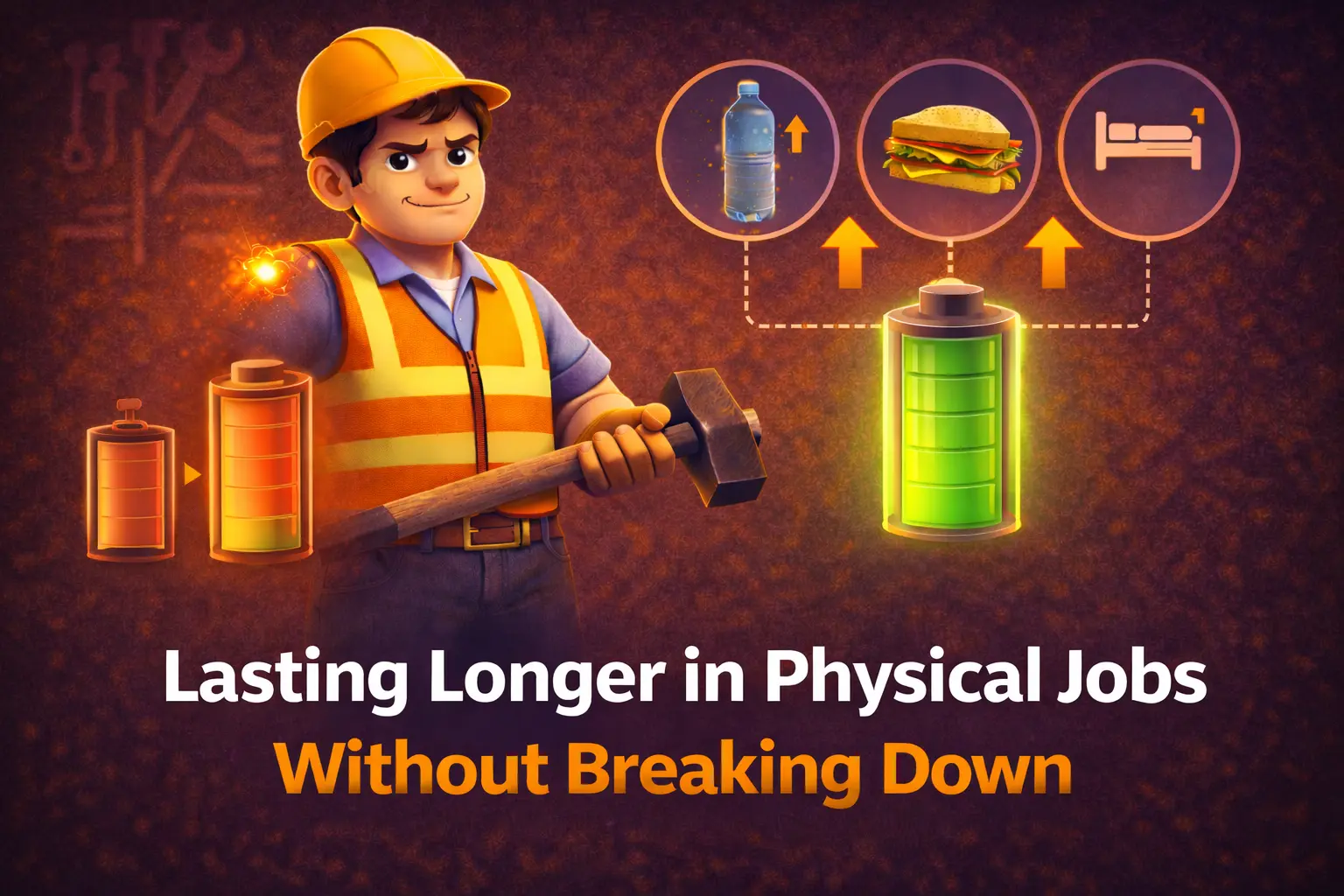
How to extend your working years in labor without chronic pain, burnout, or injury
Idea in one line: physical jobs don’t break you from one bad day. They break you from unmanaged load and missing recovery systems. This post gives you a simple longevity framework: reduce useless strain, protect joints, recover like it matters, and keep earning for years without chronic pain.
Table of Contents
- What “lasting longer” actually means
- Why physical workers break down early
- The real enemy: accumulated load
- How the body fails in physical jobs
- Work levers that save joints
- Recovery levers that prevent breakdown
- The minimum strength work you actually need
- Pain vs injury: your stop/go rules
- Food + hydration for physical work
- Sleep when shifts ruin your schedule
- A weekly longevity system
- FAQs
What “lasting longer” actually means
“Lasting longer” is not motivation. It’s not being the strongest guy on the line. It’s having enough margin that your body can absorb today’s work and still recover for tomorrow.
In physical jobs, you’re spending physical capacity every day. Longevity is the difference between:
- finishing a shift and being mildly tired, then normal again after sleep, and
- finishing a shift and carrying pain, stiffness, and fatigue into the next day.
If you keep starting each shift “not fully repaired,” your baseline drops every month. That’s how people end up with permanent back issues, knee pain, tendonitis, and burnout even when they “never got injured.”
Why physical workers break down early
Most workers don’t get taken out by one accident. They get taken out by compounding:
- reps under fatigue
- awkward positions that repeat thousands of times
- poor sleep quality
- not enough calories, protein, and fluids
- no strength base to protect joints
Then one random day the body says “no.” It feels sudden, but it was built slowly.
If you want the “warning signs” explained properly, read: Accumulated Fatigue: The Damage You Don’t Feel Yet and Micro-Damage: How Repetitive Work Destroys Joints Quietly.
The real enemy: accumulated load
Your body doesn’t count “hard days.” It counts total load:
- how many lifts
- how many twists
- how many steps on concrete
- how many hours with a braced core
- how many hours short on sleep
When load is high, your recovery must be high. If load is high and recovery is low, you get breakdown. Simple.
How the body fails in physical jobs
Most breakdown in labor jobs comes from a few predictable “failure modes.” Knowing them lets you prevent them.
| Failure mode | What it feels like | What causes it | What fixes it |
|---|---|---|---|
| Overuse tendon pain | sharp pain with gripping/lifting, worse over weeks | same motion + not enough rest + weak supporting muscles | reduce reps temporarily, strengthen slowly, fix technique |
| Low back flare-ups | stiffness, spasm, “locked” feeling | repeated flexion + fatigue + weak hips/glutes | hinge technique, load management, core + hips strength |
| Knee wear | ache on stairs, deep squat pain | bad footwear, hard floors, weak legs, excess weight load | better shoes/insoles, leg strength, reduce impact |
| Nervous system fatigue | low drive, poor sleep, irritability, “wired but tired” | stress + shifts + under-eating + no recovery habits | sleep routine, carbs timing, walking, deload days |
For the decision rules on when pain is a warning vs a stop sign, read: Work Pain vs Injury: Knowing the Difference Matters and Why “Everyone Hurts” Is a Dangerous Lie.
Work levers that save joints
You can’t “out-recover” bad mechanics repeated all day. Your goal at work is not perfect form. It’s reducing useless strain.
1) Reduce twist under load
Twisting while holding weight is a classic back and knee destroyer. The fix is boring: move your feet, rotate your whole body, and set the load down to reposition if needed. Every small “I’ll just twist” becomes thousands per month.
2) Use the strongest positions by default
- Keep loads close to your body.
- Hinge at hips instead of rounding your back when possible.
- Use two hands, not one-hand reaches, for heavy or awkward items.
3) Build micro-pauses into heavy sequences
Fatigue is where form collapses. Before a heavy series (loading, stacking, moving bulky items), take 5–10 seconds to breathe, reset posture, and plan the movement. That tiny pause can prevent the “one bad rep” day.
4) Protect your feet like they’re equipment
Footwear is a joint multiplier. Bad shoes = more knee/hip/back cost per step. If you work on concrete or hard floors, your shoes are as important as gloves. Replace them before they are destroyed, not after.
Recovery levers that prevent breakdown
Recovery is not a luxury. In physical jobs it’s part of the job, just unpaid. If you skip it, you pay later.
1) Post-shift downshift (10–20 minutes)
Your goal is to signal “work is over” to your nervous system.
- 10–20 minutes easy walking, even around your neighborhood.
- 2–4 minutes slow breathing (long exhales).
- Light mobility for the most loaded area (hips, calves, back).
Want the deeper explanation of why resting doesn’t equal recovery? Read: Rest vs Recovery: Why Sleeping Isn’t Fixing You.
2) Stop trying to “fix everything” on days off
Days off are for repair, not punishment. If you go from hard labor to a brutal gym session to “get strong,” you often just add more load to an already overloaded system. Strength work should be minimal, consistent, and targeted.
3) Treat soreness as data
Occasional soreness is normal. Soreness that:
- gets worse each week,
- moves from mild to sharp,
- changes how you move,
- or doesn’t improve with rest,
is a sign your load exceeds your capacity.
The minimum strength work you actually need
You don’t need a bodybuilder program. You need joint armor. Two short sessions per week is enough for most workers.
| Goal | Best simple movements | Why it helps |
|---|---|---|
| Back resilience | hip hinge pattern, loaded carries, controlled core work | reduces collapse when fatigued |
| Knees and hips | split squats, step-ups, hamstring work | strong legs absorb impact instead of joints |
| Grip and shoulders | rows, hangs, controlled presses | reduces tendon flare-ups from repetitive handling |
Rule: finish strength sessions feeling better, not destroyed. Your job already supplies destruction.
Pain vs injury: your stop/go rules
If you mess this up, you shorten your career.
- Green light: dull soreness that improves as you warm up, doesn’t change your movement, and fades within 24–48 hours.
- Yellow light: pain that returns every shift in the same spot, is sharper with specific movements, or is getting worse week to week.
- Red light: sharp localized pain, numbness/tingling, sudden weakness, swelling, or pain that forces you to compensate.
Get the full breakdown here: Work Pain vs Injury: Knowing the Difference Matters.
Food + hydration for physical work
Under-eating is a hidden reason workers “age fast.” If your body can’t rebuild, small damage becomes chronic damage.
Protein
Have protein at every meal. If you only get one proper meal, make that meal high-protein. Physical work is tissue damage + repair every day.
Carbs (yes, carbs)
Carbs around work hours help performance and recovery. Many workers feel “dead” because they run on caffeine while under-fueling.
Hydration + salt
If you sweat, you lose fluids and electrolytes. Dehydration increases fatigue and cramping and makes work feel harder than it needs to be.
Sleep when shifts ruin your schedule
Sleep is your main repair tool. If your schedule is chaotic, aim for consistency in what you can control:
- Same wind-down routine (even if bedtime changes)
- Dark room, cool room, minimal phone time before sleep
- Caffeine cutoff early enough that you can actually sleep
If you want the “why” behind the fatigue feeling, read: Why You’re More Tired After Days Off.
A weekly longevity system
This is the simplest system that keeps people functional long-term.
| Daily | 2–3 times per week | Weekly |
|---|---|---|
| Protein with meals | Short strength sessions (30–45 min) | Footwear check (replace before it dies) |
| Hydration | Post-shift walk (10–20 min) | One lower-load “deload” day if possible |
| Wind-down routine | Mobility for tight areas | Review pain signals and adjust load |
Longevity is not a hack. It’s doing the basics longer than everyone else.
FAQs
How do I know if I’m breaking down or just sore?
If the pain is getting worse week to week, coming back in the same spot every shift, changing how you move, or lasting beyond 48 hours, treat it as a warning. Use this post for the rules: Work Pain vs Injury: Knowing the Difference Matters.
Is the gym necessary if my job is already physical?
Yes, but not “more suffering.” Your job is repetitive load. The gym should build protective strength in controlled ways: hips, legs, core, upper back, grip. Two sessions per week is enough for most people.
Why do I feel worse after days off sometimes?
Because days off often remove movement, change sleep timing, and make stiffness louder. Also, accumulated fatigue can show up when you stop running on adrenaline. Full explanation: Why You’re More Tired After Days Off.
What’s the fastest way to reduce joint pain from work?
Reduce twist under load, fix footwear, fuel properly, and add 10–20 minutes of easy walking after shifts. If pain is sharp or worsening, stop treating it like normal soreness.
What should I do first if I’m already hurting everywhere?
Start with diagnosis and boundaries: Why “Everyone Hurts” Is a Dangerous Lie, then use: Accumulated Fatigue and Rest vs Recovery.
Related reading: Why Most Recovery Advice Fails Physical Workers and The Real Cost of Physical Work on the Body.
This article is general recovery education, not a diagnosis or a substitute for care from a qualified clinician. Stop and get medical help for severe pain, numbness, weakness, chest pain, sudden swelling, fever, or symptoms that keep worsening.
Log in to leave a comment.