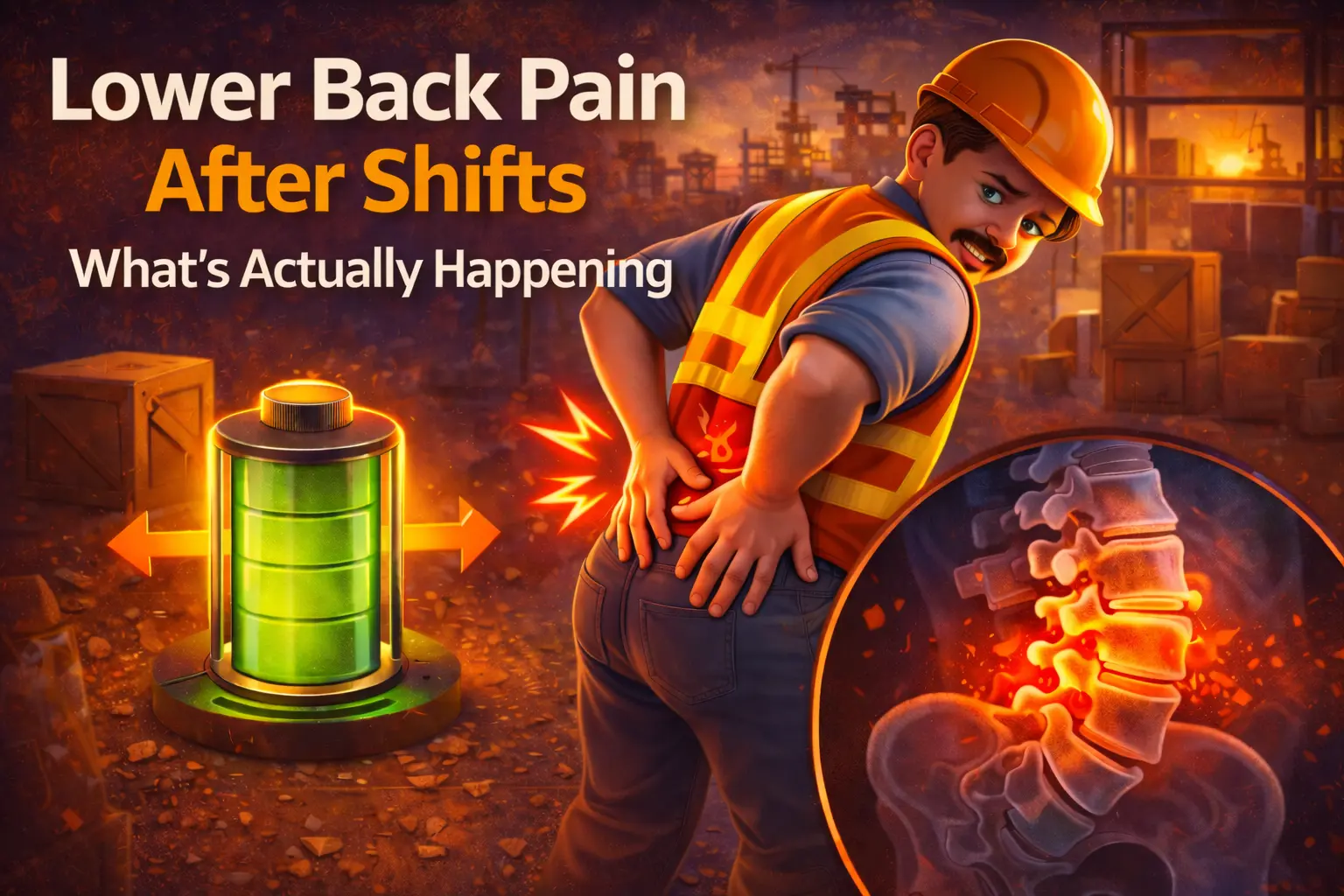
Why your back hurts after work — and what your body is really reacting to, not just “bad posture.”
Lower Back Pain After Shifts: What’s Actually Happening
Subtitle: Why your lower back hurts after physical work — and what your body is reacting to (fatigue, load, compression), not “bad posture.”
If you keep getting lower back pain after shifts, it’s usually not random and it’s not “because you’re weak.” It’s your body telling you the same thing every day: today’s workload exceeded your current load tolerance. This is the reality for warehouse, construction, trades, delivery, and any job with long hours on feet, repetitive lifting, carrying, twisting, or bending.
Table of Contents
- What lower back pain after work actually is
- Pain vs injury: how to tell the difference fast
- What’s happening inside your back during a shift
- Why it hits after the shift (not during)
- Common job patterns that create lower back pain
- What doesn’t work (and why)
- What actually works (simple, repeatable)
- A practical post-shift plan
- Prevention that holds up long-term
- Related guides on After The Shift
- FAQs
What lower back pain after work actually is
Most lower back pain after physical work is a combination of:
- Fatigue (your stabilizers stop doing their job reliably)
- Compression (your spine and discs take hours of load)
- Repetition (small stress repeated thousands of times)
- Compensation (hips/hamstrings/feet get stiff → back takes the hinge)
In plain terms: your back isn’t “breaking.” It’s overworking. If you do physical shifts, your lower back becomes the default stabilizer when the rest of your system is tired or locked up.
Two key ideas control almost everything here:
- Load tolerance: how much stress your body can handle before pain shows up.
- Accumulated fatigue: what builds quietly day after day until your back complains louder.
If you want the big picture on why fatigue sneaks up on workers, read: Accumulated Fatigue: The Damage You Don’t Feel Yet.
Pain vs injury: how to tell the difference fast
Not all back pain is the same. If you treat fatigue like an injury, you’ll do the wrong things. If you treat an injury like fatigue, you’ll get worse.
| More likely fatigue-based pain | More likely injury warning |
|---|---|
| Dull ache, tightness, “worked” feeling | Sharp pain, stabbing, sudden “caught” sensation |
| Builds during the day, worse after shift | Starts suddenly or escalates rapidly |
| Improves with light movement | Worsens with movement or certain positions |
| Stiff at first, loosens a bit | Radiating pain, numbness, tingling down leg |
| Better within 24–48 hours with smart recovery | Not improving, or getting worse over days |
If you need a deeper breakdown of this exact line, use: Work Pain vs Injury: Knowing the Difference Matters.
If you have red flags (numbness, tingling, weakness, loss of control, severe night pain), treat it as medical and get assessed. This post is about the typical case: lower back pain after shifts driven by load + fatigue.
What’s happening inside your back during a shift
Your lower back is a transfer station. It connects legs to upper body and deals with: lifting, carrying, twisting, pushing, pulling, bending, and standing.
1) Spinal compression adds up
Hours on feet + load = compression. That doesn’t mean damage by itself, but it creates the “heavy, sore” feeling at the end of the day. When you lift, your spine compresses more. When you carry unevenly, one side compresses more. When you twist under load, stress concentrates.
2) Stabilizers fatigue and stop protecting you
The small muscles that stabilize your spine are endurance muscles. They’re supposed to hold you together while the big muscles do the job. After hours, stabilizers lose timing and endurance. Then your body recruits bigger muscles (erectors, QL, hip flexors) to compensate. Those bigger muscles were not built to do eight hours of precision stabilization. Result: tightness, spasm, pain.
3) Your hips stop moving, so your back starts moving
Many physical workers develop stiff hips and tight hip flexors. When the hips won’t hinge, the lower back becomes the hinge. That is a direct pipeline to lower back pain after work.
4) Repetition creates micro-damage and irritation
It’s rarely one big lift that causes the chronic problem. It’s thousands of “small enough” lifts, reaches, twists, and awkward positions. That’s why many workers feel pain earlier each year. For the long-term body cost and repetitive stress angle: Micro-Damage: How Repetitive Work Destroys Joints Quietly and The Real Cost of Physical Work on the Body.
Why it hits after the shift (not during)
A lot of people say: “I feel fine while working, then I get home and my back is done.” That’s common. Here’s why:
- Adrenaline + momentum hide symptoms while you’re moving
- Muscles cool down when you stop, stiffness increases
- Inflammation signaling catches up after repetitive load
- End-of-day fatigue removes your last layer of stability
Also: if you sit hard after a shift (car, couch, bed), you often lock the hips further and the back tightens more. This is why “just rest” doesn’t always work. If you want the straight talk on why recovery advice often fails workers: Why Most Recovery Advice Fails Physical Workers.
Common job patterns that create lower back pain
Warehouse / logistics
- Forward bending to pick items repeatedly
- Carrying boxes or totes with one arm dominant
- Twisting to place items on pallets / racks
- Long walking on hard floors with minimal shock absorption
Construction / trades
- Twisting under load (materials, tools, buckets)
- Working from awkward angles (kneeling, crouched, reaching)
- Tool belts shifting posture and loading one side
- Uneven surfaces increasing spinal stabilization demand
Standing shifts (retail, service, line work)
- Static compression for hours
- Locked knees and tight hips reducing shock absorption
- “Leaning” posture that loads one side of the lumbar spine
If you’re thinking “everyone hurts after work,” stop. That mindset keeps people injured. Use: Why “Everyone Hurts” Is a Dangerous Lie.
What doesn’t work (and why)
Here’s the stuff that sounds good but usually fails in real life.
| Common move | Why it fails | What to do instead |
|---|---|---|
| Doing nothing except rest | Stiffness increases, recovery is passive | 5–8 minutes of light movement after shift |
| Random stretching only | Temporary relief, no load tolerance built | Build endurance + mobility |
| “Lift with your legs” clichés | Real work is messy; form breaks under fatigue | Reduce repetition, improve symmetry, manage fatigue |
| Back brace every day | Short-term help, long-term stabilizer weakening | Use only for acute flare-ups, not as a lifestyle |
If you sleep more and still feel broken, you’re mixing rest with recovery. Use: Rest vs Recovery: Why Sleeping Isn’t Fixing You.
What actually works (simple, repeatable)
The goal is not “never feel anything.” The goal is: your back stops being the weakest link. That means building load tolerance with minimal effort and maximum consistency.
Principle 1: Reduce spinal load peaks
- Stop doing uneven carries by default (switch sides on purpose)
- Bring loads closer (distance from body = more back torque)
- Avoid twisting under load when possible (step and turn instead)
Principle 2: Restore motion after shifts
Post-shift stiffness isn’t a mystery. You were in the same patterns for hours. Give your spine and hips permission to move again. Not a 45-minute routine. A short reset you actually do.
Principle 3: Build endurance, not ego strength
Most workers don’t need max lifts. They need endurance in:
- deep core
- glutes
- hips
- upper back posture muscles
Endurance is what keeps your form from collapsing in hour 7.
Principle 4: Fix the weak link that forces your back to compensate
For many workers, the real problem isn’t the back. It’s what makes the back do extra work: stiff hips, weak glutes, poor footwear, fatigue stacking, low sleep quality. If you want the wider longevity system: Lasting Longer in Physical Jobs Without Breaking Down.
A practical post-shift plan
This is the simplest version that works for most people with lower back pain after shifts. It’s designed to be realistic, not perfect.
Step 1 (2 minutes): unload and move
- Walk slowly for 60–90 seconds (don’t collapse immediately)
- Breath deep into the belly for 5–8 slow breaths
Step 2 (3–5 minutes): spine + hips reset
- Gentle spinal movement (flex/extend) for 30–60 seconds
- Hip flexor opening (light stretch) 30–45 seconds each side
- Glute activation (easy bridges or slow bodyweight hinges) 8–12 reps
Step 3 (optional 3–6 minutes): endurance micro-work
- Front plank or dead-bug style core: 2 sets
- Side plank or suitcase carry concept: 1–2 sets each side
This is not a workout. It’s a daily maintenance reset. Done consistently, it reduces stiffness, improves stability, and increases tolerance.
Prevention that holds up long-term
Prevention is not one magic trick. It’s a system. If you only do prevention when you’re in pain, you’ll stay in the pain loop.
1) Load symmetry rules
- Switch sides when carrying (set a rule: every second carry changes side)
- Use two hands when possible
- Stop “one-sided living” (wallet, phone, tools always on one side)
2) Footwear that absorbs impact
Hard floors punish your back through your feet. Protective shoes are not automatically shock-absorbing shoes. If your feet take impact poorly, your back stabilizes harder.
3) Micro-breaks that actually matter
- 30 seconds to stand tall and breathe every hour
- 1 hip hinge pattern reset instead of constant bending
- 5 slow steps and posture check before heavy lifts
4) Stop stacking fatigue blindly
If you feel pain earlier each year, you’re stacking fatigue. Use: Why Pain Shows Up Earlier Every Year.
5) Recovery that matches physical work
Physical workers don’t need influencer recovery. They need recovery that fits real schedules and real exhaustion. Start here: Why You’re More Tired After Days Off and Why You’re Exhausted After Work (Even When You Didn’t Do Much).
Related guides on After The Shift
- Work Pain vs Injury: Knowing the Difference Matters
- Accumulated Fatigue: The Damage You Don’t Feel Yet
- Why Most Recovery Advice Fails Physical Workers
- Rest vs Recovery: Why Sleeping Isn’t Fixing You
- Lasting Longer in Physical Jobs Without Breaking Down
- Micro-Damage: How Repetitive Work Destroys Joints Quietly
- Why “Everyone Hurts” Is a Dangerous Lie
- The Real Cost of Physical Work on the Body
FAQs
Is lower back pain after shifts normal?
It’s common, but “common” doesn’t mean “fine.” It usually means your workload is exceeding your current tolerance and your recovery system is too weak or too passive.
How do I know if it’s fatigue or a real injury?
Fatigue pain is usually dull, tight, improves with light movement, and calms down in 24–48 hours with smart recovery. Injury warnings include sharp pain, radiating symptoms, weakness, numbness, or escalating pain that doesn’t improve. Use this guide: Work Pain vs Injury.
Should I stretch my lower back?
Sometimes, but don’t make it your main tool. Most workers need hip mobility + core endurance more than aggressive low-back stretching. Stretching can feel good and still fail long-term if you don’t build stability and tolerance.
Does sleeping more fix lower back pain after work?
Sleep helps. Sleep alone usually doesn’t fix it. You need active recovery (movement + endurance) and better load management. Start here: Rest vs Recovery.
Do back braces help for physical jobs?
Short-term, sometimes. Long-term daily reliance can reduce stabilizer demand and keep you fragile. Use braces as a temporary tool, not a permanent solution.
Bottom line:
If you get lower back pain after shifts, it’s usually fatigue + compression + repetition. The fix is not “tough it out” or “rest more.” The fix is building load tolerance with a simple system: restore motion after shifts, build endurance, reduce asymmetry, and stop stacking fatigue blindly.
Log in to leave a comment.