Decision rules + symptom?fix matrix + edge cases. No fluff.
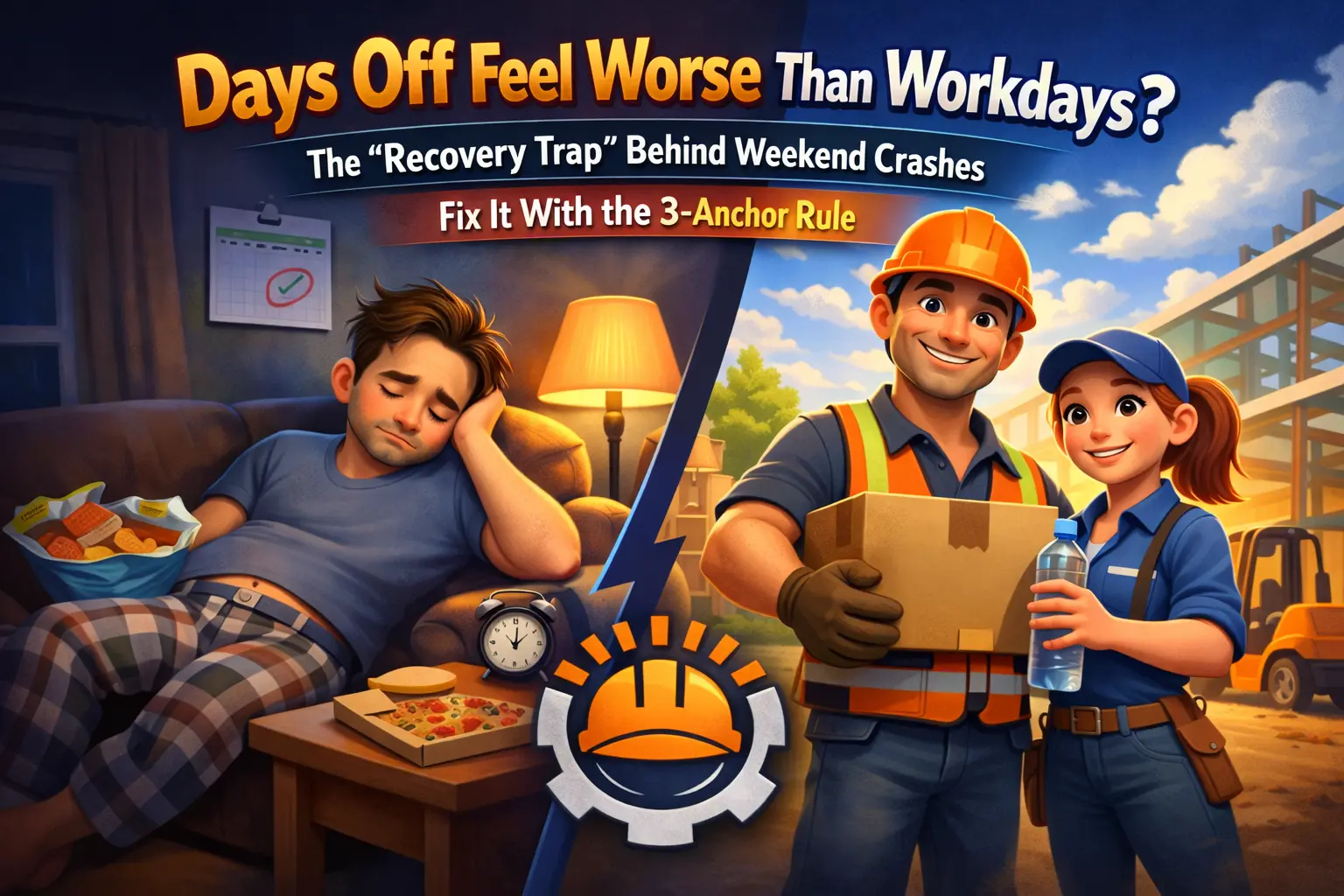
If your days off feel worse than workdays, you’re not lazy. You’re running into a predictable recovery trap: your body finally drops the “work mode” adrenaline, your sleep schedule drifts, and accumulated fatigue shows up all at once.
This is for physical workers (warehouse, construction, trades, long shifts) who feel more tired, more sore, more moody on free days than on the job. After this, you’ll know what’s happening and exactly how to structure a day off so you feel better by tomorrow.
Pattern interrupt: Your “rest day” might be the most stressful day of your week.
Quick Answer (read this first)
Direct answer: Days off feel worse than workdays because accumulated fatigue surfaces when work adrenaline drops, and your weekend routine often breaks sleep timing + movement + fueling—so your body can’t “complete” recovery.
- Do this: Keep 3 anchors stable: wake time, light movement, protein+salt+water.
- Avoid this: Sleeping in 2–4 hours, zero movement, and “random eating.”
- Do this today: 15–25 min easy walk + normal wake time tomorrow + 30–40g protein at first meal.
- Skip this: The all-day couch + late-night scrolling combo.
One rule that decides everything: If you keep the 3 anchors, your day off upgrades; if you break them, your day off crashes.
Jump links: Best pick · Decision tree · Decision table · 48-hour steps · Symptom→fix matrix · FAQ
Table of Contents
- The hook: why your “rest” backfires
- Decision tree: what to do based on your symptoms
- Best pick: the 48-hour Off-Day Reset
- Comparison table: what’s actually making you worse
- Why days off feel worse than workdays
- The steps: a simple 48-hour recovery protocol
- Edge cases: pain, night shifts, low budget, low appetite
- Original insight: Symptom→Fix Matrix
- Trust & sources
- Key takeaways
- FAQ
The hook: why your “rest” backfires
Hot take: Most advice is backwards because it treats days off as “do nothing.” For physical workers, “do nothing” often means break your rhythm, under-prime your system, and let fatigue hit you full force.
Workdays have structure: wake time, movement, meals, sunlight, social contact. Days off often remove all of that—so your body loses the signals that keep energy stable.
Reality check: Sleep debt and disrupted sleep timing can take days to normalize, not one long sleep-in. :contentReference[oaicite:0]{index=0}
Decision tree: what to do (in 30 seconds)
- If you feel “heavy + foggy” → keep wake time within 60–90 min, get outdoor light in first hour, 15–25 min easy walk.
- If you feel “wired but tired” → no caffeine after lunch, stop naps after 20–30 min, do a 10-min slow breathing downshift at night.
- If you feel “sore everywhere” → gentle movement + protein + hydration; avoid full-day immobility.
- If mood drops (Sunday dread) → add light structure: one small task + one enjoyable thing + one social touch.
- If you work nights → keep the same sleep window on off-days; shift it gradually, not abruptly.
Best pick: the 48-hour Off-Day Reset (works for most people)
Best for most people: The 3-Anchor + 2-Block Reset
- Anchor #1 (time): Wake within 60–90 minutes of workday time.
- Anchor #2 (movement): 15–25 min easy walk + 5 min mobility.
- Anchor #3 (fuel): 30–40g protein early + salt/water.
- Block A (recovery): 20–40 min “active recovery” (walk, light cycle, easy chores).
- Block B (life): One errand + one fun thing (so your brain stops treating off-days as “empty”).
Trade-offs: You’ll feel less “lazy-rested” in the moment—but you’ll feel better later.
Already feeling this problem hard? Read this next: Why You’re More Tired After Days Off.
Decision table: what’s actually making your days off feel worse
| What you feel | Likely driver | What to do today | Best for |
|---|---|---|---|
| More tired on off-days than workdays | Sleep debt + rhythm break | Wake within 60–90 min + morning light | Most people |
| Sore the day after “rest” | Under-priming (too little movement) | Easy walk + mobility + hydration | Physical workers |
| Headache / groggy / “hungover” (no alcohol) | Dehydration + low salt + irregular meals | Water + salt + protein early | Hot/long shifts |
| Anxious / low mood | No structure + dread loop | One task + one fun + one connection | Sunday scaries |
| Wired at night, sleepy all day | Late naps + screens + shifted wake time | Cap naps, cut late screens, consistent wake | Night owls |
| Verdict | Days off feel worse when you “break signals” (time, movement, fuel) that stabilize your nervous system. | ||
| If you’re a physical worker with weekend crashes → choose the 3-Anchor Reset. | |||
Why days off feel worse than workdays (the real mechanism)
There are two layers: physiology (fatigue finally reveals itself) and signals (your routine stops telling your body when to be awake, fed, and moving).
1) Accumulated fatigue finally gets a quiet room
On workdays, you run on urgency, repetition, and stress hormones. On days off, that “drive” drops—so what you’ve been suppressing shows up: soreness, heaviness, brain fog.
AfterTheShift calls this out directly in Accumulated Fatigue: The Damage You Don’t Feel Yet.
2) Sleep debt doesn’t repay in one long sleep-in
If you’ve been shorting sleep all week, your body is not “fixed” by sleeping until noon once. Sleep loss can take multiple nights of consistent sleep to normalize. :contentReference[oaicite:1]{index=1}
What people get wrong: They “catch up” by sleeping late, then can’t fall asleep at night—so Monday hits like a truck.
3) Rest vs recovery: zero movement isn’t recovery
Rest is stopping load. Recovery is restoring function. If your day off is all immobility, you often get stiffer, sorer, and more tired.
Read: Rest vs Recovery: Why Sleeping Isn’t Fixing You.
The steps: a simple 48-hour recovery protocol (no fluff)
-
Set your wake time anchor (tomorrow): within 60–90 minutes of your workday wake time.
Why it works: stabilizes circadian timing and reduces the “social jet lag” effect.
Common mistake: sleeping in 3–4 hours “because I deserve it.”
Micro-upgrade: get outdoor light in the first hour after waking.
-
Do 15–25 minutes easy movement: walk, light cycle, easy errands on foot.
Why it works: clears stiffness, improves circulation, reduces under-primed sluggishness.
Common mistake: “I’ll rest harder” (staying still all day).
-
Eat protein early: 30–40g in your first real meal (eggs, yogurt + oats, tuna, chicken, beans).
Why it works: supports tissue repair and steadies energy/appetite.
Common mistake: coffee-only morning → crash → random snacking at night.
-
Hydration + salt (especially if you sweat at work): water + a salty meal (or broth).
Why it works: many “off-day headaches” are dehydration + low electrolytes.
Common mistake: drinking only when you feel thirsty.
-
One “reset chore”: laundry, room reset, meal prep, or a short shop run.
Why it works: reduces background stress and Monday dread.
Common mistake: trying to do 12 chores, then calling it “productive rest.”
-
One enjoyable thing (non-scroll): walk with music, café, hobby, friend visit.
Why it works: gives your brain an actual “off switch.”
Common mistake: passive scrolling that leaves you more drained.
-
Cap naps: 20–30 minutes max, and not late afternoon.
Why it works: prevents wrecking nighttime sleep.
Common mistake: 2-hour nap → insomnia → Monday fatigue loop.
If your “recovery” keeps failing, you’ll want: Why Most Recovery Advice Fails Physical Workers and What Real Recovery Looks Like After Physical Work.
Edge cases (where the standard advice breaks)
- If you’re in real pain (not soreness): don’t “push through” on your day off. Use gentle movement and address the cause. Start here: Work Pain vs Injury.
- If you wake with lower back pain on off-days: do 5–7 minutes mobility + short walk before sitting long. See: Lower Back Pain After Shifts.
- If knees flare after shifts: avoid “all-day couch” stiffness; do gentle range-of-motion and easy steps. See: Knee Pain That Starts After Work.
- If you work nights: don’t flip your sleep schedule on off-days. Keep the same sleep window or shift it gradually (1 hour per day).
- If budget is low: your best tools are free: wake-time consistency, walking, basic protein (eggs, yogurt, beans), water + salt.
Original insight: Symptom → Fix Matrix (print this mentally)
| Symptom | Likely cause | Fix (today) | Don’t do this |
|---|---|---|---|
| “I slept more but feel worse” | Sleep timing drift + debt not repaid | Wake anchor + morning light + consistent bedtime | Sleeping until noon |
| Heavy legs / stiff body | Under-priming + immobility | Easy walk + mobility + hydration | All-day sitting |
| Headache / brain fog | Dehydration + low electrolytes | Water + salty meal + protein | Only coffee |
| Anxiety / irritability | No structure + dread loop | One task + one fun + one connection | “Do nothing” all day |
| Wired at night | Late nap + late screens | Cap naps + screen cutoff + wind-down | 2-hour late nap |
| Soreness spikes on off-day | Inflammation + stiffness | Active recovery + protein + sleep consistency | Hard workout “to fix it” |
Content upgrade idea (killer for your site): Turn this matrix into a printable “Off-Day Reset Scorecard” page later (same table + a checkbox version).
Trust & Authority: how we chose the rules
- Criteria used: sleep timing stability, nervous system load, movement priming, hydration/electrolytes, protein timing, stress reduction, practicality for physical workers.
- We prioritized: changes that work in 24–48 hours with no equipment.
- We ignored: expensive gadgets and “perfect routines” that collapse after a hard shift.
Sources (primary / reputable): Sleep debt and catch-up sleep mechanics :contentReference[oaicite:2]{index=2}, and recovery models explaining resource depletion and the need for real recovery time :contentReference[oaicite:3]{index=3}.
Related AfterTheShift reads (useful next)
- Why You’re More Tired After Days Off
- Accumulated Fatigue: The Damage You Don’t Feel Yet
- Rest vs Recovery: Why Sleeping Isn’t Fixing You
- What Real Recovery Looks Like After Physical Work
- Why Most Recovery Advice Fails Physical Workers
- Work Pain vs Injury
- Lower Back Pain After Shifts
- Toughing It Out Backfires
Key takeaways (don’t overthink it)
- Days off feel worse when you break the 3 anchors: wake time, movement, protein+hydration.
- One long sleep-in rarely fixes sleep debt—consistency beats “catch-up.” :contentReference[oaicite:4]{index=4}
- Rest isn’t recovery if you become immobile all day.
- Light structure reduces dread: one task + one fun + one connection.
FAQ
Why do I feel more tired after doing nothing all day?
Short answer: because your system becomes under-primed—low movement, irregular meals, and poor sleep timing make fatigue feel louder.
Do a short walk, hydrate, and keep tomorrow’s wake time close to normal. Your energy usually improves within 24 hours.
Is it normal to feel sore on a rest day?
Short answer: yes—when you stop moving, stiffness increases and soreness becomes more noticeable.
Use gentle movement + protein + hydration. If pain is sharp or worsening, treat it as injury risk (not “normal soreness”).
Should I sleep in on my days off?
Short answer: a little is fine; a lot usually backfires.
Keep wake time within 60–90 minutes to avoid wrecking your next night of sleep. Sleep debt typically needs multiple consistent nights, not one huge lie-in. :contentReference[oaicite:5]{index=5}
Why do I get Sunday anxiety even when the weekend was “easy”?
Short answer: lack of structure + looming workload creates a dread loop.
Fix it by doing one small reset task early and planning a simple first step for Monday.
What if I work night shifts?
Short answer: don’t flip your sleep schedule on off-days.
Keep the same sleep window or shift gradually (about 1 hour per day). Sudden flips produce the “jet lag” crash.
When should I worry this is medical?
Short answer: if fatigue is persistent, extreme, or paired with red flags (fainting, chest pain, unexplained weight loss, fever).
Also consider getting checked if you’re always exhausted regardless of sleep and routine changes.
Do this next (fast)
Pick one:
- If you want the simplest start: do the 48-hour Off-Day Reset this weekend.
- If you’re stuck in the loop: read Why You’re More Tired After Days Off and apply the matrix.
Start here: AfterTheShift home
Author note: AfterTheShift is built for physical workers who want recovery that actually works—simple decision rules, not “wellness vibes.”
This article is general recovery education, not a diagnosis or a substitute for care from a qualified clinician. Stop and get medical help for severe pain, numbness, weakness, chest pain, sudden swelling, fever, or symptoms that keep worsening.

Log in to leave a comment.