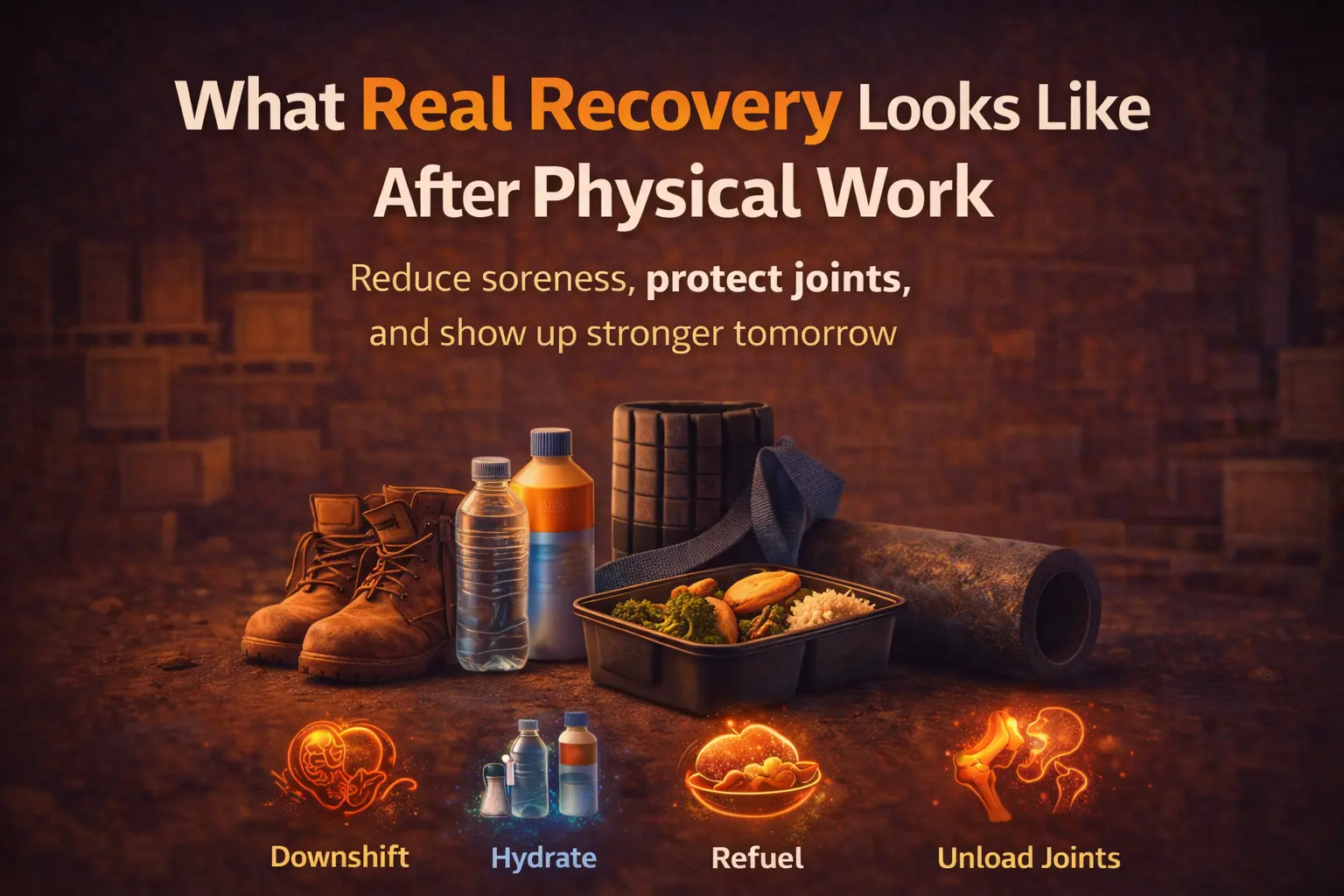
A no-BS system that actually reduces soreness, protects joints, and gets you ready for tomorrow Category: Recovery
Real Recovery After Physical Work: What It Actually Looks Like
Last updated: January 17, 2026
Quick answer: Real recovery after physical work is not “just rest.” It’s a repeatable sequence: downshift your nervous system, rehydrate with fluids + sodium, refuel with protein + carbs, unload the joints that took the beating, then protect sleep. Do this consistently and soreness drops, stiffness clears faster, and you stop carrying yesterday into tomorrow.
Most workers fail recovery for one reason: they treat it like a vibe (“I’ll chill”) instead of a process. Physical work stacks fatigue in the background—especially in the back, hips, knees, wrists, and feet. If you want to last in a physical job, recovery has to be boring, repeatable, and tied to what your body actually needs after a shift.
Definition: what “real recovery” means
Real recovery is the set of actions that reduces your stress load (nervous system, inflammation signals, joint irritation) and restores resources (fluids, electrolytes, glycogen, tissue tolerance) so you can repeat work tomorrow without degrading.
It’s not about feeling “fresh.” It’s about stopping the slow slide where pain shows up earlier every year.
Related reading on AfterTheShift:
Why rest alone doesn’t fix you
“Rest” usually means collapsing, scrolling, and eating whatever is around. That can reduce effort, but it does not reliably:
- flip you out of stress mode,
- replace sodium and fluids lost through sweat,
- refill muscle energy (glycogen),
- decompress joints that were loaded all day.
If you’re consistently sore, stiff, and waking up feeling heavy, you’re not broken. Your inputs are.
For high-quality general guidance on recovery basics (sleep, nutrition, activity), see:
The 4 recovery signals your body needs after a shift
1) “We’re safe now” (nervous system downshift)
After physical work, your body often stays keyed up. If you stay wired, you recover slower and sleep worse.
2) “Fluids are back” (hydration + sodium)
Most workers underestimate how much fatigue is dehydration plus low sodium. Water alone can be the wrong move if you’re salt-depleted.
3) “Fuel is available” (protein + carbs)
Protein supports repair; carbs refill working muscles. Undereating creates “I’m tired for no reason” days.
4) “Joints can breathe” (decompression + range)
Recovery isn’t only muscle soreness. It’s joints and connective tissue irritated by repetition, awkward positions, and constant loading.
More context:
The Real Recovery System (step-by-step)
This is not a “wellness routine.” It’s an off-switch for physical work.
Step 1: 5-minute downshift (immediately after you get home)
- Sit down. Feet flat. Hands on thighs.
- Inhale through your nose for ~4 seconds.
- Exhale slowly for ~6–8 seconds.
- Repeat 10–15 cycles.
This lowers “wired after work” and makes the rest of recovery easier.
Step 2: Rehydrate correctly (10 minutes)
Baseline: 500–750 ml water + sodium. If you sweat heavily, sodium matters.
- If you’re cramping or getting headaches: consider electrolytes or salty food with water.
- If your urine is very dark: you’re behind.
Step 3: Refuel (within 60 minutes)
Keep it simple:
- Protein: 30–50 g
- Carbs: 60–120 g (more if your job is high-output: lifting, stairs, fast pace)
- Fats: moderate (don’t turn it into a greasy brick before sleep)
Step 4: Unload the “usual suspects” (8–12 minutes)
Pick the joints you abuse most. Do not do random stretching. Do targeted unloading:
- Back/hips: gentle hip flexor opening + glute activation
- Shoulders/neck: scap retraction + chest opening
- Feet/calves: calf length + foot rolling (light)
- Wrists/forearms: slow wrist circles + extensor relief
Step 5: Protect sleep (starting 2–3 hours before bed)
- Keep the last hour low-stimulation.
- Keep your room dark and cool.
- Avoid heavy alcohol: it ruins sleep quality and recovery.
If sleep is your weak link, read: Rest vs Recovery: Why Sleeping Isn’t Fixing You.
Fast triage by body part (when something always hurts)
| Hot spot | What it usually is | Do this first (10 minutes) | Stop doing |
|---|---|---|---|
| Lower back | compressed + fatigued hips/glutes | walk 5 min + hip flexor open + glute squeeze sets | hard stretching while cold |
| Knees | tendon irritation + quad tightness | easy cycling/steps + quad/hip mobility | dropping into deep knee flexion when stiff |
| Wrists/forearms | repetition overload | warm water + slow circles + extensor relief | death-grip phone scrolling |
| Feet | impact + stiff calves | calf length + gentle rolling + elevate legs | standing at home “because it hurts to sit” |
| Shoulders/neck | trap overuse + forward posture | chest opening + scap pulls + breathing | scrolling with head forward for hours |
Deep dives:
Hydration + food: what to do, what to skip
Hydration rules that matter
- Don’t “chug and forget”: spread fluids across the evening.
- Add sodium if you sweat: salty food or electrolytes.
- Watch late caffeine: it steals sleep, and sleep is recovery.
Food rules that matter
- Protein first (30–50 g). Make it automatic.
- Carbs are not the enemy after labor. They refill what work burned.
- Don’t end the day underfed: it increases next-day soreness and irritability.
Three simple recovery meals (no cooking skills required)
- Option A: yogurt + oats + banana + honey + nuts (fast carbs + protein)
- Option B: rice + eggs + tuna + olive oil + salt (cheap, dense, effective)
- Option C: chicken + potatoes + fruit (basic and repeatable)
Sleep after shifts: the recovery multiplier
If your sleep is bad, your recovery is capped. Full stop.
What actually helps (and what doesn’t)
- Helps: consistent bedtime, cool/dark room, downshift breathing, earlier dinner.
- Doesn’t help: scrolling in bed, alcohol “to relax,” huge meals right before sleep.
On night shifts, you’re fighting daylight and noise. Treat sleep like protection equipment.
Tools and methods: pros/cons (useful, not mandatory)
Hot shower
Pros: downshifts the system, reduces stiffness, feels good.
Cons: can become procrastination; don’t let it replace hydration + food.
Light walking
Pros: clears stiffness, improves circulation, lowers stress.
Cons: keep it easy; this is recovery, not training.
Hard stretching
Pros: can help specific tight areas when warmed up.
Cons: often done too aggressively when cold; can irritate joints.
Three real routines (pick one and repeat)
10-minute minimum (when you’re destroyed)
- 2 minutes slow breathing (downshift).
- Drink 500 ml water with sodium (electrolytes or salty food).
- 5 minutes easy walk or gentle mobility (hips + shoulders).
- Eat a protein-forward snack if dinner is far away.
30-minute standard (best ROI)
- 5 minutes downshift breathing.
- Hydrate with sodium.
- Eat: protein + carbs.
- 10 minutes targeted unloading (back/hips + the worst joint).
60-minute full system (when you want to upgrade your baseline)
- Downshift breathing + shower.
- Hydration with sodium.
- Meal: protein + carbs + fruit/veg.
- 20 minutes mobility + light strengthening (glutes, upper back).
- Sleep setup: dark/cool room, low stimulation.
The biggest recovery mistakes
- Waiting until pain is loud before you act.
- Skipping sodium and wondering why you feel flat and crampy.
- Undereating because you’re tired and “don’t feel hungry.”
- Hard stretching cold instead of decompression + gentle range.
- Destroying sleep with late caffeine, alcohol, and scrolling.
If pain is confusing, start here: Work Pain vs Injury: Knowing the Difference Matters.
Key takeaways
- Recovery is a sequence, not a vibe.
- Downshift + sodium + protein/carbs + joint unloading covers most of what workers miss.
- Sleep quality sets your recovery ceiling.
- Consistency beats intensity. The best routine is the one you repeat.
FAQ
How fast should I eat after physical work?
Ideally within 60 minutes, especially if your shift is high-output. If dinner is delayed, take a protein-forward snack immediately.
Is soreness always bad?
No. Some soreness is normal. The problem is soreness that stacks weekly, spreads to joints, and shows up earlier each year. That’s usually accumulated fatigue and overload.
Should I stretch right after work?
Light, targeted mobility is fine. Avoid aggressive stretching when cold and stiff. Prioritize downshift, hydration, and gentle unloading first.
Why do I feel worse on days off?
Because accumulated fatigue finally shows up when you stop. See: Why You’re More Tired After Days Off.
When should I worry and get checked?
If pain is sharp, escalating, associated with numbness/weakness, swelling, or you can’t load the joint normally—treat it as more than “work soreness.” Use: Work Pain vs Injury.
Log in to leave a comment.