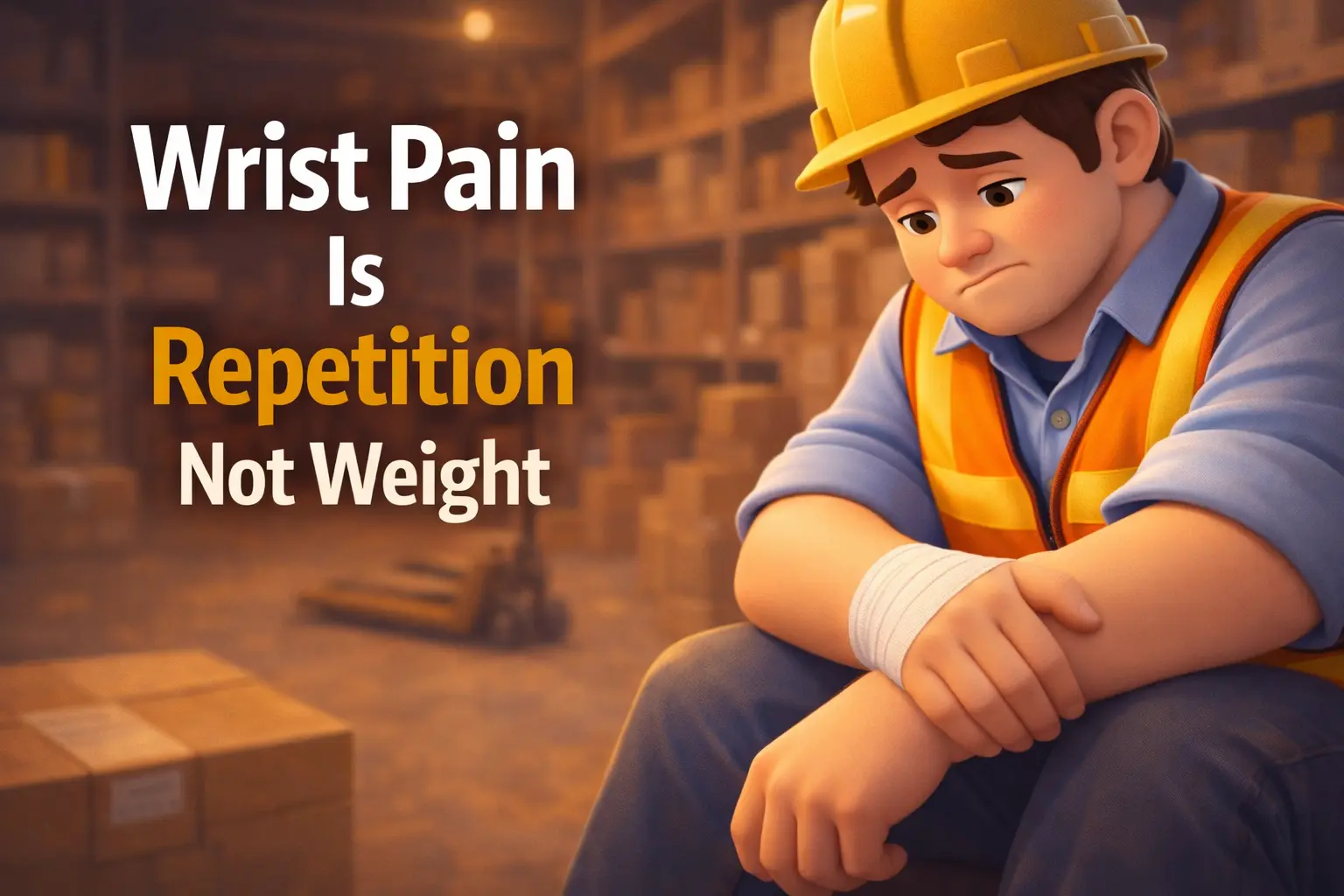
Why light tasks destroy your wrists faster than heavy lifting—and how to stop it.
Keyword: wrist pain from repetition
Wrist pain at physical jobs is usually not caused by heavy weight. It’s caused by repetition: thousands of small motions, sustained gripping, and bent wrist positions that never get enough recovery. That’s why you can feel “fine” during the shift, then the wrist starts aching after work—or wakes you up at night.
This post focuses on one thing: how repetitive work creates wrist pain (RSI / tendonitis patterns) and the fastest, realistic fixes that reduce load without needing a perfect job, perfect tools, or perfect rest.
Last updated: 2026-01-13
Table of Contents
- Definition: Repetitive Strain Wrist Pain (RSI)
- Why Repetition Hurts More Than Weight
- What Actually Gets Irritated in the Wrist
- Early Signs You Should Not Ignore
- Top Work Triggers (Warehouse / Construction / Trades)
- The Fast Fix Plan (Do This This Week)
- Repetition vs Weight: What Changes the Outcome
- Braces, Ice, Heat: Pros / Cons
- FAQ
- Sources
- About the Author
Definition: Repetitive Strain Wrist Pain (RSI)
Repetitive strain injury (RSI) is wrist pain caused by high movement volume + fixed joint angles + low recovery. It usually involves tendons and tendon sheaths (and sometimes nerve irritation), not muscle “soreness.”
RSI is a volume problem. One rep rarely hurts. Ten thousand reps per week does. Your wrist doesn’t fail dramatically—it gets worn down quietly.
Why Repetition Hurts More Than Weight
Heavy lifts tend to be intermittent. Repetitive jobs are continuous.
With repetition you get:
- Micro-damage (tiny irritation that accumulates)
- Friction + swelling around tendons
- Same angle for hours (wrist extension, deviation)
- Grip held too long (tape gun, scanner, knife, tools)
Answer box: If your wrist hurts from “light work,” it’s usually because your daily reps are too high and your wrist angle/grip never resets. Reduce volume spikes, keep the wrist more neutral, and the pain trend reverses.
What Actually Gets Irritated in the Wrist
Most repetitive wrist pain is driven by:
- Tendons (overuse + friction)
- Tendon sheaths (swelling reduces glide)
- Nearby nerves (irritation when tissues tighten/swelling increases pressure)
That’s why pain often appears after the shift. When you stop moving, tissues stiffen, irritation becomes more noticeable, and “quiet damage” finally gets your attention.
If you want the bigger framework, this fits the same pattern described here: Micro-Damage: How Repetitive Work Destroys Joints Quietly.
Early Signs You Should Not Ignore
The mistake is waiting for sharp pain. RSI usually starts as “annoying” symptoms.
- Dull ache after work
- Stiffness when you wake up
- Grip weakness (jar lids, steering wheel, carrying bags)
- Tingling that comes and goes
- Pain that moves around (top of wrist, thumb side, pinky side)
These signals mean you’re accumulating load faster than you recover. That’s not “normal work pain.” That’s a warning. (Related: Work Pain vs Injury: Knowing the Difference Matters.)
Top Work Triggers (Warehouse / Construction / Trades)
1) Sustained grip
Tape guns, scanners, knives, impact tools, screwdrivers—anything that makes you clamp hard for long periods.
2) Bent wrist positions
Wrist extension (bent up) or deviation (bent sideways) while you work multiplies tendon load.
3) High reps with no reset
Picking, sorting, packing, fastening, cutting, wiping—same motion for hours.
4) “Extra” volume after work
Phone scrolling, gaming, DIY work, driving—your wrist total volume keeps climbing even when the shift ends.
The Fast Fix Plan (Do This This Week)
This is a practical step-by-step plan. No fantasy “rest two weeks” advice.
Step 1: Identify your top 1–2 wrist movements
Pick the two motions you repeat most (example: tape gun squeezing + wrist twisting; scanner grip + box lifting). Those are your primary load drivers.
Step 2: Make the wrist more neutral
- Stop working with the wrist bent up or sideways when possible
- Change hand position so the forearm stays more in-line
- Avoid planting your wrist on sharp edges
Step 3: Cut grip force by 20–30%
Most workers death-grip tools without realizing it. Intentionally reduce clamp pressure. Keep control, not tension.
Step 4: Add micro-breaks (not long breaks)
Every 10–15 minutes: 10–20 seconds of hand opening/closing + gentle wrist circles. This restores glide better than one big break later.
Step 5: De-load after your shift
For 5 minutes after work:
- Warm water or heat pack on forearms/wrist (comfort level)
- Gentle wrist circles (no forcing)
- Forearm self-massage (light to moderate)
Why this works: it reduces cumulative load and restores tendon glide. It does not rely on willpower or “toughness.”
If you’re already accumulating fatigue across the whole body, that matters too: Accumulated Fatigue: The Damage You Don’t Feel Yet.
Repetition vs Weight: What Changes the Outcome
| Factor | Repetition (RSI pattern) | Heavy weight (acute pattern) |
|---|---|---|
| Main driver | Volume + fixed angles + sustained grip | Peak load + technique failure |
| Pain timing | After work / at night, then during work | Often immediate |
| Best lever | Neutral wrist + volume control + micro-breaks | Technique + progressive loading |
Braces, Ice, Heat: Pros / Cons
Wrist brace
- Pros: can reduce night irritation; helps during flare-ups
- Cons: does not fix the cause; overuse can reduce tolerance
Ice
- Pros: short-term pain relief after a spike
- Cons: can mask the pattern and encourage overuse
Heat
- Pros: better for stiffness; supports movement/glide
- Cons: not a standalone fix without load control
Key Takeaways
- Wrist pain is usually repetition, not weight.
- Fix wrist angle, grip pressure, and daily volume.
- Micro-breaks beat long breaks because they restore tendon glide.
- If pain is “showing up earlier every year,” that’s accumulated load, not bad luck.
Related reads (internal):
- Why Most Recovery Advice Fails Physical Workers
- Why You’re Exhausted After Work Even When You Didn’t Do Much
- Lower Back Pain After Shifts: What’s Actually Happening
FAQ
Is wrist pain at work usually from lifting heavy things?
Most cases come from repetitive strain: high reps, sustained grip, and bent wrist positions. Heavy weight can trigger pain, but repetition is the common cause in physical jobs.
Why does wrist pain show up after work, not during?
Repetition irritates tendons gradually. Pain becomes obvious after the shift when movement stops, stiffness increases, and inflammation is easier to feel.
How long does RSI wrist pain take to improve?
If you correct the main drivers (angle, grip, volume), many people feel improvement within 1–2 weeks. Chronic cases take longer, but the trend can still reverse.
When should I get it checked?
If you have persistent numbness/tingling, dropping objects, visible swelling, or pain that escalates fast, get evaluated. That’s beyond “normal work soreness.”
Sources
- NIOSH (CDC) — Workplace ergonomics and musculoskeletal risk factors
- OSHA — Ergonomics overview
- NHS — Repetitive strain injury (RSI) overview
About the Author
Nojus Ramonas writes AfterTheShift: practical recovery and longevity strategies for warehouse, construction, and shift-based workers. Focus: simple mechanics, realistic recovery, and cutting accumulated damage before it becomes permanent.
This article is general recovery education, not a diagnosis or a substitute for care from a qualified clinician. Stop and get medical help for severe pain, numbness, weakness, chest pain, sudden swelling, fever, or symptoms that keep worsening.
.webp)

Log in to leave a comment.