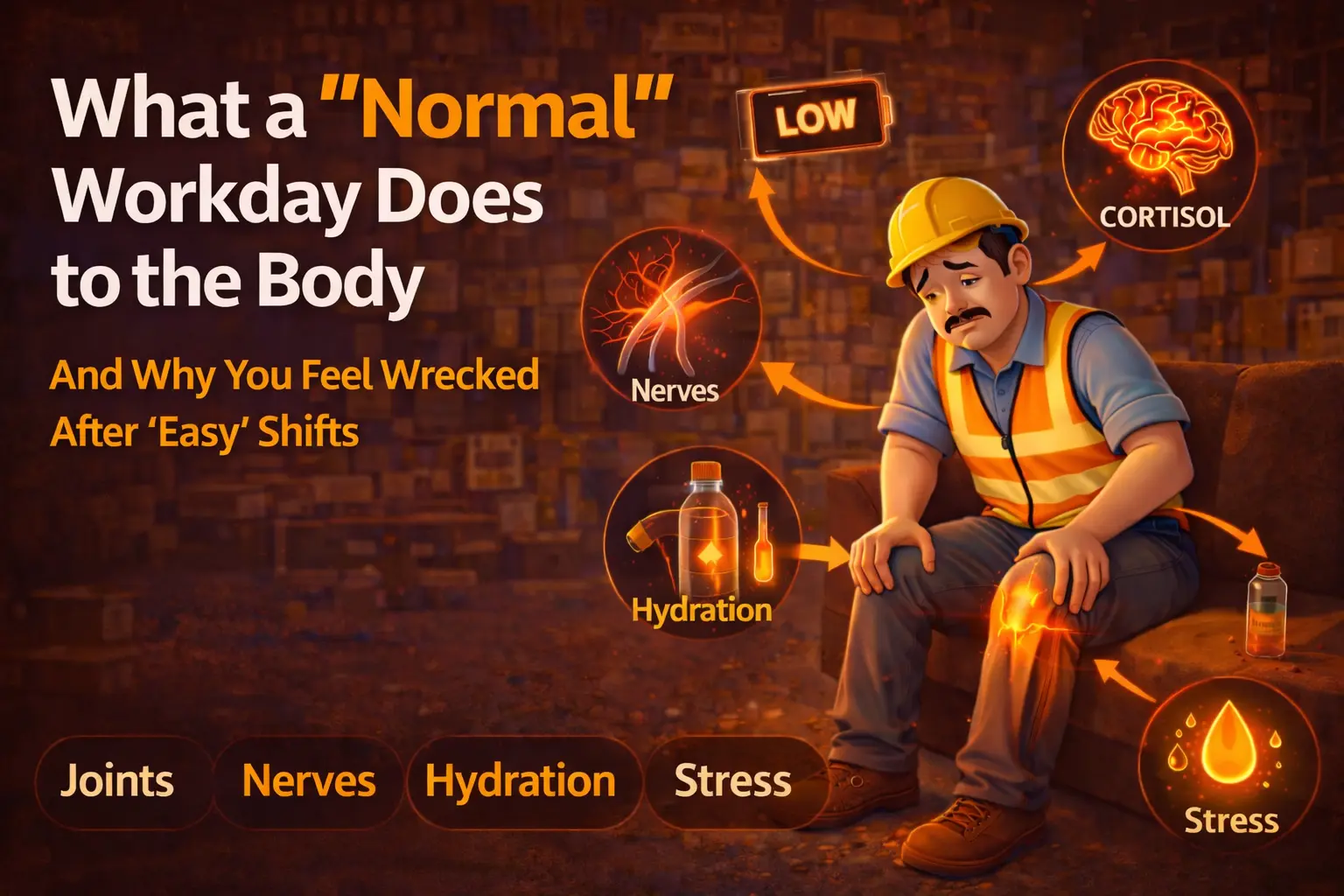
Your shift isn’t “fine.” It quietly taxes joints, nerves, hydration, and sleep—then the pain shows up later. Here’s the real timeline + the fastest daily reset.
Last updated: 2026-01-15
Your shift isn’t “fine.” A normal workday quietly taxes joints, tendons, feet, hydration, and your nervous system—so fatigue and pain hit after work, not during.
If you’ve ever searched “why am I so tired after work” or wondered why you feel wrecked after an “easy” day, this is the missing explanation: most jobs create high-volume stress—repetition, fixed postures, low-grade lifting, standing, walking, gripping, and time pressure. The body adapts… until recovery falls behind and you start carrying accumulated fatigue from one shift into the next.
Answer box (read this first):
A normal workday does three things: (1) creates micro-irritation in joints and tendons, (2) raises stress arousal (your system stays “on”), and (3) drains hydration + electrolytes. You often feel worse after work because inflammation and sensitivity rise when you finally stop moving.
This post stays focused on one topic: what a normal workday does to the body—hour by hour—and what to do about it without turning your life into a full-time recovery project.
Definition: “Normal Workday Stress”
Normal workday stress is the slow, repeatable load your body absorbs from a typical shift: repeated angles (wrists, knees, back), long standing/walking, frequent bracing, small lifts, and steady mental pressure. It’s rarely one big injury—more often it’s micro-damage + under-recovery.
If you want the deeper context, these posts connect directly: Accumulated Fatigue: The Damage You Don’t Feel Yet, Micro-Damage: How Repetitive Work Destroys Joints Quietly, and Rest vs Recovery: Why Sleeping Isn’t Fixing You.
The Workday Timeline: What Changes Hour by Hour
Hour 0–2: Warm-up + early overconfidence
Early shift feels “fine,” which is exactly why form breaks first. You move faster, grip harder, and shrug your shoulders without noticing. That’s how wrist pain from repetition, neck tension, and early back tightness start building.
Hour 2–5: Micro-irritation starts (you usually don’t feel it yet)
Tendons and joint surfaces don’t love high-volume, same-angle stress. If your job repeats reaching, scanning, lifting, typing, or pushing carts, you’re stacking friction on the same tissue lines. This is when tendon irritation and inflammation after work begin.
Hour 5–8: Compensation phase (new pains appear)
As your “good” muscles fatigue, your body shifts load to backup structures: lower back takes more bracing, knees take more impact, wrists take more gripping. This is where you start feeling “random” pain that seems unrelated to what you did.
Hour 8+: The after-work penalty
After you stop moving, tissues swell, stiffness sets in, and the nervous system becomes more sensitive. That’s why knee pain after work, lower back pain after shifts, and foot throbbing often show up at night or the next morning. If this sounds familiar, also read: Knee Pain That Starts After Work, Not During and Lower Back Pain After Shifts: What’s Actually Happening.
Body Systems a “Normal” Shift Hits (and why)
1) Joints + discs: the “stiff later” effect
Even moderate loads cause stress when the angle is repeated all day. Hips, knees, shoulders, and the spine are built for variety—not the same posture for 8–12 hours. The result is stiffness, reduced range of motion, and aching that peaks after work.
2) Tendons: the “quiet overuse” pathway
Tendons prefer controlled, progressive loading. Work often gives the opposite: volume without control. That’s how elbow tendinopathy, wrist tendon pain, Achilles irritation, and shoulder impingement patterns build quietly. If your pain is linked to repetition more than weight, read: Wrist Pain From Repetition, Not Weight.
3) Feet + circulation: the “heavy legs” drain
Long standing and walking increases lower-leg fluid pooling and foot swelling. If your shoes are worn or your insoles collapse, you amplify knee and back stress upstream. Foot pain after standing all day is rarely “just feet”—it’s your whole chain.
4) Hydration + electrolytes: the “cramps and headaches” trap
Busy shifts reduce drinking, and sweating is easy to underestimate. Dehydration and low electrolytes raise perceived effort, worsen cramps, and make you feel drained. Many workers interpret this as “I’m just tired,” when it’s partly a fluid problem.
5) Nervous system + stress: the “can’t switch off” problem
Noise, pace, supervisors, safety vigilance, and deadlines keep your system slightly activated. You go home physically tired but mentally wired. That’s why sleep can be long but shallow—especially after late meals and screens.
Related reading for the “system” view: Why You’re Exhausted After Work Even When You Didn’t Do Much and Why Most Recovery Advice Fails Physical Workers.
Symptom Map: What Your Pain Usually Means
This is not a diagnosis. It’s pattern recognition for common work-related fatigue and overuse injuries. If you see red flags, skip to Red Flags.
| Symptom | Common driver | High-return move |
|---|---|---|
| Low back pain after shift | Hip tightness + bracing fatigue + repeated bending | 5-minute easy walk + hip flexor reset + gentle decompression |
| Knee pain starts after work | Swelling + tendon irritation + foot mechanics | Ankle/calf mobility + step-down control + footwear check |
| Wrist/forearm ache | Repetition + grip overload + awkward angles | Grip breaks + neutral wrist setup + short extensor work |
| Feet burning or throbbing at night | Foot swelling + poor support + calf tightness | Foot roll + calf reset + elevate legs 10 minutes |
| Headache + cramps | Dehydration/electrolytes + long periods without drinking | Electrolyte water + steady sips during shift |
| Wired-but-tired at night | Stress arousal stays high + late screens/food | 5 minutes breathing + low light + earlier last heavy meal |
The 15-Minute Post-Shift Recovery Routine (Do This Before You Sit Down)
This is not a full workout. It’s a downshift: reduce stiffness, calm the nervous system, and restore fluids so you don’t carry today into tomorrow. If you only do one thing from this post, do this.
Step-by-step (15 minutes):
- 3–5 minutes easy walk (hallway, outside, stairs slowly). Purpose: flush stiffness and reduce “lock-up.”
- 2 minutes breathing (slow inhale through nose, longer exhale). Purpose: signal “safe” to the system.
- 5 minutes mobility reset:
- Hip flexor stretch (30–45s each side)
- Calf/ankle rocks (60s each side)
- Upper-back openers (60–90s total)
- Hydration + electrolytes: drink one bottle with electrolytes or a salty meal + water. Purpose: stop cramps and next-day fatigue.
- Protein within 1–2 hours (simple). Purpose: muscle repair, appetite control, better sleep.
Why it works: it targets the big drivers of after-work misery—stiffness, arousal, and dehydration. Long routines fail because you won’t do them daily. This one is built to be repeatable.
Workday Fixes That Actually Reduce Damage
Your best recovery tool is not another gadget. It’s reducing the daily load where it matters. Below are low-drama fixes that cut the “normal workday damage” without slowing you down.
Micro-breaks (30–60 seconds) beat long breaks you never get
- Every 30–60 minutes: relax shoulders, open hands, shake out wrists, 3 slow breaths.
- If standing: 10 calf pumps + 10 slow ankle circles.
- If bending: hinge once slowly with a neutral spine to “reset” pattern.
Stop living in one posture
“Neutral” isn’t one perfect pose. Neutral is movement variety. Rotate tasks, swap stance, change grip, change foot position, change where the load sits.
Hydration strategy that workers actually follow
- Start shift: drink before you get busy.
- During shift: small sips on a schedule (not “when thirsty”).
- Cramping/sweaty days: one electrolyte bottle.
Footwear is upstream medicine
If your feet collapse, knees and back pay. Replace worn shoes, consider supportive insoles if you stand all day, and don’t ignore socks—hot spots and friction matter more than people admit.
If you keep thinking “everyone hurts,” read: Why “Everyone Hurts” Is a Dangerous Lie.
“Rest” vs “Recovery” vs “Training” (Quick Comparison)
| What you do | What it improves | What it doesn’t fix |
|---|---|---|
| Rest (sit, sleep only) | Basic fatigue reduction | Stiffness patterns, tissue tolerance, stress arousal |
| Recovery (downshift routine) | Mobility, nervous system calming, hydration | Long-term capacity if you never build strength |
| Training (strength/mobility work) | Tissue tolerance, resilience, posture control | Doesn’t help if you’re dehydrated, sleep-deprived, and stressed |
If “sleeping isn’t fixing you,” that’s normal. Here’s the deeper breakdown: Rest vs Recovery: Why Sleeping Isn’t Fixing You.
Pros / Cons: Pushing Through vs Fixing the System
| Approach | Pros | Cons |
|---|---|---|
| “Just push through” | Simple; no routine; feels tough | Accumulated fatigue grows; pain shows up earlier each year |
| Daily downshift + small fixes | Reduces next-day stiffness; improves sleep; prevents flare-ups | Requires consistency; results are gradual |
If you feel like pain is showing up earlier every year, read: Why Pain Shows Up Earlier Every Year.
Red Flags: When to Stop Calling It “Normal”
Aches and stiffness can be normal. The following are not:
- Sharp pain that changes your gait or grip.
- Numbness/tingling or radiating pain (arm/leg).
- Swelling, heat, redness, or visible deformity.
- Loss of strength or dropping objects.
- Pain that worsens daily or wakes you at night.
If those appear, treat it as an injury—not “work soreness.” This post helps you separate them: Work Pain vs Injury: Knowing the Difference Matters.
Medical note: if you’re unsure, get assessed by a qualified clinician. Early assessment is cheaper than chronic problems.
Key Takeaways
- A “normal” shift can create micro-damage and accumulated fatigue even without heavy lifting.
- Feeling worse after work is common because stiffness + swelling + nervous-system sensitivity rise after you stop moving.
- Hydration is performance: electrolytes often matter as much as water for workers.
- The highest ROI recovery habit is a 15-minute post-shift downshift before you sit.
- If pain is sharp, spreading, numb, or worsening daily, stop treating it as “normal.”
Sources and authority links
For general, non-brand-specific background on occupational fatigue, sleep, and musculoskeletal strain, these are reputable starting points:
- NIOSH (CDC) — Workplace safety and health research
- World Health Organization — General health guidance
- PubMed (NIH) — Research database for occupational health and fatigue
(These links are for credibility and further reading. Your actual fixes still come down to load management + recovery consistency.)
FAQ
Why do I feel more tired after work even when I didn’t do much?
Because “didn’t do much” usually means you did the same small things for hours: standing, walking, gripping, reaching, bracing, dealing with pace and pressure. That’s high-volume stress, and fatigue often hits when you stop moving.
Why does pain start after work, not during the shift?
Movement and adrenaline can mask symptoms during work. After the shift, tissues swell and stiffen, and your nervous system becomes more sensitive. That’s why knee pain, back pain, and wrist pain often peak later.
How do I recover faster after a physical job?
Do the 15-minute downshift: easy walk, breathing, mobility reset, hydration with electrolytes, and protein within 1–2 hours. Consistency beats intensity.
Is soreness after work normal?
Mild soreness and stiffness can be normal. Sharp pain, numbness/tingling, swelling, weakness, or pain that worsens daily is not—treat that as a potential injury.
What’s the simplest way to prevent accumulated fatigue?
Reduce daily debt: micro-breaks, posture variation, hydration, and a short post-shift downshift routine. Weekly, add one strength + mobility session to increase your tolerance over time.
This article is general recovery education, not a diagnosis or a substitute for care from a qualified clinician. Stop and get medical help for severe pain, numbness, weakness, chest pain, sudden swelling, fever, or symptoms that keep worsening.
Log in to leave a comment.