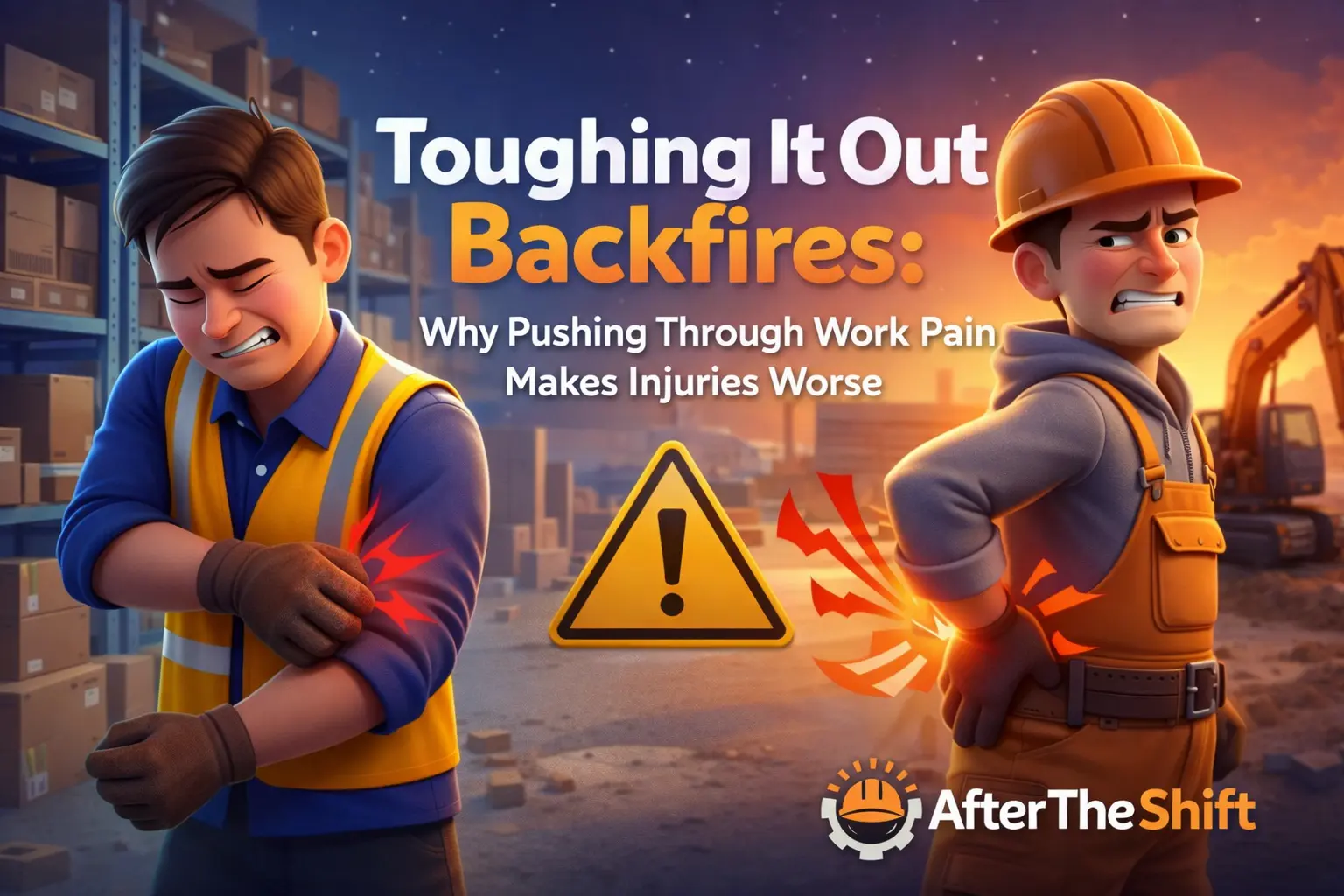
The “just finish the shift” mindset quietly turns small pain into long downtime—here’s how to spot the line and recover smarter.
Keyword focus: pushing through work pain makes injuries worse
If you work warehouse, construction, delivery, or trades, you’ve heard it: “Just tough it out.” The problem is simple—pushing through work pain can turn a small problem into a real injury. The body doesn’t “adapt” to damage; it compensates, shifts load, and stacks micro-damage until something fails. That’s how minor soreness becomes tendonitis, back flare-ups, knee pain, wrist pain, or weeks off work.
Fast answer: when does toughing it out backfire?
Toughing it out backfires when pain changes your movement, increases day-to-day, or sticks around after rest. If you’re altering form, losing strength/grip, or pain is sharp, radiating, or waking you up, you’re no longer “building toughness”—you’re buying downtime.
Table of Contents
- What “toughing it out” really means
- Why pushing through pain makes injuries worse
- The “too-late line”: warning signs you can’t ignore
- A simple decision framework: work, modify, or stop
- Fix it fast: 24–72 hour recovery plan after a bad shift
- Warehouse vs construction: common pain patterns
- Pros and cons of “pushing through”
- Pain vs injury: quick comparison table
- Real-world examples from physical jobs
- FAQ
What “toughing it out” really means
Definition: In physical work, “toughing it out” usually means continuing the same workload despite pain signals that your tissues aren’t recovering between shifts.
There’s a difference between normal training discomfort and job-based wear. Training gives you planned stress + recovery. Physical work often gives you stress + no real recovery (sleep debt, repetitive motion, cold floors, time pressure, bad tools, overtime).
The result: your body doesn’t get stronger—it gets better at hiding the warning signs, until it can’t.
Related on AfterTheShift:
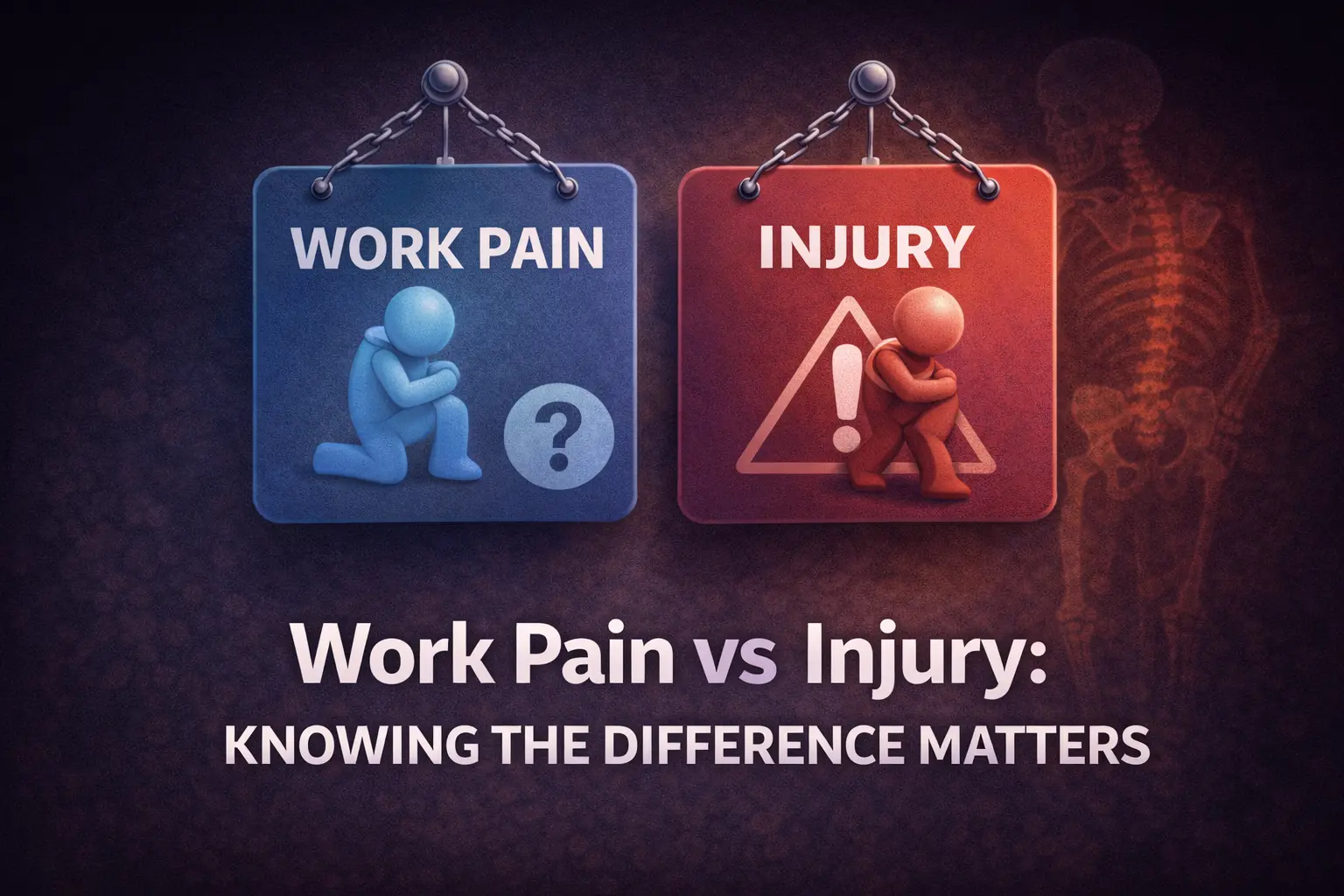
- Work Pain vs Injury: Knowing the Difference Matters
- Accumulated Fatigue: The Damage You Don’t Feel Yet
- Micro-Damage: How Repetitive Work Destroys Joints Quietly
Why pushing through pain makes injuries worse
1) Compensation spreads the damage
When something hurts, your nervous system changes your mechanics. You shift load to the other side, twist the spine, overgrip, or shorten your stride. That protects the painful tissue but overloads the neighbors—hips, low back, opposite knee, shoulder, wrist.
2) Repetition multiplies tissue stress
Repetition is the silent killer in warehouses and trades. The weight might not be extreme, but the cycle count is. Tendons and joints hate high repetition when recovery is insufficient. That’s how “not heavy” becomes “not sustainable.”
3) Inflammation becomes your new baseline
If you keep working through irritation, tissues can stay inflamed. Then your “normal” becomes stiff mornings, reduced range of motion, tight forearms, angry knees, and recurring back pain—until one day the pain spikes.
4) Fatigue reduces technique under pressure
You don’t lift “wrong” because you’re stupid. You lift wrong because you’re tired, rushed, and your stabilizers are cooked. Fatigue makes form collapse. That’s where strains happen.
Authority references worth checking: guidance on overexertion and musculoskeletal injury prevention from OSHA; occupational ergonomics resources from CDC/NIOSH; clinical guidance on tendon pain and back pain from NHS and Mayo Clinic.
The “too-late line”: warning signs you can’t ignore
Red flags (stop or get medical evaluation)
- Sharp, stabbing pain or a “pop”
- Numbness, tingling, burning, or radiating pain (hand/arm or leg)
- Sudden weakness, dropping tools, loss of grip
- Swelling that grows, visible deformity, hot/red joint
- Pain that wakes you up or won’t settle after rest
- New loss of range of motion (can’t bend, can’t rotate, can’t squat)
Yellow flags (modify work immediately)
- Pain changes your movement (limp, twist, shoulder hike)
- Pain increases day-to-day even if you’re “used to it”
- Stiffness lasts longer each morning
- You need more warm-up time just to function
- One side is doing all the work to protect the painful side
Green flags (usually manageable)
- Muscle soreness that improves with light movement
- No movement compensation
- Improves within 24–48 hours with basic recovery
A simple decision framework: work, modify, or stop
- Rate it (0–10) + pattern: Is it sharp, dull, tight, burning? Does it radiate?
- Check compensation: Are you moving differently? If yes, assume damage risk is rising.
- Test function: Can you do a bodyweight hinge, squat to a safe depth, or grip without pain spike?
- Choose:
- Work as normal if pain is mild, non-sharp, no compensation, improving.
- Modify if pain persists, increases, or changes mechanics.
- Stop/seek help if red flags show up.
Smart modifications that keep you employed
- Lower repetition: rotate tasks or insert micro-breaks every 20–40 minutes
- Reduce peak load: team lift, split loads, use carts, change pick strategy
- Change grip: use thicker handle/anti-slip gloves where appropriate
- Protect the joint: knee pads on hard floors; supportive work shoes; bracing only when truly needed
- Change tempo: slow down the “yank” and “twist” moments (where strains happen)
Related: Lasting Longer in Physical Jobs Without Breaking Down
Fix it fast: 24–72 hour recovery plan after a bad shift
0–24 hours: reduce threat, restore movement
- Don’t “stretch into pain”; use gentle range-of-motion instead.
- Heat or contrast can help stiffness; use what reduces symptoms.
- Walk 10–20 minutes if back/hips are angry (easy pace).
- Protein + hydration (simple but non-negotiable for recovery).
24–48 hours: rebuild capacity (light loading)
- Isometrics (pain-free holds) for tendons: forearm, shoulder, knee as tolerated.
- Hinge pattern practice (light, controlled) if back is involved.
- Sleep extension: add 60–90 minutes if possible.
48–72 hours: decide next exposure
- If symptoms are improving, reintroduce work exposure with modifications.
- If symptoms are stagnant or worse, stop treating it like “normal soreness.” Escalate: clinician, physio, or occupational health.
Related: What Real Recovery Looks Like After Physical Work
Warehouse vs construction: common pain patterns
Warehouse patterns
- Wrist/forearm: scanning + repetitive gripping + awkward picks
- Shoulder/neck: reaching to high racks, fast packing
- Knee/foot: concrete floors, high step counts
- Low back: twisting under fatigue, rushed lifts
Internal reads: Lower Back Pain After Shifts: What’s Actually Happening · Wrist Pain From Repetition, Not Weight
Construction/trades patterns
- Shoulder/elbow: overhead work, tool vibration, repetitive fastening
- Knee/hip: kneeling, climbing, uneven ground
- Back: carries, awkward loads, long days + cold
Internal read: Knee Pain That Starts After Work, Not During
Pros and cons of “pushing through”
| What you gain (short-term) | What you risk (medium/long-term) |
|---|---|
| Finish the shift, avoid conflict, keep metrics | Compensation patterns that overload other joints |
| Feel “tough” and reliable | Chronic inflammation and recurring flare-ups |
| More hours now | More days off later (injury downtime) |
| Temporary numbness via adrenaline | Masking symptoms until damage is larger |
Pain vs injury: quick comparison table
| Signal | More like normal soreness | More like injury risk |
|---|---|---|
| Onset | After shift, general ache | Sudden during task, sharp/targeted |
| Movement | Feels better when lightly moving | Alters your form or makes you limp |
| Duration | Improves in 24–48 hours | Persists, escalates, or returns stronger |
| Neurology | No numbness/tingling | Numbness/tingling/radiating pain |
| Function | Strength mostly intact | Weakness, dropping tools, unstable joint |
Internal read: Work Pain vs Injury: Knowing the Difference Matters
Real-world examples from physical jobs
Example 1: “It’s just forearm pump” becomes tendon pain
A picker ignores forearm tightness for weeks. Grip gets weaker. They start over-squeezing to compensate. Now wrist/forearm tendon pain shows up off-shift, then during shift. Result: can’t hold scanner without burning pain.
Example 2: “My back is fine after warm-up” becomes a flare cycle
A worker needs 45 minutes to “loosen up” every morning. They keep twisting under fatigue to hit numbers. One day a minor tweak becomes a full flare: spasms, limited range, and missed work.
Example 3: Knee pain after work becomes “stairs are a problem”
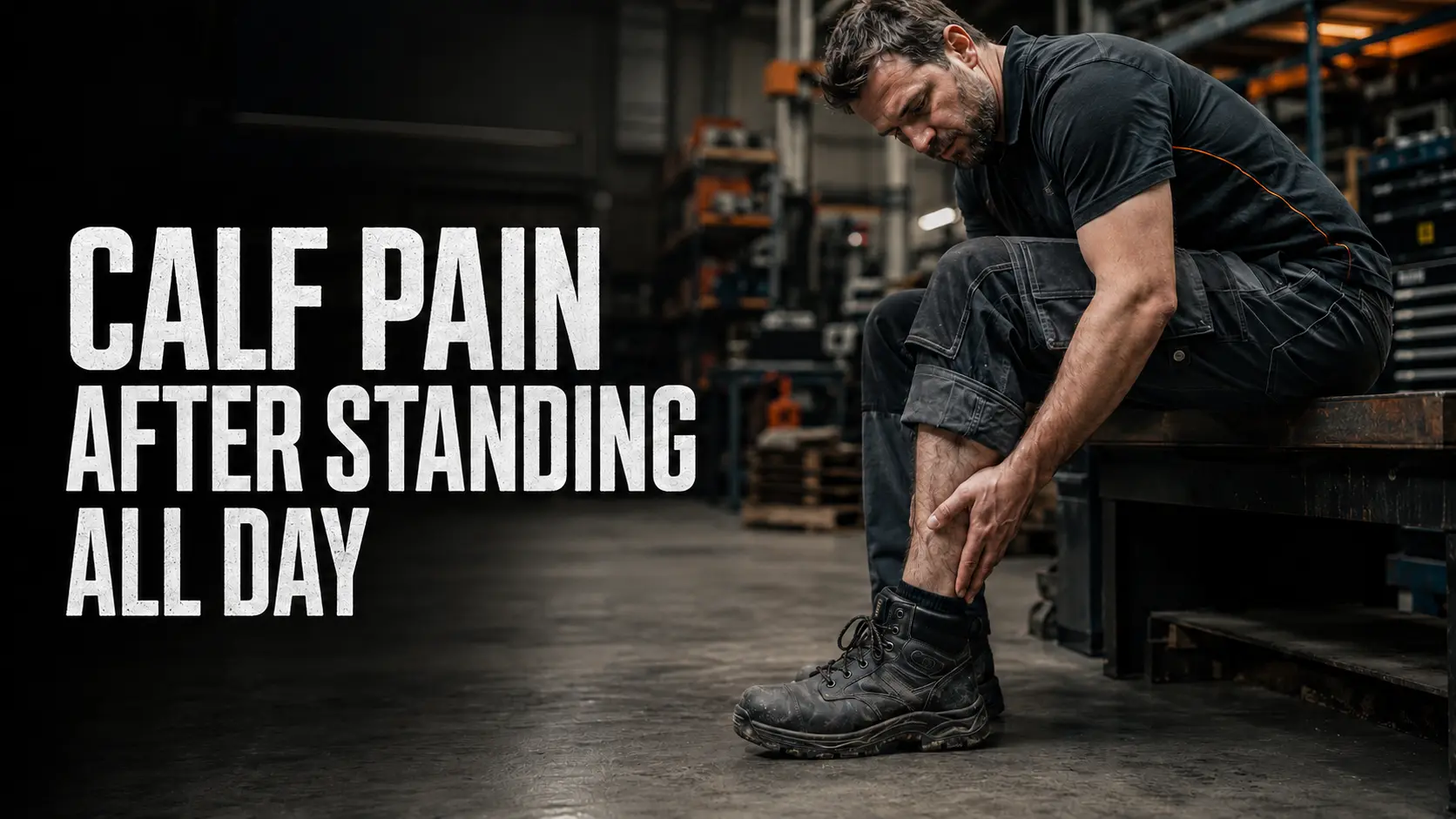
Pain isn’t bad during the shift—only later. They ignore it because it doesn’t stop them. But the pattern worsens: stiffness, swelling, clicking, and stairs start to hurt. The “after work only” phase is often the early warning.
Internal read: Pain That Becomes Background Noise
Key takeaways
- Toughing it out often means you’re stacking micro-damage without recovery.
- Compensation is the giveaway—if you move differently, risk is rising.
- Modify early to stay working longer; waiting usually costs more time.
- Red flags (sharp pain, radiating symptoms, weakness) deserve escalation, not bravado.
FAQ
Is it ever okay to push through pain at work?
Mild soreness that improves with light movement and doesn’t change your mechanics is usually manageable. The moment pain alters form, escalates day-to-day, or includes nerve symptoms (tingling/numbness), pushing through becomes a bad trade.
Why does pain sometimes feel worse after work, not during?
During work, adrenaline and heat can mask symptoms. After work, inflammation and tissue irritation show up. “Only after work” pain is not harmless—it can be an early-stage warning.
Should I rest completely if something hurts?
Full rest can help briefly, but total shutdown often stiffens you up. The goal is usually modified movement: reduce the aggravating task, keep gentle range-of-motion, and rebuild capacity with light loading if symptoms allow.
How do I tell my supervisor I need modifications without sounding weak?
Use productivity language: “If I keep doing X at full pace, I’m going to lose output for days. If I rotate tasks or reduce repetition for 48 hours, I can keep consistent performance.” Reliability beats hero mode.
When should I see a professional?
If symptoms persist beyond a few days, worsen despite modifications, include red flags (radiating pain, numbness, weakness, significant swelling), or keep recurring, get assessed.
Last updated: January 25, 2026
This article is general recovery education, not a diagnosis or a substitute for care from a qualified clinician. Stop and get medical help for severe pain, numbness, weakness, chest pain, sudden swelling, fever, or symptoms that keep worsening.
Log in to leave a comment.