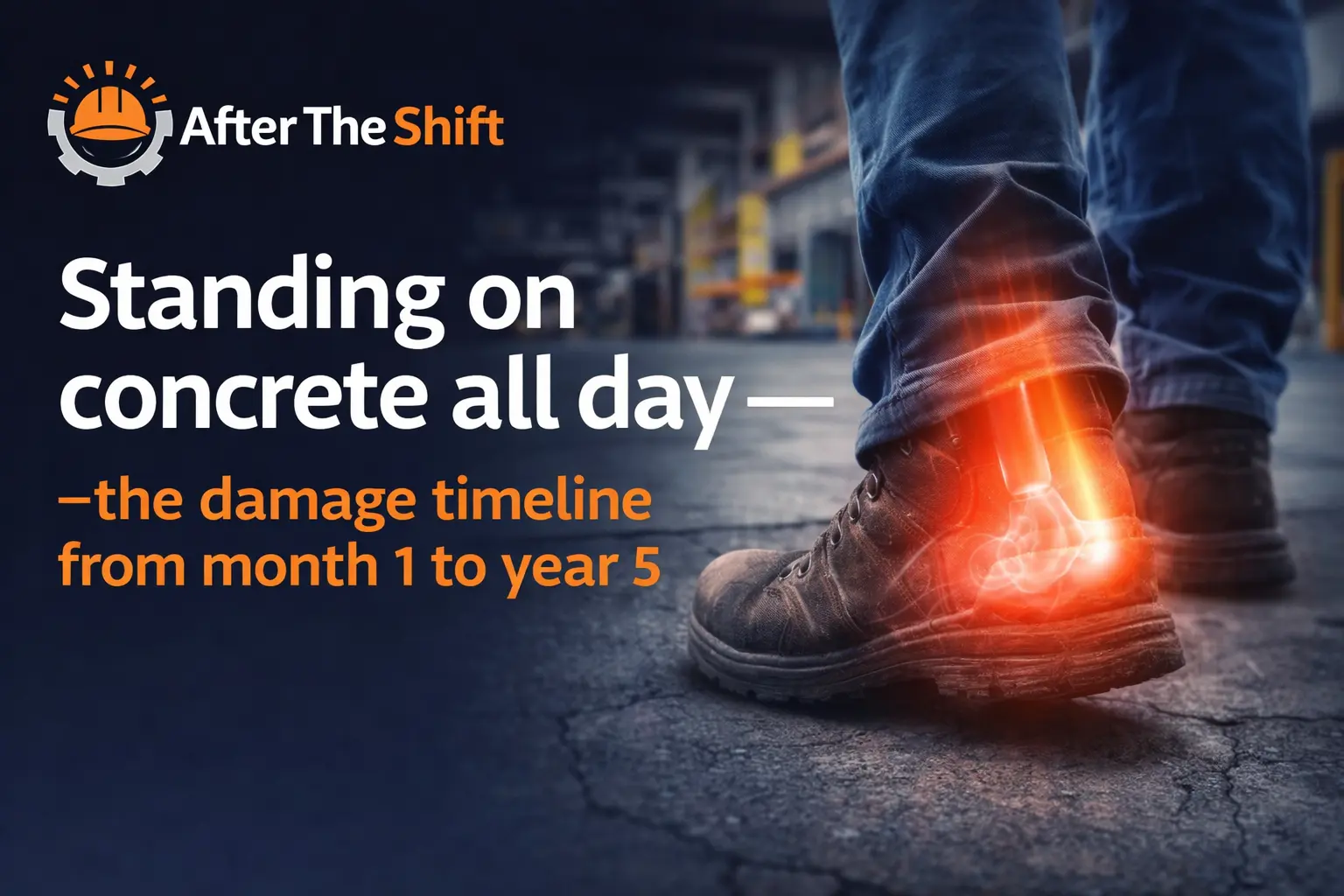
How hard floors quietly move the problem from sore feet to swelling, heel pain, compensation, and reduced work capacity — and what to fix before it gets there.
Concrete doesn’t usually break you in one dramatic moment. It usually does it quietly: feet first, then calves, knees, hips, and lower back. This guide shows what that damage pattern often looks like from the first month on the job through year 5, how to tell whether you’re still in the “fix it fast” stage, and which changes actually lower the load.
This is a pattern guide, not a diagnosis. The timeline speeds up if your shoes are bad, you stand mostly in one spot, you’re carrying extra bodyweight, or you already have a foot/knee/back issue.
Quick answer
If you stand on concrete all day, the usual pattern is end-of-shift soreness first, then earlier fatigue, morning heel pain, swelling, stiffness, and compensation, and later a more stubborn cycle where the pain starts sooner and leaves later. The smartest move is to fix the load before symptoms start showing up earlier in the shift.
- Do: upgrade shoes, add the right insole, break up static standing, and use a mat if you work in one station.
- Do: use compression socks if you get swelling, heaviness, or deep sock marks.
- Do: treat morning first-step heel pain as an early warning, not “normal soreness.”
- Avoid: waiting until the pain starts before lunch every day.
- Avoid: hard, worn-out midsoles and flattened insoles.
- Avoid: thinking a day off means the setup is fine.
Blunt rule: If the pain now starts earlier in the shift, lasts into the next morning, or comes with swelling, numbness, or gait changes, stop calling it “just sore feet” and change the setup now.
Table of contents
What this timeline means
This post is not claiming every worker hits the same symptom on the same date. Real life is messier than that. What it does show is the usual order: fatigue and pressure overload first, compensation second, chronic irritation third.
The big mistake is waiting for “real pain.” By the time pain becomes obvious, your body has often been changing movement patterns for months. That is why workers suddenly notice their feet, knees, or back getting worse in the parking lot, the shower, the drive home, or the first steps the next morning.
Read this as a field guide:
- Month 1: your body still hides the bill.
- Months 2–12: the bill starts arriving earlier.
- Years 1–5: the body adapts badly unless you reduce the load.
Fast decision table: where you probably are right now
| If you… | You’re probably in… | Do this now |
|---|---|---|
| Only ache near the end of the shift and wake up mostly fine | Early overload stage | Fix shoes and insoles before the pattern hardens |
| Feel heaviness, calf tightness, or sock marks by mid-shift | Circulation and fatigue stage | Add movement breaks, calf pumps, and compression if tolerated |
| Get sharp heel pain on your first steps in the morning | Plantar fascia/Achilles overload stage | Do not ignore it; change footwear and reduce foot strain now |
| Notice knee, hip, or low-back pain after your feet started hurting | Compensation stage | Fix the foot setup and standing pattern, not just the back pain |
| Pain starts earlier every month and lingers on days off | Entrenched pattern | Treat it as a real work-capacity problem and escalate your fix plan |
The damage timeline from month 1 to year 5
Important: this is the usual sequence for workers who spend long hours on hard floors, especially concrete, with limited sitting, repetitive walking, static standing, poor rotation, or worn footwear.
| Timeframe | What you usually feel | What is likely changing | Best move |
|---|---|---|---|
| Month 1 | Hot feet, tired arches, calf tightness, “normal” soreness after work | Soft tissues are taking repeated load; muscles are doing too much shock management | Do not adapt by denial; set up better shoes, lacing, and insoles immediately |
| Months 2–3 | Fatigue arrives earlier, feet feel “flat,” calves stay tight longer, deep sock marks show up | Recovery is no longer complete between shifts; swelling and lower-leg fatigue start stacking | Add micro-breaks, calf pumps, and compression if swelling/heaviness is your pattern |
| Months 4–6 | Heel pain after rest, stiffness on the drive home, more relief when shoes come off | The foot is no longer just tired; irritated structures start reacting predictably | Treat morning heel pain like a warning flare, not an inconvenience |
| Months 7–12 | You shift weight more, knees feel “off,” lower back gets tighter, days off feel too short | Compensation starts spreading the problem up the chain | Fix the standing system, not just the loudest body part |
| Years 1–2 | Pain starts sooner, flare-ups are easier to trigger, one bad shift can ruin the next day | Your margin is shrinking; the same job now costs more recovery | Upgrade footwear, floor interface, and work-rest pattern together |
| Years 3–5 | Persistent heel/arch pain, swelling or visible veins, chronic stiffness, reduced tolerance for overtime | The issue has shifted from temporary overload to recurring work-capacity damage | You need a serious plan: load reduction, better gear, rotation, and proper assessment if symptoms persist |
Why concrete is worse than “just standing”
Standing on concrete is not only about the number of hours. It is also about how little help the surface gives back.
- Hard surfaces increase pressure concentration. That usually means your feet and lower legs absorb more of the day.
- Static standing is brutal. If you mostly stand in one zone instead of moving naturally, your calves do less useful pumping and the legs feel heavier faster.
- Bad shoes multiply the floor problem. A dead midsole on concrete is a terrible combo.
- Once the foot gets irritated, the rest of the chain pays. Knees, hips, and lower back often join later.
Mid-post next step: If your whole body feels beat up after shifts, not just your feet, read the Physical Work Recovery Guide. It helps you build the full recovery system around the job instead of patching one symptom at a time.
Symptom → cause → fix matrix
| Symptom | Likely driver | Best first fix | Common mistake |
|---|---|---|---|
| Burning or aching under the whole foot | Overall pressure overload + poor cushioning | Replace dead shoes or add better insole support | Buying the hardest “durable” boot and calling it support |
| Sharp heel pain on first steps | Plantar fascia / heel overload | Unload the heel with better footwear, calf work, and less barefoot time on hard floors | Ignoring it because it warms up after a few minutes |
| Heavy legs, swelling, sock marks | Blood pooling + static standing | Compression, calf pumps, walking breaks, leg elevation after shift | Thinking it is harmless because it goes down overnight |
| Outer hip or low-back tightness | Compensation from foot fatigue and altered stance | Fix the foot-floor setup first, then address trunk mobility/strength | Only stretching the back while the foot problem stays the same |
| Numbness, tingling, hot spots | Tight footwear, pressure points, or irritated tissue | Check width, toe box, lacing, insole shape, and pressure areas | Sizing only by length and ignoring width/fit |
Decision tree: what to do based on your pattern
Start here: When does the pain show up?
- Only near the end of the shift, gone by morning
- You still have room to fix this cheaply.
- Prioritize shoes, insoles, and breaking up static standing.
- By mid-shift, with heaviness or swelling
- You need circulation help, not just more toughness.
- Add calf movement, walking breaks, compression, and post-shift leg elevation.
- First-step heel pain in the morning
- That is a bigger warning sign than “tired feet.”
- Reduce heel/arch strain now and stop doing long barefoot time on hard floors.
- Knee, hip, or low-back pain after the foot pain started
- The body is compensating.
- Fix the floor-foot interface first or the chain keeps getting worse.
- One-sided swelling, red/hot calf, chest pain, breathlessness, or sudden severe pain
- This is not a “work soreness” problem.
- Get urgent medical help.
Mini-test: how far along are you?
Score yourself. Add the points.
- 0 points: Never
- 1 point: Sometimes
- 2 points: Most shifts
- 3 points: Almost every shift
- Your feet feel beaten up before the shift is over.
- You get deep sock marks, swelling, or leg heaviness.
- You have first-step pain after getting out of bed.
- You shift weight away from one foot without thinking.
- Your lower back or knees hurt more after your feet started hurting.
- Your days off are not fully resetting the problem.
- You can tell one pair of shoes makes the job much more survivable.
- Your pain now starts earlier than it did a few months ago.
Score guide
- 0–5: Early stage. Fixable fast if you act now.
- 6–11: Established pattern. Your setup is already costing you recovery.
- 12–17: Escalating problem. You are likely compensating somewhere else already.
- 18–24: High-risk pattern. Stop treating this like ordinary soreness and get more serious with changes and assessment.
Best fixes ranked: what actually gives the most payoff
This rubric scores each option on four things: relief speed, long-term value, cost efficiency, and how easy it is to keep doing. Higher total = better return for most workers standing on concrete.
| Fix | Relief | Long-term | Cost efficiency | Compliance | Total /20 | Best for |
|---|---|---|---|---|---|---|
| Supportive work shoes with live cushioning | 5 | 5 | 4 | 5 | 19 | Almost everyone |
| Insoles matched to your pain pattern | 4 | 4 | 5 | 5 | 18 | Foot fatigue, arch strain, heel pain |
| Micro-break rule every 30–40 minutes | 3 | 5 | 5 | 3 | 16 | Workers who get stuck in one spot |
| Anti-fatigue mat at a fixed station | 4 | 4 | 4 | 4 | 16 | Packing benches, assembly, checkout-style stations |
| Compression socks | 4 | 3 | 5 | 4 | 16 | Swelling, heaviness, sock marks |
| Only stretching after work with no load change | 2 | 1 | 5 | 4 | 12 | Small add-on, not a main fix |
| Option | Best for | Avoid relying on it if… |
|---|---|---|
| Better shoes | You walk and stand across the whole shift | You keep wearing them long after the cushioning is dead |
| Insoles | Arch fatigue, heel pain, pressure hotspots | The shoe fit is already wrong in width or volume |
| Anti-fatigue mat | You work in one standing station | Your day is mostly walking, not standing in place |
| Compression socks | Swelling, heaviness, visible veins, long static shifts | Your main issue is purely shoe pressure or nerve irritation |
Best first fix
If you can only change one thing this week, change the shoe + insole system. For most workers, that beats random stretching, recovery gadgets, or “just sitting more after work.”
Best budget fix
If your symptoms are more swelling/heaviness than sharp pain, start with compression. If your symptoms are more heel/arch pain, start with insoles.
Best upgrade
If you stand in one place most of the shift, the best upgrade is usually anti-fatigue mat + better shoes + a forced movement rule.
Concrete-shift protection checklist
Copy/paste checklist
- [ ] My work shoes still have real cushioning, not just an intact outer shell.
- [ ] My shoes fit my width, not only my length.
- [ ] I know whether my pain is mainly heel/arch pressure or leg swelling/heaviness.
- [ ] I do at least one movement reset every 30–40 minutes.
- [ ] I do not spend long periods barefoot on hard floors after work if my heels already hurt.
- [ ] I elevate my legs after heavy standing days if swelling is part of my pattern.
- [ ] I replace or rotate footwear before it becomes obviously dead.
- [ ] I am not waiting for “real injury” before changing the setup.
Common mistakes that make the timeline speed up
- Confusing numbness with fatigue. That is not the same problem.
- Using one cheap fix for every symptom. Swelling and heel pain often need different first moves.
- Keeping dead boots because the outsole still looks okay. The midsole is what usually dies first.
- Trying to stretch your way out of a load problem. Recovery helps, but load management matters more.
- Ignoring the chain reaction. Once your gait changes, your back and knees start paying too.
When to stop self-managing and get checked
Book a proper assessment if the pain keeps escalating despite footwear changes, if you cannot fully weight-bear, if numbness or weakness shows up, or if the problem is clearly affecting how you walk. Get urgent help for one-sided swelling, a hot/red painful calf, chest pain, or breathlessness.
Next steps
- Read the pillar guide: Physical Work Recovery Guide
- If your main issue is the feet themselves: Foot pain after standing 8 hours — why it’s not just sore feet
- If the pain spikes after you stop moving: Why your feet hurt worse in the parking lot than on the warehouse floor
- If you keep telling yourself you’ll adapt: You’ll get used to it is caused by accumulated fatigue
- If you want the bigger picture: What a normal workday does to the body
- If you’re unsure whether this is still “work pain” or already something else: Work pain vs injury — knowing the difference matters
Save this: If you work on concrete, bookmark this post before the problem becomes your new normal. The timeline is easier to stop at month 2 than at year 2.
FAQs
Is standing on concrete really worse than standing on other floors?
Usually, yes. Concrete gives you very little cushioning, so your feet and lower legs absorb more of the repeated load. That does not mean every softer surface is perfect, but hard flooring usually gives workers less margin for bad shoes, long static standing, and overtime.
How long does it take standing on concrete to start causing damage?
For many workers, the first signs show up fast as simple soreness and fatigue. The real problem is not the first ache — it is when the ache starts arriving earlier, lasts longer, or turns into morning heel pain, swelling, stiffness, and compensation. That is the shift from temporary overload to a more established pattern.
Does your body just get used to standing on concrete?
Sometimes your pain threshold changes before the load changes. That is not the same as the job becoming harmless. A lot of workers mistake adaptation for improvement until symptoms start showing up earlier or spread to the knees, hips, or back.
Are anti-fatigue mats actually worth it?
Yes, if you stand mostly in one station. No, they are not the main fix if your shift is mostly walking across a large site. Mats help most when the problem is static standing on one hard spot for hours.
Should I buy expensive work boots or insoles first?
Usually shoes first, then insoles if needed. Insoles can improve a decent shoe, but they cannot fully rescue a boot that is too narrow, too hard, flattened out, or wrong for your work pattern.
Can compression socks help with concrete-floor fatigue?
They can help when your pattern includes swelling, heaviness, tired calves, or deep sock marks. They are less likely to be the main answer if your biggest issue is a sharp pressure point, numb toe box, or heel pain caused by poor fit and poor cushioning.
Is morning heel pain a sign of plantar fasciitis?
It can be, especially when the first few steps out of bed are the worst. It is not the only cause of heel pain, but it is a common reason workers on hard floors should stop treating the issue like ordinary tiredness.
When should I worry that this is more than normal work soreness?
Worry sooner if symptoms are one-sided, keep getting worse, affect how you walk, do not settle with basic changes, or include numbness and weakness. Get urgent help for sudden one-leg swelling, a hot or red calf, chest pain, or breathlessness.
Can the damage be reversed after years of standing on concrete?
Often the pattern can still be improved, but it is usually slower and takes more than one fix. The longer the problem has been there, the less useful quick hacks become. Years 3–5 usually require a real load-reduction plan, not just “better recovery.”
This article is general recovery education, not a diagnosis or a substitute for care from a qualified clinician. Stop and get medical help for severe pain, numbness, weakness, chest pain, sudden swelling, fever, or symptoms that keep worsening.
Log in to leave a comment.