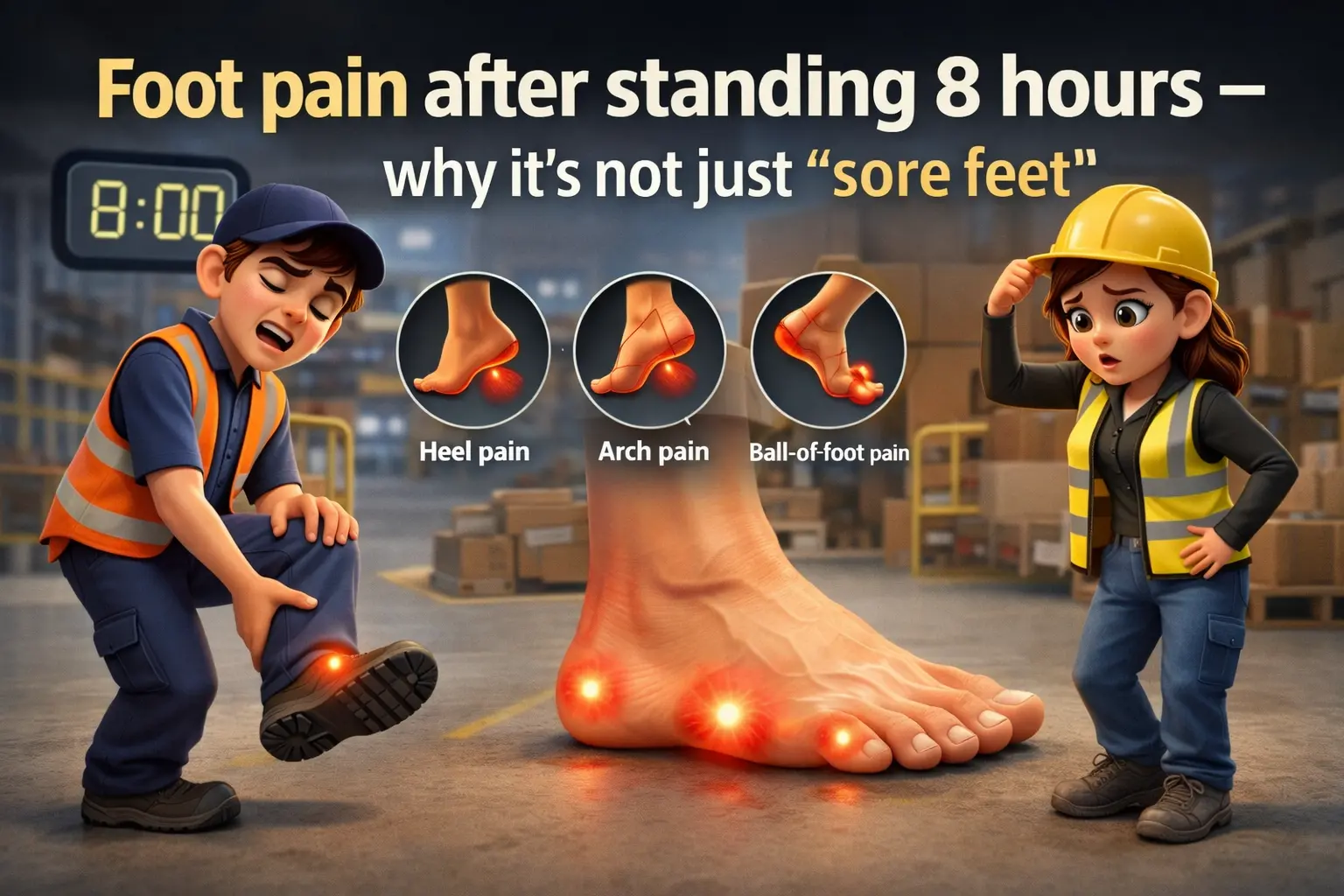
Heel pain, arch pain, ball-of-foot pain, swelling, and burning feet are not the same problem. Here’s how to tell what you’re dealing with, what to fix first, and what needs medical attention.
Home → Injuries & Prevention → Foot pain after standing 8 hours — why it’s not just “sore feet”
Standing all shift does not create one type of foot pain. It creates different overload patterns: heel pain, arch strain, forefoot pressure, swelling, or burning and numbness. Treat them all the same, and you waste money and stay sore.
This guide helps physical workers figure out what the pain pattern actually points to, what changes usually help first, what to stop doing, and when “tired feet” is a bad excuse for a real problem.
The blunt rule:
If your foot pain is sharp in one spot, worst on first steps after rest, comes with burning or numbness, or keeps getting worse week by week, stop calling it “just sore feet.” Generic rest is not enough. You need the right fix for the right pattern.
Quick answer
Foot pain after standing 8 hours is usually a load management problem, not a toughness problem. Where the pain sits and how it behaves tells you whether the main issue is heel/arch overload, forefoot pressure, swelling, or nerve irritation.
- Heel or arch pain often means the sole of the foot is getting overloaded, especially if first steps after rest are rough.
- Ball-of-foot pain usually means pressure is being dumped into the forefoot by footwear, hard floors, or poor load distribution.
- Burning, tingling, or numbness is not “normal soreness” and needs more caution.
- Swelling-heavy pain points more to circulation, heat, fluid build-up, or too much uninterrupted standing.
- Best first fixes: better shoe support, better pressure distribution, shorter static standing blocks, and a simple post-shift recovery routine.
- Skip: paper-thin flat shoes, dead worn-out insoles, “push through it” logic, and spending money before identifying the pain pattern.
- Get checked fast if you cannot walk normally, the foot is hot/red/deformed, or you have numbness, diabetes, or pain that keeps escalating.
Save this page before your next shift. Most people forget what their pain pattern was by the time they get home, then buy random gear that does not match the problem.
Table of contents
- Why “sore feet” is too vague to fix anything
- Fast sort table: what your pain pattern usually means
- Decision tree: what to do first
- Mini-test: are you dealing with fatigue, overload, or something that needs checking?
- Symptom → cause → fix matrix
- Best gear by problem type: shoes, insoles, socks, recovery slides
- Mistakes that keep foot pain alive
- Next steps and related reads
- FAQ
Why “sore feet” is too vague to fix anything
“My feet hurt after work” sounds simple, but it hides completely different problems. One worker has heel pain that screams on the first step out of bed. Another has a crushed feeling under the ball of the foot by hour six. Another gets swollen, heavy feet in hot shoes. Another gets burning or pins-and-needles.
Those are not interchangeable. They respond to different changes. That is why random inserts, cheap work shoes, or pure rest often fail.
Method used in this post: sort pain by location, timing, sensation, and what makes it better or worse. That gets you close enough to stop guessing and start fixing the right thing.
Fast sort table: what your pain pattern usually means
| If your pain feels like… | Usually points toward… | Do first | Do not ignore it if… |
|---|---|---|---|
| Sharp heel or arch pain, especially on first steps after rest | Bottom-of-foot overload | Improve shoe support, reduce flat-shoe time, add calf/foot mobility | It keeps worsening each week or you start limping |
| Pain under the ball of the foot, feels bruised or compressed | Forefoot pressure overload | Check toe box, cushioning, worn insoles, pressure distribution | Pain becomes point-specific or you feel a pop or instability |
| Feet feel heavy, tight, swollen by end of shift | Fluid build-up and standing load | Break up static standing, elevate after shift, review socks and shoe fit | One-sided swelling, heat, redness, or swelling that does not settle |
| Burning, tingling, numbness, electric pain | Nerve irritation or another condition, not simple soreness | Stop shrugging it off, assess shoe compression and get checked if persistent | Sensation loss, weakness, diabetes, or symptoms spreading |
| One exact spot hurts badly with each step | Something more focal than general fatigue | Unload it, stop “testing” it every shift | You cannot walk normally, foot shape changes, or swelling rises fast |
Decision tree: what to do first
Start here: Where is the main pain?
- Heel or arch → Is it worst on first steps after getting up or after sitting? Yes → treat it like bottom-of-foot overload first: support, mobility, less flat-shoe time, less barefoot hard-floor time.
- Ball of foot → Does it feel bruised, cramped, or worse in tight shoes? Yes → fix toe-box space, forefoot pressure, worn midsoles, and shift-time pressure distribution.
- Whole foot feels heavy/swollen → Does it improve with elevation and movement? Yes → break up static standing, consider compression if appropriate, and stop trapping your feet in heat all day.
- Burning, tingling, numbness → treat this as more than soreness. Check for shoe compression, swelling, diabetes risk, or persistent nerve-type symptoms.
- One sharp spot or you cannot walk right → stop self-experimenting and get it assessed.
Mini-test: fatigue, overload, or something that needs checking?
Score yourself from the last 7 days. Add the points.
- My pain is in one repeatable spot, not just everywhere tired. (2 points)
- My first steps after rest are noticeably worse. (2 points)
- I get burning, tingling, or numbness. (3 points)
- The pain is getting worse week to week, even if my shift is the same. (2 points)
- I changed shoes, workload, floor surface, or hours recently. (1 point)
- I have visible swelling that lasts into the next day. (2 points)
- I limp, avoid loading one area, or walk differently by the end of shift. (2 points)
Score guide
0–2: likely general fatigue. Start with footwear review, shift-time movement breaks, and post-shift recovery.
3–5: likely overload pattern. Match the fix to the pain location instead of buying random comfort gear.
6+: this is moving beyond generic soreness. Treat it seriously, especially if the pain is focal, nerve-like, or affecting how you walk.
Symptom → cause → fix matrix
| Symptom | Likely load problem | Best first fix | What usually makes it worse |
|---|---|---|---|
| Heel pain after getting up | Repeated strain through the bottom of the foot | Supportive shoe, calf stretch, less barefoot time on hard floors | Flat dead shoes, long static standing, ignoring early-morning pain |
| Arch feels tight, pulled, or crampy | Support mismatch and fatigue under the arch | Better midfoot support, foot mobility, less time in worn-out insoles | Hard floors, thin soles, over-tight laces |
| Bruised feeling under forefoot | Too much pressure dumped into the front of the foot | Roomier toe box, better cushioning, pressure redistribution | Tight shoes, worn midsoles, leaning forward all shift |
| Feet feel swollen and tight by evening | Fluid pooling and not enough movement variety | Movement breaks, elevation after work, review sock and shoe compression | Standing still for long blocks, heat, cramped footwear |
| Burning, pins-and-needles, numb toes | Nerve irritation, compression, or something beyond simple fatigue | Reduce compression, stop ignoring it, get checked if ongoing | Tight toe box, swelling, waiting weeks hoping it disappears |
Soft CTA: buy later, diagnose first
Before you spend on premium work shoes, inserts, or recovery slides, identify where the pain is and when it hits. The wrong category can feel comfortable for 20 minutes and still fail your 8-hour shift.
Best gear by problem type: shoes, insoles, socks, recovery slides
This is not a brand ranking. It is a what-to-buy-first ranking based on the pain pattern.
| Option | Best for | Skip if | Impact score /10 | Budget score /10 |
|---|---|---|---|---|
| Supportive work shoes | Most workers with whole-shift standing pain, worn-out footwear, poor support | Your current shoes are still structurally solid and the issue is very localized | 9 | 5 |
| OTC insoles / inserts | Arch support mismatch, mild heel/arch overload, tired but salvageable shoes | The shoe itself is dead, twisted, too narrow, or too flat | 7 | 8 |
| Compression socks | Heavy, swollen feet and lower legs from prolonged standing | Your main issue is sharp focal pain, numbness, or a shoe-fit problem | 6 | 8 |
| Recovery slides / house shoes | Post-shift relief at home when hard floors keep aggravating you | You expect them to fix a bad work-shoe setup by themselves | 5 | 7 |
Best pick
A genuinely supportive work shoe is usually the highest-leverage fix if you stand all day and your current pair is soft, flattened, twisted, or too narrow.
Best budget
If the shoe is still decent, OTC inserts often beat buying random “comfort” shoes with no structure.
Best upgrade
For workers whose feet feel swollen and cooked after long static shifts, combining better shoes with compression and post-shift elevation usually beats any single purchase.
Who should buy what first
- Buy supportive shoes first if your current pair is visibly worn, bent, uneven, or collapses inward/outward.
- Buy inserts first if the shoe is still good but the support feels wrong or the stock insole is useless.
- Buy compression first if swelling and heaviness are your main complaint.
- Skip all shopping for a week if the main issue is burning, numbness, one pinpoint pain spot, or a limp. That is not the time to solve it with retail therapy.
Mistakes that keep foot pain alive
- Calling everything “sore feet.” That destroys good decisions.
- Replacing support with softness. Cushy is not the same as stable.
- Keeping dead shoes too long. A worn midsole lies to you because it still looks usable.
- Going barefoot on hard floors after shift. That can keep irritated tissues irritated.
- Ignoring first-step pain in the morning. That is useful information, not random stiffness.
- Waiting for numbness or burning to “walk off.” Bad move.
- Standing static for hours without micro-movement. Standing is not the same as moving.
Your 7-day reset checklist
- Identify the main pain zone: heel, arch, forefoot, whole-foot swelling, or nerve-like symptoms.
- Check whether your work shoes are dead, narrow, uneven, or over-compressed.
- Stop spending long periods barefoot on hard floors after work.
- Add 2–3 short movement breaks during the shift if possible.
- Elevate feet for 10–15 minutes after work if swelling is part of the problem.
- Track whether first-step pain is present in the morning.
- If burning, numbness, sharp focal pain, or limping shows up, escalate faster.
Next steps and related reads
Do not stop at this page if your feet are part of a wider breakdown pattern. Use these next:
- What real recovery looks like after physical work — the broader recovery system behind pain that keeps coming back.
- Lasting longer in physical jobs without breaking down — bigger picture survival for construction, warehouse, and trade work.
- Knee pain that starts after work, not during — useful if foot pain is changing how you load the knee.
- Lower back pain after shifts — what’s actually happening — because bad shoes and altered gait love dragging the back into it.
- Work pain vs injury: knowing the difference matters — read this if you are not sure whether you are still in “normal soreness” territory.
- After The Shift home — browse the rest of the recovery guides for physical workers.
Hard CTA
If you stand 8+ hours for work, stop treating foot pain like background noise. Match the pain pattern, fix the pressure problem, then upgrade the gear that actually matters.
Bookmark this page, send it to a coworker, or keep it open while you check your shoes and insoles tonight.
FAQ
Is foot pain after standing all day normal?
Some end-of-day fatigue can happen, but pain that is sharp, repeatable, worsening, or tied to swelling, numbness, or first-step pain is not something to normalize. “Common” and “fine” are not the same thing.
Why do my feet hurt more after work than during work?
Because tissues often stiffen up once you stop moving. Load, pressure, and fluid build through the shift, then you notice it most when you slow down, sit, drive home, or get up later.
What does heel pain on first steps in the morning usually mean?
That pattern often points more toward bottom-of-foot overload than plain tiredness. It is one of the biggest clues that your issue is not just “my feet were sore after work.”
Are insoles enough, or do I need better work shoes?
If the shoe itself is worn out, narrow, or unstable, inserts are often a patch, not a solution. Insoles work best when the base shoe is still structurally good.
Do compression socks help sore feet from standing?
They can help more when the problem is heaviness, swelling, and lower-leg fatigue from prolonged standing. They are much less useful when the issue is sharp heel pain, forefoot pressure, or nerve-like symptoms.
How long should I try self-fixes before getting checked?
If pain is mild and clearly tied to load, a short trial of better footwear, pressure changes, and recovery habits is reasonable. But if the pain is severe, persistent, recurrent, nerve-like, or affects walking, do not drag it out.
What is the biggest mistake people make with foot pain from work?
Buying for comfort before identifying the pain pattern. Soft is not automatically supportive, and random “comfort” gear often hides the problem for one shift while making nothing better long term.
When is foot pain after standing a safety issue?
When you cannot walk normally, the foot is hot, red, badly swollen, visibly deformed, or you have numbness, spreading symptoms, fever, or diabetes-related foot pain. That is not a “wait and see” situation.
This article is general recovery education, not a diagnosis or a substitute for care from a qualified clinician. Stop and get medical help for severe pain, numbness, weakness, chest pain, sudden swelling, fever, or symptoms that keep worsening.
Log in to leave a comment.