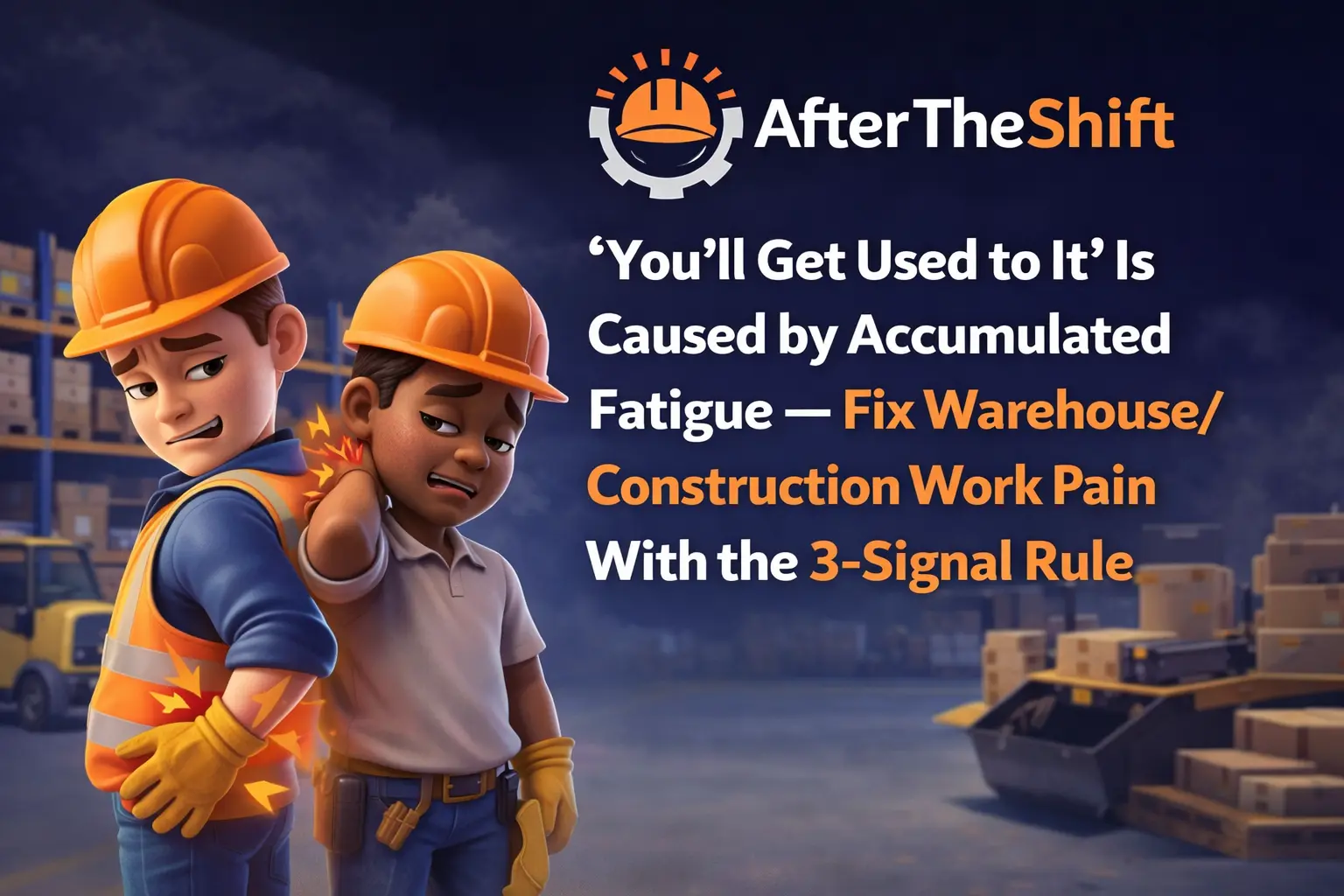
How to tell normal soreness vs injury warning signs in physical jobs.
If you do physical work and you’re waiting to “get used to” soreness, aches, or joint pain—this is for you.
You don’t “adapt” to damage. You adapt to ignoring signals, and that’s how small problems turn into long layoffs.
After this, you’ll know exactly what to fix first (sleep, load, technique, or recovery) using one rule and two tables.
Pattern interrupt: Your body doesn’t become tougher. Your alarm system just gets quieter.
Quick answer (read this first)
Most “getting used to it” is accumulated fatigue + repetitive micro-damage. If you keep pushing, the pain often stops feeling “sharp”… right before it becomes chronic.
- Do this: track pain signals for 7 days, then reduce the highest trigger by 20%.
- Avoid this: “resting” only on days off while keeping the same work intensity all week.
- Do this: fix the biggest lever first: sleep timing, load spikes, or technique.
- Avoid this: stretching as your only strategy (it can hide the real cause).
- Do this: use the symptom→fix matrix below to pick the fastest change.
One rule that decides everything: If pain violates any of the 3 signals below, treat it as a problem—not “normal.”
Jump to:
Table of contents
- Why “you’ll get used to it” is a trap
- The 3-Signal Rule
- Decision tree: what to do next
- Decision table: soreness vs injury vs fatigue
- Why this happens (the mechanism)
- The steps (7 moves, no drama)
- Original insight: Symptom → Fix Matrix
- Edge cases + real examples
Why “you’ll get used to it” is a trap
Myth bust: If you believe “everyone hurts, it’s normal,” you’ll waste months doing the wrong fix.
What usually happens is simpler: you start a physical job, your body screams, you push through… and the screaming becomes background noise.
Then one day you wake up stiff, weak, or numb—and now it’s not a “phase.”
This is the same pattern behind pain that becomes background noise and why “toughing it out” often backfires in physical jobs.
The 3-Signal Rule (use this daily)
“Normal soreness” is allowed. “Signal pain” is not. The fastest filter is the 3-Signal Rule.
- Signal #1 — Pattern: same spot, same movement, same time of shift (repeating pattern).
- Signal #2 — Progression: it’s getting worse week to week, or showing up earlier each shift.
- Signal #3 — Function: it changes how you move (limp, compensation, weaker grip, altered posture).
Reality check: If any ONE signal is present for 7+ days, you’re not “adapting.” You’re accumulating.
If this sounds familiar, it overlaps hard with accumulated fatigue and repetitive micro-damage.
Decision tree (3–7 branches, no guessing)
- If pain is sharp, sudden, or you felt a “pop” → stop that movement today and get assessed.
- If pain repeats in the same spot → reduce the trigger by 20% for 7 days + add recovery steps (below).
- If pain shows up after work (not during) → you’re exceeding recovery capacity; fix sleep + load spikes first.
- If pain comes with tingling/numbness → treat as a nerve issue; change posture + reduce compression immediately.
- If fatigue is the main symptom (no clear pain) → audit sleep timing + hydration + meal timing; don’t “add caffeine.”
- If you’re new (first 2–4 weeks) → keep exposure, but control spikes (no hero days).
Related reads you’ll want open in another tab: work pain vs injury and why young workers get aches fast.
Decision table: what you’re feeling vs what it means
| What it feels like | Most likely meaning | Fastest action | Best for |
|---|---|---|---|
| Dull soreness, spreads across muscle | Training-style soreness / workload | Keep working + improve recovery basics | New job / higher volume weeks |
| Same spot pain on repeat movements | Tendon/overuse warning | Reduce trigger 20% for 7 days + technique change | Pickers, packers, lifting, repetitive tools |
| Sharp pain, “caught” feeling, sudden | Acute strain/sprain risk | Stop provoking movement + assess | Any worker, any trade |
| Numbness/tingling, burning, radiating | Nerve irritation / compression | Change posture + reduce compression points today | Back/neck/wrist-heavy tasks |
| Feels “fine” at work, wrecked after | Recovery capacity exceeded | Fix sleep timing + load spikes + post-shift routine | Long shifts, overtime, nights |
| VERDICT ROW | If it repeats, progresses, or changes your movement → treat it as a problem, not a phase. | ||
| If you’re X → choose Y | If you’re “fine during work but destroyed after” → choose recovery-capacity fixes first (sleep + spikes), not stretching. | ||
Why this happens (the real mechanism)
Physical work creates two debts at the same time: tissue debt (micro-damage) and system debt (sleep + nervous system fatigue).
What people get wrong
They treat pain like a motivation problem: “I’m just soft.”
But a lot of “getting used to it” is your body lowering the alarm volume—while damage still accumulates.
Micro-proof (simple mechanism)
Repetitive loading + not enough recovery time increases irritation in tendons/joints. Add sleep debt, and your pain threshold shifts while healing slows.
This is why “rest vs recovery” matters: sleeping isn’t automatically fixing you.
The steps (7 moves that actually change outcomes)
-
What to do: Run a 7-day “signal log” (0–10 pain + what task triggered it).
Why it works: Patterns reveal the real lever (task, grip, posture, pace, sleep).
Common mistake: logging pain but changing everything at once.
Micro-upgrade: add “earliest time it appears” — progression shows up fast.
-
What to do: Cut the biggest trigger by 20% for 7 days (pace, weight, reps, or duration).
Why it works: Small reductions often stop the slide without needing time off.
Common mistake: taking a full rest day, then returning to the same spike pattern.
-
What to do: Remove “load spikes” (hero days, overtime bursts, rushing to catch up).
Why it works: Spikes are what your tissues fail to recover from.
Common mistake: blaming one bad day instead of the weekly pattern.
-
What to do: Fix one technique cue that reduces stress (neutral wrist, closer load, shorter reach).
Why it works: Small joint-angle changes reduce tendon irritation dramatically over thousands of reps.
Common mistake: “powering through” with sloppy angles when tired.
Micro-upgrade: if wrist pain is your issue, read wrist pain from repetition.
-
What to do: Add a 6–10 minute post-shift downshift (walk + light mobility + hot shower if helpful).
Why it works: You exit “high tension mode,” improving sleep and next-day readiness.
Common mistake: collapsing into a chair for hours immediately after work.
-
What to do: Set a sleep anchor (same wake time 5–6 days/week, even on days off).
Why it works: Recovery capacity depends on consistency, not “catch-up.”
Common mistake: weekend sleep swings (the recovery trap).
Micro-upgrade: see why days off can feel worse.
-
What to do: If the 3-Signal Rule keeps triggering after 14 days → escalate (assessment, physio, medical).
Why it works: Early intervention is cheaper than chronic rehab.
Common mistake: waiting for “real pain” that never arrives—only dysfunction does.
Common mistakes that keep you stuck
- Confusing rest with recovery (you rest, but don’t rebuild capacity).
- Stretching as a cover-up (temporary relief, zero cause change).
- Only changing pain management (painkillers, braces) instead of load and technique.
- Assuming “everyone hurts” is normal (it’s common, not normal).
This connects directly with why “everyone hurts” is a dangerous lie and the hidden damage most workers ignore.
Original insight: Symptom → Fix Matrix (pick the fastest lever)
| Symptom | Likely cause | Fix (start here) | Don’t do this |
|---|---|---|---|
| Lower back pain after shifts | Fatigue + bracing + poor load distance | Bring load closer + reduce spikes + sleep anchor | Only stretching your back |
| Wrist/forearm pain | High rep angles + gripping + tool vibration | Neutral wrist + rotate tasks + micro-break cadence | “Stronger grip” mentality |
| Knee pain that starts after work | Volume + steps + downhill load + weak support | Reduce step spikes + footwear check + strength basics | Ignoring swelling/stiffness |
| Neck/shoulder tightness | Raised shoulders under fatigue + reach | Lower reach height + cue “shoulders down” + pace control | More caffeine to push through |
| “Fine at work, destroyed after” | Recovery capacity exceeded | Sleep anchor + post-shift downshift + reduce spikes | Weekend-only recovery |
Edge cases (where normal advice fails)
- If you’re on night shifts: keep the wake-time anchor relative to your shift, not the clock. Consistency wins.
- If you’re new (week 1–4): don’t quit—just control spikes. Your job should ramp like training.
- If pain is “moving around”: you’re compensating. Focus on the first spot that started it.
- If budget is zero: your biggest “purchase” is schedule discipline + load spike control.
- If you’re sensitive to pain/fatigue: treat signals earlier, not later. Early fixes are smaller.
Real examples (so you can copy/paste the strategy)
If you’re a warehouse picker with wrist pain
- Change first: neutral wrist + rotate grip + reduce peak rush periods by 20%.
- Track: when pain appears (hour into shift vs end).
- Next read: wrist pain from repetition.
If you’re in construction with lower back pain after work
- Change first: bring load closer + eliminate “one big lift” moments + sleep anchor.
- Track: does it show up earlier each day? That’s progression.
- Next read: lower back pain after shifts.
If you’re constantly wiped out even when work “wasn’t crazy”
- Change first: sleep timing + hydration + meal timing (not more stimulants).
- Track: weekend crash intensity.
- Next read: exhausted after work.
How we chose the rules (no fake experience)
This post uses simple, repeatable decision logic—not “motivation.”
- We prioritized: early warning signals, load management, sleep consistency, and technique levers.
- We ignored: motivational quotes, “push through” culture, and one-size-fits-all stretching lists.
- Criteria used (5–7): repeatability, progression, functional impact, trigger clarity, recovery capacity, load spikes, and time-to-improvement.
Key takeaways
- If it repeats, it’s a signal. Don’t wait for “real pain.”
- Control spikes first. Most breakdowns come from weekly load swings.
- Fix one lever at a time. Biggest trigger minus 20% beats random changes.
- Sleep consistency is capacity. Weekend-only recovery is a trap.
FAQ
Is it normal to hurt when you start a warehouse or construction job?
Short answer: Some soreness is common; repeating or progressing pain is not.
If the same spot flares with the same task, treat it as an overuse warning and change the trigger this week.
How long should “getting used to it” take?
Short answer: You should see improvement in 1–3 weeks if recovery capacity matches workload.
If it’s getting worse after 2 weeks, you’re not adapting—you’re accumulating.
What if pain only shows up after work?
Short answer: That’s usually recovery capacity being exceeded.
Start with sleep timing + load spikes. Don’t rely on weekend catch-up.
Does stretching fix this?
Short answer: Stretching can help comfort, but it rarely fixes the cause.
Use it after you reduce the trigger and improve technique—otherwise it becomes a mask.
When should I stop working and get assessed?
Short answer: Sharp/sudden pain, numbness/tingling, swelling, or any functional change.
If you limp, lose grip strength, or change movement to “avoid” pain—escalate.
What’s the fastest “next read” if I’m not sure what’s happening?
Short answer: Start with the decision logic in work pain vs injury.
Then follow with what real recovery looks like to build a plan.
Do this next
Pick one problem spot and run the 7-day signal log + the 20% trigger reduction.
Then read What Real Recovery Looks Like After Physical Work and build your baseline routine.
This article is general recovery education, not a diagnosis or a substitute for care from a qualified clinician. Stop and get medical help for severe pain, numbness, weakness, chest pain, sudden swelling, fever, or symptoms that keep worsening.


Log in to leave a comment.