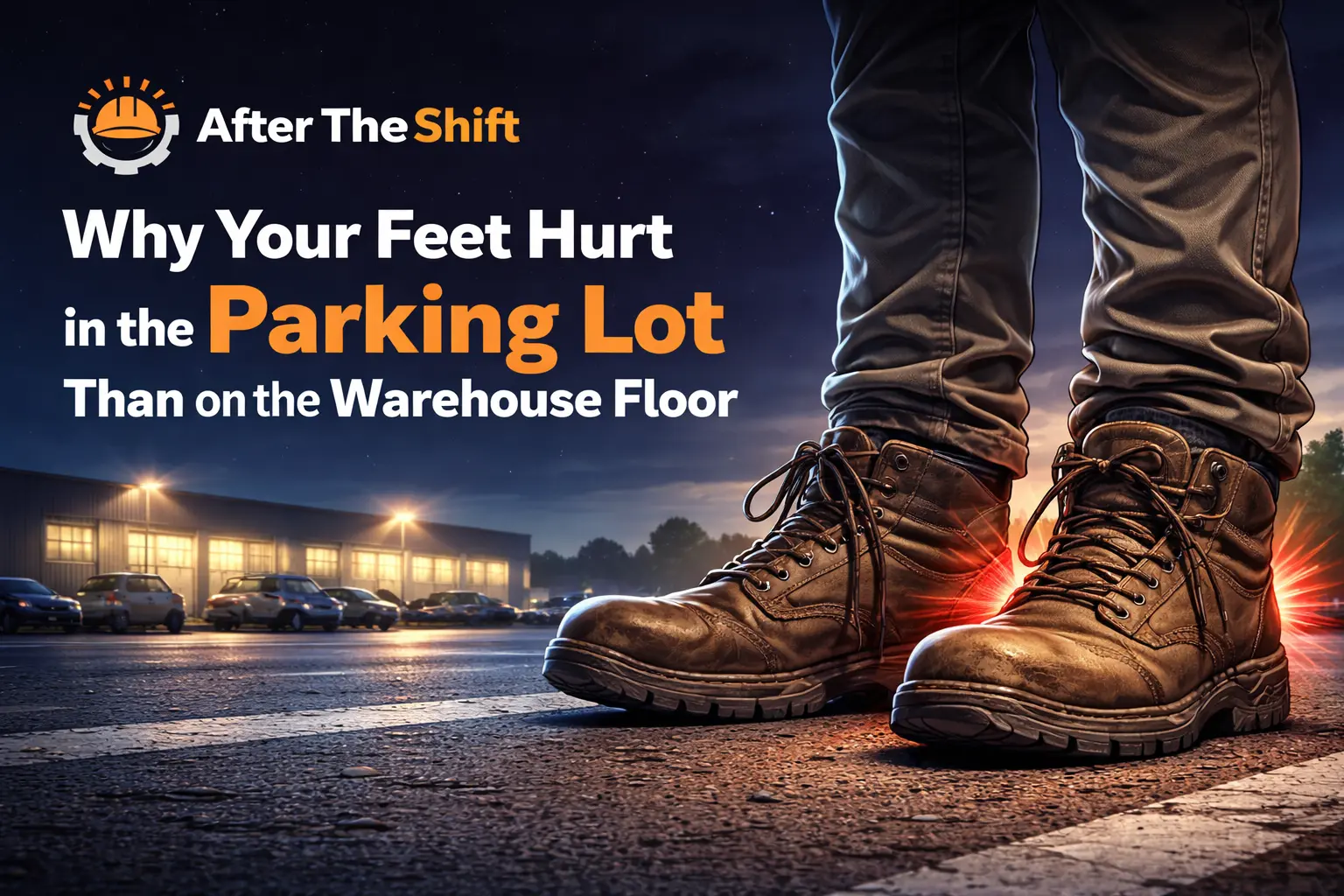
The pain is not random. It usually shows up when warm, loaded tissue suddenly cools down and your stride changes after the shift.
If your feet feel “fine enough” during the shift but suddenly light up on the walk to the car, that usually points to a stiffness, swelling, support, or friction problem that gets exposed when you stop moving—not some mystery pain out of nowhere.
Quick answer
Your feet often hurt worse in the parking lot because the warehouse floor kept you warm, mechanically busy, and moving in one rhythm. Once you stop, swelling settles, tissues cool, your gait changes, and pressure points suddenly become obvious.
- Do: walk for 2–3 easy minutes before fully stopping after shift.
- Do: loosen forefoot pressure but keep the heel secure.
- Do: use a 90-second calf + arch reset before the drive home.
- Avoid: assuming “softer” always fixes foot pain.
- Buy: firmer support first if your arch collapses more as the day goes on.
- Skip: sizing up boots just to reduce pain unless your toes are actually cramped.
- Watch out: one-sided swelling, numbness, burning, or sharp heel pain that keeps worsening.
Why the pain shows up after the shift instead of during it
This pattern is common in warehouse work, retail stock work, delivery, and trade jobs where you spend hours standing, turning, braking, and walking on hard surfaces. The key point is this: pain timing matters. Pain that explodes once you stop moving usually means the shift built up load, but the transition out of the shift is what reveals it.
Here is what usually changes in the parking lot:
- Your calves cool down: tight calves pull harder on the heel and flatten your walking mechanics.
- Your arch loses its “active” support: during the shift, movement hides the weakness; when you slow down, the arch drops and aches.
- Swelling becomes more obvious: pressure from boots, socks, or a narrow toe box starts to announce itself.
- Your stride changes: you walk differently when the job is over, especially if you were bracing all day.
- Hot spots stop being masked by momentum: friction, lacing pressure, and forefoot compression show up fast.
That is why “my feet hurt more walking to the car than on the warehouse floor” usually is not random bad luck. It is a clue. It tells you what kind of fix to try first.
This post does not fit: sudden injury, major swelling on one side, numb toes, red/hot foot, severe night pain, or pain after a twist/fall. Those need medical assessment.
Fast decision table: what your first steps are telling you
| If you notice this... | Most likely issue | Do this tonight |
|---|---|---|
| Heel pain on the first few steps after stopping | Calf tightness + heel/plantar load | Calf stretch, slow calf raises, do not switch straight to ultra-soft insoles |
| Arch feels tired, spread out, or “collapsed” by the end | Support mismatch or fatigued arch | Try firmer support, better heel hold, and arch-friendly lacing |
| Burning or numb toes after shift | Toe box pressure or sock/boot compression | Check width, loosen forefoot laces, inspect sock seams and toe crowding |
| Ball of foot hurts worse when walking to the car | Forefoot overload | Reduce toe gripping, check boot flex point, avoid overly soft “squishy” inserts |
| Top of foot soreness under laces | Lacing pressure | Relace to reduce midfoot pressure and keep heel lock only where needed |
| One foot much worse than the other | Fit asymmetry, old injury, or gait compensation | Check wear pattern, compare lacing, and do not assume both feet need the same fix |
For broader recovery after shift work, keep the Physical Work Recovery Guide open. For the more classic “standing all day” problem, read Foot Pain After Standing 8 Hours — Why It’s Not Just Sore Feet.
2-minute mini-test: what kind of foot pain do you actually have?
Score each item from 0 to 2.
- 0 = not true
- 1 = somewhat true
- 2 = very true
- My first steps after work are worse than my mid-shift steps.
- My calves feel tight or “short” by the end of the day.
- My arch feels flatter, weaker, or more tired later in the shift.
- I get pressure, numbness, or soreness from the boot itself.
- I change my walk in the parking lot without thinking about it.
| Total score | What it usually means | Best first move |
|---|---|---|
| 0–3 | Probably a mild load issue, often solved by small fit and recovery changes | Start with lacing, socks, post-shift walk, and calf reset |
| 4–7 | Clear support/stiffness mismatch building through the shift | Add support changes plus arch/calf work for 7–10 days |
| 8–10 | Your setup is probably wrong enough to keep repeating the pain loop | Check boot width, insole type, lace pressure, and workload pattern together |
Decision tree: what to do based on where and when it hurts
- If the pain is worst in the heel on first steps after shift, start with calf tightness and plantar load. Use a calf reset, avoid barefoot pacing at home, and check if your boot is too flat or too dead.
- If the pain is more in the arch by the end of the day, treat it like an arch-support mismatch first. Test firmer support before softer cushioning.
- If the pain is in the ball of the foot, look for toe gripping, forefoot overload, a stiff boot flex point, or an insert that is too squishy and unstable.
- If the top of the foot hurts, the problem is often lace pressure, not the floor. Relace before buying anything.
- If your toes burn, go numb, or feel packed together, check width and sock bulk. Do not just loosen everything and let the heel slip.
- If one foot is way worse, stop treating this like a generic “standing all day” issue. Check wear patterns, old injuries, and left-right fit differences.
- If pain is getting worse week to week, do not keep “testing” random cheap inserts. Fix the obvious mechanics or get assessed.
Symptom → cause → fix matrix
| Symptom | Likely cause | Why it shows up in the parking lot | First fix to try |
|---|---|---|---|
| Sharp heel pain on first steps | Calf tightness, plantar fascia overload | Tissue cools and tightens right after work | Calf stretch, gentle heel raises, avoid barefoot hard floors |
| Arch ache or “collapse” feeling | Support too weak, arch fatigue | Active support disappears when pace slows | Firmer insole, secure heel, better lacing pattern |
| Ball-of-foot pain | Forefoot overload, toe gripping | Walking slower changes pressure toward the front | Check boot flex, reduce toe clawing, avoid mushy inserts |
| Top-of-foot soreness | Lace bite / pressure | Swelling makes existing pressure much more obvious | Relace to reduce pressure over the sore spot |
| Hot spots or rubbing | Friction, sock bunching, heel slip | Short relaxed walk exposes rubbing that work pace masked | Swap sock type, check heel hold, inspect inside boot |
| One foot much worse | Asymmetry, old injury, uneven fit | Compensation becomes more obvious when tired | Compare both shoes, insoles, wear pattern, and stride |
What usually fixes it fastest
Most workers waste time chasing one big magic fix. That usually backfires. The better method is to rank fixes by speed, cost, chance of helping during a real shift, and risk of making the problem worse.
| Option | Speed | Cost | Shift payoff | Risk | Total / 10 |
|---|---|---|---|---|---|
| Relace to reduce pressure and keep heel secure | 2 | 2 | 2 | 2 | 8/10 |
| 90-second calf + arch reset after shift | 2 | 2 | 2 | 2 | 8/10 |
| Swap socks to reduce friction/compression | 2 | 2 | 1 | 2 | 7/10 |
| Firmer supportive insole | 1 | 1 | 2 | 2 | 6/10 |
| Ultra-soft cushioning insert | 1 | 1 | 1 | 0 | 3/10 |
| Buy bigger boots without checking width/heel hold | 1 | 0 | 0 | 0 | 1/10 |
Best first fix
Relace + calf reset. Cheap, fast, and it solves more parking-lot pain than people expect.
Best budget move
Better socks. Less friction, less compression, less bunching. Cheap, low risk.
Best upgrade
Supportive insole for tired arches. Best when your arch feels more dead than your heel feels sharp.
Comparison table: what each option is actually good for
| Option | Best for | Avoid if |
|---|---|---|
| Relacing | Top-of-foot soreness, heel slip, forefoot pressure | Your boot is simply the wrong size or width |
| Firmer support insole | Arch fatigue, end-of-day collapse feeling | Your main problem is lace bite or narrow toe box |
| Softer cushioned insert | Some mild impact discomfort | You already feel unstable, roll inward, or grip with toes |
| Sock upgrade | Hot spots, sweating, bunching, toe compression | The pain is clearly mechanical rather than friction-based |
| Post-shift calf and arch routine | First-step pain, heel soreness, stiffness after stopping | Pain is acute, swollen, or from a fresh injury |
What to do tonight: 7-minute reset
- Walk 2–3 easy minutes before fully stopping after shift.
- Take boots off and check for sock lines, red spots, or lace pressure marks.
- Do 30 seconds per side of a calf stretch.
- Do 10 slow calf raises.
- Do 5 slow toe-extension rocks against a wall or step.
- Relace boots so the sore zone is not being crushed.
- Log where the pain is: heel, arch, ball, top, toes, or one side only.
Who should buy support, and who should skip it
Supportive insole: good fit for you if...
- Your arch feels more tired as the day goes on
- Your foot feels “spread out” by the end of shift
- You pronate more when tired
- Your current boot feels flat and dead, not just hard
Skip support as the first move if...
- Your main pain is on the top of the foot under laces
- Your toes are cramped or numb from width issues
- Your heel slips because the boot fit is wrong
- You are trying to fix a clear sizing problem with inserts
Mistakes that make parking-lot foot pain worse
- Buying the softest insert you can find. Soft is not the same as supportive. Too soft can make you work harder.
- Ignoring the top of the foot. A lot of “my feet hurt after work” cases are really lacing-pressure cases.
- Wearing socks that are too thick for the boot fit. That creates compression, not comfort.
- Standing still immediately after the shift. A short transition walk often reduces the first-step shock.
- Only thinking about the sole. Heel hold, width, flex point, and lacing matter just as much.
- Assuming pain during the parking-lot walk means the floor is the only problem. Timing usually says otherwise.
Similar delayed pain patterns show up elsewhere too. See why your lower back hurts more on the drive home than during the shift and knee pain that starts after work, not during. Also keep work pain vs injury bookmarked so you do not normalize the wrong symptoms.
When to stop self-testing and take it seriously
Do not keep experimenting forever. If the pain is more intense each week, wakes you up, causes limping, comes with numbness, or is clearly much worse on one side, that is not just normal worker wear-and-tear. That is where a proper assessment saves time.
Myth to kill: “If the pain comes after work, it can’t be serious.” Wrong. Delayed pain still reflects load and mechanics.
Next steps
Save this: bookmark it, pin it, or send it to the coworker who always says “my feet only kill me when I’m walking out.”
FAQ
Why do my feet hurt more after work than during work?
Because the shift kept your feet warm, moving, and mechanically “busy.” Once you stop, swelling, stiffness, pressure points, and gait changes become much easier to feel. The timing usually points to load buildup plus a transition problem, not just random soreness.
Is this usually a boot problem or a body problem?
Usually both, but not equally. Tight calves, tired arches, and altered gait are body-side issues. Narrow toe boxes, bad lacing, dead midsoles, or wrong insoles are boot-side issues. The trick is to stop treating them as separate worlds.
Do I need softer insoles if my feet hurt in the parking lot?
Not automatically. If your arch is collapsing or your foot feels unstable, softer can actually make things worse. Firmer support often beats more squish when the problem is fatigue and mechanics rather than pure impact.
How long should I test one fix before changing something else?
Give simple changes like lacing and socks 2 to 3 shifts. Give support changes about 7 to 10 days unless they clearly feel wrong immediately. Constantly changing everything at once makes it impossible to know what helped.
What is the most common mistake workers make with this kind of foot pain?
They assume more cushion is always better. The second big mistake is ignoring fit and lace pressure. A lot of foot pain blamed on the floor is actually caused by compression, instability, or an arch that is getting no help late in the shift.
Can this be plantar fasciitis?
It can be, especially if heel pain is sharp on the first few steps after stopping or the next morning. But not every heel ache is plantar fasciitis. Calf tightness, arch fatigue, and boot setup can create a very similar pattern.
How much does it usually cost to improve this?
The cheapest fixes are often the best first ones: relacing costs nothing, a better sock setup is low-cost, and a basic support upgrade costs far less than replacing boots too early. Expensive does not equal correct.
Is it dangerous if only one foot hurts much worse than the other?
It is a flag, not automatic danger. One-sided pain can come from old injury, uneven fit, different wear patterns, or compensation higher up the chain. If it keeps getting worse, comes with swelling, or changes your walk, stop guessing.
Should I walk barefoot at home after the shift to “strengthen” my feet?
Not if your first-step pain is already bad. Barefoot on hard flooring can irritate a sore heel or tired arch. Use common sense: strength work belongs in a controlled plan, not as an automatic reaction to pain.
When should I worry that it is more than normal work pain?
Worry less about the word “pain” and more about the pattern. Red flags are night pain, major swelling, numbness, burning, limping, one foot clearly worsening, or symptoms that climb week by week even when workload stays similar.
This article is general recovery education, not a diagnosis or a substitute for care from a qualified clinician. Stop and get medical help for severe pain, numbness, weakness, chest pain, sudden swelling, fever, or symptoms that keep worsening.
Log in to leave a comment.