
You’re not “fine at work.” You’re just moving enough to hide the damage—then the car seat compresses the exact tissues you irritated all day.
If your back “holds up” during the shift but lights up the moment you sit in the car, that’s a pattern. It usually means you irritated your back while working, then the drive home adds the final trigger: compression + flexion + stillness.
One blunt rule: If the pain spikes mainly when sitting and eases when you stand or walk, treat it like a “sitting trigger” problem first (seat setup + 2-minute reset), not a “get stronger” problem.
Quick Answer (what to do today):
Your lower back hurts more on the drive home because work loads the tissues, but movement masks it; then sitting puts your lumbar spine into a compressed, rounded position with vibration and no blood flow. Fix it by doing a 2-minute reset before you drive, setting the seat to reduce spinal flexion, and adding micro-movement during the drive.
- Do: 6 deep breaths + glute squeeze reset before getting in the car.
- Do: sit back on your sit-bones; add a small lumbar roll (or towel).
- Do: raise the seat slightly; keep hips level with or slightly above knees.
- Do: stop once (even 60 seconds) if the drive is >30–40 minutes.
- Avoid: slumping, wallet in back pocket, legs stretched straight.
- Avoid: “collapse” into the seat right after heavy lifting.
- Buy/consider: lumbar roll, seat wedge, heated pad (if cold triggers you).
- Skip: tight belts during the drive if they force more sitting stiffness.
Table of contents
- Fast decision table: what your pattern means
- Why the drive triggers pain
- 2-minute mini-test: find your main driver
- Fix before you start the engine (2–4 minutes)
- Car seat setup that stops the spike
- Symptom → cause → fix matrix
- Best pick / best budget / best upgrade
- Red flags: when this isn’t normal
- FAQs
- Next steps (stay on-site)
Fast decision table: what your pattern means
| If you… | Most likely driver | Do this first |
|---|---|---|
| Pain spikes within 5–15 minutes of sitting | Flexion + compression sensitivity (disc/ligament irritation) | Seat angle + lumbar roll + 2-minute reset before driving |
| Pain is sharp when you stand up after the drive | Stiffness + spinal “lock” from stillness | 1-minute walk + hip hinge reps after parking |
| Pain is mostly one-sided near the beltline | QL/hip hike fatigue or SI irritation | Glute activation + avoid leaning on one arm/one hip in the car |
| Pain goes into butt/leg, worse with coughing/sneezing | Nerve irritation pattern | Stop slumping; shorten drive; consider a clinician if persistent |
| Heat helps a lot; cold makes it worse | Muscle guarding + circulation drop | Heated pad + micro-movement + reduce seat pressure points |
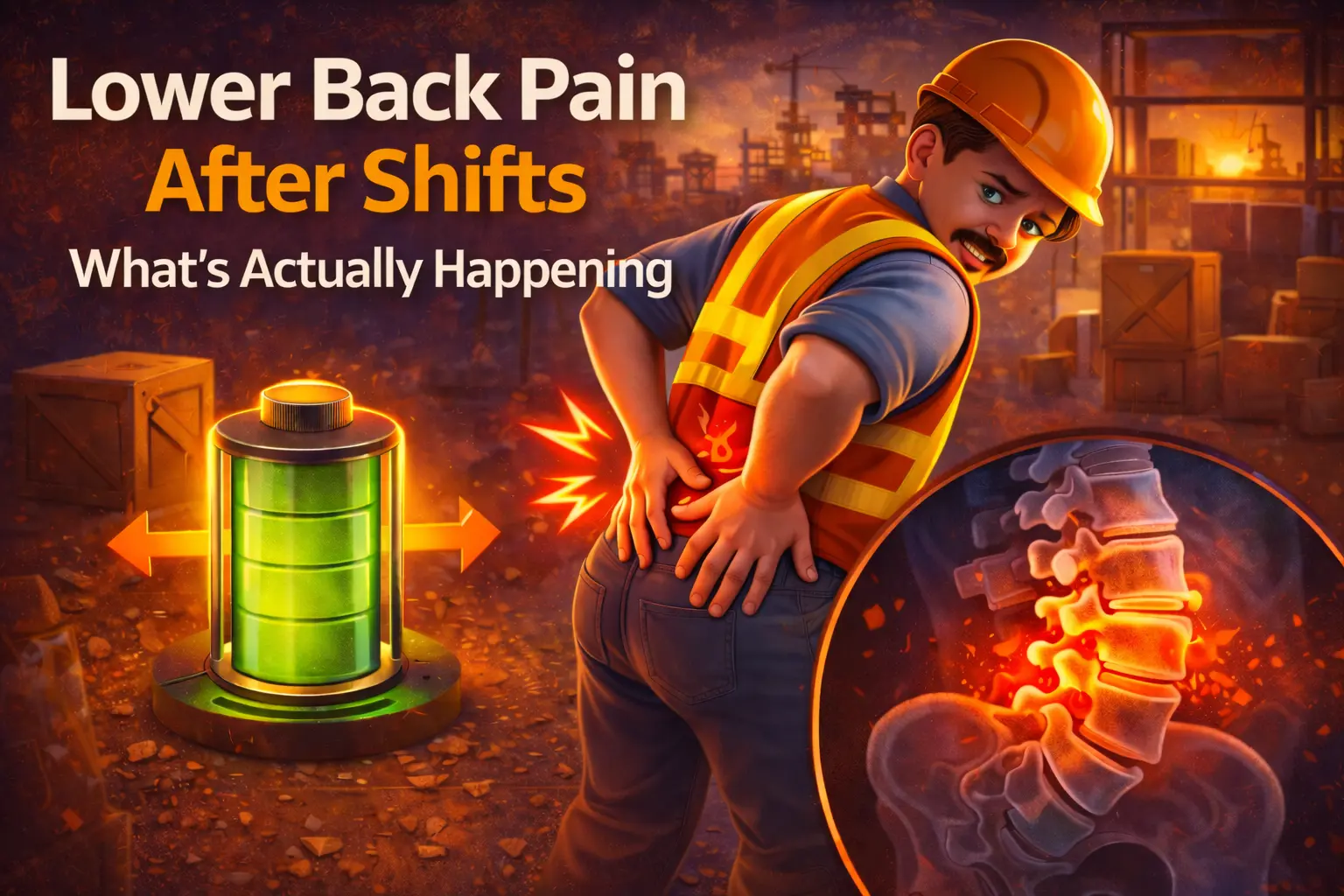
Related deep dives: If you want the bigger picture on post-shift back pain (not just the car trigger), start here: Lower back pain after shifts: what’s actually happening.
Why the drive triggers pain (even if you felt “okay” at work)
During the shift, you move. Movement is a pain-masker: circulation is higher, joints change angles constantly, and your core stays “on” without you noticing. Then the shift ends and you do the worst possible combo for an irritated lower back:
- Stillness: the back hates staying in one position after being loaded all day.
- Flexion (rounding): most people slump in the car—lumbar spine loses its neutral curve.
- Compression: sitting concentrates load through the pelvis into the lumbar segments.
- Vibration: road vibration adds micro-stress when your tissues are already sensitized.
- “Guarding” turns on: tired muscles tighten to protect you, which can feel like deep aching or burning.
So the drive home doesn’t “create” the problem. It reveals it and often amplifies it.
If you regularly lift, twist, or carry at work, also read: Lower back pain from lifting boxes all day: the 3 positions that wreck your spine.
2-minute mini-test: find your main driver
Do these tests right after a shift (before you get in the car if possible). Score what changes your pain fastest.
- Slump test (10 seconds): sit and intentionally round your low back. If pain jumps fast, flexion sensitivity is likely.
- Neutral reset (30 seconds): sit tall on your sit-bones, place a rolled towel at your lower back, take 6 slow breaths. If pain drops, seat setup is your lever.
- Glute “wake-up” (30 seconds): standing, squeeze glutes hard for 10 reps, then do 8 slow hip hinges (butt back, spine neutral). If pain drops, you’re likely running on fatigued back extensors and sleeping glutes.
- Walk test (60 seconds): walk briskly for one minute. If pain drops a lot, stillness is your main trigger.
Interpretation:
Biggest relief from neutral/towel = fix the seat first.
Biggest relief from glutes/hinges = do the reset before you sit.
Biggest relief from walking = add micro-breaks; don’t “freeze” post-shift.
Fix before you start the engine (2–4 minutes)
This is the missing piece. Most people finish a shift and immediately collapse into the seat. That’s exactly when your back is most irritable.
2-minute “post-shift back reset”
- 6 deep breaths (long exhale). Drop the rib flare; let your abs turn on gently.
- 10 glute squeezes (hard, 1 second each). This shifts load away from tired low-back muscles.
- 8 hip hinges (slow). Keep spine neutral; move from hips.
- 10-second hang (optional): hands on a rack/door frame, let your hips sit back slightly.
Why it works: it reduces guarding, restores hip function, and prevents you from starting the drive already “locked.”
If your pain is part of bigger accumulated fatigue, this will connect the dots: The 3-signal rule: why “you’ll get used to it” is a trap.
Car seat setup that stops the spike
Goal: reduce lumbar rounding and reduce pressure concentration.
Set it in this order (takes 60 seconds)
- Seat back: more upright than you think (avoid lounging).
- Seat height: raise slightly so hips are level with or a bit above knees.
- Seat depth: leave 2–3 fingers between the seat edge and the back of your knee.
- Lumbar support: add a small roll at belt height (towel works).
- Steering wheel: bring it closer so you’re not reaching (reaching makes you slump).
- Wallet/phone: nothing in back pockets. Uneven pelvis = uneven spine load.
Micro-movement rule during the drive
- Every red light: 1 tall breath + reset sit-bones.
- Every 10 minutes: 3 gentle glute squeezes.
- If the drive is >30–40 minutes: stop once, walk 60–90 seconds.
Common mistake: using a giant pillow that pushes your spine into a weird curve. You want small support that restores neutral, not a big lump.
Symptom → cause → fix matrix
| Symptom you notice | Likely cause | Fix that usually works |
|---|---|---|
| Deep ache that builds while sitting | Compression + stillness; muscle guarding | Seat reset + 60–90s walk break; heated pad if cold-sensitive |
| Sharp pinch when you slump | Flexion sensitivity (irritated disc/ligaments) | Lumbar roll + upright seat + avoid bending forward right after driving |
| One-sided tight band near beltline | QL overwork; pelvis tilt from uneven stance | Remove wallet; sit centered; glute squeezes; avoid leaning on one armrest |
| Pain when standing up after the drive | Stiffness “lock” from freezing post-shift | Walk 1–2 minutes after parking; 8 hip hinges; don’t immediately sit again |
| Pain into butt/leg with tingling | Nerve irritation pattern | Stop slumping, shorten sitting time; consider evaluation if it persists |
Decision tree: pick the right fix in 30 seconds
- If pain spikes mainly while sitting → do car setup + lumbar roll first.
- If pain spikes mainly when you stand up after driving → do post-parking walk + hinges.
- If pain shoots down the leg or tingles → prioritize no slumping, reduce drive time, and watch red flags.
- If pain is one-sided → remove uneven pelvis triggers (wallet, leaning) + add glute activation.
- If pain is worse in cold → add heat + micro-movement (don’t rely on heat alone).
Weighted scoring rubric: what should you try first?
Score each factor. Then use the recommendation at the bottom.
| Factor | Score |
|---|---|
| Drive is 30+ minutes | +2 |
| Pain jumps within 10 minutes of sitting | +3 |
| You slump or “lounge” in the seat | +2 |
| You feel stiff when standing up | +2 |
| Cold makes it worse | +1 |
Your total:
- 0–3: Start with the 2-minute reset only. Monitor.
- 4–6: Reset + seat setup (lumbar roll + upright).
- 7+: Reset + seat setup + planned break (60–90s walk). Add heat if cold-sensitive.
Best pick / best budget / best upgrade (car + recovery)
Best budget: a rolled towel as a lumbar roll + remove wallet + set seat upright.
Best pick: a small lumbar roll (not huge) + seat height adjustment to keep hips level with knees.
Best upgrade: seat wedge (to reduce hip flexion) + lumbar roll + compact heated pad for winter drives.
Save this: bookmark this page or send it to a coworker who always says “my back only hurts after work.”
Red flags: when this isn’t “normal shift pain”
Don’t tough this out if you have any of these:
- New weakness in the leg/foot, or foot drop.
- Numbness in the groin/saddle area or bowel/bladder changes.
- Fever, unexplained weight loss, or constant night pain.
- Severe pain after a fall/impact.
If you’re unsure whether you’re dealing with “work pain” or an actual injury pattern, read: Work pain vs injury: knowing the difference matters.
FAQs
Why doesn’t my back hurt during the shift but hurts in the car?
Movement masks symptoms. You’re changing positions, staying warm, and your trunk is braced without thinking. The car locks you into flexion and compression when your tissues are already irritated.
Is it my “disc slipping” when I sit?
Most of the time it’s not a dramatic “slip.” It’s irritation plus a sitting trigger (slump + pressure). Treat the pattern first: neutral spine + micro-movement. If you have persistent leg symptoms or worsening weakness, get evaluated.
Should I use a back brace for the drive?
Sometimes it helps short-term if it reminds you not to slump. But if it makes you stiffer or you rely on it daily, it can backfire. Use it as a temporary cue, not a permanent crutch.
What’s the #1 mistake people make after a shift?
They go from heavy work to instant sitting with zero reset. That’s when the back is most sensitive. Two minutes of breathing + glute activation changes the whole drive.
How long does it take to calm this down?
If it’s mainly a sitting trigger, many people feel improvement the same day with seat setup + reset. If it’s accumulated irritation, expect a 1–2 week window of consistent adjustments and better recovery habits.
Does heat actually help, or is it placebo?
Heat can reduce guarding and make movement easier, especially in cold weather. But heat alone won’t fix a slumped seat position. Use heat as an add-on, not the main strategy.
What if my pain goes down the leg?
That’s a nerve-pattern possibility. Stop slumping immediately, shorten sitting time, and monitor. If tingling/weakness progresses or doesn’t improve, that’s your cue to get checked.
Can stretching fix it before I drive?
Sometimes, but aggressive stretching right after a shift can irritate sensitive tissue. Start with breathing + glute activation + gentle hip hinges. If you stretch, keep it light and short.
Is it dangerous to keep driving like this?
Usually it’s not “dangerous,” but it’s a strong sign your load management is failing. Repeating the same trigger daily is how temporary pain becomes a chronic pattern. Fix the trigger now.
Next steps (stay on-site)
Pick your path:
- If your back pain is tied to lifting form: the 3 positions that wreck your spine
- If everything hurts and you’re “toughing it out”: why pushing through backfires
- If recovery isn’t working: rest vs recovery (why sleep alone doesn’t fix you)
- If you need the full back-pain map: what’s actually happening after shifts
- Browse everything: After-the-Shift home
Soft CTA: If you want more “do-this-today” fixes like this, subscribe to the site updates and save this article for your next bad drive home.
Hard CTA: Tonight, do the 2-minute reset, fix the seat, and take one micro-break if your drive is long. Then track: Did sitting trigger drop by 30%+? If yes, you just found your lever.
This article is general recovery education, not a diagnosis or a substitute for care from a qualified clinician. Stop and get medical help for severe pain, numbness, weakness, chest pain, sudden swelling, fever, or symptoms that keep worsening.
Log in to leave a comment.