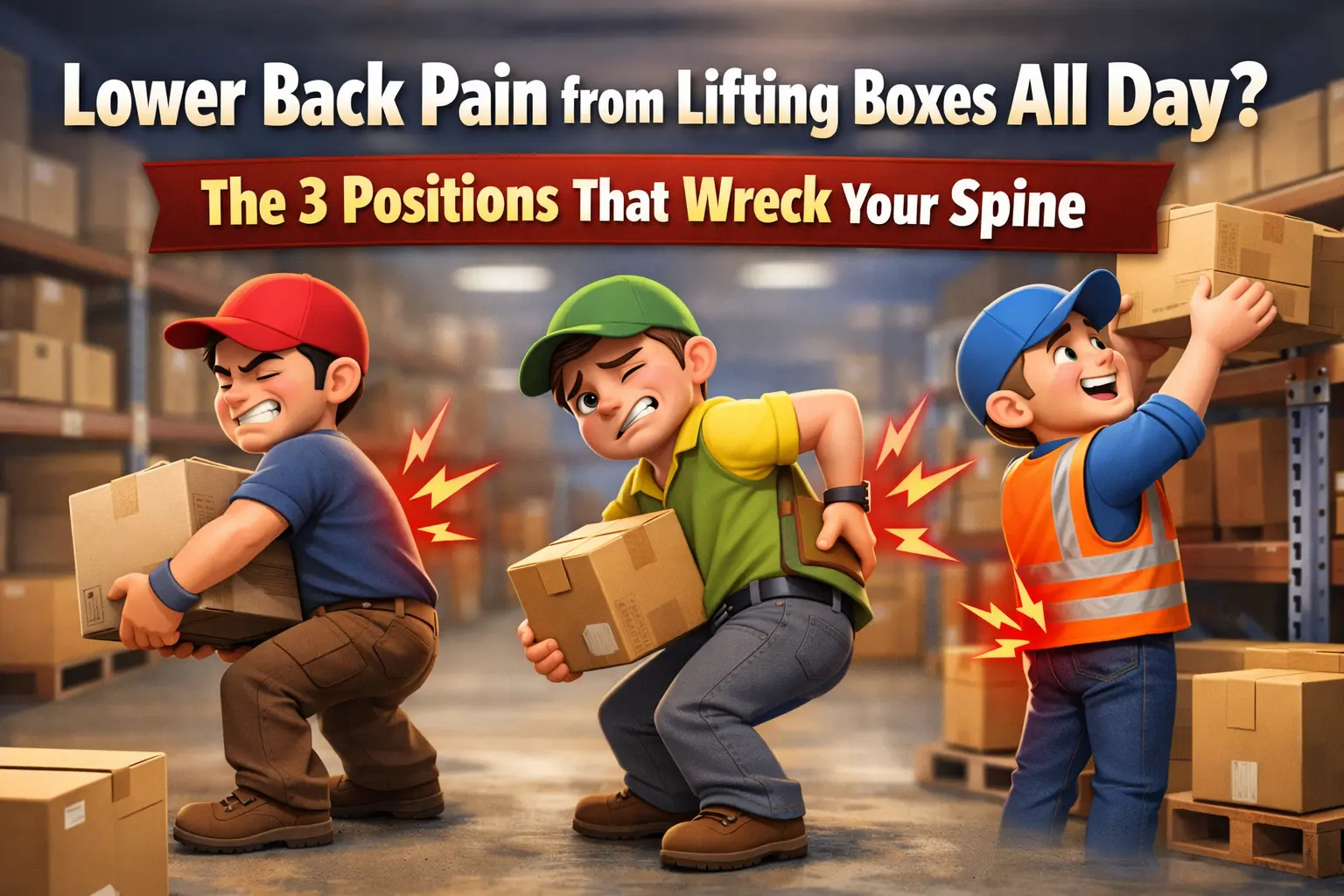
Spot the exact move that’s loading your lumbar spine, then fix it today with a 2-minute decision tree + shift-proof lifting cues.
Home → Injuries & Prevention → Lower Back Pain From Lifting Boxes All Day
If you lift boxes all shift and your lower back lights up, it’s usually not “weak back.” It’s one repeatable position (or two) that keeps loading your lumbar spine like a bent paperclip.
One-page promise: In 5 minutes you’ll identify which of the 3 positions you’re doing, and you’ll leave with exact cues + a shift plan that reduces back flare-ups fast.
Blunt rule that decides most cases: If the box moves and your hips don’t, your lower back will pay. Fix the hinge, the distance (keep it close), and the twist.
Quick Answer: The 3 spine-wrecking positions are (1) rounded-back pick, (2) twist-and-place, and (3) reach-away lift (long arms / box far from you). Your fastest win is: hip hinge + box tight + pivot feet.
- Do: Hinge (hips back), brace (exhale then “lock”), keep the box against your torso, pivot with your feet.
- Do: Put the first hand on the box, then set your hips, then lift (sequence matters).
- Avoid: Rounding to reach low, lifting while twisted, carrying with one hip popped out.
- Skip: “Stretch it out” mid-shift if you’re in a flare (it often makes it worse).
- Buy (optional): A basic lifting belt if you’re doing high-volume lifts (as a reminder to brace, not as a crutch).
- Upgrade (best): Change the work setup: raise low picks, reduce deep bends, stage loads at waist height.
Fast decision table (fix in 60 seconds)
| If you… | You’re probably doing… | What it does to your back | Fix cue (use today) |
|---|---|---|---|
| Feel a “pull” when picking from low pallets or floor | Rounded-back pick | High stress in lumbar flexion under load | Hips back, chest “long,” box tight, lift like a deadlift |
| Lift + turn to place, and pain spikes on the twist | Twist-and-place | Rotation + load = nasty combo for discs/joints | Pivot feet. Face the target before the box leaves your legs |
| Carry with arms stretched, box drifting away from you | Reach-away lift | Long lever multiplies back torque | Hug the load (forearms vertical), elbows down, walk it in |
Keep this simple: fix distance first (box closer), then fix twist (pivot), then fix hinge (hips back).
The 3 positions that wreck your spine
1) The Rounded-Back Pick (the “folded taco” lift)
What it looks like: You bend from the waist, your lower back rounds, and you “curl” the box up from low height.
Why it wrecks you: The spine hates repeated loaded flexion. Do it 200 times and the small tissues that stabilize your lumbar region get cooked.
- Fix cue: “Butt back first, then hands.” Push hips back like you’re closing a car door with your butt.
- Fix cue: “Ribs down.” Don’t over-arch; just stack ribs over pelvis and brace.
- Workaround: If the pick is too low: stage the box to knee height first (one step), then lift to carry height (second step).
2) The Twist-and-Place (the “lift + rotate” trap)
What it looks like: You lift and your feet stay planted while your torso turns to aim the box onto a belt, shelf, or cart.
Why it wrecks you: Under load, twisting turns stabilizers into brakes. Add fatigue and it becomes “micro-slip” territory.
- Fix cue: “Nose, knees, toes point the same way.” Turn your feet first, then lift/place.
- Fix cue: “Step to turn.” One small pivot step beats a spinal twist every time.
- Workaround: If space is tight: do a two-step place (set on thigh/edge briefly → slide into final spot).
3) The Reach-Away Lift (long arms, box drifting)
What it looks like: The box starts close, but as you stand/carry, it drifts away (or you grab it far in front of you).
Why it wrecks you: Distance is leverage. Even a small drift can multiply torque on your lower back.
- Fix cue: “Zip it up your shirt.” Keep the box sliding up your torso path, not floating in space.
- Fix cue: “Elbows down.” If elbows flare, the box moves away.
- Workaround: If the box is bulky: use a forearm shelf (box on forearms, elbows close) instead of fingertips.
Decision tree: which fix you need today
Run this in your head on the next lift:
- If the box starts below your knees → treat it as a deadlift: hinge + stage it (don’t curl it).
- If you must turn to place → pivot feet first; no loaded twist.
- If the box ever drifts away → solve distance: hug it + elbows down + shorter carries.
- If pain builds across the shift → it’s volume + fatigue: add micro-breaks + rotate tasks if possible.
- If pain shoots down the leg, or numbness starts → stop the heavy lifting and escalate (see red flags).
Symptom → cause → fix matrix (use your pain pattern)
| Symptom (your words) | Most likely cause at work | Best fix to try first | Avoid |
|---|---|---|---|
| Deep ache in the center low back after shift | High reps + bracing fatigue + box drifting | Box closer + 30–60s micro-break every 20–30 min | Random stretching mid-flare |
| Sharp “pinch” when you stand up from a low pick | Rounded-back pick from low height | Stage to knee height, then lift; hinge first | Fast jerky first pull |
| Pain spikes when you turn to place | Loaded twist | Pivot feet; face target before lifting | Plant feet + rotate torso |
| One-sided pain near hip/SI area | Asymmetric carry, one-hip “rest stance,” uneven loads | Switch sides on purpose; square stance; shorter carries | Always carrying on the same side |
| Tingling/numbness down leg | Nerve irritation (can be disc-related, not always) | Reduce load + avoid flexion/twist; seek assessment if persistent | “Push through it” heavy |
Want the deeper breakdown on what “back after shifts” usually is? Read: Lower back pain after shifts: what’s actually happening.
Shift-proof plan (before / during / after)
Mini-test: your Back-Wreck Risk Score (0–12)
Score each 0–3. Total it. Then follow the match.
- Low picks: How often do you lift from below knee height? (0 never / 1 sometimes / 2 often / 3 constantly)
- Twist: How often do you lift and rotate to place? (0 never / 1 sometimes / 2 often / 3 constantly)
- Distance: How often is the box away from your body? (0 never / 1 sometimes / 2 often / 3 constantly)
- Fatigue: By mid-shift, do you feel your brace “turn off”? (0 no / 1 mild / 2 yes / 3 strong)
Interpretation:
- 0–3: Your issue is likely one bad moment or a setup problem. Fix the specific position and staging.
- 4–7: You’re in the danger middle. You need two fixes: (a) remove twist/distance, (b) add micro-breaks.
- 8–12: High risk. Your back isn’t “weak” — your volume and angles are abusive. Reduce the worst lifts today and escalate setup changes.
Before shift (3 minutes)
- 1 set of 6 hinges: hands on thighs, push hips back, feel hamstrings, stand tall.
- 1 set of 5 braced breaths: exhale, ribs down, then inhale into belly/sides (not chest).
- Plan your “no twist” rule: you pivot feet every time you place.
During shift (the part that actually changes outcomes)
- Micro-break rule: every 20–30 minutes, take 30–60 seconds: walk, reset brace, 3 hinges. (Yes, it’s tiny. Yes, it works.)
- Sequence rule: hands → hips back → brace → lift. Don’t start pulling while still folded.
- Staging rule: if it’s below knee height and heavy, stage to knee/waist height first.
- Switch sides on purpose: if you carry one-sided, alternate every set, not “when you remember.”
Save this: Bookmark this page and share it with the one coworker who always twists with a box. That move spreads injuries.
After shift (reduce the “locked up” feeling)
- 5-minute downshift walk: easy pace to calm the nervous system.
- Hip flexor opening (gentle): short stance lunge, 30s each side (stop if it increases sharp pain).
- Recovery basics: if your sleep is trash, your back tolerance drops. Start here: Rest vs recovery.
Weighted scoring rubric: what fixes are worth your effort?
Method: the best fixes reduce (1) loaded rounding, (2) loaded twisting, (3) distance/lever arm, and (4) fatigue accumulation. Score each fix below and start with the highest total for your situation.
| Fix option | Impact (x3) | Speed (x2) | Effort (x1, lower is better) | Total (max 18) | Best for |
|---|---|---|---|---|---|
| Keep box close + elbows down | 3 | 2 | 1 | 14 | Most workers, immediate win |
| Pivot feet (no loaded twist) | 3 | 2 | 1 | 14 | Sorting/placing tasks |
| Stage low picks (two-step lift) | 3 | 1 | 2 | 13 | Low pallets, floor picks |
| Micro-breaks every 20–30 min | 2 | 2 | 2 | 12 | High-volume shifts |
| Basic lifting belt (reminder to brace) | 1 | 2 | 1 | 9 | People who forget to brace |
Related: if you’re not sure whether this is “work pain” or an actual injury, read Work pain vs injury: knowing the difference matters.
Belt vs brace vs nothing (comparison)
| Option | Best for | Avoid if | What it really does |
|---|---|---|---|
| Lifting belt | High-rep lifting; reminds you to brace | You use it to “ignore” bad technique | Gives feedback to brace; doesn’t fix twisting or distance |
| Rigid back brace | Short-term support after a flare (limited use) | All-day every-day reliance | Restricts motion; can hide bad mechanics while fatigue grows |
| Nothing | When technique + setup are already solid | You’re lifting in bad positions all shift | No reminder to brace; forces you to earn good mechanics |
When to stop and get checked (red flags)
Most work-related back pain improves with position fixes and load management. But don’t gamble if you have:
- New numbness/tingling or weakness in a leg that doesn’t quickly settle
- Loss of bowel/bladder control, saddle numbness, or severe progressive symptoms
- Fever, unexplained weight loss, major trauma, or pain that’s unrelenting at rest
If any of those are present, get medical assessment urgently.
Printable checklist (copy/paste)
- ☐ Box stays close (touching torso path)
- ☐ I pivot feet before I place
- ☐ Low picks are staged (two-step)
- ☐ I use the hands → hips → brace → lift sequence
- ☐ I take a 30–60s micro-break every 20–30 minutes
- ☐ If symptoms go neural (numbness/shooting), I stop heavy and escalate
FAQs
Is it normal for your lower back to hurt after lifting at work?
Common, yes. “Normal,” no. Frequent back pain is usually a sign you’re repeatedly loading the spine in a bad angle (rounding/twisting) or you’re doing more volume than your recovery can handle.
Should I stretch my lower back during a shift?
If you’re in an active flare, aggressive stretching can irritate it. A better mid-shift move is a short walk + a few controlled hip hinges to restore movement without yanking tissues.
How long does a back strain from lifting boxes take to heal?
Mild strains often settle in 1–3 weeks if you stop feeding the injury (fix positions, reduce worst lifts). If it’s not improving, keeps recurring, or symptoms are worsening, get assessed.
What’s the most common mistake that keeps back pain coming back?
Fixing “form” once, then returning to the same three problems: low picks, twisting, and the box drifting away. The fix has to be a system (staging + pivot + close carry), not a vibe.
Do lifting belts prevent injuries in warehouse jobs?
A belt can help you brace consistently and may reduce pain for some people, but it won’t save you from twisting or long-reach lifts. Treat it as a reminder tool, not armor.
What if my job forces twisting because the conveyor/shelf is sideways?
Then you need a footwork solution: small pivot steps, turning the whole body to face the target, and staging the box on a thigh/edge before final placement. If possible, ask for a layout tweak—small changes beat months of back pain.
My pain is on one side near the hip—SI joint?
Could be SI region irritation or muscular overload from asymmetric carries and “one hip popped” resting stance. Alternate sides intentionally, square your stance, and shorten carries; if it persists, get evaluated.
Can I keep working through back pain to “get used to it”?
That’s how pain becomes background noise—and then permanent. If pain is escalating, changing character, or going neural (tingling/numbness), you’re not “adapting,” you’re accumulating damage.
Related: Why pushing through work pain backfires.
What’s the safest “minimum strength” work I can do at home for this?
Start with hinges (pattern), then add gentle posterior chain work (like bridges) when symptoms calm. The goal is tolerance and mechanics—not max weight. If you’re flaring hard, fix the work positions first.
Next steps (stay on-site and fix the root cause)
- If you’re unsure what kind of pain this is: Work pain vs injury
- If your back hurts mainly after shifts: Lower back pain after shifts (what’s happening)
- If fatigue is making everything worse: Accumulated fatigue (the damage you don’t feel yet)
- If you want a recovery baseline that actually works: What real recovery looks like
Soft CTA: If this helped, bookmark it for your next flare-up and share it with a coworker. Most “back pain culture” is just bad positions repeated.
Hard CTA: Start with the decision table above on your next shift, then read Lower back pain after shifts to lock in the long-term fix.
This article is general recovery education, not a diagnosis or a substitute for care from a qualified clinician. Stop and get medical help for severe pain, numbness, weakness, chest pain, sudden swelling, fever, or symptoms that keep worsening.
Log in to leave a comment.