Why your knees take the punishment silently — and how to read the damage before it becomes permanent
Why your knees take the punishment silently — and how to read the damage before it becomes permanent
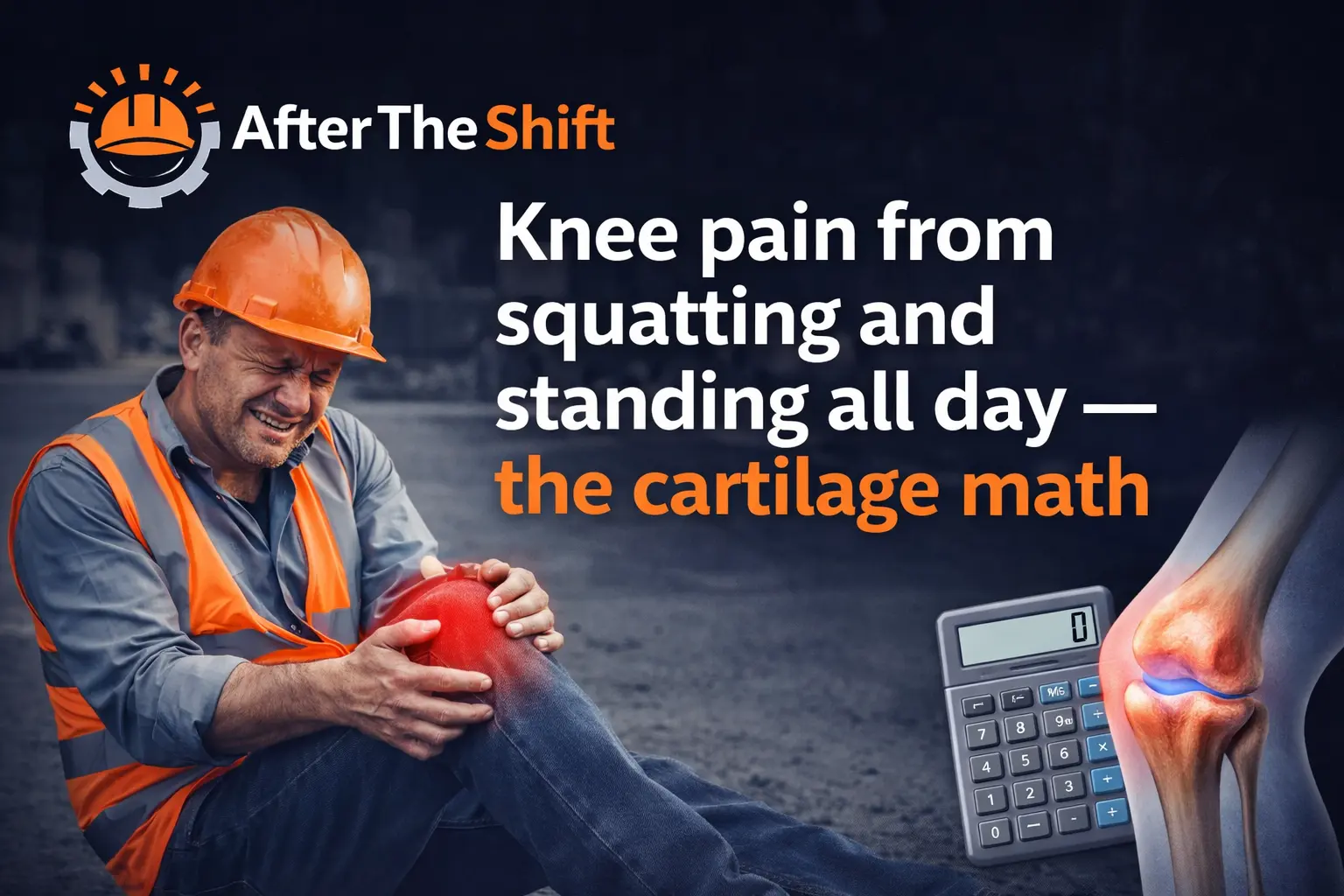
Knee pain from squatting and standing all day is cartilage compression overload — not muscle soreness. Your cartilage is 2–4 mm thick, has no blood supply, and does not regenerate. Every squat at 90° loads each knee at 3–5× your body weight. Over a full shift, that's 40,000+ kg of cumulative force per knee.
- Do: Partial squats (<60°), load spreading across the full foot, knee sleeves on long shifts
- Do: Address pain within the first 3 months — cartilage loss is irreversible after a threshold
- Avoid: Deep squats on concrete without cushioning, kneeling directly on hard surfaces, ignoring aching that outlasts sleep
- Skip: "Just push through it" — that's the fastest path to early arthritis
- Buy: Anti-fatigue insoles + compression knee sleeve (see picks below)
- Blunt rule: If your knee still aches 12 hours after finishing your shift, cartilage is signalling damage — not just fatigue
- What's Actually Happening Inside Your Knee
- The Cartilage Math — The Numbers Stacked Against You
- Symptom → Cause → Fix Matrix
- Decision Tree: Wear, Overuse, or Something Worse?
- Mini-Test: How Fast Is Your Cartilage Wearing Down?
- The 4 Positions That Accelerate Damage
- What You Can Actually Do Right Now
- FAQ
- Next Steps
What's Actually Happening Inside Your Knee
Your knee is not a hinge. It's a compression engine — and it was never designed for 8-hour repetitive loading on concrete.
The cartilage in your knee (articular cartilage) is a thin, smooth layer that lines the ends of your femur and tibia. It acts as a shock absorber and low-friction glide surface. Here's what most workers don't know about it:
- It's 2–4 mm thick. That's roughly the width of a coin.
- It has zero blood supply. Nutrients arrive only through compression-and-release motion — like squeezing a sponge. But constant loading prevents the release phase.
- It cannot regenerate on its own. Once cartilage cells (chondrocytes) die, they don't grow back. Scar tissue fills the gap — but scar tissue doesn't absorb force the same way.
- It doesn't have pain receptors. You won't feel cartilage wearing down. You'll feel the bone underneath once it's already too late.
This last point is why workers show up with knee X-rays at 35 that look like a 60-year-old's. The damage happened silently over three to five years while they felt "a bit sore" at the end of shifts.
For a broader picture of how repetitive micro-loading destroys joints over time, see our deep-dive on micro-damage and how repetitive work destroys joints quietly.
The Cartilage Math — The Numbers Stacked Against You
This is the section most health guides skip. They tell you "squatting puts stress on your knees" — but they never show you how much, or how it adds up across a career. Here's the actual math.
Force multipliers by position
| Position / Activity | Knee Force (× Body Weight) | Example at 80 kg |
|---|---|---|
| Walking on flat ground | 1.5–2× | 120–160 kg per knee |
| Going up/down stairs | 3–4× | 240–320 kg per knee |
| Squat to pick (60° bend) | 3–4× | 240–320 kg per knee |
| Squat to pick (90° bend) | 4–6× | 320–480 kg per knee |
| Kneeling on hard floor | 7–8× (sustained) | 560–640 kg sustained |
| Carrying a 20 kg box + squatting | 6–8× | 480–640 kg per knee |
Shift-by-shift accumulation
A warehouse picker doing 200 squats per day at 90° bend, body weight 80 kg:
| Timeframe | Squats | Cumulative Force Per Knee | What's Happening |
|---|---|---|---|
| 1 shift | 200 | ~80,000 kg | Cartilage compressed, inflamed by end of day |
| 1 month | ~4,400 | ~1.76 million kg | First signs: morning stiffness, aching after sitting |
| 1 year | ~52,000 | ~20.8 million kg | Cartilage surface starts showing wear patterns |
| 5 years | ~260,000 | ~104 million kg | Measurable cartilage thinning on imaging possible |
This is the cartilage math. 104 million kilograms of force absorbed by tissue that's 3 mm thick, has no blood supply, and cannot repair itself. And that's just from the squatting — before you add walking, kneeling, carrying, or stair climbing.
"Your knees don't fail all at once. They fail in instalments — silently, then suddenly."
See how concrete floors specifically compound this damage in our piece on standing on concrete all day — the damage timeline from month 1 to year 5.
Symptom → Cause → Fix Matrix
Not all knee pain is the same, and treating the wrong cause will either do nothing or make it worse. Use this matrix to identify what's driving your specific pain.
| Symptom | Most Likely Cause | Urgency | Immediate Fix |
|---|---|---|---|
| Aching 2–4 hours after shift, gone by morning | Normal cartilage fatigue — compression not yet causing damage | Low — monitor | Elevate legs post-shift, anti-fatigue insoles |
| Stiffness first 10 minutes after sitting, then eases | Early cartilage wear — joint fluid thickening from overuse | Medium — act now | Reduce deep squats, add compression sleeve, walking breaks |
| Pain that starts halfway through shift and gets worse | Cartilage overload threshold — tissue cannot recover mid-shift | High — change technique immediately | Load modification, footwear change, physio assessment |
| Pain still present the next morning | Inflammatory response — cartilage or synovium damaged | High — don't wait | Rest for 48h, ice, doctor if not improving in 3 days |
| Grinding, clicking, or catching sensation | Cartilage surface roughening (early chondromalacia) or loose fragment | High — see a doctor | Stop deep squats, imaging referral |
| Swelling around kneecap after shifts | Bursitis (direct pressure/kneeling) or joint effusion | Medium–High | Anti-inflammation protocol, avoid kneeling, compression wrap |
| Pain on inside of knee (not front) | Medial meniscus stress or MCL strain from repeated twisting | Medium–High | Reduce pivot/twist movements, physio |
| Sharp pain on stairs, not during flat walking | Patellofemoral syndrome — kneecap tracking issues from muscle imbalance | Medium | Quad/hip strengthening, avoid stairs where possible |
Decision Tree: Wear, Overuse, or Something Worse?
Run through this decision tree based on your current situation. It routes you to the right response — not a generic "see a doctor."
START: Does your knee pain outlast your shift by more than 12 hours?
NO → Normal post-shift fatigue. Focus on load reduction, insoles, and post-shift elevation. Monitor for 4 weeks. Go to "What You Can Actually Do" section.
YES → Continue below.
Is there any swelling (visible puffiness around the knee)?
YES → Inflammatory response is active. Rest 48–72h, ice 15 minutes 3× daily, elevate. If swelling doesn't reduce in 3 days → see a doctor. Do not return to squatting work until cleared.
NO → Continue below.
Is there any grinding, catching, or clicking sensation during movement?
YES → Possible cartilage roughening or loose body. Book imaging (X-ray/MRI) — do not delay. Structural damage progresses faster if you keep loading it.
NO → Continue below.
Has the pain been building gradually over weeks or months?
YES → Accumulated overuse. You're in the cartilage wear zone. Start load modification this week. See a physio within 30 days. Go to the mini-test below to assess your speed of damage.
NO (started suddenly during or after a specific movement) → Acute injury — possible meniscal or ligament involvement. Stop loading it. See a doctor within 48 hours.
Mini-Test: How Fast Is Your Cartilage Wearing Down?
Answer these 8 questions. Add your score at the end.
| Question | Answer → Points |
|---|---|
| 1. How many hours per day are you on your feet? | Under 4h = 0 | 4–6h = 1 | 6–8h = 2 | 8h+ = 3 |
| 2. How often do you squat below 90° per shift? | Rarely = 0 | ~50 times = 1 | ~100–200 times = 2 | 200+ = 3 |
| 3. What floor surface do you work on most? | Cushioned mat = 0 | Asphalt/tile = 1 | Concrete = 2 |
| 4. How old is your current work footwear? | Under 3 months = 0 | 3–6 months = 1 | 6–12 months = 2 | 12+ months = 3 |
| 5. Do you feel morning stiffness in your knees? | Never = 0 | Occasionally = 1 | Most mornings = 2 | Every morning = 3 |
| 6. Do you kneel directly on hard floors during work? | Never = 0 | Occasionally = 1 | Regularly = 2 |
| 7. Do you carry loads while squatting (boxes, materials)? | Rarely = 0 | Sometimes = 1 | Most squats involve a load = 2 |
| 8. How long have you been doing this type of work? | Under 1 year = 0 | 1–3 years = 1 | 3–5 years = 2 | 5+ years = 3 |
| Your Score | Risk Level | What It Means |
|---|---|---|
| 0–5 | Low | Your knee loading is manageable. Maintain footwear and technique. |
| 6–11 | Moderate | Wear is accumulating faster than recovery. Start load modifications now. |
| 12–16 | High | You are on the fast track to measurable cartilage loss. Physio assessment this month. |
| 17–19 | Critical | Immediate structural risk. Book imaging and a physio. Do not treat this as normal work soreness. |
The 4 Positions That Accelerate Damage (vs. Safer Alternatives)
The biggest gains in knee longevity don't come from supplements or fancy gear — they come from changing the specific positions your knees spend the most time in.
| High-Damage Position | Why It's Destructive | Safer Alternative | Force Reduction |
|---|---|---|---|
| Deep squat (90°+) to pick items from floor | Maximum cartilage compression + full posterior chain unloading | Staggered stance, knee bent to 60°, hinge at hip more than knee | ~35–40% less per rep |
| Kneeling directly on concrete | Sustained high-force contact compresses bursa + cartilage with no relief phase | Foam kneeling pad, knee cap protection, standing tool use where possible | ~50% pressure reduction |
| Knee-forward squat (knees tracking past toes) | Dramatically increases patellofemoral pressure — kneecap grinding | Push hips back first, keep shin more vertical, use a ramp if needed | ~25–30% patellofemoral relief |
| Pivoting/twisting under load | Shear forces — meniscus is not designed for rotation under compression | Pivot feet first (reposition feet), then turn body | Eliminates majority of meniscal shear load |
For workers already experiencing pain that escalates during the shift, read leg pain that starts halfway through your shift and won't stop — a separate but related pattern.
What You Can Actually Do Right Now
Immediate (this week) — Reduce the Math
- ☐ Replace your work boots if they're over 6 months old — midsole compression failure removes most of the cushioning. Boot midsoles stop absorbing force well before the outsole shows wear.
- ☐ Add anti-fatigue insoles to your current boots. Full-length viscoelastic insoles (not just heel cups) reduce knee-transmitted impact by up to 24%.
- ☐ Wear a compression knee sleeve on your dominant squat knee. It won't fix damage but reduces inflammation accumulation and improves proprioception — how the knee senses its own position.
- ☐ Cut your deep squats in half today. Use a half-squat or staggered deadlift technique instead (see table above). The math changes dramatically below 60°.
- ☐ Stop kneeling directly on concrete. A £8 foam kneeling pad on your belt loop pays for itself in cartilage saved in the first week.
Short-term (this month) — Slow the Wear Rate
- ☐ Strengthen your quadriceps off the job — stronger quads reduce knee joint stress by absorbing force before it reaches cartilage. Wall sits, terminal knee extensions, step-ups.
- ☐ Stretch hip flexors daily. Tight hip flexors shift load forward to the knee. 60 seconds per side, twice a day.
- ☐ Walk on non-concrete surfaces on your days off. This allows the sponge-effect rehydration of cartilage that sustained work-floor loading prevents.
- ☐ Book a physio if your score above was 12+. This is not optional — it's the only intervention that catches technique problems you can't self-diagnose.
Long-term (next 3 months) — Stop the Clock
- ☐ Request a mat or standing pad for your most frequent picking station. This is an ergonomics request, not a medical one — frame it that way to a supervisor.
- ☐ Begin a full lower-body recovery routine 3× per week off-shift. Full post-shift recovery guide: Physical Work Recovery — The Complete Guide.
- ☐ Track your knee symptoms in a basic log (morning stiffness, during-shift pain, post-shift pain) — this gives a physio or doctor actionable data instead of vague "it hurts."
FAQ
Does squatting every day at work permanently damage your knees?
Not automatically — but the risk is directly proportional to depth, load, and duration. The key variable is whether your body has time to recover between shifts. Cartilage rehydrates and partially restores during rest. If your loading outpaces your recovery window (which happens when you're squatting 200+ times daily on concrete), damage accumulates faster than repair. Most occupational knee damage is preventable if technique and footwear are addressed in the first 1–2 years. After 5+ years of heavy loading without intervention, some cartilage loss is likely structural.
My knees don't hurt during work, only after — is that still a warning sign?
Yes, and it's actually the most common pattern for cartilage damage. Cartilage has no pain receptors. Pain appears in the bone and surrounding tissue after the joint has been over-compressed. Post-shift pain that resolves overnight is a yellow flag. Post-shift pain that's still present the next morning is a red flag. This is covered in more detail in our piece on knee pain that starts after work, not during.
Can supplements like glucosamine or collagen actually help?
The evidence is mixed. Glucosamine sulfate has moderate research support for slowing cartilage degradation in people with early osteoarthritis — not for reversing it. Collagen peptides (specifically Type II hydrolysed collagen) show some promise in supporting joint tissue. Omega-3s reduce joint inflammation meaningfully. None of these replace load reduction and technique change — they're supportive, not protective. Don't rely on supplements while continuing to load the joint the same way.
A lot of guys at my job have knee pain — doesn't that just mean it's normal?
Widespread doesn't mean normal. When 60–70% of workers at a physical job report knee pain, that's evidence of a systemic ergonomic problem — not proof that knees are supposed to hurt. The same logic applies to back pain and foot pain in physical work. Why "everyone hurts" is a dangerous lie breaks down why normalising pain is the single most common reason workers end up with permanent joint damage in their 40s.
How long does it take to go from "sore knees after work" to actual cartilage damage?
This varies based on body weight, squat depth, hours per shift, and floor surface — but the cartilage math suggests measurable wear can begin within 2–3 years under high-load conditions (scoring 12+ on the mini-test above). The first 6–12 months are a window where changes in technique and footwear can prevent most long-term damage. After year 3 of heavy, unmanaged loading, the window closes significantly. The full cumulative timeline is covered in our damage timeline from month 1 to year 5.
Is it worth seeing a physio if I can still work and the pain isn't that bad?
A physio visit when pain is manageable is 10× more valuable than one when you're already limping. Mild persistent knee pain is the ideal intervention point — the physio can identify gait, technique, or strength imbalances that you cannot self-diagnose, and make recommendations before structural damage occurs. Waiting until the pain forces you off the job often means the damage is already significant. The £30–60 cost per session is far less than the cost of surgery, time off work, or chronic pain management in your 40s.
Do knee braces or sleeves help for warehouse and construction work?
Compression sleeves (not rigid braces) are genuinely useful for active labour — they improve proprioception, reduce swelling, and maintain warmth that reduces joint stiffness. They're not a fix for cartilage damage, but they meaningfully reduce how much inflammation accumulates during a shift. Rigid braces are generally for post-injury or post-surgical recovery — wearing one without a structural reason can actually reduce the strength development the joint needs.
I'm only 22 — surely this isn't an issue for me yet?
Age is the most dangerous myth in this area. Young workers have high pain tolerance, recover faster, and often don't notice the gradual accumulation — which is exactly why they're the most vulnerable to long-term damage. Cartilage wear is cumulative, not age-dependent. A 22-year-old who spends five years squatting on concrete daily without addressing it can have the knee cartilage of a 45-year-old by 27. Our post on why young workers get body aches so fast covers this in full.
Next Steps
Based on your score and symptoms, here's where to go next:
- 📌 Score 0–5, no symptoms: Read how micro-damage destroys joints quietly — understand what's coming before it arrives.
- 📌 Score 6–11 or morning stiffness: Start the checklist above this week. Read accumulated fatigue: the damage you don't feel yet.
- 📌 Score 12+ or pain outlasting sleep: Book a physio within 30 days. Read the full physical work recovery guide for a structured plan.
- 📌 Pain during the shift getting worse over weeks: Read leg pain that starts halfway through your shift and won't stop — different mechanism, same urgency.
Save this post. Bookmark it, pin it, or send it to a colleague — this is the kind of thing you'll want to re-read in six months when the knees start talking louder.
This article is general recovery education, not a diagnosis or a substitute for care from a qualified clinician. Stop and get medical help for severe pain, numbness, weakness, chest pain, sudden swelling, fever, or symptoms that keep worsening.
Log in to leave a comment.