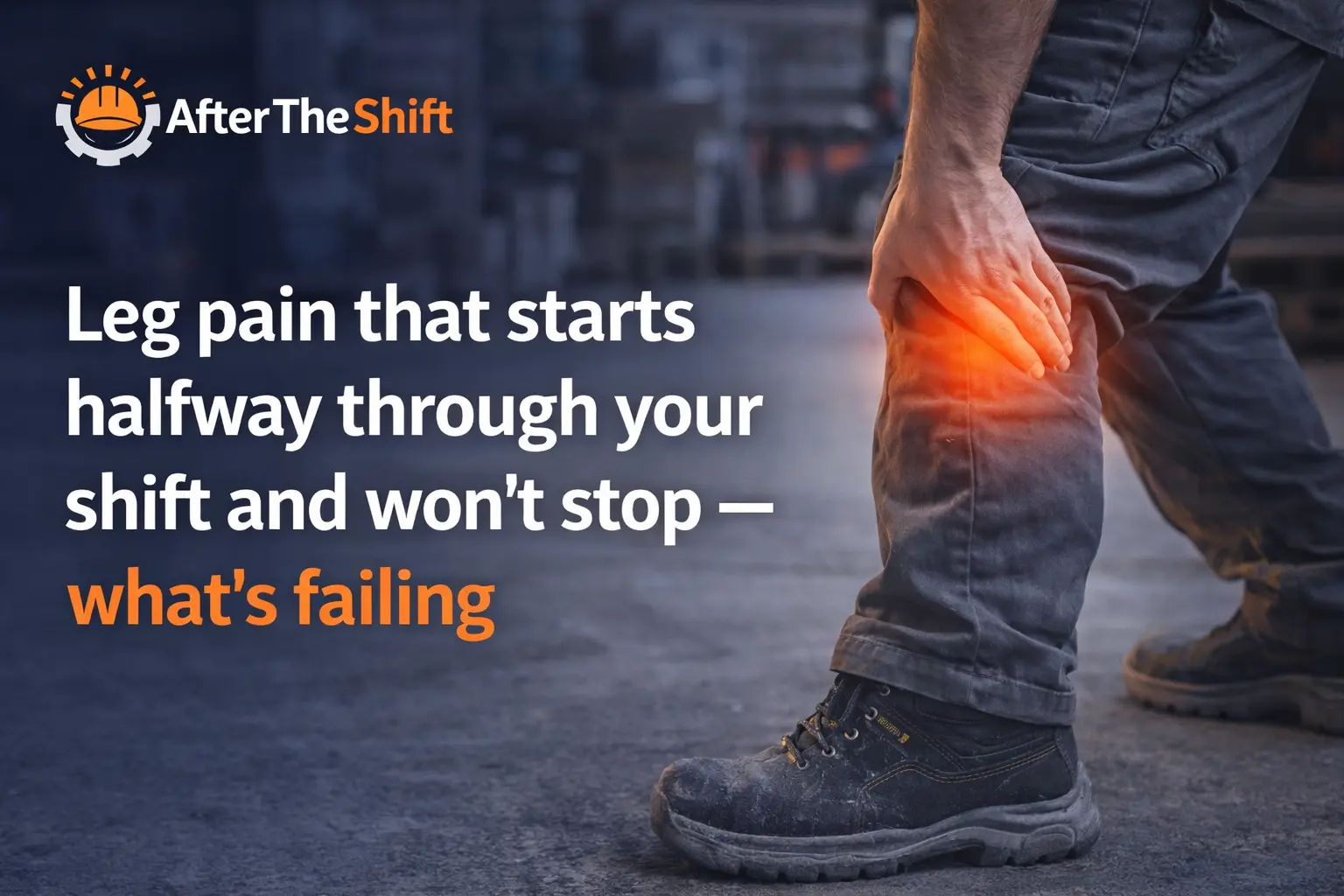
When leg pain shows up mid-shift, it usually means one system is losing the fight first: muscle endurance, vein return, nerve tolerance, or load management. Here’s how to tell which one is failing and what to change fast.
Leg pain that starts halfway through your shift is usually not random soreness. It usually means one of four systems is failing first: your calf and shin muscles cannot keep up, your veins are pooling blood, a nerve is getting irritated, or the load under you is too repetitive for the tissue you’re asking to work.
Blunt rule: if the pain comes with one-sided swelling, warmth, redness, numbness, weakness, chest pain, or breathlessness, stop treating it like “normal work pain.” Get medical help.
Quick answer: most mid-shift leg pain in warehouse, construction, retail, and trade work comes from a mix of static standing, poor foot/boot support, calf overload, and bad recovery between shifts. But the pattern matters.
- Do: identify whether the pain feels heavy, burning, cramping, or sharply localized.
- Do: test whether 2 minutes of walking, elevation, or unloading changes it.
- Do: check whether it is both legs or one leg only.
- Avoid: assuming all calf pain is “tight calves.”
- Avoid: adding random stretches if the issue is nerve or circulation based.
- Buy/consider: better boot support, insoles, or compression only after you match the pattern.
- Skip: pushing through pain that gets sharper, more one-sided, or more predictable every week.
Fast decision table
If you only have 30 seconds, use this. This is the fastest way to stop guessing.
| If you feel… | Most likely failing | First move today |
|---|---|---|
| Heavy, full, swollen legs by mid to late shift | Vein return / blood pooling | Walk breaks, ankle pumps, elevate later, consider compression if appropriate |
| Tight calves or shins that build the longer you stand or walk | Muscle endurance / tissue overload | Reduce static standing, improve boot support, add calf strength and foot control work |
| Burning, tingling, numbness, electric pain, or pain from butt/back into leg | Nerve irritation | Unload positions, check back/hip drivers, stop aggressive calf stretching |
| Pain at a precise spot on the shin or bone, worse with impact and weight | Load injury / stress reaction | Stop hammering it, unload early, get assessed if it keeps returning |
| Cramping or aching that starts after a repeatable amount of walking and eases with rest | Circulation problem | Take it seriously, especially if you smoke, have diabetes, or it is one-sided |
Why it starts halfway through the shift instead of right away
The timing is the clue. Pain that waits until halfway through the shift usually means the tissue can handle the first few hours, but cannot keep handling the same load without relief.
That usually happens for one of four reasons:
- Your muscles lose endurance first. Calves, shins, feet, hips, and glutes stop sharing the load well. The lower leg then starts doing too much.
- Your veins lose the return battle first. Standing still for long periods lets blood and fluid pool in the lower legs. That creates heaviness, swelling, ache, and fatigue.
- Your nerves get irritated as the shift goes on. A back, hip, or glute position can slowly feed pain down the leg.
- Your tissues hit a repetition threshold. Concrete floors, poor footwear, ladders, stairs, repetitive walking, or pushing carts keep loading the same structures until something starts complaining.
Translation: the pain is not “starting halfway through” by accident. Your body is crossing a tolerance line halfway through.
That is why “just stretch more” fails so often. Stretching helps only if mobility is the real bottleneck. A lot of shift-related leg pain is actually a strength, support, circulation, or nerve-load problem.
Mini-test: what’s most likely failing
Score each statement that matches you. The highest total points to your most likely pattern.
| Statement | Points |
|---|---|
| My legs feel heavy or swollen more than sharp or pinpoint painful | Vein return +3 |
| The pain is both legs and builds the longer I stand still | Vein return +2, Muscle overload +1 |
| The pain is mostly calf, shin, or arch fatigue and feels like overwork | Muscle overload +3 |
| It gets worse on concrete, in bad boots, or on long walking routes | Muscle overload +2, Load injury +1 |
| It burns, tingles, zaps, or runs from back/butt into leg or foot | Nerve irritation +4 |
| I notice numbness, weakness, or my leg feels unreliable | Nerve irritation +4 |
| The pain starts after a predictable amount of walking and eases after a short rest | Circulation / load pattern +4 |
| I can point to one exact spot on the shin, ankle, or foot that hurts with impact | Load injury +4 |
Interpret your score:
- Vein return wins: think pooling, heaviness, swelling, static standing, and end-of-day legs.
- Muscle overload wins: think calves, shins, arches, poor support, weak hips, repetitive loading.
- Nerve irritation wins: think back/hip driver, tingling, numbness, burning, weakness, or pain that travels.
- Load injury wins: think tissue damage threshold, stress reaction, shin pain, sharp local pain, or too much impact too often.
Decision tree
Use this if/then routing:
- If the pain is in one leg with swelling, heat, redness, or obvious size difference → stop self-testing and get assessed.
- If the pain is burning, tingling, numb, or shoots down from the back or butt → treat it like a nerve pattern, not a “tight calf” problem.
- If the pain feels heavy, full, and worse after standing still → think vein return and blood pooling.
- If the pain is sharp in one exact shin or foot spot and each shift makes it earlier → think stress reaction / overload, not simple fatigue.
- If the pain arrives after a repeatable amount of walking and then settles with rest → think circulation pattern and get it checked, especially with smoking, diabetes, or age-related vascular risk.
- If the pain is mainly tight calves/shins and poor foot stamina without red flags → think support + endurance + work setup first.
Symptom → cause → fix matrix
This is the block most people actually need. Match the pattern, then stop doing random fixes.
| Symptom pattern | Most likely cause | Best first fix |
|---|---|---|
| Heavy calves, sock marks, swollen ankles by shift end | Poor venous return from prolonged standing | More movement, less standing still, leg elevation later, compression if medically appropriate |
| Tight calves and aching arches on concrete | Foot and calf overwork from poor support and surface load | Better boots/insoles, calf raises, foot control drills, unload static standing |
| Shin pain that starts dull, becomes sharper every week | Shin overload or stress reaction | Reduce impact and repetition early, check footwear and step load, get assessed if focal pain persists |
| Back/butt pain plus leg tingling or numbness | Sciatic or other nerve irritation | Change positions, reduce compression positions, address back/hip driver |
| Cramping calf after a set walking distance, relieved by rest | Circulation issue | Do not ignore it; get assessed, especially with smoking, diabetes, high blood pressure, or older age |
| Severe tightness with numbness, swelling, or weakness during exertion | Compartment pressure problem | Stop and get assessed if it keeps repeating or escalates |
How I’d rank the likely failure in a physical job
For most workers, I’d rank the first suspects like this:
- Calf/foot endurance failure — especially with bad boots, hard floors, old insoles, and long standing.
- Venous pooling and leg heaviness — especially if you stand more than you move.
- Nerve irritation — especially if there is back, glute, or hamstring involvement.
- Stress reaction / focal overload — especially if the pain is precise and getting earlier each week.
- True circulation issue — less common in young workers, but not something to miss if the pattern fits.
Method: I rank by pattern, not by body part. “Calf pain” is not one thing. The deciding factors are location, sensation, timing, one leg vs both, and what changes it.
That is the difference between content that sounds smart and content that actually helps you fix the problem.
Best fixes by pattern
1) If it’s muscle endurance failure
This is the most common pattern in physical jobs. The lower leg starts doing too much because the foot collapses, the calves never get relief, and the hips are not sharing load well.
- Best pick: replace dead insoles or upgrade footwear support first.
- Best budget fix: add 2–3 sets of slow calf raises and tibialis raises on non-consecutive days.
- Best upgrade: change the work pattern so you stand still less and shift your foot position more often.
If your feet are also getting wrecked, read Foot pain after standing 8 hours — why it’s not just sore feet.
2) If it’s vein return / heaviness / swelling
This is the “my legs feel full, tired, thick, and worse late in the day” pattern. Standing still is usually worse than walking.
- Use brief movement breaks instead of staying planted.
- Do ankle pumps and calf squeezes during dead moments.
- Put your legs up after work instead of collapsing flat immediately.
- Consider compression only if the pattern fits and you do not have a circulation problem that makes compression a bad idea.
3) If it’s nerve irritation
Do not attack this like a flexibility problem first. If pain is burning, numb, tingling, electric, or runs from butt/back into the leg, aggressive calf stretching can make it worse.
- Reduce positions that load your back and hips the same way all shift.
- Check whether sitting, driving, or bending triggers it more than walking.
- Address the source, not just the calf.
If your leg pain comes with back pain, read Lower back pain after shifts — what’s actually happening and Why your lower back hurts more on the drive home than during the shift.
4) If it’s load injury or a stress reaction
This is where people mess up badly. They keep “working through it” because the pain is still technically possible to work on. Then the pain starts earlier, gets sharper, and takes longer to settle.
- Who should unload fast: workers with pinpoint shin, ankle, or foot pain.
- Who should skip the tough-guy approach: anyone whose pain is getting earlier every week.
- What to change first: repetitive walking route, boot support, ladder/stair volume, and off-shift impact training.
Mid-post next move: If your whole body is starting to break down, go to the Physical Work Recovery Guide. It connects pain patterns, recovery mistakes, and what to fix first so you stop treating symptoms one by one.
What to try first vs what to skip
| Option | Best for | Skip or be careful if | Time to judge |
|---|---|---|---|
| New insoles / better support | Calf, arch, foot, shin overload on hard floors | Pain is clearly nerve-based or sharply localized to bone | 3–10 shifts |
| Compression socks | Heavy, pooled, swollen lower legs | You suspect arterial circulation issues or you get worse in them | A few shifts |
| Calf raises / lower-leg strength | Muscle endurance failure | Acute sharp pain, stress reaction, major swelling | 2–4 weeks |
| Random stretching | Only if true stiffness is the issue | Burning, tingling, numbness, or nerve-type pain | Usually obvious fast |
| “Push through it” | Almost never | Pain is earlier, sharper, one-sided, or more frequent | Usually makes it worse |
Checklist: what to change this week
- Check whether the pain is both legs or one leg.
- Write down what hour of the shift it starts.
- Note whether it feels heavy, tight, sharp, burning, numb, or pinpoint.
- Replace dead insoles or worn boots before buying random recovery gadgets.
- Add brief movement breaks instead of staying planted.
- Do calf raises and shin work 2–3 times a week if it is an endurance pattern.
- Unload sooner if the pain is getting earlier each week.
- Get checked fast if you have one-sided swelling, numbness, weakness, chest pain, or breathlessness.
Red flags you do not tough out
Most shift-related leg pain is overuse and poor load distribution. Some is not. These are the patterns that deserve real caution:
- One leg suddenly more swollen, warm, red, or painful than the other
- Chest pain or breathlessness with leg swelling/pain
- Burning, numbness, or weakness that keeps worsening
- Foot drop, loss of control, or the leg feeling dead
- Severe tight pain with swelling during activity
- Precise bone pain that keeps getting worse with weight-bearing
- Calf pain that comes at a predictable walking distance and eases with rest, especially with smoking, diabetes, or vascular risk
There is a difference between work pain and possible injury or circulation risk. If you need that distinction broken down, read Work pain vs injury — knowing the difference matters.
Next steps
Use this route based on what your legs are telling you:
- Feet + calves + concrete pain: read Standing on concrete all day — the damage timeline from month 1 to year 5
- Feet are part of the problem: read Foot pain after standing 8 hours — why it’s not just sore feet
- Pain gets weird after the shift ends: read Why your feet hurt worse in the parking lot than on the warehouse floor
- Your whole recovery is weak: go to the Physical Work Recovery Guide
Save this post. Mid-shift leg pain gets ignored because it starts as “annoying” before it turns into “constant.” That is exactly why people lose months instead of fixing it in two weeks.
FAQ
Why does leg pain start halfway through the shift instead of at the beginning?
The tissue usually has enough capacity for the early part of the shift, then loses the load-sharing battle as fatigue builds. That can mean muscles are running out of endurance, veins are pooling fluid, or a nerve is getting more irritated the longer you stay in the same positions. The timing is useful because it points to a tolerance problem, not random pain.
Is calf pain during a shift usually a muscle problem or a circulation problem?
Usually it is a muscle-load problem first, especially in younger workers on hard floors or in poor footwear. But if the pain shows up after a repeatable amount of walking and settles with a short rest, or if one leg is more swollen or different in color/temperature, circulation moves much higher on the list. The pattern matters more than the body part.
Do compression socks fix shift-related leg pain?
They can help if your main issue is heaviness, swelling, and blood pooling from prolonged standing. They do not fix weak feet, poor boots, nerve irritation, or a developing stress injury. They are a tool, not a diagnosis.
When is leg pain at work a red flag and not just fatigue?
Red flags include one-sided swelling, warmth, redness, chest pain, breathlessness, worsening numbness, weakness, or severe tight pain with swelling. Another one people miss is pinpoint bone pain that keeps getting worse with weight-bearing. Those patterns deserve proper assessment, not a “wait and see” game.
Why does the pain get worse on concrete floors?
Concrete removes almost nothing from the impact and stance load. That means your feet, calves, shins, knees, and hips have to absorb and manage more of it themselves. If your support system is already weak, concrete exposes it faster.
Can weak glutes really cause calf and shin pain?
Yes. If hips and glutes do not control your stride and stance well, the lower leg often becomes the backup system. The result is usually more calf, shin, and foot work than those tissues were built to handle all shift long.
How long should shift-related leg pain last after work?
Mild fatigue should settle quickly with rest, movement, and overnight recovery. If it is still strong the next day, keeps returning earlier each shift, or is getting more local and sharper, you are no longer dealing with simple tiredness. At that point you need to change load, not just endure it.
What’s the cheapest first fix: insoles, compression, or stretching?
For most workers, the cheapest high-value move is replacing dead insoles or worn footwear support. Compression makes more sense for heavy swollen legs, while stretching only makes sense if stiffness is actually the limiter. The expensive mistake is buying the wrong fix for the wrong pattern.
Is it normal if only one leg hurts?
Not automatically. One-sided pain can still come from asymmetry, old injury, or the way you load one side more. But one-sided swelling, heat, redness, or obvious weakness is more serious than symmetrical end-of-day fatigue and should not be brushed off.
Should I keep training legs at the gym if work already makes them hurt?
That depends on the pattern. If it is general fatigue, smart strength work can help. If it is sharp, focal, worsening, or clearly not recovering between shifts, more loading usually just speeds up the breakdown.
This article is general recovery education, not a diagnosis or a substitute for care from a qualified clinician. Stop and get medical help for severe pain, numbness, weakness, chest pain, sudden swelling, fever, or symptoms that keep worsening.
Log in to leave a comment.