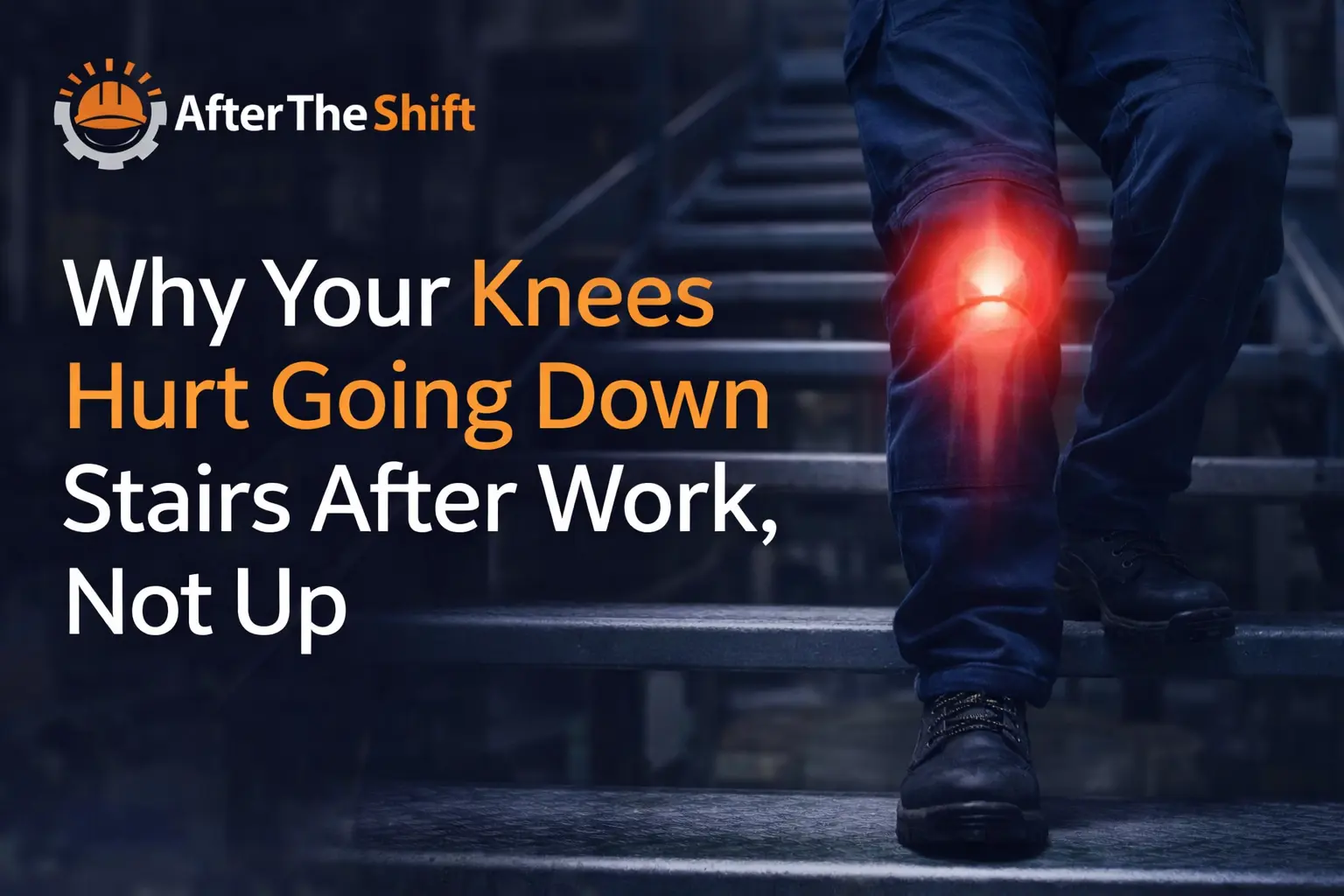
Stair descent exposes a different knee problem than stair climbing. Here is how to tell whether it is kneecap overload, tendon irritation, joint-line trouble, or a red flag that should not be self-managed.
You finish work, start going downstairs, and that is when the knee talks back. Not always on flat ground. Not always going up. Just on the way down.
For warehouse workers, construction workers, tradespeople, delivery drivers, and anyone spending hours on their feet, that pattern usually points to a load-control problem around the knee, not random soreness. By the end of this page, you will know which bucket your pain fits, what to do this week, and when not to self-manage it.
Blunt rule: If the pain is mostly at the front of the knee and gets worse going down stairs, squatting, or after sitting with the knee bent, treat it first like a kneecap load problem. If it is sharp on the inside or outside joint line, or comes with swelling, locking, a twist/pop, or the knee giving way, stop guessing and get it checked.
Quick answer
Why it hurts going down stairs after work: descending stairs is a braking task. Your quads and hips have to control your body as the knee bends under load. If the kneecap joint, tendon, or joint surface is irritated by the end of the shift, the staircase is where it often shows up first.
- Do: use the handrail, shorten your step, and slow down for a few days.
- Do: start controlled hip and quad work instead of only resting.
- Do: watch where the pain is: front of knee, below kneecap, joint line, or outer side.
- Avoid: repeatedly testing deep squats, lunges, and stairs to “see if it is gone.”
- Buy later, not first: a simple compression sleeve only if it helps you move more comfortably.
- Skip as a first move: a bulky hinged brace for vague after-work stair pain.
- Get checked sooner: if there is swelling, locking, a twist injury, deformity, heat/redness, or you cannot bear weight properly.
Save this page: this is the kind of problem people forget until the next shift, then repeat for months.
Table of contents
Why downstairs hurts more than upstairs
Going upstairs is a drive task. Going downstairs is a control task. On the way down, your body is dropping and your knee has to brake that drop while bent. That usually means more irritation if the problem is around the kneecap or the structures that hate repeated loaded bending.
That is why people often say things like:
- “It is fine walking around, but stairs down are bad.”
- “It is worst after work, not first thing in the morning.”
- “I can get up stairs better than I can get down them.”
- “Squats and low chairs feel similar.”
After a shift, this gets more obvious because your legs are already tired, your movement gets sloppier, and the staircase exposes the weak link fast.
Fast decision table
| If you feel... | Most likely bucket | Start with | Do not start with |
|---|---|---|---|
| Pain at the front of the knee or behind the kneecap; worse going down stairs, squatting, or after sitting | Patellofemoral overload | Reduce stair volume, use rail, strengthen hips and quads | Testing deep squats all week |
| Pain and tenderness just below the kneecap | Patellar tendon irritation | Reduce loaded bending volume, start controlled tendon-friendly loading | Aggressive stretching into pain |
| Sharp pain on the inside or outside joint line, especially with catching, swelling, or a twist story | Meniscus or joint-surface irritation | Unload, control swelling, get assessed if not settling | Twisting drills or forcing range |
| Burning or rubbing on the outer side of the knee | IT band irritation | Reduce repetitive stair/hill volume, rebuild hip control | Hammering side steps into a flare |
| Front-of-knee pain with creaking, chair-rise pain, and stair pain that has built up over time | Patellofemoral arthritis pattern | Lower-load strengthening, volume control, bodyweight management if relevant | Treating it like one brutal leg workout will fix it |
2-minute self-sort score
Use this weighted score to sort the common after-work stair pain pattern from the “stop guessing” pattern.
Stair pain self-sort rubric
- +2 = Pain is mostly at the front of the knee or feels like it is behind the kneecap
- +2 = It hurts more going down stairs than going up
- +2 = Squats, lunges, or step-downs feel similar
- +1 = Sitting with the knee bent for a while makes it ache when you stand up
- -3 = There is locking, catching, or a stuck feeling
- -3 = It started after a twist, pop, sudden misstep, or obvious injury
- -3 = The knee is visibly swollen, hot, unstable, or hard to bear weight on
Score 4 to 7: Most consistent with a load-related kneecap pattern. Start with the 7-day plan below.
Score 1 to 3: Mixed picture. You can try the 7-day plan, but be stricter with monitoring.
Score 0 or lower: Do not treat this like routine after-work stair pain. Get assessed.
Decision tree
- Where is the pain?
- Front of knee / behind kneecap → go to step 2
- Below kneecap on the tendon → think tendon irritation
- Inside or outside joint line → go to step 3
- Outer side of knee → think IT band pattern
- What makes it worse?
- Downstairs, squats, low chairs, sitting bent → most likely kneecap load problem
- Only after jumping, sprinting, repeated explosive work → tendon irritation moves up the list
- Any red-flag features?
- Swelling, locking, giving way, twist/pop, cannot bear weight well → get checked
- No swelling or instability, mostly gradual overload → start conservative plan
- How long has it been going on?
- Less than 2 weeks and already improving → stay the course
- 2 to 6 weeks with no real improvement → get assessed
- Older knee, creaky, chair-rise pain, recurring stair pain → consider arthritic kneecap pattern
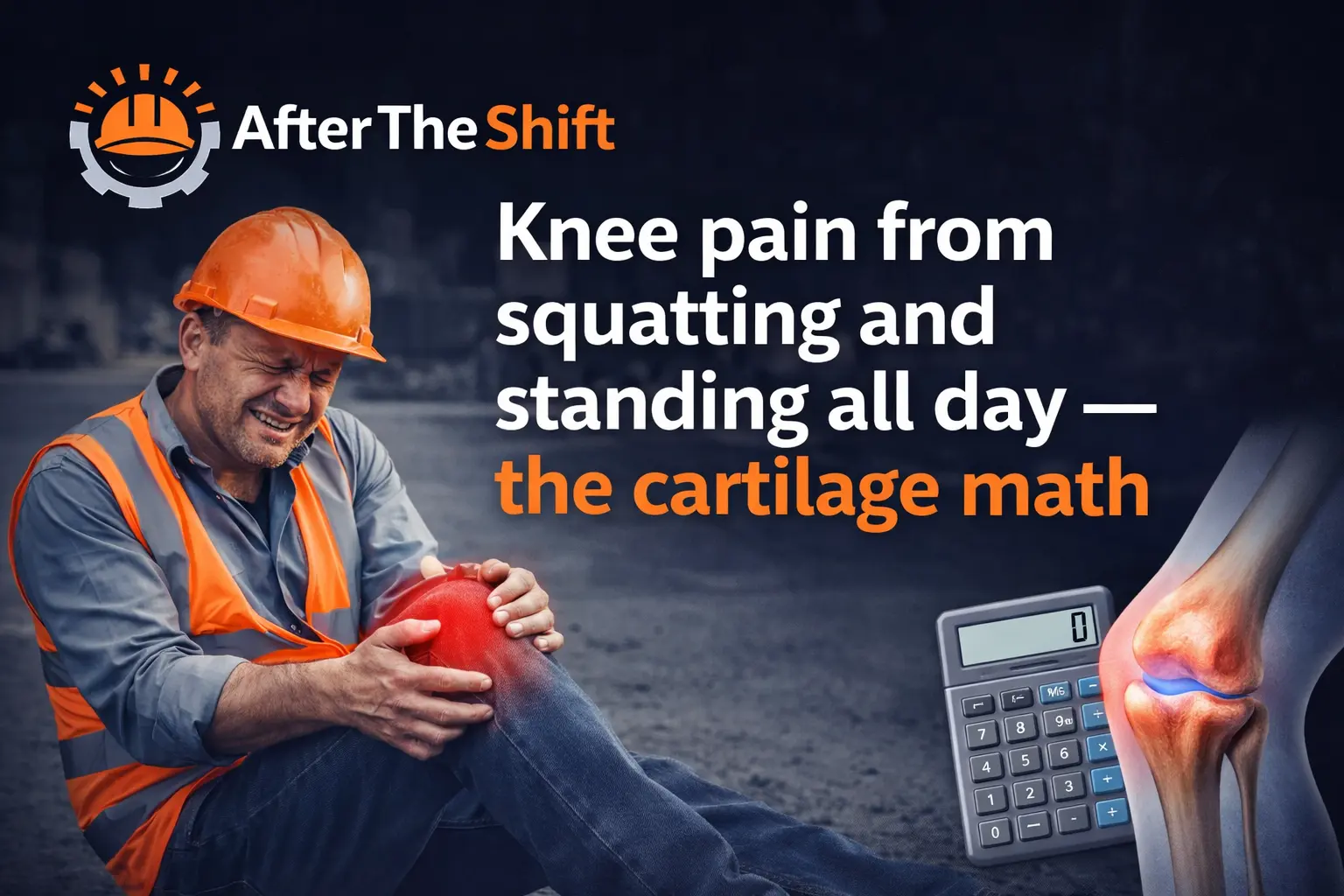
If this sounds close to your pattern, also read Knee pain from squatting and standing all day — the cartilage math. It pairs well with this page because squat pain and stair-descent pain often live in the same bucket.
Symptom → cause → fix matrix
| Symptom | Common cause bucket | What is usually driving it | Best first fix |
|---|---|---|---|
| Dull ache in front of knee; worse on stairs down | Patellofemoral overload | Too much loaded bending with poor control late in the day | Reduce flare triggers and rebuild quad + hip control |
| Pain just below kneecap; tender to touch | Patellar tendon irritation | Repeated heavy tendon loading without enough recovery | Reduce load spikes and use controlled strengthening |
| Sharp inside/outside pain with catching or swelling | Meniscus / joint-surface irritation | Twist, degeneration, or compression irritation | Do not force it; get assessed if not settling quickly |
| Outer knee burning, rubbing, or side pain | IT band pattern | Repetitive friction + hip control issues | Reduce aggravating volume and build hip strength |
| Recurring front knee pain, chair-rise pain, grinding, slower warm-up | Patellofemoral arthritis pattern | Joint-surface wear + tolerance dropped below daily demand | Consistent lower-load strengthening and better workload control |
What to do in the next 7 days
This plan works best for: gradual stair pain, front-of-knee pain, after-work flares, squat-like symptoms, and no major swelling or instability.
This plan is not for: a locked knee, visible swelling after a twist, a knee that gives way badly, fever/redness/heat, or a knee you cannot load properly.
Days 1 to 2: calm the flare without going soft
- Use the handrail and go slower downstairs.
- Shorten your step. Do not drop fast into the next stair.
- Avoid repeated “test reps” of stairs, squats, kneeling, and low chairs.
- Keep normal walking if it is tolerable. Total rest usually makes the next load feel worse.
- If cold helps, use it briefly after work. If it does nothing, skip it.
Days 2 to 4: restore control
- High chair sit-to-stand: 2 to 3 sets of 8 to 12
- Straight-leg raise: 2 to 3 sets of 10 to 15
- Side-lying hip raise or banded side step: 2 to 3 sets of 10 to 15
- Calf raises: 2 to 3 sets of 12 to 20
- Supported step-down from a low step: 2 sets of 6 to 8 each side if pain stays controlled
Days 4 to 7: rebuild stair tolerance
- Keep stair trips necessary, not extra.
- Progress the step-down slightly only if next-day pain is not worse.
- Add a shallow split squat or wall sit if it feels better than stairs.
- Keep the work honest and controlled. This is not the week to chase burn or leg-day pride.
7-day checklist
- Use handrail on the way down
- Stop retesting painful depth
- Track whether pain is front, below kneecap, joint line, or outer side
- Do hip + quad work at least 3 times this week
- Keep walking unless it clearly worsens symptoms
- Check next-day response, not just same-day toughness
- If swelling, locking, or giving way appears, switch from self-management to assessment
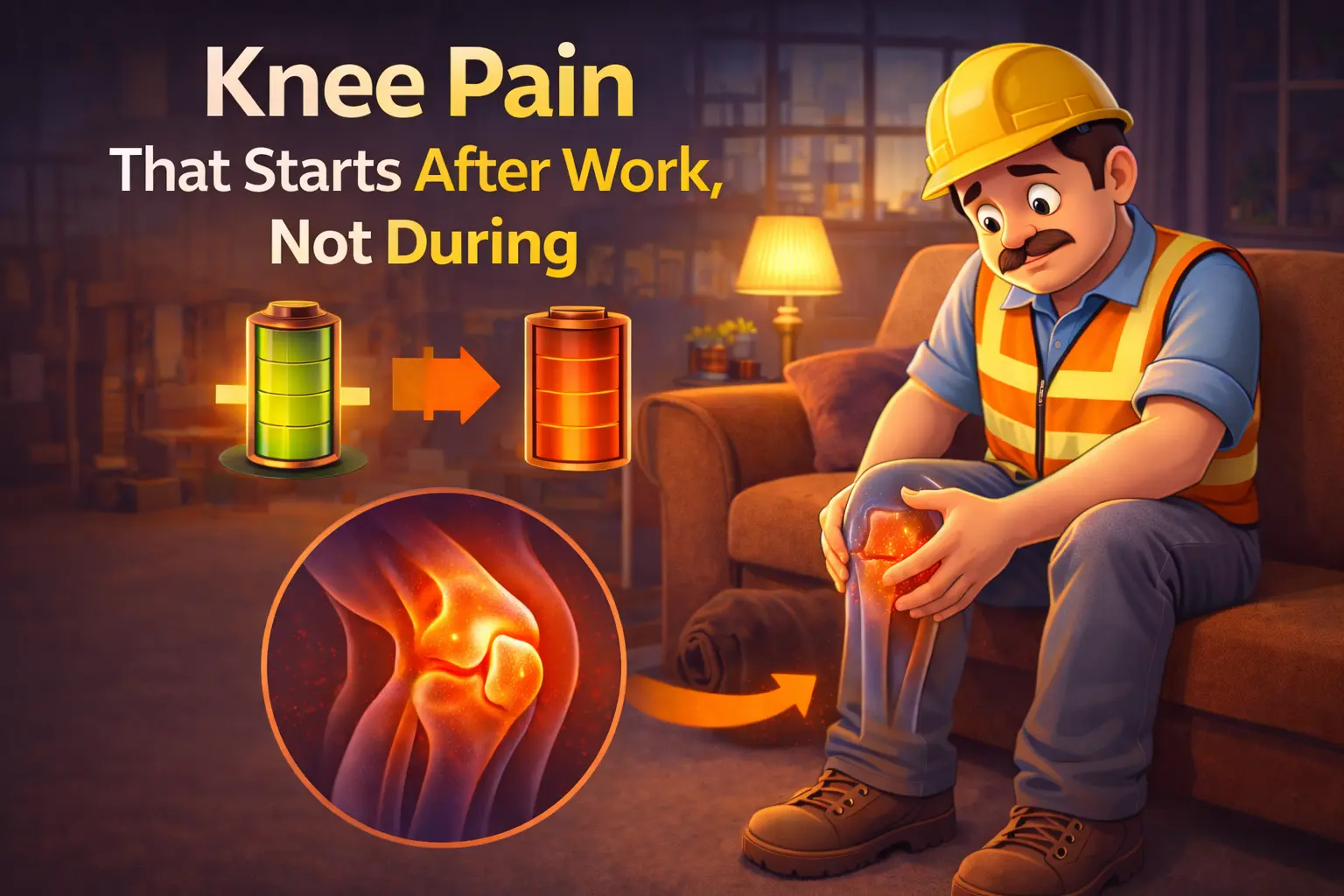
Mid-post reality check: if the problem is getting older and more repetitive, not dramatic, read Knee pain that starts after work, not during and Standing on concrete all day — the damage timeline from month 1 to year 5. That is the bigger pattern most workers miss.
Sleeve vs tape vs brace vs exercise
| Option | Best for | What it really does | Avoid if |
|---|---|---|---|
| Compression sleeve | Mild comfort, warmth, confidence | Can make movement feel better; does not fix the cause | You expect it to replace strengthening |
| Tape | Short-term symptom relief | Can reduce pain enough to train better | Skin reacts badly or you cannot reapply it consistently |
| Hinged brace | Specific instability or diagnosed injury | Limits movement more than vague stair pain usually needs | The issue is just generic front-knee pain after work |
| Exercise + load control | Most gradual after-work stair pain | Improves the actual capacity problem | You have red-flag symptoms and should be assessed first |
Best pick / best budget / best upgrade
Best pick: controlled hip + quad work plus stair volume control.
Best budget: a simple compression sleeve if it makes work and walking easier.
Best upgrade: a proper assessment if you have swelling, locking, giving way, or the problem keeps returning every week.
Mistakes that keep it going
- Only stretching it: many stair-pain cases are more about load tolerance and control than “tightness.”
- Doing nothing for 5 days, then smashing legs on day 6: that resets the flare cycle.
- Using pain only during the shift as your test: after-work pain is the real clue here.
- Buying a big brace first: comfort is not the same as solving the problem.
- Ignoring the hips: a tired hip usually leaves the knee doing extra control work.
- Blaming only boots: footwear matters, but the knee still needs enough strength and tolerance to do the job.
Also worth reading next: Why your feet hurt worse in the parking lot than on the warehouse floor and What real recovery looks like after physical work. Bad stair pain is often part of a bigger lower-body fatigue pattern, not an isolated knee mystery.
When to get checked
Do not try to out-grit this if any of these are true:
- The knee is visibly swollen, hot, or red
- You heard or felt a pop with a twist or misstep
- The knee locks, catches, or will not move normally
- The knee gives way
- You cannot bear weight properly
- The shape looks off
- The pain is not improving after 2 to 6 weeks of sensible load changes
Next steps
If your pain is mainly front-of-knee and stair-related: follow the 7-day plan above, then move into more controlled strengthening.
If your pain also shows up with squatting and long standing: read Knee pain from squatting and standing all day — the cartilage math.
If the whole lower body is wearing down from work: go to the Physical Work Recovery Guide.
Save this post so you do not have to relearn the same stair-pain pattern after every shift.
FAQ
Why does my knee hurt more going down stairs than up?
Because going down is a braking job. Your knee bends while your quads and hips control your bodyweight downward. That usually exposes kneecap-related pain faster than climbing up does. For many workers, the staircase becomes the first obvious test after the shift is over.
Is this runner’s knee even if I do not run?
It can be. “Runner’s knee” is a casual label for patellofemoral pain, but the same pain pattern can show up in warehouse work, construction, delivery, trades, and any job with repeated loaded knee bending. You do not need to be an athlete to irritate the kneecap joint.
Does grinding or crackling mean my cartilage is gone?
Not automatically. Noise by itself is not a diagnosis. What matters more is the combination of pain location, swelling, locking, loss of function, and whether the knee is getting worse or better over time. Noise with front-of-knee pain can happen without the knee being “finished.”
Should I rest completely for a week?
Usually no. A short reduction in irritating tasks makes sense, but total rest often leaves the knee less ready for the next load. In most gradual after-work stair-pain cases, the better move is to reduce the flare triggers while keeping some tolerable walking and controlled strengthening in place.
Should I use a sleeve, tape, or a brace?
A sleeve is the simplest first test for comfort. Tape can help short term if it reduces pain enough for you to move and train better. A big hinged brace is usually not the first answer for vague front-of-knee stair pain unless there is a specific injury or instability issue behind it.
Do I need an X-ray or MRI right away?
Not always. Many gradual overuse patterns are managed first by symptom pattern, function, and response to load changes. Imaging moves higher up the list when there was a twist injury, major swelling, locking, a deformity, inability to bear weight, or symptoms that are not improving with sensible care.
How long should it take to improve?
You should usually notice at least some shift within a couple of weeks if you stop poking the flare and start rebuilding tolerance properly. Full improvement can take longer, especially if the problem has been repeating for months. No clear improvement after 2 to 6 weeks is a good reason to get assessed.
When should I stop self-managing and get checked?
Stop self-managing if the knee locks, gives way, swells significantly, feels hot or red, will not take weight properly, or started after a twist/pop. Also get checked if you have been “managing” it for weeks and the staircase still exposes the exact same pain pattern every time.
This article is general recovery education, not a diagnosis or a substitute for care from a qualified clinician. Stop and get medical help for severe pain, numbness, weakness, chest pain, sudden swelling, fever, or symptoms that keep worsening.
Log in to leave a comment.