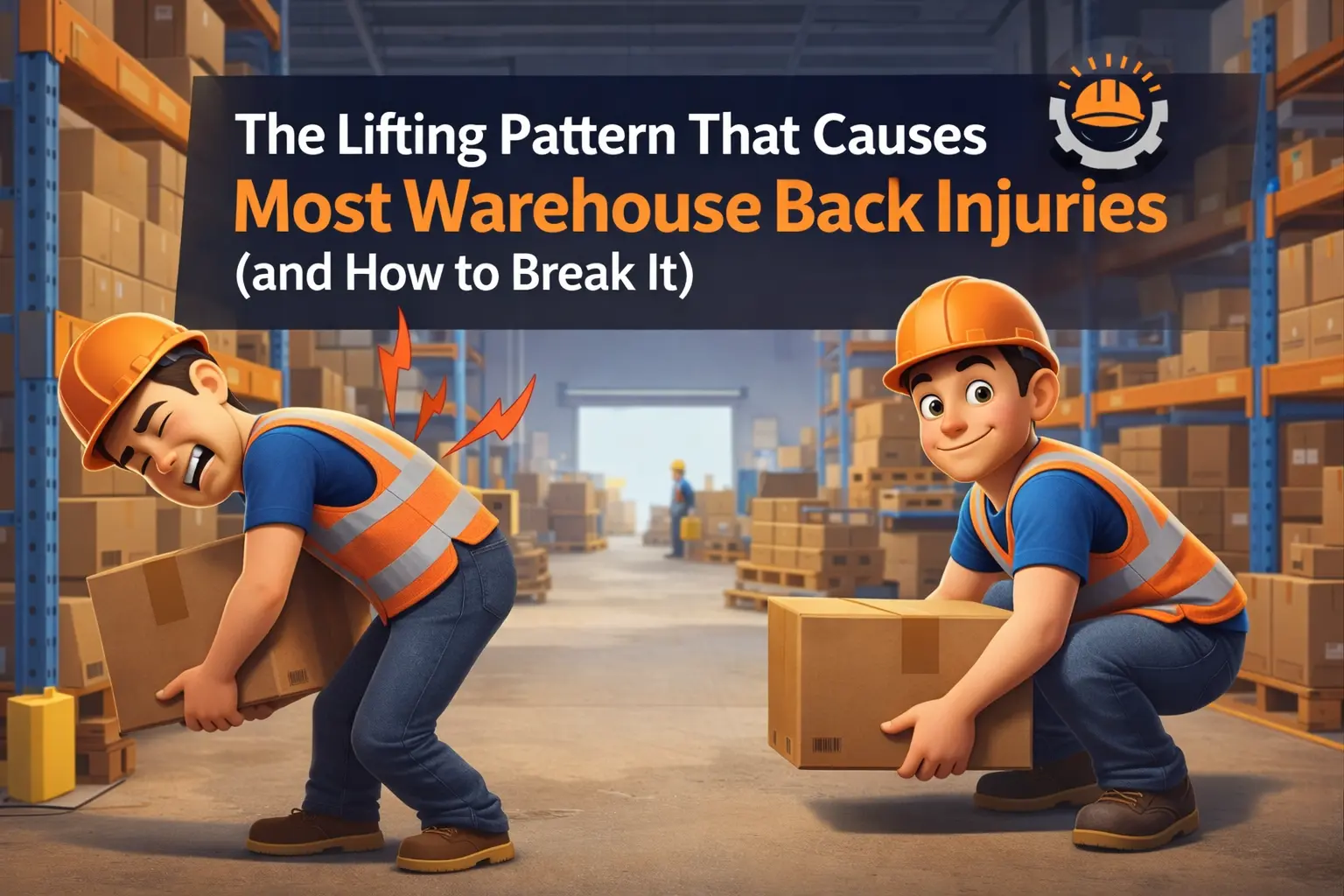
The problem isn’t “weak core.” It’s the same bad rep done 300 times a shift. Fix the pattern, not your willpower.
If you work warehouse, the lift that hurts you isn’t the “heavy one.” It’s the same awkward rep you repeat all shift: bend, reach, twist, lift—usually while rushed.
This guide shows you exactly what the injury pattern looks like, how to spot it in 60 seconds, and how to replace it with a safer pattern that still works at warehouse speed.
Blunt rule: If your spine is bent AND you twist while holding weight, you’re gambling. You can bend or rotate, but don’t combine them under load.
Quick Answer (read this in 15 seconds)
The most common warehouse back-injury pattern is “bend + reach + twist” under load. Break it by squaring your feet to the load, lifting with a hip hinge, then turning with a step/pivot (not a spine twist).
- Do: “Set → Lift → Turn” (feet set, hinge lift, step turn).
- Do: Pull the box close before it leaves the shelf/pallet.
- Do: Use a micro-reset every rep: exhale-brace for 1 second, then lift.
- Avoid: Lifting from end-range rounded back.
- Avoid: Twisting while bent (placing to the side without stepping).
- Buy/Use: Height hacks (extra pallet, tote, stand) to keep loads between mid-shin and sternum.
- Skip: Thinking a belt “solves” bad reps. It can hide the problem while the pattern stays.
Save this: bookmark or screenshot the decision table + the 3-step reset below.
Fast Decision Table: what to change first
| If you… | That usually causes… | Do this next rep |
|---|---|---|
| Lift with your arms extended (box far from you) | Back works like a crane (high spinal load) | Pull it to your thighs first, then lift close |
| Twist to place items beside/behind you | Flexion + rotation stress (classic “tweak”) | Step turn: move your feet, don’t rotate your spine |
| Pick from floor / bottom layer all shift | End-range rounding + fatigue | Raise the work: extra pallet/tote + rotate stock up |
| Feel back pain more after shift/drive home | Accumulated irritation + stiffness | Use the micro-reset + hinge + stop “snap lifts” |
| Rush and “yoink” boxes to stay on rate | Speed spikes load; form collapses late shift | 1-second brace before lift; keep reps identical |
Table of contents
- The injury pattern (what it looks like)
- 60-second mini-test: are you doing it?
- Decision tree: which fix fits your station?
- The 3-step reset: Set → Lift → Turn
- Environment fixes that make good reps automatic
- Weighted scoring rubric: pick your best intervention
- Pitfalls & myths that keep the pattern alive
- FAQs
The lifting pattern that causes most warehouse back injuries
Call it whatever you want—bend-reach-twist-lift, “stoop and spin,” “grab-and-snap.” It stacks distance, rotation, and fatigue. Most “random tweaks” happen on a normal box, late shift, one sloppy rep.
- Bend (often rounded low back at the bottom)
- Reach (box away from your centerline)
- Twist (placing to the side without stepping)
- Lift fast (because rate/flow)
60-second mini-test: are you doing the injury pattern?
Score your last 10 lifts.
- +2 if you twisted to place without moving your feet
- +2 if the box was far when it left the surface
- +2 if you lifted from below mid-shin or deep rounding
- +1 if you braced randomly (no controlled exhale/brace)
- +1 if you felt a tug and kept going unchanged
- 0–3: mostly safe; focus on environment fixes
- 4–7: danger zone; implement the reset today
- 8+: you’re training the injury; change reps immediately
Decision tree: which fix fits your station?
- If you lift from low levels (floor/bottom pallet): raise the work + hip hinge.
- If you place to the side/behind: step-turn placement or move the drop zone in front.
- If you reach far (deep shelf/across conveyor): bring it to you first, then lift close.
- If speed breaks form late shift: 1-second micro-reset every rep.
- If you have leg symptoms/weakness: treat it as a safety issue (see FAQs).
Symptom → cause → fix matrix
| Symptom | Likely cause | Fastest fix |
|---|---|---|
| Pinch when placing to the side | Twist while bent | Step turn + face the target |
| Tightness builds all shift | Too many rounded reps | Hinge + raise pick height + micro-reset |
| Sudden tweak on a normal box | Speed spike + awkward angle | Exhale-brace, lift close |
| Pain down leg / numbness | Possible nerve irritation | Stop provoking reps + follow safety guidance |
The 3-step reset: Set → Lift → Turn
1) SET (2 seconds)
- Feet: aim your body where the box will go.
- Box: slide/pull it close before lifting.
- Rule: if elbows can’t come near ribs, it’s too far.
2) LIFT (1–2 seconds)
- Hinge: hips back, ribs stacked over pelvis.
- Brace: light exhale → tighten 360° for one second.
- No snap lifts: smooth up, smooth down.
3) TURN (0–2 seconds)
- Step/pivot: move feet, don’t twist spine.
- Stay close: keep the box near your torso.
One-line cue: Close. Hinge. Step.
Environment fixes that make safe lifting automatic
- Raise the work: extra pallet/tote = fewer deep bends.
- Front-facing drop zone: reduce twist placements.
- Touch point: box touches thighs before the lift.
- Batch awkward items: team lift/tool instead of hero reps.
Weighted scoring rubric: pick your best intervention
Score each 0–10 and pick the top 1–2 to run for 7 shifts.
| Option | Risk (x4) | Speed (x3) | Ease (x2) | Cost (x1) |
|---|---|---|---|---|
| Raise pick height (extra pallet/tote) | __ | __ | __ | __ |
| Change drop zone to front | __ | __ | __ | __ |
| Step-turn rule (no twist while bent) | __ | __ | __ | __ |
| 1-second micro-reset (exhale → brace) | __ | __ | __ | __ |
Total: (Risk x4) + (Speed x3) + (Ease x2) + (Cost x1). Highest wins.
Pitfalls & myths that keep the pattern alive
- “Lift with your legs” is useless if you still reach and twist.
- Belt = safety is a myth if mechanics stay the same.
- “I only twist a little” becomes a lot after 400 reps.
- Stretching without changing reps just resets pain temporarily.
Next steps
- Lower back pain after shifts: what’s actually happening
- Lower back pain from lifting boxes all day — the 3 positions that wreck your spine
- Why your lower back hurts more on the drive home
- Work pain vs injury: knowing the difference matters
FAQs
What’s the single most dangerous move when lifting at work?
Twisting while bent and holding weight. Step-turn instead—move your feet to face the drop zone.
If the box is light, can the pattern still injure me?
Yes. Light boxes become risky with repetition + fatigue. Most injuries come from awkward reps done too many times.
Do lifting belts help for warehouse work?
Sometimes for specific tasks, but belts don’t cancel bad mechanics. Fix the rep first.
How fast can I feel improvement?
Often within 1–3 shifts if you remove twist-under-load and keep boxes close. If symptoms worsen, stop provoking reps.
What’s the most common mistake when people try to “lift with legs”?
They squat but still reach forward and twist to place. Geometry beats effort: close, hinge, step.
When is it not safe to “push through”?
If you have shooting leg pain, numbness/tingling, weakness, bladder/bowel changes, fever, or worsening day-to-day symptoms—get checked.
Hard CTA: Save this post and share it with one coworker. If your team stops bend-twist reps, injury rates drop. Period.
This article is general recovery education, not a diagnosis or a substitute for care from a qualified clinician. Stop and get medical help for severe pain, numbness, weakness, chest pain, sudden swelling, fever, or symptoms that keep worsening.
Log in to leave a comment.