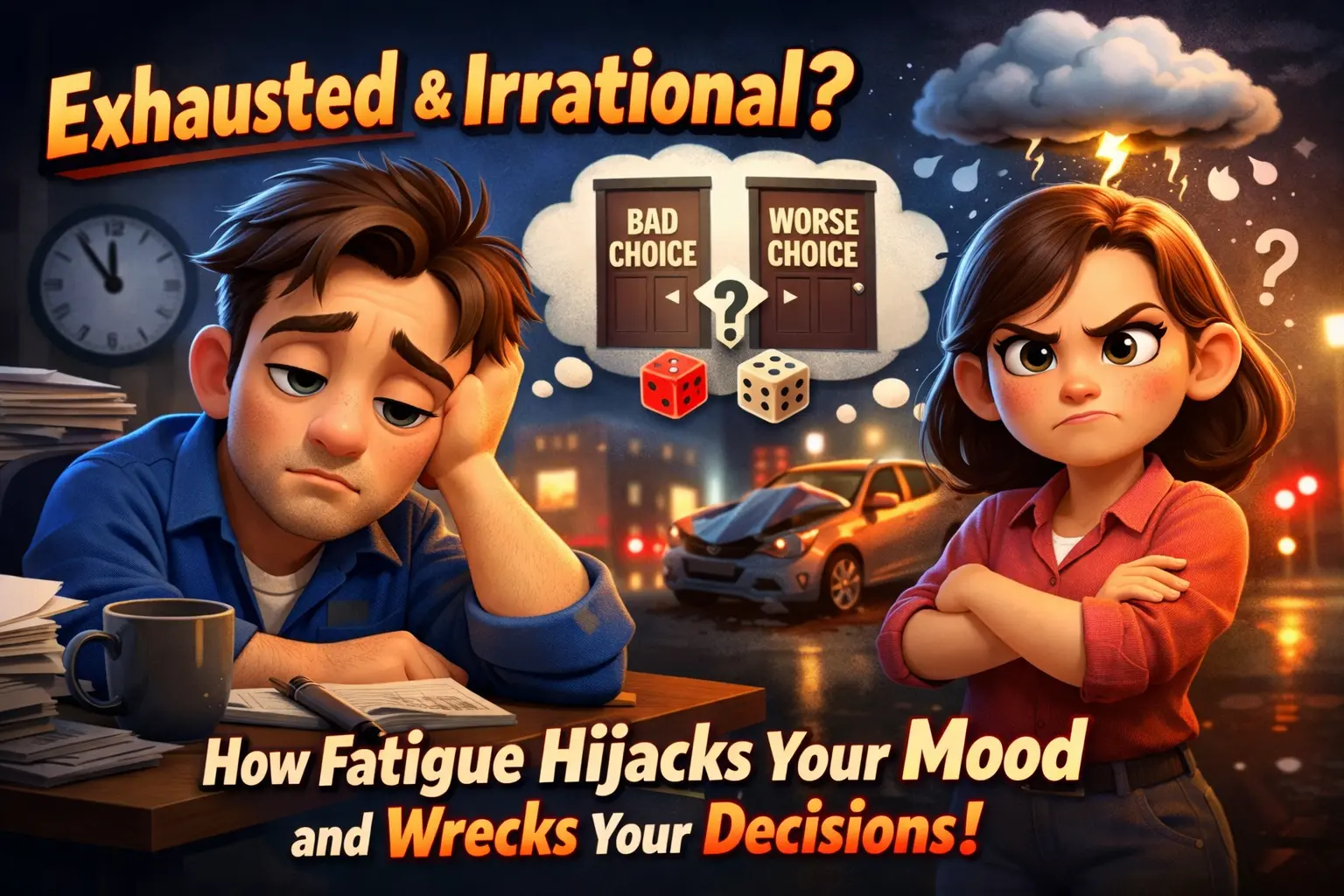
How tired brains create bad choices, fights, cravings, and “I don’t care” mode — and the 3-signal reset that pulls you back fast.
If you get snappy, careless, reckless, or “I don’t care” after shifts, it’s not your personality. It’s fatigue changing how your brain evaluates risk, effort, and reward.
This is for warehouse/construction/trades/shift workers who feel mood swings, brain fog, impulse spending, cravings, or dumb decisions after work — and want a simple system that works in real life.
Outcome promise: In 10 minutes you’ll know if today is a “fatigue day,” what to stop doing immediately, and the smallest reset that restores judgment without needing a perfect routine.
The blunt rule that decides most cases:
If your mood gets worse + your decisions get faster when you’re tired, do NOT trust “how you feel” as information. Trust signals + a reset protocol.
Quick Answer
Fatigue reduces self-control, increases irritability, and makes your brain chase quick relief (food, arguing, spending, risky choices). The fix is detect a fatigue day early and run a short reset: fuel + fluids + light + 10-minute decompression, then postpone irreversible decisions.
- Do: run the 3-signal check (below) before you talk, buy, drive fast, or “decide your life.”
- Do: eat a real meal (protein + carbs) within 90 minutes of finishing work.
- Do: 10 minutes “low-stimulus” decompression (no doomscroll, no arguments).
- Avoid: “serious talks,” online shopping, gambling, drinking, revenge texts when you’re drained.
- Avoid: interpreting irritation as “they disrespected me.” That’s often just low battery.
- Buy/Use: electrolytes + a simple post-shift snack plan (cheap, consistent).
- Skip: complex self-help routines you won’t do after a 10-hour shift.
Jump to:
Why fatigue changes mood & decision-making (in plain language)
Fatigue doesn’t just make you sleepy. It changes the filters your brain uses:
- Threat filter gets louder: neutral comments feel like disrespect.
- Effort feels expensive: “small tasks” feel impossible → you procrastinate or quit.
- Reward gets urgent: your brain wants quick relief now (junk food, spending, arguing, porn, alcohol, reckless driving).
- Time horizon collapses: you pick “good now” over “good tomorrow.”
This is why tired you makes choices awake you would never defend. It’s not morality. It’s bandwidth.
Translation: You don’t need a stronger personality. You need a fatigue protocol.
Decision tree: what to do right now (if/then routing)
Start here (60 seconds):
- If you’re about to argue / buy something / make a big decision: pause and run the 3-signal check:
- Signal 1: you feel irritated at small things
- Signal 2: your brain feels foggy or “slow”
- Signal 3: you crave quick relief (sugar, scrolling, spending, substances)
- If you have 2+ signals: it’s a fatigue day → postpone irreversible decisions 24 hours.
- If you have 0–1 signals: proceed, but still use the 10-minute decompression before sensitive conversations.
- If you have 2+ signals AND you’re driving: treat it like impaired attention → slow down, no aggressive maneuvers, no phone.
Non-negotiable: When it’s a fatigue day, don’t “push through” emotional decisions. You’re operating with a distorted cost/reward system.
2-minute mini-test: “Is this fatigue talking?”
Score each 0–2. Total 0–12.
| Item | 0 | 1 | 2 |
|---|---|---|---|
| I’m more irritable than usual | No | A bit | Yes |
| I’m making faster, sloppier decisions | No | Some | Yes |
| I’m craving quick relief | No | Some | Strong |
| I’m replaying conflicts in my head | No | A bit | Yes |
| I feel “wired but tired” | No | Sometimes | Yes |
| I’m more clumsy / error-prone | No | A bit | Yes |
Interpretation:
0–3: likely normal stress. Use a quick reset anyway.
4–7: fatigue is influencing mood/choices. Postpone big decisions 24 hours.
8–12: high fatigue. Treat today like “limited capacity.” Do the reset + protect sleep window.
Symptom → cause → fix matrix (table)
This table is your “stop guessing” tool.
| If you… (user language) | Most likely cause | Do this (fast fix) | Avoid this |
|---|---|---|---|
| Snap at people after work | low bandwidth + threat sensitivity | 10-min decompression + eat + postpone serious talk | “We need to talk right now” |
| Impulse buy / doomshop | reward urgency (“relief now”) | 24h rule + block shopping apps after shifts | scrolling sales feeds tired |
| Crave sugar or junk | energy dip + stress hormones | protein + carbs snack (planned) + water/electrolytes | “I’ll just white-knuckle it” |
| Make risky choices (speeding, “one more drink”) | time horizon collapse | slow down + strict rules when fatigued | “I’m fine” logic |
| Can’t start tasks at home | effort feels expensive | 2-minute starter + set a “minimum version” | trying to do it perfectly |
Weighted scoring rubric: fatigue vs stress vs burnout (rank what’s happening)
Most people mislabel this. Use points instead of vibes.
| Signal | Fatigue (0–3) | Stress (0–3) | Burnout (0–3) |
|---|---|---|---|
| Improves after a nap / good sleep | 3 | 1 | 0 |
| Short fuse after shifts | 3 | 2 | 1 |
| Constant dread / worry | 1 | 3 | 2 |
| Emotional numbness (“nothing matters”) | 1 | 1 | 3 |
| Weekends don’t restore you | 1 | 2 | 3 |
How to use it: Add points in each column. Highest total is your current driver. If burnout is highest, you need workload boundaries and recovery structure, not just “more sleep.”
Fast resets that actually work after shifts (no motivational nonsense)
Best pick: the 10-minute “brain unlock” reset
- Fuel: eat something simple (protein + carbs). Example: yogurt + banana; eggs + bread; tuna sandwich.
- Fluids: 500ml water (add electrolytes if you sweat a lot).
- Light: 3–5 minutes outside or by a bright window (tells your brain “reset mode”).
- Low-stimulus: 5 minutes no phone, no drama, no news. Just sit, shower, or slow walk.
Best budget: the “planned snack” that prevents impulse behavior
- Pick one post-shift snack you can repeat daily.
- Keep it boring on purpose. Boring beats binge.
- Goal: stop the “reward urgency” before it chooses for you.
Best upgrade: a “decision quarantine” rule
- No serious talks until you’ve eaten + decompressed.
- No purchases over a set amount (you choose) until next day.
- No life decisions after 10pm or post-night shift.
Why this works: You’re not trying to “be disciplined.” You’re changing the environment so tired-you can’t self-sabotage.
Save this: Bookmark this page and run the mini-test for 7 days. Patterns show up fast when you track.
Pitfalls + edge cases (where people mess this up)
- Common mistake: thinking irritation means the other person is “the problem.” Fatigue amplifies threat detection.
- Edge case: caffeine late shift → you feel awake but judgment is still damaged. “Alert” isn’t “restored.”
- Edge case: under-eating all day → mood crashes look like “anger issues.” It’s often fuel timing.
- Trade-off: pushing through every day builds accumulated fatigue. It feels “fine” until it isn’t.
- Safety: if you’re so fatigued you’re nodding off while driving or at work, that’s an immediate risk. Treat it seriously.
Next steps (keep readers onsite)
Route yourself based on what you scored:
- Accumulated fatigue: the damage you don’t feel yet (pillar-style foundation)
- Rest vs recovery: why sleeping isn’t fixing you (fix the false model)
- What real recovery looks like after physical work (execution plan)
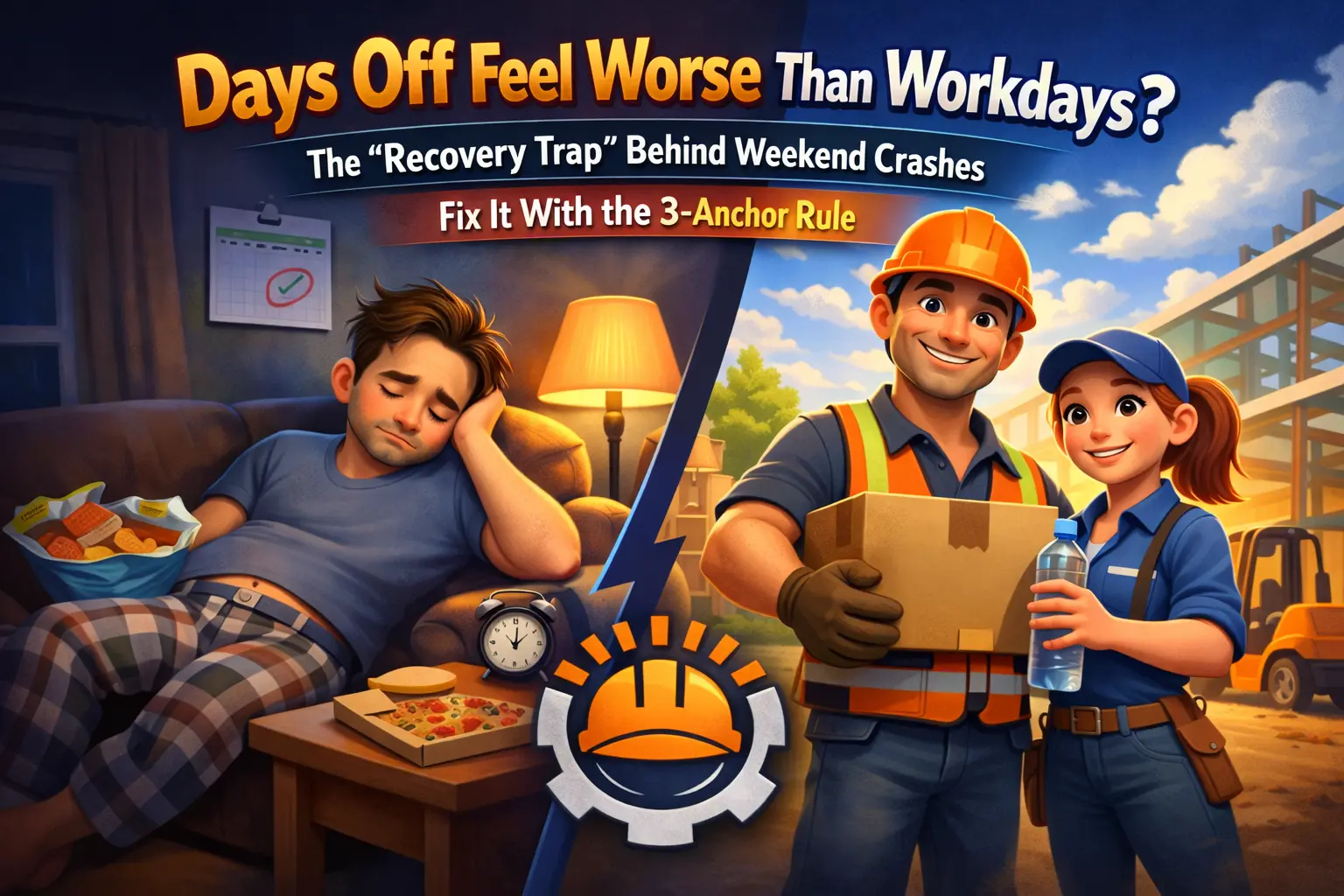
- Why days off feel worse than workdays (weekend crash pattern)
- “You’ll get used to it” is fatigue (the 3-signal rule) (same detection system)
- AfterTheShift home (browse Recovery / Sleep / Nutrition)
Hard CTA: If this described you, pick one rule to enforce this week:
- Decision quarantine: no serious talks + no big buys post-shift
- Fuel timing: real meal within 90 minutes of finishing work
- 10-minute reset: daily, no exceptions
Do it for 7 days and your mood will stop “mysteriously” swinging.
FAQs (traffic winners)
Can fatigue really make me meaner or more emotional?
Yes. Fatigue reduces emotional regulation and increases threat sensitivity, so small triggers feel bigger. That doesn’t excuse behavior, but it explains why “tired you” reacts differently. Use rules + timing so you don’t act during distorted states.
Why do I make dumb decisions after night shifts?
Night shifts compress your time horizon: your brain prioritizes immediate relief. That’s why shopping, junk food, and risky driving spike. The fix is decision quarantine + a short reset before you interact with people or money.
Is it fatigue or stress? How can I tell fast?
If a nap/solid sleep noticeably improves you, fatigue is a major driver. Stress is more “mind spinning,” and burnout is more “nothing matters” plus weekends don’t restore you. Use the weighted rubric above instead of guessing.
What’s the biggest mistake people make when tired?
They treat feelings as facts. Fatigue makes annoyance look like betrayal and cravings look like “I deserve it.” The safest move is postponing irreversible decisions until you’ve eaten, hydrated, and decompressed.
How long does it take to fix fatigue-driven mood issues?
You can often get a noticeable improvement the same day with fuel + fluids + decompression. The deeper fix (accumulated fatigue) is usually 1–3 weeks of consistent recovery habits. If nothing improves after 2–3 weeks, re-check workload, sleep schedule, and stress drivers.
Is it unsafe to drive when I’m fatigued?
Yes, especially if you’re nodding off, missing exits, or feeling “auto-pilot.” Treat it like impaired attention: slow down, no aggressive moves, and no phone. If you’re repeatedly near-missing, your recovery plan has to become a safety plan.
Does caffeine fix decision-making when tired?
Caffeine can increase alertness but it doesn’t fully restore judgment and impulse control. It may even make you feel confident while still impaired. Use caffeine strategically, but keep the decision quarantine rules on fatigue days.
Edge case: I’m tired but I have to have a serious conversation tonight. What do I do?
Do a 10-minute reset first, then set rules: keep it short, stick to one topic, and stop when voices rise. If it escalates, pause and reschedule. The goal is preventing fatigue from turning it into damage.
Could this be something medical instead of “just fatigue”?
Sometimes. If fatigue is extreme, sudden, or paired with symptoms like chest pain, fainting, severe depression, or sleep issues that don’t improve, talk to a clinician. This guide is about common fatigue mechanics, not diagnosing medical conditions.
This article is general recovery education, not a diagnosis or a substitute for care from a qualified clinician. Stop and get medical help for severe pain, numbness, weakness, chest pain, sudden swelling, fever, or symptoms that keep worsening.
Log in to leave a comment.