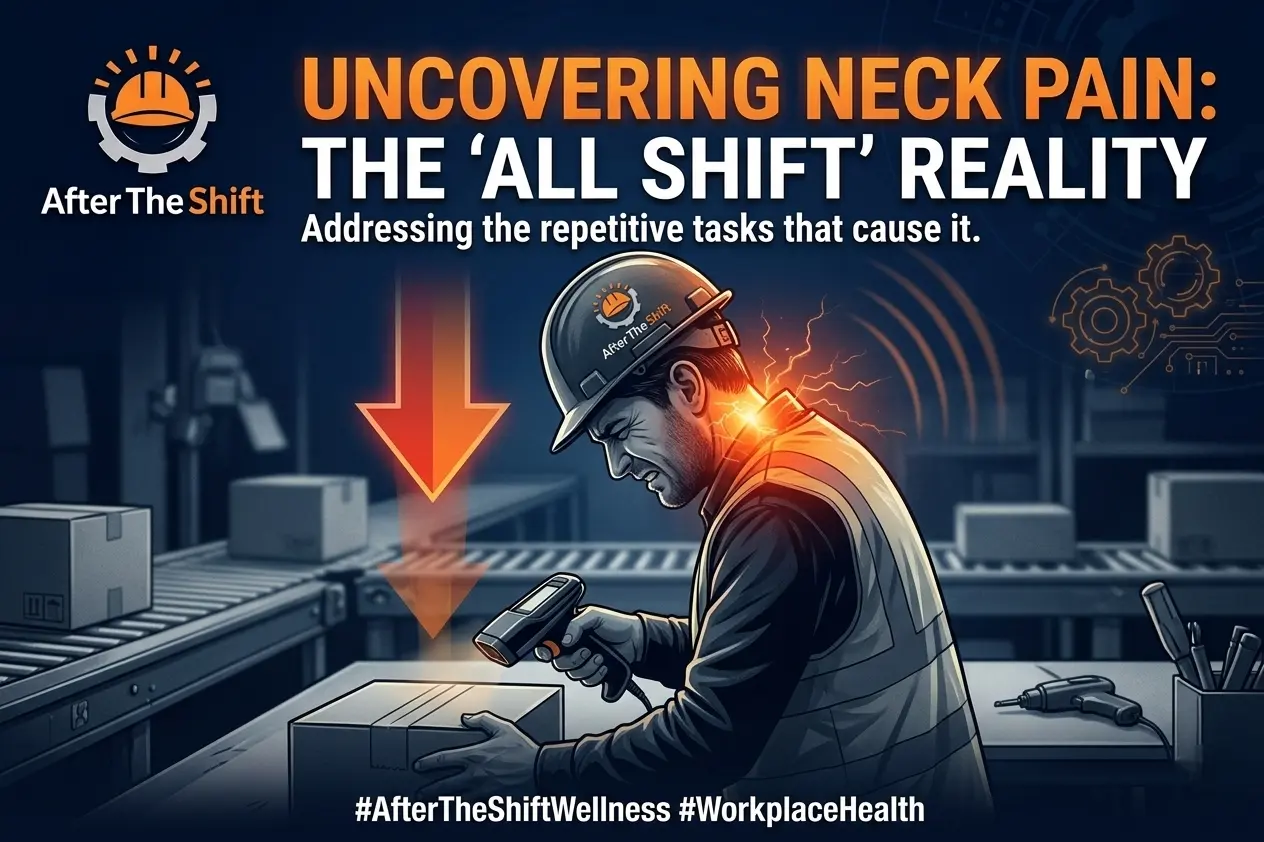
Your head weighs up to 60 lbs when tilted forward. Every shift multiplies that load across your discs and muscles — here's the exact damage pattern and what actually stops it.
⚡ Quick Answer
Neck pain from heads-down work is caused by sustained cervical flexion. At 45° of forward tilt — where most packaging and assembly workers spend the majority of their shift — your head effectively loads your spine with 49 lbs of force. Multiplied across a full shift, this exhausts posterior neck muscles and compresses discs faster than they can recover overnight.
✓ Do
- Raise work surface or scan height toward eye level
- 60-second neck reset every 45 minutes on-shift
- Strengthen deep neck flexors off-shift — 10 min/day
- Flag any pain that radiates into your arm or hand
✗ Avoid
- Static posture with zero movement breaks
- Sleeping face-down — forces rotation for 6–8 hrs
- Daily NSAIDs without fixing the root position
- Cervical collars for regular use — weakens neck muscles
The Rule
If your neck pain is gone by mid-shift but back by end of day — that's load fatigue, and positioning changes will fix it. If it's there when you wake up and hasn't shifted in 3+ weeks, or radiates into your arm — see a physio before it becomes structural.
In This Article
- Why Looking Down Damages Your Neck Over Time
- How Packaging, Assembly & Scanning Each Load the Neck Differently
- Symptom → Cause → Fix Matrix
- Interactive Decision Tree: Fatigue or Something Worse?
- The 4 Damage Stages
- Neck Load Severity Quiz
- What Actually Fixes It — By Shift Phase
- Treatment Options Compared
- Interactive Off-Shift Recovery Checklist
- FAQs
- What to Do Next
Why Looking Down Damages Your Neck Over Time
Your head weighs roughly 10–12 lbs in a neutral, upright position. The moment you tilt it forward, physics multiplies that load dramatically. This isn't theory — it's been measured repeatedly in occupational health research and the numbers are not small.
| Head Angle | Effective Spine Load | Where You See This | Risk Level |
|---|---|---|---|
| 0° (neutral, upright) | ~12 lbs | Standing at eye-level station | Low |
| 15° forward | ~27 lbs | Checking a phone, slight lean | Moderate |
| 30° forward | ~40 lbs | Scanning conveyor belt, reading labels | High over time |
| 45° forward | ~49 lbs | Most packaging & assembly workers | Very high — chronic |
| 60° forward | ~60 lbs | Quality inspection, close assembly | Extreme |
Multiply 49 lbs by 6–10 hours. That's not soreness — that's cumulative compression on cervical intervertebral discs, chronic eccentric overload of the posterior neck muscles (upper trapezius, levator scapulae, cervical erector spinae), and progressive tightening of the anterior neck structures that pull your head further forward over months.
The first structure to fail is muscle endurance. The posterior cervical muscles fatigue within 20–40 minutes of sustained flexion. Once fatigued, they lose the ability to absorb shock — and load transfers directly into the facet joints and disc cartilage. That's when what felt like a muscle ache shifts to something deeper, more specific, and longer-lasting.
How Packaging, Assembly & Scanning Each Load the Neck Differently
The underlying mechanism is the same — sustained cervical flexion — but the specific angle, duration, and compounding factors vary by role. Getting this right matters because the fix is slightly different for each.
| Job Type | Typical Neck Angle | Primary Structure at Risk | Biggest Compounding Factor |
|---|---|---|---|
| Packaging / packing lines | 30–50° continuous | C5–C7 discs; upper trap | No movement variation — static load never releases across the shift |
| Assembly / production line | 20–45° flex + lateral rotation | Facet joints; levator scapulae | Rotation while flexed = combined loading — highest disc injury risk |
| Scanning / warehouse picking | 15–30° high frequency | Upper trapezius; cervical extensors | Repetitive micro-resets — muscle never fully recovers between reps |
| Quality control / inspection | 40–60° sustained concentration | C4–C6 discs; suboccipitals | Visual focus suppresses postural awareness — workers don't notice the angle |
| Machine operation (seated) | 15–25° static, full shift | Deep neck flexors; discs | Rounded lower back (seated) forces greater forward head position even at low angles |
Symptom → Cause → Fix Matrix
Not all neck pain from heads-down work is the same tissue, the same cause, or the same fix. Match your symptom to the most likely source before applying any protocol. Using the wrong approach — especially treating disc irritation as plain muscle soreness — wastes weeks and risks worsening the damage.
| Symptom | Most Likely Cause | First Fix Step | Red Flag? |
|---|---|---|---|
| Ache at back of neck that fades after an hour off work | Posterior cervical muscle fatigue | Chin tucks every 45 min on-shift; raise work surface | No |
| Stiffness at the base of skull in the morning | Suboccipital tension; early disc compression at C4–C5 | Suboccipital release on waking; stop stomach sleeping | Persistent = physio |
| Pain builds across the shift, peaks in last 2 hours | Muscle endurance failure — posterior cervicals run out of capacity | Movement breaks every 45 min; off-shift strengthening | No |
| Neck pain + headache at base of skull or behind eyes | Cervicogenic headache — referred from C1–C3 joints | Upper cervical mobility work; physio if recurring weekly | Severe/sudden = GP first |
| Pain that radiates into the shoulder or upper arm | Cervical disc irritation; early nerve root involvement (C5–C6) | Stop the triggering position; physio this week | Yes — 1 week |
| Tingling, numbness, or weakness in arm or hand | Cervical nerve root compression / disc herniation | Stop heads-down work; see a doctor — may need imaging | Yes — urgent |
| Clicking or grinding in neck without significant pain | Facet joint crepitus; usually benign | Deep neck flexor strengthening; don't self-crack | No — monitor |
| Pain constant even at full rest | Active disc inflammation or nerve irritation | See a physio or doctor — past self-management territory | Yes |
Interactive Decision Tree: Muscle Fatigue or Something Worse?
Answer each question in sequence. The tree routes you to the right action without guesswork.
Does your neck hurt right now — at rest, not during or after work?
? Stop Work and See a Doctor Immediately If:
- Numbness, tingling, or weakness in the arm or fingers
- Sudden severe neck pain after a movement or impact
- Loss of coordination or clumsy hands alongside neck pain
- Pain does not ease at all with any position change
- Neck pain with fever, unexpected weight loss, or night sweats
The 4 Damage Stages
Most workers don't progress through all four — but this is the arc when the problem goes unaddressed. Your stage determines whether you can self-manage, need physio, or need imaging.
| Stage | What You Feel | What's Damaged | Recovery Time | Action |
|---|---|---|---|---|
| Stage 1 Fatigue |
Post-shift ache; clears overnight; stiffness on waking | Muscle fatigue; minor disc compression — fully reversible | 1–2 weeks | Positioning changes; on-shift breaks; post-shift decompression |
| Stage 2 Chronic overload |
Pain during the shift; lingers 12–24 hrs; regular morning stiffness | Sustained disc compression; early facet joint irritation | 4–8 weeks with physio | Physio 1–2x/week; deep neck flexor strengthening; work surface adjustment |
| Stage 3 Disc & joint |
Pain at rest; morning stiffness 30+ min; radiating into shoulder/arm; headaches | Disc annulus irritation or early herniation; facet inflammation | 3–6 months | Physio immediately; imaging if radiating; modified duties |
| Stage 4 Structural / nerve |
Constant pain; arm tingling or weakness; significant ROM loss | Disc herniation with nerve compression; possible stenosis | 6–18 months | Doctor + imaging urgently; orthopaedic or neurosurgery referral |
Stage 1 to early Stage 2 intervention costs almost nothing and takes two weeks. Stage 3–4 can cost six months of income and permanent job modification. The gap between those outcomes is almost always just how long someone waited. See the too-late line physical workers don't see coming.
Neck Load Severity Quiz
Answer all 10 questions. Your score tells you exactly what action level you're at right now.
1. Does your neck hurt during the shift — not just after it?
2. Has this pain been present for more than 4 weeks?
3. Do you wake up with neck stiffness that takes 20+ minutes to ease?
4. Does pain occasionally radiate into your shoulder or arm?
5. Do you look down for more than 3 hours uninterrupted per shift?
6. Do you have no ability to adjust your work surface height?
7. Do you take ibuprofen or painkillers to get through shifts?
8. Is your neck pain getting worse month to month?
9. Do you sleep on your stomach most nights?
10. Have you had a previous neck injury or disc problem in the same area?
What Actually Fixes It — By Shift Phase
The fix isn't a single stretch you do once a day. It's a three-phase protocol. Most workers only ever address the "after" phase — and wonder why they're still in pain after two weeks of neck rolls at home.
Before Shift — 5 min
- Chin tucks — 3×10, activates deep neck flexors before load begins
- Shoulder shrugs + rolls — 10 slow reps, wakes upper trap
- Thoracic extension over a chair back — 60 sec, unlocks mid-back which directly determines neck angle
During Shift — Every 45 min
- 60-second neck reset — lift head to neutral, 5 chin tucks, 5 shoulder rolls, look up 10 sec
- Raise work surface — even 5–10 cm cuts load nearly in half
- Alternate hands when scanning — breaks asymmetric rotation load
After Shift — 10 min
- Suboccipital release — rolled towel at base of skull, 3–5 min lying down
- Levator scapulae stretch — chin toward armpit, 30–45 sec each side
- Doorway chest opener — 30 sec, reverses anterior shortening
- Thoracic foam roll — 60 sec, restores extension that drives neck angle
Treatment Options Compared
| Treatment | Best For | Skip If | Cost / Timeframe |
|---|---|---|---|
| Positioning + on-shift breaks | Stage 1–2; prevents all stages progressing | Radiating or nerve symptoms — alone won't fix structural damage | Free; results in 1–2 weeks |
| Deep neck flexor strengthening | Stage 1–3; most evidence-backed long-term fix | Active nerve symptoms — only after physio clears it | Free; 6–12 weeks for significant change |
| Physiotherapy | Stage 2–4; proper diagnosis; mobilisation + guided rehab | Stage 4 with nerve compression without imaging first | €40–80/session; 6–10 sessions typical |
| NSAIDs (ibuprofen) | Short-term acute flare — 3–5 days max | Daily to keep working — you're masking the signal | Low cost; zero long-term benefit without fixing root cause |
| Imaging (X-ray / MRI) | Stage 3–4; any radiating symptoms; no improvement after 6 weeks physio | X-ray won't show disc or nerve — MRI needed for those | X-ray €50–100; MRI €200–500 |
| Cervical collar | Acute severe flare — 48–72 hours maximum | Regular use — weakens the muscles that hold your head up | €10–30; counterproductive beyond short acute use |
Interactive Off-Shift Recovery Checklist
Tick each item off as you complete it. Workers who run this protocol consistently are the ones still in their jobs at year 5 without chronic neck problems.
After Every Shift
FAQs
Related on After the Shift
- Shoulder pain from overhead work — why it escalates month by month
Same cumulative damage pattern, different joint — read together - Wrist pain from repetition, not weight — the same mechanism, different joint
- How repetitive micro-damage destroys joints quietly over years
- The too-late line — when work pain stops being reversible
- Full physical work recovery guide → the complete hub
What to Do Next
- Run the quiz above. This tells you whether you're self-managing or need professional assessment right now.
- Tonight: Stop stomach sleeping. Do the 5-minute post-shift decompression. These two changes alone make a measurable difference within a week.
- Tomorrow's shift: Add the 60-second neck reset every 45 minutes. Request a work surface height review from your supervisor if your station is fixed below elbow height.
- This week: Start off-shift strengthening 3 days — chin tucks, band pull-aparts, face pulls. Under 15 minutes total.
- If you scored 6+ on the quiz, have radiating symptoms, or this has been going on for more than 6 weeks: Book a physio assessment this week. The cost of early physio is a fraction of the cost of Stage 3–4 treatment.
This article is general recovery education, not a diagnosis or a substitute for care from a qualified clinician. Stop and get medical help for severe pain, numbness, weakness, chest pain, sudden swelling, fever, or symptoms that keep worsening.



Log in to leave a comment.