How to spot the shift from normal soreness to chronic injury risk—plus what to do in the next 7–14 days to stop it.
Last updated: 2026-01-23
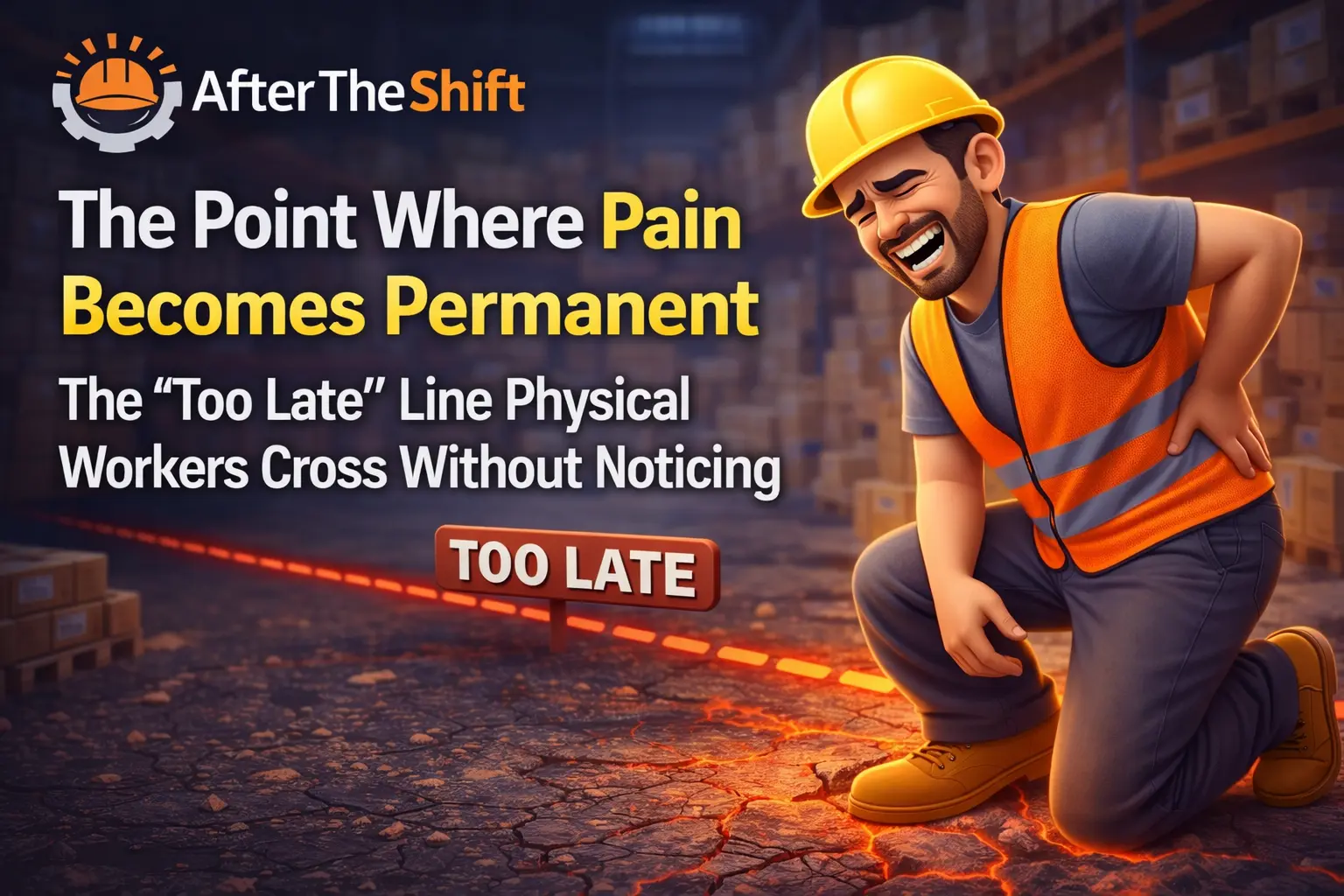
The Point Where Pain Becomes Permanent: The “Too Late” Line Physical Workers Cross Without Noticing
Chronic pain usually doesn’t start with a dramatic injury. For warehouse workers, construction workers, tradespeople, and anyone doing repetitive lifting, carrying, bending, kneeling, or overhead work, it often begins as “normal soreness” after shifts—then quietly turns into persistent pain, overuse injury, or a repetitive strain injury (RSI).
This post stays focused on one question: when does pain stop being temporary and start becoming long-term? You’ll get clear red flags, a simple self-check, and a practical 7–14 day reset plan that reduces inflammation, improves tissue tolerance, and lowers the odds of pain becoming your “new normal.”
Quick answer: the “too late” line
Pain starts trending permanent when it keeps returning under the same workload, spreads, or starts changing your movement (limping, guarding, compensating) and doesn’t improve week-to-week. The biggest tell: your recovery stops working—sleep, rest days, stretching, and “taking it easy” no longer bring you back to baseline.
Definition: what “permanent pain” actually means
“Permanent pain” usually isn’t literally permanent. In most cases it means pain has become persistent—it repeats, lingers, or comes back faster and harder under normal work demands. Clinically, many guidelines label pain that lasts or recurs beyond the expected healing window (often 3+ months) as persistent or chronic pain.
The dangerous part is not the calendar. It’s the pattern: your tissues and nervous system adapt to pain the same way they adapt to workload. If the input stays the same (repetition + load + fatigue + poor recovery), the output becomes predictable: recurring back pain, shoulder pain, knee pain, wrist pain, tendinopathy/tendonitis-like symptoms, plantar fascia pain, or nerve-type pain (tingling, numbness, burning).
If you want the baseline framework first, read: Work pain vs injury: knowing the difference matters and Micro-damage: how repetitive work destroys joints quietly.
The point where pain becomes permanent (the real mechanism)
1) You stop returning to baseline
Normal soreness fades. Risk starts rising when you don’t fully reset between shifts. That means each week starts with leftover pain, stiffness, or tightness. Over time, your “zero” becomes a 2/10… then a 4/10… then an 6/10 on bad days.
2) You begin compensating (and your body learns it)
Limping, twisting to avoid back pain, shrugging through shoulder pain, changing grip because of wrist pain—these are not harmless hacks. They redistribute stress and can create secondary problems (hip pain, neck pain, opposite-side knee pain).
3) The workload stays constant while capacity drops
This is the trap in physical jobs: the job doesn’t scale down when you’re fatigued. If your recovery (sleep, hydration, nutrition, conditioning, mobility) is weak, your tissue capacity drops while the workload remains fixed. That mismatch is where overuse injuries thrive.
Related deep-dives you may need: Lower back pain after shifts, Knee pain that starts after work, Wrist pain from repetition.
Red flags you should not ignore
- Night pain or pain that wakes you up (especially if new or worsening).
- Nerve symptoms: numbness, tingling, burning, shooting pain, weakness, dropping items, foot slapping, or radiating pain (e.g., sciatica-like symptoms).
- Stalled progress: no improvement over 2–3 weeks despite rest days and basic recovery.
- Spreading pain: it starts local, then expands (back → hip → leg; shoulder → neck → arm).
- Function loss: reduced range of motion, grip strength, overhead tolerance, squat tolerance, or walking tolerance.
- “Warm-up gets you through, then it’s worse later”: classic overuse/tendon irritation pattern.
Reality check: if you’re asking “is this normal?”
Most people ask that question only after the pattern has started. Don’t debate semantics. Treat it as a capacity problem and act early.
60-second self-check for chronic pain risk
Score yourself (0–2 each): 0 = no, 1 = sometimes, 2 = yes.
- My pain returns every week under the same work tasks.
- I’m starting shifts already stiff/sore.
- I change how I move to avoid pain (guarding/compensating).
- Rest days don’t reset me back to normal.
- I have tingling/numbness/burning/shooting pain.
Interpretation:
0–3: monitor, improve recovery basics.
4–6: high risk—apply the 7–14 day reset now.
7–10: treat as a real problem—scale workload, consider a clinician/physio evaluation.
The 7–14 day reset plan (step-by-step)
This is not “rest and hope.” It’s load management + tissue-friendly movement + sleep/recovery upgrades—the three levers that actually change outcomes in overuse pain.
Step 1 (Days 1–3): Stop the bleed (reduce aggravation)
- Identify the trigger: which movement or task spikes pain (lifting from floor, twisting, overhead reaching, kneeling, gripping, vibrating tools).
- Scale the trigger by 30–50%: fewer reps, lighter loads, shorter sets, more breaks, swap tasks where possible.
- Rule: pain during work stays ≤ 3/10 and returns to baseline by next morning.
Step 2 (Days 4–10): Rebuild capacity (without flare-ups)
- Daily 8–12 minutes of easy movement targeting the area: walking + gentle range-of-motion.
- 2–4 sessions of simple strengthening (light): slow controlled reps to build tolerance.
- Keep it boring: consistency beats intensity when pain is recurring.
Step 3 (Days 11–14): Return to normal work smarter
- Add back load gradually: 10–20% increases in volume, not sudden jumps.
- Keep breaks “planned,” not “panic breaks.”
- Track one metric: next-morning baseline. If baseline worsens, you overdid it.
For the recovery foundation, use: What real recovery looks like after physical work and Rest vs recovery: why sleeping isn’t fixing you.
Pros & cons: pushing through vs scaling intelligently
Pushing through
- Pros: short-term productivity, avoids awkward conversations, feels “tough.”
- Cons: higher chronic pain risk, compensation injuries, slower long-term performance, possible nerve irritation, missed work later.
Scaling intelligently (load management)
- Pros: maintains career longevity, reduces flare-ups, improves tissue tolerance, supports strength progression.
- Cons: requires planning, sometimes needs task negotiation, ego hit at first.
Comparison table: soreness vs overuse injury vs nerve pain
| Type | How it feels | Typical timing | What helps most | What to avoid |
|---|---|---|---|---|
| Normal soreness | dull ache, muscle tenderness | 12–48 hours after new/hard work | sleep, hydration, light movement | total inactivity for days |
| Overuse / tendinopathy-style pain | localized ache, stiffness, “warm-up then worse later” | builds over weeks; flares with repetition | load management + progressive strength | spikes in volume, “stretch it harder” as a fix |
| Nerve-type pain | tingling, numbness, burning, shooting, weakness | can be sudden or gradual; radiates | early assessment + targeted plan | ignoring weakness/numbness |
Actionable examples (warehouse + construction)
Warehouse: wrist/forearm pain from repetition
- Swap grip where possible (neutral grip), reduce “death-grip.”
- Micro-breaks: 20–40 seconds every 20–30 minutes.
- Light forearm strength 2–3x/week (controlled reps).
Construction: lower back pain after shifts
- Reduce floor-to-waist lifts; raise the work height when possible.
- Break up long bending blocks (rotate tasks or posture).
- Daily walking + gentle hip mobility + basic trunk endurance work.
If you catch yourself saying “everyone hurts,” read this: Why “everyone hurts” is a dangerous lie.
When to get medical help (serious symptoms)
This site is practical education, not a diagnosis. If any of the following are present, get evaluated promptly:
- New or worsening weakness (hand grip, foot lift, leg giving out)
- Persistent numbness, spreading tingling, or severe radiating pain
- Unexplained fever, weight loss, major trauma, or pain that is severe and escalating
- Loss of bladder/bowel control (urgent)
For general health guidance on musculoskeletal pain and when to seek care, see: NHS: Back pain, CDC/NIOSH (workplace health & safety), and World Health Organization.
FAQ
How long does it take for pain to become chronic?
There isn’t a single clock, but persistent symptoms that last or recur for months—especially with stalled improvement—are higher risk. The more important marker is pattern: pain that keeps returning under normal workload.
Is it okay to work through pain?
Sometimes, yes—if pain stays mild (about 3/10 or less), doesn’t spread, doesn’t change your movement, and returns to baseline by the next morning. If not, you’re training the wrong adaptation.
What’s the fastest way to stop overuse pain?
Load management plus a simple strength plan. Stretching alone rarely fixes overuse injuries because it doesn’t rebuild capacity for repetition and load.
Why does pain show up after work but not during?
Fatigue masks symptoms during the shift, then inflammation/irritation catches up later. This pattern is common in repetitive strain, tendon irritation, and joint overload.
What if I can’t reduce workload at my job?
Then you reduce the damage per hour: micro-breaks, rotation, better movement choices, and rebuilding strength outside work. It’s not perfect, but it shifts the math in your favor.
Sources & references
- General clinical definitions and guidance on persistent/chronic pain and red-flag symptoms: major public health and national healthcare resources (e.g., NHS, WHO).
- Occupational health context: CDC/NIOSH workplace safety and ergonomics resources.
- Conceptual framework: load management, tissue capacity, and conditioning principles used broadly in physiotherapy and sports medicine.
About the author
This article is general recovery education, not a diagnosis or a substitute for care from a qualified clinician. Stop and get medical help for severe pain, numbness, weakness, chest pain, sudden swelling, fever, or symptoms that keep worsening.


Log in to leave a comment.