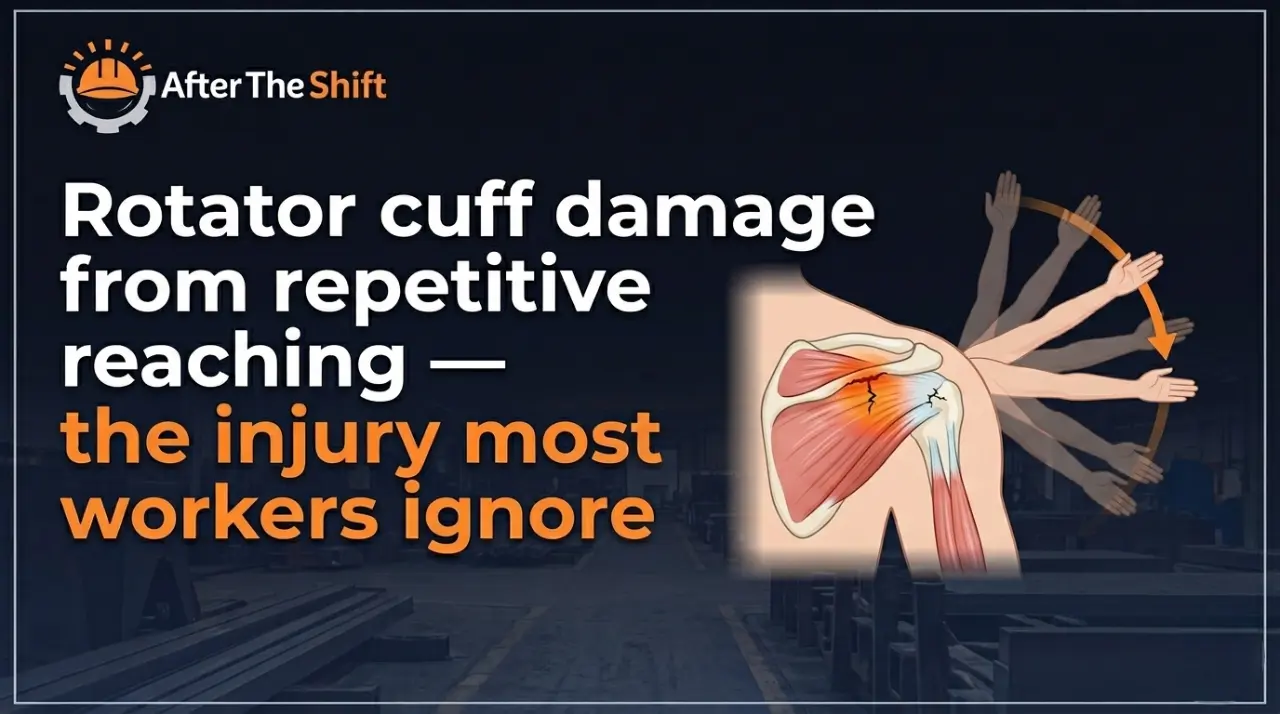
If reaching, scanning, stocking, hanging, or overhead grabs keep lighting up your shoulder, this breaks down what stage you’re in, what to change, and when to stop guessing.
If reaching, scanning, stocking, hanging, or overhead grabs keep lighting up your shoulder, this breaks down what stage you’re in, what to change, and when to stop guessing.
Rotator cuff damage from repetitive reaching usually starts as irritation from repeated arm elevation, poor shoulder position, and too much volume without enough recovery. If the pain is getting worse, your arm feels weak, or you have night pain and loss of motion, you need to reduce the trigger fast and treat it like a developing injury, not “normal soreness.”
- Cut down repeated overhead reaches for a few days
- Use pain-guided range-of-motion work, not total shutdown
- Ice after the shift if the shoulder feels hot or irritated
- Track weakness, night pain, and loss of motion
- Pushing through sharp pain on reaches above shoulder height
- Heavy jerking lifts when the shoulder already feels unstable
- Copying random rehab drills that spike pain for hours
- Ignoring new weakness or sudden inability to lift the arm
If reaching overhead or out in front keeps causing pain for more than 2 weeks, or you now have weakness or night pain, stop treating it like “work soreness” and change the load pattern immediately.
| If you… | Most likely meaning | What to do today | Risk flag |
|---|---|---|---|
| Feel pain only at the end of the shift | Early overload or tendon irritation | Reduce reach volume, ice, start light controlled motion | Low |
| Feel pain when lifting the arm to the side or above shoulder height | Classic cuff irritation / impingement pattern | Cut overhead tasks, improve arm path, consider rehab tools | Moderate |
| Have pain at night or when lying on that shoulder | Inflamed cuff or bursa; recovery is already lagging | Unload hard, use positioning support, monitor sleep disruption | Moderate |
| Notice weakness, dropping items, or can’t raise the arm well | Possible more serious cuff damage or tear | Get medically assessed sooner rather than later | High |
Why repetitive reaching beats up the rotator cuff
Your rotator cuff is a set of muscles and tendons that help center and control the shoulder joint. Reaching over and over, especially above shoulder level or slightly out in front, can irritate the cuff and surrounding structures. The usual pattern is not one dramatic lift. It is hundreds of small reaches stacked on top of fatigue, poor shoulder position, and no real recovery.
That is why workers in picking, stocking, hanging, painting, scanning, packaging, cleaning, and assembly can get shoulder damage even when nothing “heavy” happened. Pain with lifting the arm, pain at night, and weakness are the signals that the shoulder is no longer tolerating the volume.
| Load pattern | What it does to the shoulder | Why it gets worse over time |
|---|---|---|
| Reaching above shoulder height | Crowds the cuff and increases irritation | High reps with poor recovery |
| Long reaches out in front | Makes the shoulder work far from its strongest position | Fatigue breaks form first |
| Fast repetitive scanning / sorting | Low force, high volume tendon overload | “Light work” hides total dose |
| Working tired at end of shift | Shoulder blade control drops | Bad reps multiply fast |
How your job pattern changes the risk
Not all shoulder work is equal. The danger is the combination of arm angle, repetition, and how far the load is from your body. Light boxes overhead all day can beat up a shoulder faster than a few heavier lifts kept close.
| Job type | Typical angle | Risk | Compounding factor |
|---|---|---|---|
| Warehouse stocking | Above shoulder / out front | High | Repetition + shelf depth |
| Packaging / scanning | Forward reach | Moderate | Thousands of small reps |
| Construction overhead install | Overhead hold | High | Static fatigue + tools |
| Cleaning / wiping walls or glass | Repeated elevation | Moderate | Long sets without breaks |
| Low-shelf picking only | Below shoulder | Lower | Usually shifts stress elsewhere |
If this sounds like your shift, also read how repetitive work quietly destroys joints, the physical work recovery guide, and why shoulder pain from overhead work keeps getting worse every month so you can catch the pattern earlier.
Symptom → cause → fix matrix
| Symptom | Likely cause | Best first fix | Red flag? |
|---|---|---|---|
| Pinch at top/outside of shoulder when lifting arm | Cuff irritation / impingement pattern | Reduce overhead reps and long reaches | No |
| Aching at night | Inflammation and poor recovery | Unload, ice, sleep support pillow | Watch closely |
| Arm feels weak when lifting or rotating | More advanced cuff irritation or tear | Assessment sooner, don’t force it | Yes |
| Pain after a sudden jerk or fall | Acute strain or tear | Seek urgent medical advice if you can’t lift well | Yes |
| Stiffness but little true pain | Protective guarding / early irritation | Gentle motion, better work setup | No |
Fast decision tree: work soreness or developing injury?
Start here: does the shoulder hurt mainly when you reach above shoulder height or far out in front?
The 4 damage stages workers pass through
| Stage | What it feels like | What’s happening | Recovery window | Action |
|---|---|---|---|---|
| 1. End-of-shift ache | Comes and goes | Early overload | Days to a couple weeks | Fix work pattern now |
| 2. Pain with reaching | Specific angles hurt | Cuff irritation is sticking around | Weeks | Unload + rehab |
| 3. Night pain / weakness | Sleep disrupted, arm feels unreliable | More significant tissue irritation or damage | Weeks to months | Get assessed |
| 4. Function loss | Can’t lift or rotate well | Possible tear / major flare | Variable | Urgent evaluation |
Mini-test: how bad is your work pattern right now?
Score 1 point for each “yes.” This is not a diagnosis. It is a risk screen for workers who keep irritating the same shoulder.
What actually fixes it — by phase
Most shoulder cases start with conservative treatment: activity change, rest from aggravating moves, ice, pain relief options, and physical therapy. The key is that “rest” does not mean total shutdown forever. It means stop feeding the exact movement pattern that keeps causing the flare.
- Warm the shoulder with easy circles and light band work
- Know which shelf heights or tasks trigger you
- Do not start cold then hit overhead work fast
- Reduce repeated high reaches where possible
- Keep loads closer to the body
- Alternate sides or tasks before fatigue wrecks form
- Ice if it feels hot or throbbing
- Use gentle mobility, not aggressive stretching
- Support sleep position so the shoulder can calm down
Treatment options compared
| Treatment | Best for | Skip if | Cost / effort |
|---|---|---|---|
| Activity modification | Everyone with work-triggered irritation | You expect zero task changes | Low cost / high payoff |
| Ice / cold wrap | Hot, irritated post-shift flare-ups | You want it to replace load changes | Low cost / easy |
| Bands / light strength work | Early rebuilding and control | Exercises spike pain for hours | Low cost / moderate effort |
| Shoulder pulley | Gentle range-of-motion work | Acute severe pain after trauma | Low cost / easy |
| Formal physical therapy | Ongoing pain, weakness, motion loss | You only want passive treatment | Higher cost / best guidance |
| Injection / surgery pathway | Cases not settling or suspected significant tear | You have not tried conservative care when appropriate | Higher cost / medical route |
A reusable shoulder ice wrap makes post-shift cooling easier than balancing loose ice.
Who should skip: anyone expecting ice to fix the root load problem.
A resistance band set is the simplest way to rebuild control without heavy loads.
Who should skip: acute injury with sharp weakness after trauma.
A shoulder pulley is useful when the shoulder is stiff and you need controlled range work.
Who should skip: people with red-flag pain or severe sudden injury.
This same “catch it before it becomes your normal” pattern shows up in other posts too: pain that becomes background noise, work pain vs injury, why pushing through work pain makes injuries worse, and what a normal workday does to the body.
Shift-proof checklist
FAQs workers actually ask
Related links
- Physical Work Recovery Guide
- Shoulder pain from overhead work: why it gets worse every month
- Micro-damage: how repetitive work destroys joints quietly
- Work pain vs injury: knowing the difference matters
- Pain that becomes background noise
- Why pushing through work pain makes injuries worse
- What a normal workday does to the body
Next steps
- Identify the exact work angle that keeps triggering the shoulder.
- Reduce overhead and long-forward reaches for the next 7 to 14 days.
- Use a cold wrap, support pillow, bands, or pulley only as tools to support the real fix: better load management.
- If weakness, night pain, trauma, or motion loss are present, get assessed instead of dragging it out.
This article is general recovery education, not a diagnosis or a substitute for care from a qualified clinician. Stop and get medical help for severe pain, numbness, weakness, chest pain, sudden swelling, fever, or symptoms that keep worsening.

Log in to leave a comment.