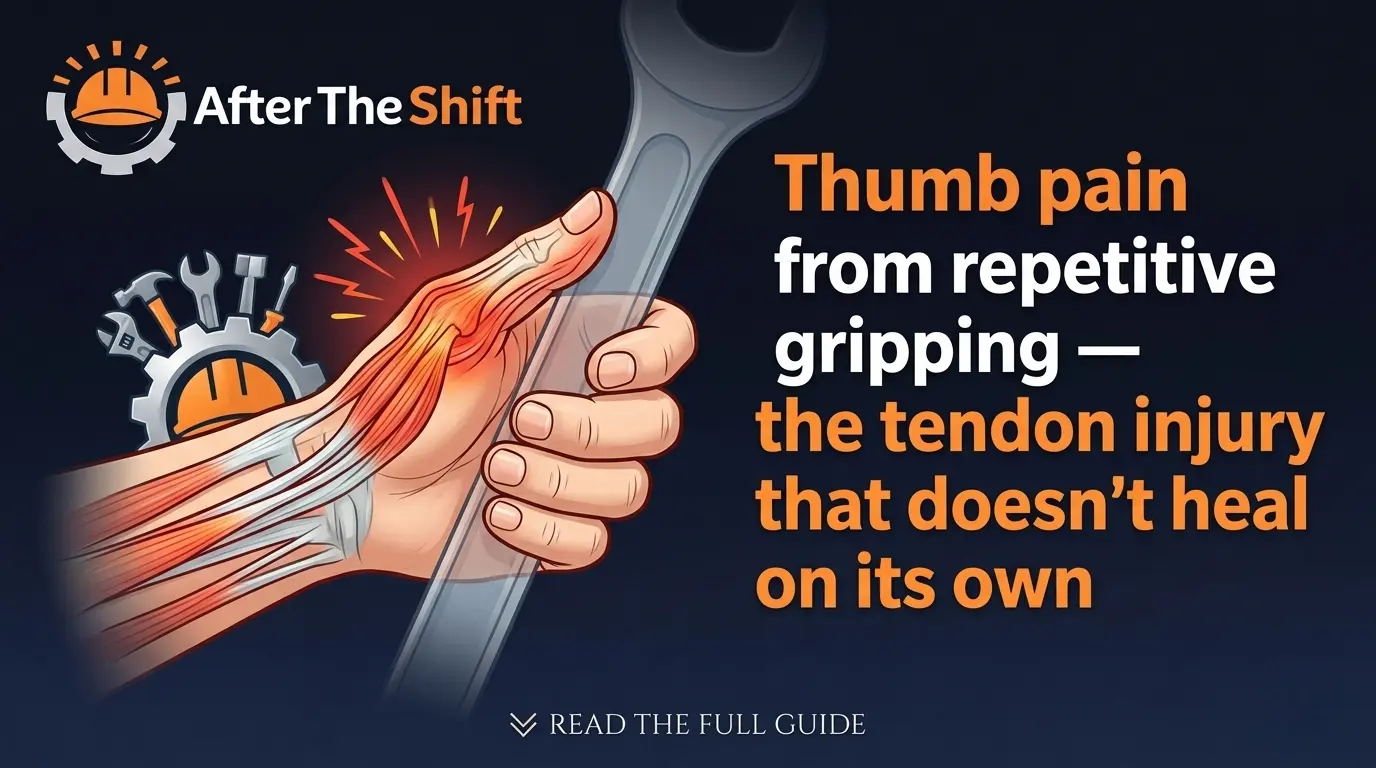
If your thumb hurts every shift and rest never fully resets it, this helps you tell irritation from tendon damage and act before grip strength drops.
Home → Physical Work Recovery Guide → Thumb pain from repetitive gripping — the tendon injury that doesn't heal on its own
Thumb pain from repetitive gripping — the tendon injury that doesn't heal on its own
Repetitive gripping can turn thumb pain into a stubborn tendon problem that keeps flaring every time you grab, pinch, twist, or lift. This guide helps physical workers spot the pattern early, reduce load fast, and know when the problem is no longer safe to push through.
Thumb pain from repetitive gripping is usually a tendon overload problem, not just “normal soreness.” If pain sits near the base of the thumb, gets worse with gripping or pinching, and keeps returning after rest, the tendon is likely staying irritated because the load never fully drops long enough to calm down.
- Reduce gripping volume early
- Use a straighter wrist and thumb position
- Break up long pinch-heavy tasks
- Track pain during and after shifts
- Pushing through sharp thumb pain
- Testing it all day by squeezing harder
- Ignoring swelling or clicking
- Assuming rest days alone will fix it
If gripping, pinching, twisting, or lifting keeps recreating the same thumb pain for more than 7 to 14 days, treat it like tendon overload now — because “working through it” is usually what keeps it from settling.
Fast Answer for Busy Readers: Thumb pain from repetitive gripping usually applies to warehouse work, tools, packaging, assembly, cleaning, food prep, moving stock, and any job with repeated pinch or squeeze force. This does not fully apply to a fresh fall, obvious deformity, sudden severe swelling, numbness spreading into the hand, or pain that is coming mainly from the wrist, thumb joint arthritis, or a fracture pattern.
| If you… | Most likely issue | What to do next | Risk flag |
|---|---|---|---|
| Feel a dull ache after long gripping but it eases overnight | Early tendon irritation | Cut load, improve grip setup, monitor 7 days | Low |
| Get pain every shift when pinching, twisting, or opening the thumb | Active overload pattern | Modify work now and start recovery plan | Moderate |
| Notice swelling, creaking, or a catching feeling near the thumb side of the wrist | More irritated tendon sheath | Stop provoking tasks and get assessed soon | High |
| Cannot grip well, pain spikes fast, or pain lasts into days off | Progressing tendon injury | Treat as injury, not soreness | High |
- Why thumb tendons get stuck in the same pain loop
- How your job type changes the risk
- Symptom → cause → fix matrix
- Decision tree: keep working, modify, or stop
- The 4 damage stages
- Mini-test: how far has it gone?
- What actually fixes it by phase
- Treatment options compared
- Shift-by-shift checklist
- FAQs workers actually ask
Why thumb tendons get stuck in the same pain loop
Thumb pain from repetitive gripping happens when the tissue handling thumb movement gets loaded more often than it recovers. The tendon can tolerate work, but it usually fails when the same pinch, squeeze, twist, and carry pattern repeats for hours with no real drop in demand.
In plain language: the tendon is not failing because one object was too heavy. It is more often failing because the same thumb angle and force were repeated hundreds or thousands of times. That is why workers in repetition-heavy package scanning jobs and all-day tool gripping work often flare faster than someone who lifts heavier loads less often.
| Load factor | What it does to the tendon | Typical work example |
|---|---|---|
| High repetition | Keeps tissue irritated before it settles | Fast picking, sorting, scanner handling |
| Pinch grip | Loads the thumb harder than a relaxed full-hand grip | Label peeling, small-part assembly, zip ties |
| Awkward angle | Adds friction and pressure | Bent wrist while squeezing tools or bottles |
| Long duration | Removes recovery windows | Back-to-back shifts or overtime |
The tendon often feels “almost okay” at rest. That fools workers into reloading it too early. If the same motion recreates the pain quickly every shift, the tissue is not actually calm yet.
How your job type changes the risk
Job type matters because different tasks force different thumb angles, grip styles, and recovery gaps. The same sore thumb means something different in packaging than it does in construction or cleaning.
| Job type | Main thumb angle/load | Risk level | Compounding factor |
|---|---|---|---|
| Warehouse picking | Repeated grab and pinch | Moderate | Speed targets |
| Package scanning | Thumb press plus wrist deviation | High | Thousands of repetitions |
| Tool use | Squeeze force and vibration | High | Tight handles, cold, torque |
| Assembly line | Fine pinch grip | High | No task variation |
| Cleaning / spray work | Trigger squeeze | Moderate | Long duration |
This is more likely when the job combines repetition + pinch + awkward wrist angle + no real rotation. It is less likely to be a pure tendon problem if the thumb pain started after one sudden impact, a crush injury, or a fall.
Symptom → cause → fix matrix
The fastest way to stop guessing is to match the symptom pattern to the likely cause. A good matrix is more useful than generic “rest it” advice.
| Symptom | Likely cause | Fastest fix | Red flag |
|---|---|---|---|
| Ache at thumb base after long shifts | Early overload | Reduce total gripping volume | Pain spreading daily |
| Pain with pinch, twist, or opening jars/tools | Thumb tendon irritation | Unload pinch-heavy tasks | Loss of grip strength |
| Swelling or rubbing feeling near wrist-thumb side | Irritated tendon sheath | Stop provoking motion and get assessed | High concern |
| Numbness or tingling into fingers | May be nerve involvement instead | Do not treat as tendon-only | High concern |
| Sharp pain after one accident | Possible sprain or fracture pattern | Get checked, do not guess | Urgent |
A thumb tendon injury from repetitive gripping is more likely when pain is recreated by pinch, squeeze, twist, or thumb opening, improves only partly with rest, and comes back quickly during normal work. It does not behave like simple fatigue because the same task keeps triggering it at a lower threshold each week.
Decision tree: keep working, modify, or stop
Use this to decide what category your thumb pain fits today. The goal is not a diagnosis. The goal is to stop treating a progressing tendon injury like ordinary shift soreness.
Did the pain start after one sudden impact, fall, crush, or obvious twist?
The 4 damage stages
Thumb tendon overload usually progresses in stages. The useful question is not “Does it hurt?” The useful question is “How easily does work recreate it, and how long does it stay angry?”
| Stage | What it feels like | What is happening | Recovery pattern | Action |
|---|---|---|---|---|
| 1. Irritation | Mild ache after work | Tissue tolerance is being tested | Usually settles quickly | Lower volume now |
| 2. Reactive overload | Pain during specific tasks | Tendon is staying irritated | Partial reset only | Modify work and recover |
| 3. Persistent overload | Pain every shift, grip weakness | Tolerance is dropping | Days off stop being enough | Treat as injury |
| 4. Entrenched stage | Pain with light daily tasks | Load tolerance is very low | Slow recovery | Needs proper assessment |
If you cannot hold normal objects well, the thumb looks visibly swollen, the pain is sharp with light motion, or numbness is present, stop treating this like ordinary overuse and get it assessed.
Mini-test: how far has it gone?
This score does not diagnose you. It ranks how much your work pattern now looks like a stubborn thumb tendon overload pattern.
What actually fixes it by phase
The fix depends on timing. Early irritation responds to smart unloading. Later-stage cases usually need a bigger drop in provocation and a slower rebuild.
- Warm the hand and thumb for 3 to 5 minutes
- Choose bigger handles when possible
- Avoid starting cold with max squeeze tasks
- Brace only if it clearly reduces provocation
- Swap pinch grip for full-hand grip where possible
- Break long gripping blocks into smaller runs
- Rotate the worst tasks sooner, not later
- Stop using pain as a test every 10 minutes
- Reduce extra phone, gaming, tool, and jar-opening load
- Use simple recovery, not endless aggressive stretching
- Track whether pain is settling by next morning
- Only rebuild load when the baseline is calmer
The best early move is usually not total rest. It is targeted load reduction: less pinch, less twisting, fewer repeated tests, and better task rotation. That keeps you functional without feeding the injury loop.
Treatment options compared
Not every option deserves the same weight. Rank them by whether they reduce provocation, protect function, and help you rebuild tolerance instead of just muting symptoms.
| Treatment | Best for | Avoid if | Cost / trade-off |
|---|---|---|---|
| Task modification | Early and mid-stage cases | Skip only if injury is from acute trauma | Best value, needs discipline |
| Thumb brace / support | Short-term calming | Avoid as a permanent crutch | Low to moderate cost |
| Simple pain relief measures | Short-term symptom control | Avoid relying on it to keep overloading | Helps symptoms, not cause |
| Progressive rehab loading | When baseline pain is calmer | Avoid starting hard during flare | High payoff, needs patience |
| Full rest with no plan | Rarely best as a solo strategy | Avoid if you will just reload the same pattern later | Low effort, weak long-term result |
Best pick: task modification plus controlled recovery. Best budget: changing the load pattern before buying anything. Best upgrade: proper rehab progression once the pain is no longer being triggered all day.
Shift-by-shift checklist
Use this as a printable or copy-paste checklist. The point is consistency, not perfection.
FAQs workers actually ask
These answers are written to stand alone. That matters because workers often search one exact question when the thumb starts failing.
Related links that complete the answer path
Thumb pain rarely happens in isolation. Use these to connect the bigger pattern of repetitive work damage and recovery:
- Physical Work Recovery Guide — the main recovery hub
- Carpal tunnel in warehouse workers — the early signs everyone misses
- Wrist pain from scanning packages — why repetition beats weight every time
- Hand pain from gripping tools all day — when “just tough hands” becomes nerve damage
- Micro-damage — how repetitive work destroys joints quietly
- Work pain vs injury — knowing the difference matters
Bottom line
Thumb pain from repetitive gripping usually responds best when you act in the early overload window, not when the problem is already running every shift. The best choice is usually to reduce the exact motions causing it, lower pinch volume, and rebuild only after the baseline calms down.
Best for: workers with repeatable thumb pain from gripping, pinching, twisting, or scanner/tool use. Avoid self-managing only: sudden injuries, major swelling, numbness, sharp pain with light motion, or obvious grip failure. What to do next: use the checklist for one week and compare how fast the pain returns.
Next steps
- Decide whether your pattern fits early irritation, active overload, or a red-flag case.
- Remove at least one high-pinch or high-twist task from the next shift.
- Use the checklist for 7 days and note whether pain shows up later, lighter, or less often.
- If pain keeps returning fast, move from “watching it” to treating it like a real injury.
- Read the linked wrist, hand, and nerve-related posts if your symptoms spread beyond the thumb.
Save this. Bookmark it before your next shift so you can compare your thumb pain pattern against the tables, decision tree, and checklist without guessing.
Log in to leave a comment.