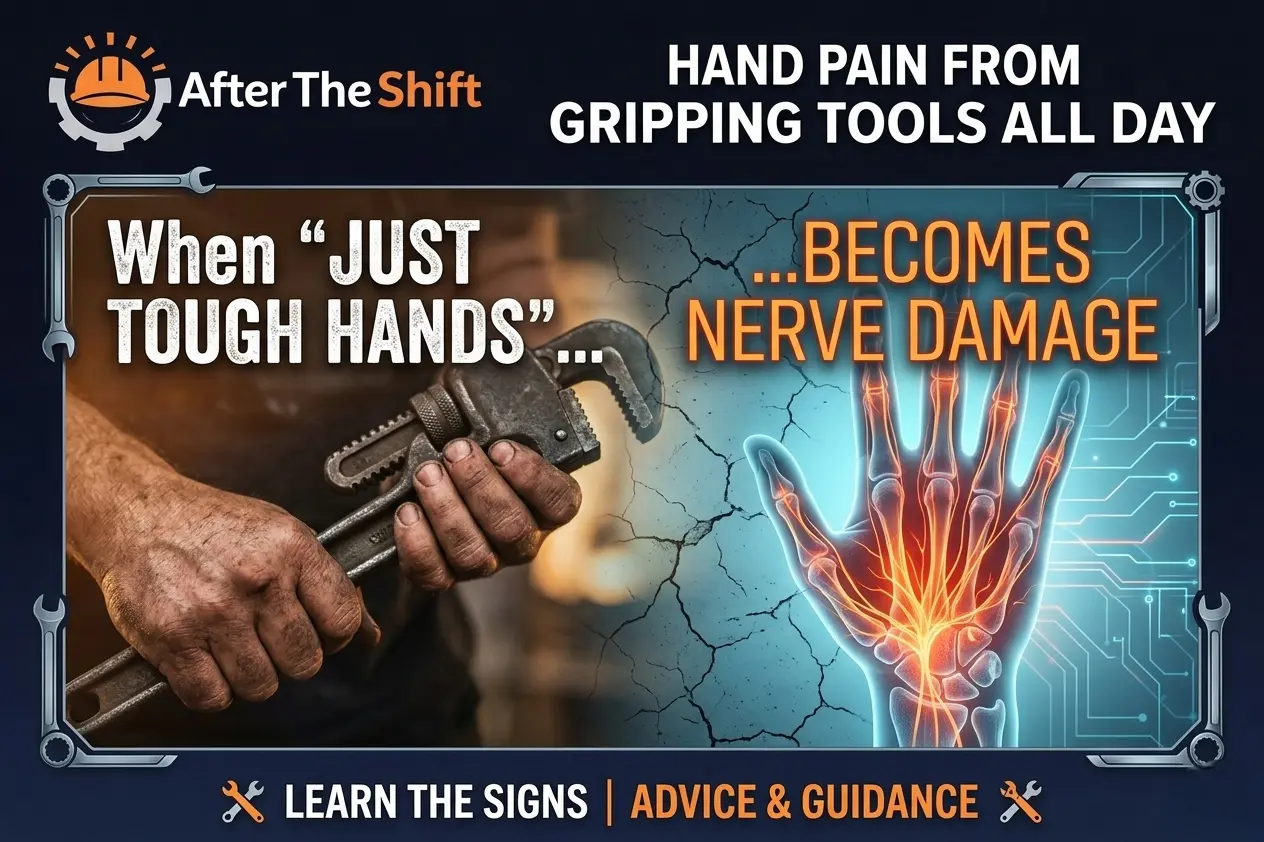
Daily gripping, vibration, and wrist compression can turn “normal sore hands” into numbness, weakness, and nerve trouble if you miss the early signs.
If your hands ache, tingle, go numb, or lose grip after tool use, that is not just “hard work pain.” The real split is simple: muscle soreness settles; nerve compression keeps sending signals.
Hand pain from gripping tools all day usually starts as a load problem in the forearm, tendons, and soft tissue, but it can become a nerve problem when swelling, wrist bending, vibration, and repeated force begin compressing the median or ulnar nerve. If your pain comes with numbness, burning, finger tingling, night symptoms, or dropping tools, treat it like a nerve-warning pattern, not just “tough hands.”
- Reduce hard squeezing whenever possible
- Change wrist angle before adding more effort
- Track numbness, weakness, and night symptoms
- Use short reset breaks before symptoms spike
- Pushing through tingling like it is normal soreness
- Death-gripping thick or vibrating handles all shift
- Sleeping on a bent wrist after flare-ups
- Ignoring dropped tools or grip weakness
If hand pain stays local and fades with rest, it is more likely overload; if it comes with numbness, finger tingling, weakness, or waking up with dead hands, assume nerve compression until proven otherwise.
| If you… | Most likely issue | What to do next | Risk flag |
|---|---|---|---|
| Feel hand fatigue only at the end of shift | Grip overload | Reduce force, improve handle fit, add micro-breaks | Low |
| Get sharp palm or wrist pain during gripping | Tendon irritation + compression | Unload early, change wrist angle, monitor swelling | Moderate |
| Wake up with numb thumb, index, or middle finger | Median nerve compression | Treat as nerve issue, not soreness | High |
| Lose grip or drop tools | Nerve irritation or muscle inhibition | Stop treating it like normal work pain | High |
Why gripping tools all day starts hurting the hand
Tool work punishes the hand in four ways at once: force, time, position, and vibration. Hard gripping increases pressure through the palm and wrist. Bent-wrist positions narrow the space where nerves glide. Long shifts reduce recovery. Vibration adds another layer by irritating tissue and dulling your sense of how hard you are actually squeezing.
That is why some workers think their hands are just “getting stronger” while the opposite is happening. The forearm flexors get overloaded, the tendons get irritated, the wrist gets crowded, and the nerve starts getting squeezed. You can see the same quiet build-up pattern in how repetitive work destroys joints quietly.
| Load factor | What it does | Why it matters |
|---|---|---|
| High grip force | Compresses palm, flexors, wrist tunnel | Creates irritation fast |
| Bent wrist | Reduces nerve space | Turns “just gripping” into compression |
| Long exposure | Keeps tissue loaded without enough reset | Moves soreness toward chronic irritation |
| Vibration | Adds nerve and vessel stress | Speeds up numbness and reduced feel |
How job type changes the risk
Not all gripping is equal. Tight repetitive pinching in assembly is different from swinging a vibrating demolition tool, but both can drive nerve irritation. The detail that matters most is not just the job title. It is the mix of handle size, wrist angle, repetition, and vibration.
| Job type | Typical hand angle | Risk | Compounding factor |
|---|---|---|---|
| Assembly / scanning | Small repeated pinch and slight wrist bend | Moderate | No real recovery between reps |
| Construction fastening | Grip + trigger + off-angle wrist | High | Force spikes |
| Demolition / hammer drill | Firm hold under vibration | High | Vibration + high squeeze |
| Warehouse cutting / taping | Repeated finger flexion | Moderate | Volume adds up fast |
| Tile / finish work | Sustained grip + awkward reach | High | Long holds without reset |
Symptom → cause → fix matrix
| Symptom | Likely cause | Best first fix | Red flag |
|---|---|---|---|
| Deep forearm burn | Grip overuse | Lower force, add resets, open the hand often | Becomes sharp near wrist |
| Thumb, index, middle tingling | Median nerve compression | Neutral wrist, unload early, stop sleeping bent | Night numbness |
| Ring and little finger numbness | Ulnar nerve irritation | Reduce elbow/wrist compression, change position | Grip weakness |
| Pain at base of thumb | Pinch overload | Reduce pinch tasks, use larger grip surface | Pain even off shift |
| Dropping tools | Weakness from nerve or severe overload | Treat as escalation, not “bad luck” | Repeated loss of grip |
If you have already had wrist pain from repetition, not weight, this is often the next step in the same chain. The wrist gets crowded, the hand starts compensating, and now the grip itself becomes the problem.
Fast decision tree
Start here: does the problem stay as pain only, or has it turned into numbness or weakness?
The 4 damage stages
| Stage | What it feels like | What is happening | Recovery window | Action |
|---|---|---|---|---|
| Stage 1 | End-of-shift soreness only | Load exceeds recovery a little | Hours to 1 day | Fix exposure early |
| Stage 2 | Pain during shift and after | Tissue irritation building | 1–3 days | Reduce force and repetition now |
| Stage 3 | Numbness, tingling, waking at night | Nerve compression pattern | Days to weeks | Treat as nerve warning |
| Stage 4 | Weak grip, dropping tools, constant numbness | Function is being affected | Unpredictable, longer | Do not keep guessing |
Mini-test: is this becoming a nerve problem?
Count 1 point for every “Yes.”
What actually fixes it — by phase
Workers usually try one of two bad strategies: total rest until the next shift, or full denial until the hand gets worse. The better play is phase-specific control: reduce the trigger before the flare, protect the hand during the shift, and reset it after the shift without feeding stiffness.
- Pick the least aggressive grip option
- Test handle size before long tasks
- Start neutral, not bent, at the wrist
- Do 30–60 seconds of open-close hand resets
- Use the minimum grip force that still controls the tool
- Stop white-knuckle squeezing on vibration tools
- Rotate tasks before symptoms surge
- Open the hand fully between reps when possible
- Let swelling settle before another long grip session
- Do gentle wrist and finger motion, not aggressive cranking
- Avoid sleeping with the wrist folded
- Track next-morning numbness honestly
This same logic applies across the site: recover the right way, not just harder. See the physical work recovery guide, what real recovery looks like after physical work, and why most recovery advice fails physical workers.
Treatment options compared
| Treatment | Best for | Skip if | Cost / effort |
|---|---|---|---|
| Reducing grip force / changing tool setup | Early and mid-stage overload | You expect it to fix severe weakness alone | Low |
| Short task rotation breaks | High-repetition shifts | Breaks happen after symptoms explode | Low |
| Neutral wrist support at night | Night numbness patterns | Symptoms are only from skin irritation, not compression | Low to moderate |
| Gentle mobility and tissue calming | Stiffness after work | You turn it into painful stretching | Low |
| Medical assessment when weakness is obvious | Stage 3–4 patterns | You are still in simple end-of-shift soreness only | Moderate to high |
Most workers look for braces, creams, or magic stretches before fixing the thing that is feeding the problem every hour: how hard they grip and how long they stay there.
This costs nothing and works best when done before the flare, not after the hand is already cooked.
Better handle fit, better trigger positioning, and less awkward wrist angle usually beat “toughing it out” by a mile.
Shift checklist: stop hand pain before it turns ugly
FAQs
Related links
- Physical work recovery guide
- Wrist pain from repetition, not weight
- Frozen shoulder from repetitive work
- Rotator cuff damage from repetitive reaching
- Neck pain from looking down all shift
- Pain that becomes background noise
Next steps
- Figure out whether your pattern is soreness only or numbness/weakness too.
- Cut unnecessary grip force on the worst task first.
- Keep the wrist more neutral before adding more effort.
- Track next-morning symptoms for 7 days.
- If the hand is getting weaker or going numb at night, stop calling it “just tough hands.”
Save this page. When hand pain turns into numbness, workers usually realize it too late. Bookmark it now before your next heavy tool day.
This article is general recovery education, not a diagnosis or a substitute for care from a qualified clinician. Stop and get medical help for severe pain, numbness, weakness, chest pain, sudden swelling, fever, or symptoms that keep worsening.


Log in to leave a comment.