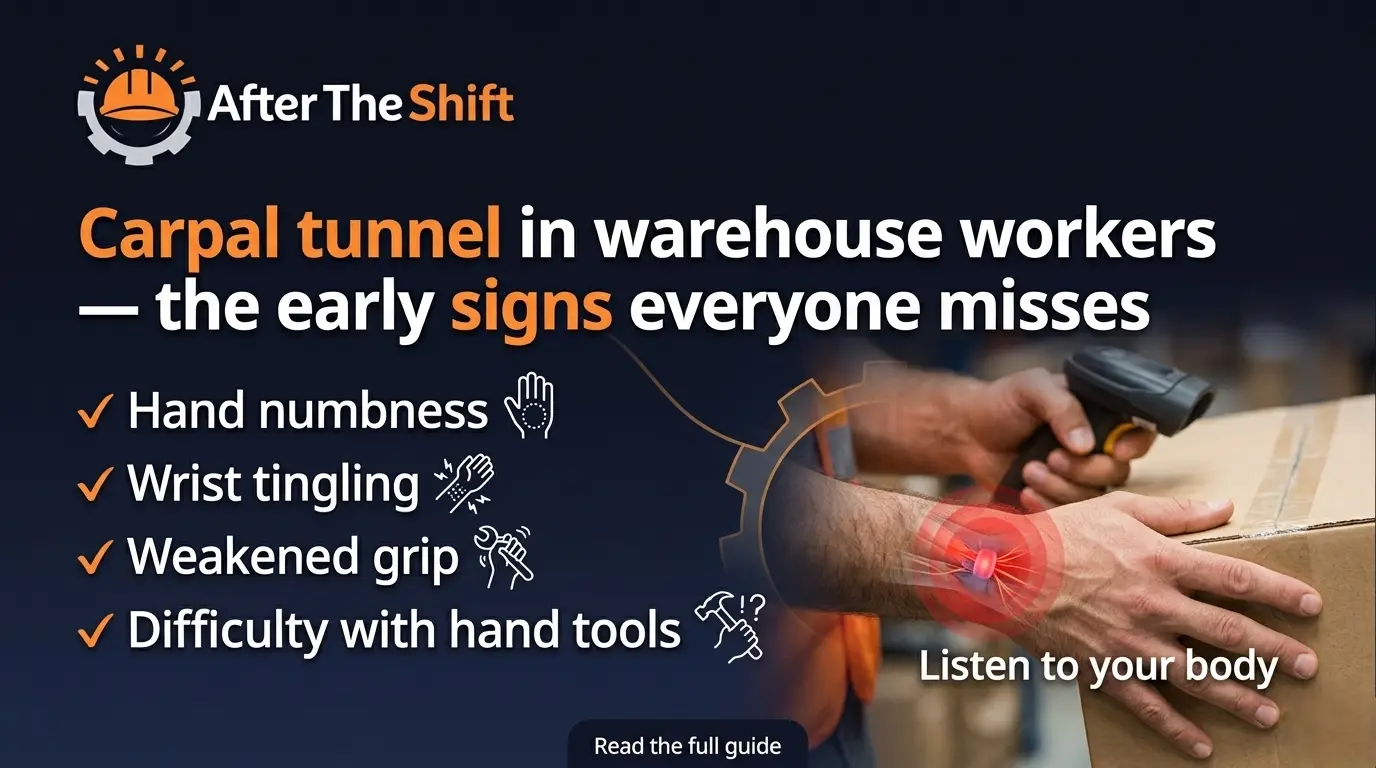
The numbness, night tingling, and grip weakness that workers brush off as “normal” are often the warning stage before carpal tunnel gets harder to reverse.
Carpal tunnel in warehouse workers usually starts with tingling, numb fingers, waking up at night, and grip weakness long before pain gets severe. It is more likely when your job combines repetition, bent wrists, forceful gripping, scanners, tape guns, box handling, pallet wrapping, or vibrating tools. This usually applies to warehouse, packing, assembly, and scanning jobs. This does not neatly apply to sudden traumatic wrist injuries, obvious fractures, or numbness coming from the neck or whole arm.
Warehouse carpal tunnel is an overload problem around the median nerve at the wrist, and the earliest signs are often missed because they feel “small” at first: finger tingling, numbness at night, dropping things, weaker grip, and needing to shake the hand out. Catching it early matters because mild cases can calm down with job changes, wrist position changes, and load control, while ignored cases can become persistent.
- Watch for night numbness or morning tingling
- Keep wrists closer to neutral during scanning and gripping
- Reduce force, repetition, and bent-wrist positions early
- Get checked sooner if weakness or dropping objects starts
- Ignoring symptoms because the boxes are “not heavy”
- Sleeping with the wrist curled hard inward
- Pushing through numbness that is getting more frequent
- Assuming all hand tingling is just fatigue or bad circulation
If your thumb, index, middle, or half of the ring finger keep tingling, waking you at night, or getting weaker, treat it like an early nerve warning now — because once weakness and constant numbness settle in, recovery is usually slower and harder.
Fast Answer for Busy Readers: In warehouse work, carpal tunnel is usually caused by high repetition plus bent wrists plus grip force, not just heavy lifting. The early signs most people miss are tingling in the thumb-side fingers, waking up with numb hands, shaking the hand for relief, reduced pinch strength, and a clumsy grip on tape guns, scanners, boxes, or shrink wrap. The fastest useful move is to reduce bent-wrist repetition early and stop treating nerve symptoms like normal soreness.
| If you… | What it likely means | Risk / flag | Best next move |
|---|---|---|---|
| Feel light tingling only after long repetitive tasks | Early overload around the wrist tunnel | Low if caught early | Reduce force and wrist bend now |
| Wake up with numb fingers and shake the hand out | Classic early carpal tunnel pattern | Moderate | Change wrist position and get assessed |
| Start dropping items or losing pinch strength | Median nerve irritation is affecting function | High | Stop delaying and get medical input |
| Have constant numbness or visible thumb weakness | More advanced nerve compression | High / urgent | Get evaluated promptly |
This usually applies to workers doing scanning, packing, relabeling, box opening, tape-gun use, pallet wrapping, repetitive picking, gripping handles, or vibration-heavy tasks. This is more likely when symptoms center in the thumb, index, middle, and half of the ring finger. This does not cleanly apply to whole-arm numbness, neck-triggered tingling, sudden crush injuries, or pinky-dominant numbness, which can point to different problems.
- What carpal tunnel really is in warehouse work
- Why it happens even when the work is not heavy
- How different warehouse jobs raise the risk
- Symptom → cause → fix matrix
- Decision tree: what your signs point to
- The 4 damage stages
- Mini-test: how worried should you be?
- What actually fixes it by phase
- Treatment options compared
- FAQ: real-worker questions
What carpal tunnel really is in warehouse work
Carpal tunnel syndrome means the median nerve is being compressed at the wrist, usually because the tunnel gets crowded by irritated tissues from repetition, force, position, or swelling.
For warehouse workers, the trap is simple: the job often feels “light” because each movement is small, but the wrist can still get hammered by thousands of repeats. That is why scanning, labeling, taping, picking, pulling wrap, and gripping awkward handles can build symptoms even without dramatic loads.
In warehouse workers, carpal tunnel is usually not a “one bad lift” injury. It is more often a repetition + bent wrist + grip force problem that quietly irritates the median nerve over days, weeks, or months.
Why it happens even when the work is not heavy
The main cause is usually accumulated load on the wrist tunnel, not one big effort. Small movements repeated with speed and bad wrist angles can beat occasional heavy work.
| Load factor | What it does to the wrist | Why it compounds |
|---|---|---|
| High repetition | Repeated tendon glide and friction | Less recovery between cycles |
| Bent wrist posture | Narrows available space in the tunnel | Turns mild load into nerve irritation |
| Forceful gripping | Increases tendon and forearm demand | Adds pressure every rep |
| Vibration | Aggravates tissue and nerve sensitivity | Makes symptoms show earlier |
| Long shifts with few changes | Keeps the same structures overloaded | Reduces recovery window |
Workers often wait for “real pain” before reacting. Early carpal tunnel is often more about tingling, numbness, waking at night, and clumsy grip than sharp pain.
How different warehouse jobs raise the risk
Job type changes risk because different tasks change the wrist angle, repetition rate, force, and recovery time.
| Job type | Typical wrist angle / demand | Risk | Compounding factor |
|---|---|---|---|
| Scanner-heavy picking | Repeated wrist extension and trigger use | Moderate | High volume, one-hand dominance |
| Packing and taping | Grip force, twist, repetitive flexion/extension | High | Speed pressure, tape gun squeeze |
| Shrink wrapping / pallet wrapping | Pull tension and awkward reach | High | Long continuous sets |
| Box cutting / relabeling | Pinch grip and repetitive tool control | Moderate | Fine motor fatigue |
| Forklift only with low hand demand | Lower repetition, lighter grip | Lower | Can still rise with vibration and poor wrist setup |
If your work also gives you wrist pain from scanning packages, the pattern overlaps heavily with early median nerve irritation. If the whole hand feels cooked after forceful gripping, compare it with hand pain from gripping tools all day.
Symptom → cause → fix matrix
The most useful first step is matching your actual symptom pattern to the likely driver instead of guessing from one word like “pain.”
| Symptom | Likely cause | Fastest fix | Red flag |
|---|---|---|---|
| Thumb, index, middle finger tingling after repetitive work | Early median nerve irritation at the wrist | Reduce bent-wrist repetition and gripping force | If frequency is rising week to week |
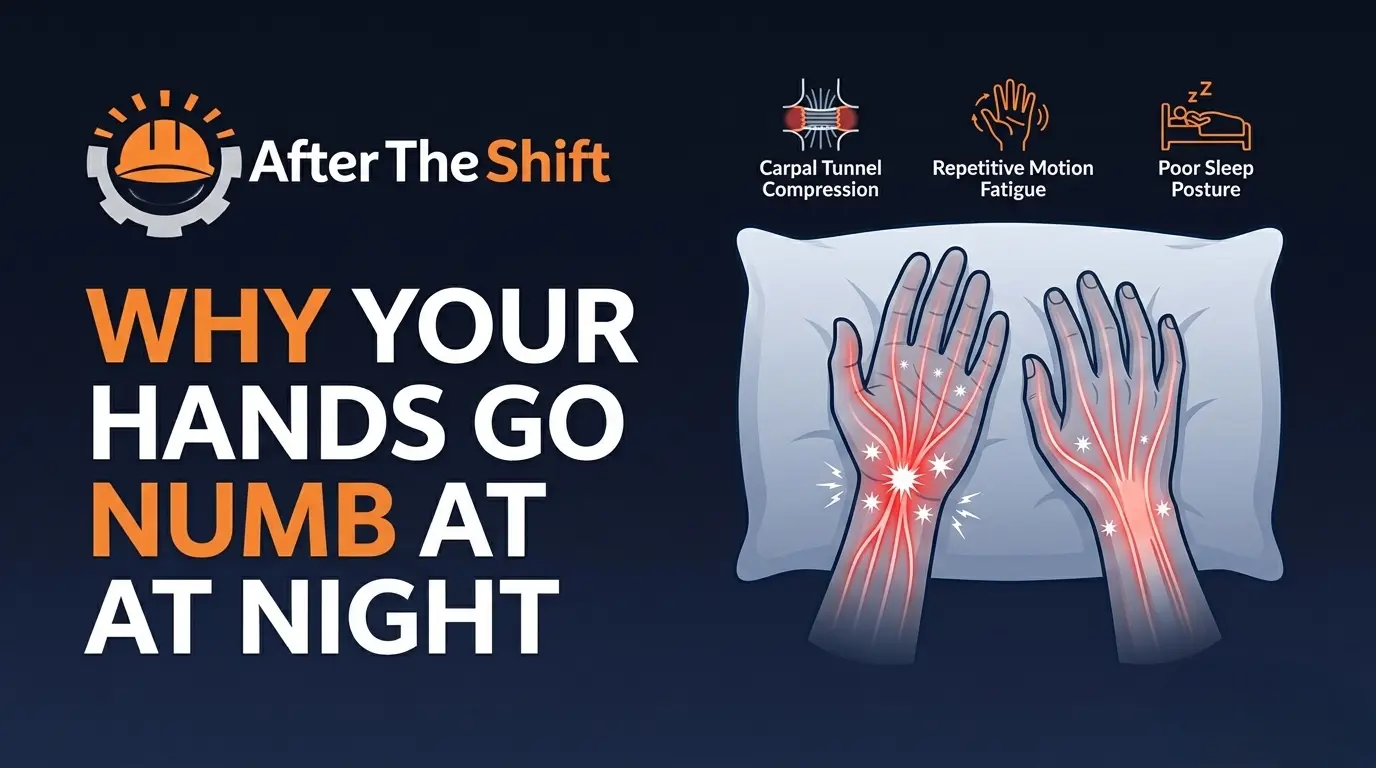
| Night numbness that improves after shaking the hand | Classic early tunnel compression pattern | Night wrist positioning and earlier assessment | If it wakes you most nights |
| Dropping scanner, tape gun, or small items | Grip weakness and reduced control | Stop delaying and get evaluated | Function loss |
| Whole arm tingling from neck to hand | May not be carpal tunnel at all | Check neck and proximal causes too | Wrong self-diagnosis risk |
| Pinky-side numbness mainly in ring/pinky fingers | May fit ulnar nerve issues better | Do not assume carpal tunnel automatically | Wrong tunnel, wrong fix |
Do not keep “testing” it for weeks if you have constant numbness, dropping objects, obvious grip weakness, or symptoms that keep spreading or waking you repeatedly. That is no longer a harmless soreness experiment.
Decision tree: what your signs point to
Use this to sort out whether your pattern looks like early overload, classic early carpal tunnel, or a stronger need for medical assessment.
Do your symptoms mainly affect the thumb, index, middle, or half of the ring finger?
The 4 damage stages
Carpal tunnel usually progresses in a pattern. The stage matters because the right move at stage 1 is not enough for stage 4.
| Stage | What it feels like | What is changing | Recovery outlook | Action |
|---|---|---|---|---|
| 1. Irritation | Occasional tingling after work | Load is exceeding recovery | Usually best if caught now | Change task setup early |
| 2. Patterned symptoms | Night numbness, frequent tingling | Tunnel irritation is repeating | Still often manageable | Reduce exposure and assess |
| 3. Functional loss | Weak grip, dropping tools/items | Nerve function is affected | Slower, less predictable | Get medical input soon |
| 4. Persistent deficit | Constant numbness or visible weakness | Compression is more established | May be much slower | Do not delay evaluation |
The early signs everyone misses are usually night numbness, shaking the hand for relief, mild thumb-side tingling, and subtle grip loss. Waiting for “serious pain” is one of the most common ways workers let stage 1 become stage 3.
Mini-test: how worried should you be?
This is not a diagnosis. It is a risk check based on common early carpal tunnel features in repetitive work.
What actually fixes it — by phase
The best fix depends on when symptoms show up: before work, during work, or after work / at night.
- Notice if numbness is already there on waking
- Start with a neutral wrist, not already curled
- Do not begin the day gripping hard from minute one
- Reduce bent-wrist repetition
- Switch hand use when possible
- Lower unnecessary squeeze force
- Break long same-task runs earlier
- Track whether symptoms are spreading
- Night symptoms matter more than people think
- If weakness or constant numbness is rising, escalate
The fastest fix is not “rest forever.” It is usually reducing the exact wrist angles, repetition blocks, and grip force that keep re-irritating the tunnel, then getting assessed sooner if weakness or constant numbness is showing up.
To build your bigger recovery base, route back through the physical work recovery guide. If your job pain keeps getting normalized, also read why pushing through work pain makes injuries worse and how to tell work pain from injury.
Treatment options compared
No single option is “best” for everyone. The right choice depends on severity, duration, weakness, job demands, and whether the pattern is clearly median-nerve dominant.
| Treatment / step | Best for | Avoid if | Cost / effort |
|---|---|---|---|
| Task modification | Early-stage work-triggered symptoms | You rely on it alone despite weakness | Low cost, high value |
| Wrist-neutral night support | Night numbness pattern | It worsens symptoms or masks progression | Low to moderate |
| Physio / clinician assessment | Pattern is unclear or getting worse | You are still guessing the cause yourself | Moderate |
| Medication / symptom management | Short-term symptom control | Used to ignore ongoing load problem | Varies |
| Further medical management | Persistent numbness or functional loss | Symptoms are mild and improving fast | Higher |
Early task modification is the best first move when symptoms are still occasional and clearly work-linked.
Changing wrist position, reducing squeeze force, and breaking repetition blocks earlier often give the highest return for the least money.
Professional assessment becomes the best upgrade when symptoms are no longer just occasional or function is slipping.
Checklist: what to change this week
Use this as a simple action list. The goal is to reduce repetition, wrist bend, and delayed reaction.
FAQ: real-worker questions
These answers are written in plain language so each one can stand alone if needed.
Related links to keep reading
Use these to finish the answer path instead of stopping at one symptom label.
- Physical work recovery guide
- Wrist pain from scanning packages — why repetition beats weight every time
- Hand pain from gripping tools all day — when “just tough hands” becomes nerve damage
- Neck pain from looking down all shift — packaging, assembly, scanning
- Work pain vs injury — knowing the difference matters
- What a normal workday does to the body — the hidden damage most workers ignore
Bottom Line
Best choice: act when the signs are still small — tingling, night numbness, hand shaking, subtle grip loss.
Who should do it: warehouse workers doing repetitive scanning, packing, gripping, taping, or wrapping that keeps the wrist loaded in the same way.
Who should avoid self-diagnosing only: workers with constant numbness, visible weakness, frequent dropping of objects, pinky-dominant symptoms, or whole-arm / neck-linked tingling.
What to do next: identify the exact task pattern, reduce the worst wrist angle and grip force first, then get assessed sooner if the pattern is repeating or function is dropping.
Next Steps
- Figure out which specific task triggers the thumb-side tingling first.
- Change the worst wrist-bent position before changing everything else.
- Track night numbness, not just end-of-shift soreness.
- If grip is weaker or you are dropping items, get checked instead of waiting.
- Use the recovery guide for physical workers to build the rest of your recovery around it.
Save this. If your hand starts tingling after scanning, packing, or gripping, bookmark this page now and compare your symptoms again in 2 weeks instead of guessing from memory.
This article is general recovery education, not a diagnosis or a substitute for care from a qualified clinician. Stop and get medical help for severe pain, numbness, weakness, chest pain, sudden swelling, fever, or symptoms that keep worsening.


Log in to leave a comment.