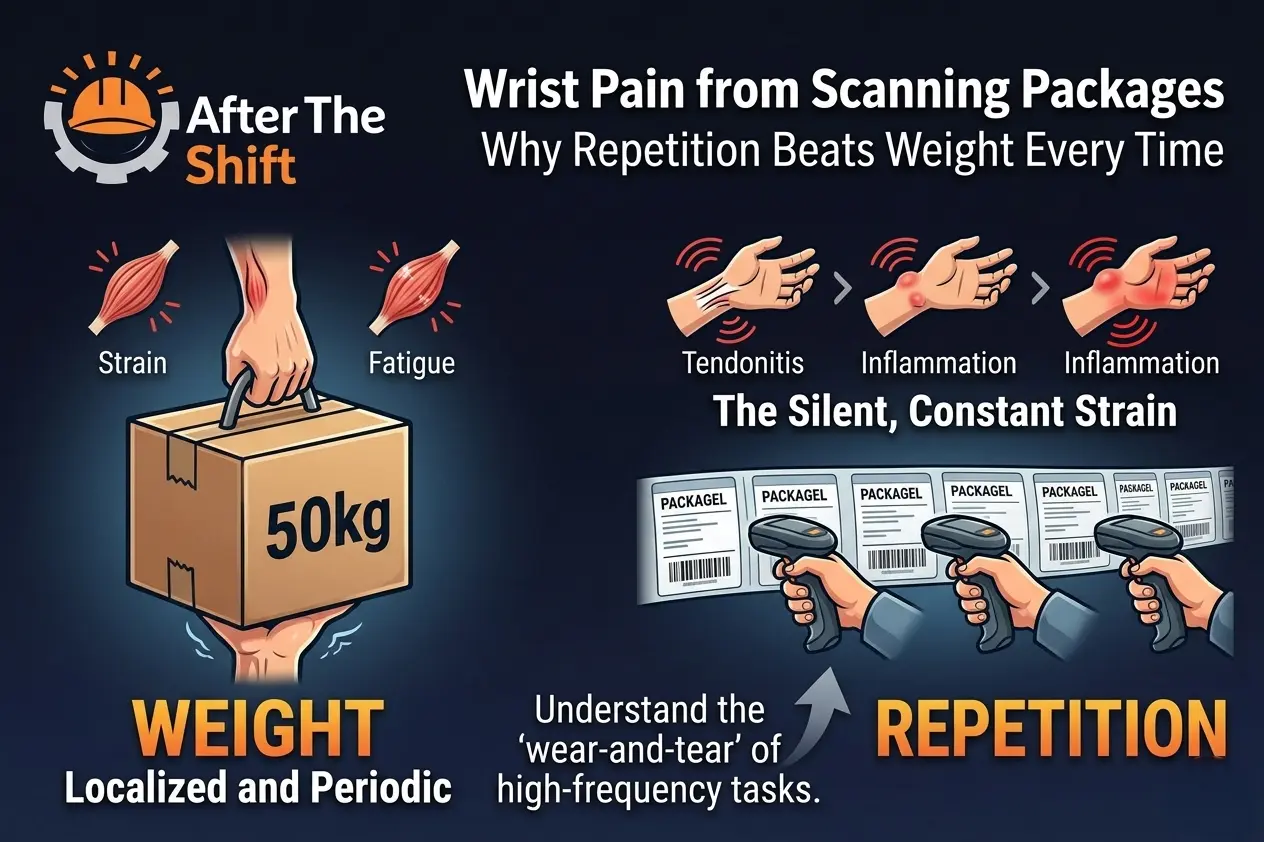
If your wrist hurts after scanning, labeling, packing, or fast picking, the problem is usually volume and angle, not heavy weight — and that changes what actually fixes it.
If your wrist starts burning, tightening, clicking, or going numb during scanning work, the main problem is usually not load. It is high-speed repetition at the same angle for hours, with almost no real reset between scans.
Wrist pain from scanning packages is usually a repetition injury, not a strength problem. Light objects can still damage tendons, tendon sheaths, nerves, and grip mechanics when the wrist keeps snapping, twisting, and extending thousands of times per shift.
- Reduce wrist bend during scans
- Switch hands or grip pattern when possible
- Use short reset breaks before numbness starts
- React early to burning, tingling, or pinch pain
- Waiting until pain becomes constant
- Death-gripping the scanner all shift
- Stretching hard into sharp pain mid-shift
- Assuming light work cannot injure your wrist
If the wrist hurts during fast repeated scans but not during heavier one-off lifts, treat it like a repetition injury first — because the longer you keep forcing the same angle, the faster irritation turns into something that follows you off shift.
| If you… | Most likely issue | Best next move | Risk flag |
|---|---|---|---|
| Hurt only late in shift | Early overload / tendon irritation | Change angle, reduce bend, add resets | Low if handled now |
| Feel burning at top or thumb side | Tendon sheath irritation | Unload repeated angle fast | Moderate |
| Get tingling or numb fingers | Nerve irritation / compression | Stop forcing it and assess quickly | High |
| Wake up stiff the next morning | Accumulated inflammation | Change workload pattern, not just painkillers | Moderate |
| Pain stays on days off too | Established tissue irritation | Treat as more than simple soreness | High |
- Why scanning wrecks the wrist faster than heavier work
- How job type changes the risk
- Symptom → cause → fix matrix
- Decision tree: sore, damaged, or red flag?
- The 4 damage stages
- Mini-test: how bad is your wrist getting?
- What actually fixes it by phase
- Treatment options compared
- Shift-saving checklist
- FAQs workers actually ask
Why scanning wrecks the wrist faster than heavier work
A lot of workers trust the wrong signal: “It is only a scanner, so it cannot be doing real damage.” That logic fails because tissue irritation does not only come from heavy force. It also comes from frequency, angle, speed, grip tension, and total daily exposure.
A wrist that bends back, twists slightly, and snaps into the same scan position thousands of times gets less recovery than a wrist that handles a few heavy lifts with neutral alignment. Repetition stacks micro-stress. By mid-shift, your body is no longer reacting to one scan. It is reacting to the last hundreds or thousands.
| Load factor | Low-force scan work | Heavier one-off lift | Why scan work wins |
|---|---|---|---|
| Force per rep | Low | Moderate to high | Lower force hides the damage |
| Repetition count | Very high | Low to moderate | Tissues never fully reset |
| Wrist angle | Often fixed and awkward | More variable | Same irritated line every time |
| Grip tension | Constant low-level squeeze | Short burst | Constant squeeze feeds fatigue |
| Recovery time | Minimal | Usually better | Damage accumulates silently |
This is the same reason so many repetitive-work injuries get ignored early. The task does not look dangerous, so the worker keeps going until the body starts giving stronger signals. By then, it is often beyond simple soreness. That is also why the older post on wrist pain from repetition, not weight fits scanning work almost perfectly.
How job type changes the risk
Not all scanning jobs hit the wrist the same way. The exact risk changes based on scanner shape, wrist angle, shelf height, package flow speed, and whether the worker has to grip, twist, lift, and scan in one motion.
| Job type | Main wrist angle | Risk level | Compounding factor |
|---|---|---|---|
| Outbound parcel scanning | Repeated extension + trigger press | High | Speed pressure |
| Picking with scan-and-reach pattern | Twist + reach | High | Shoulder and neck fatigue feed bad wrist position |
| Receiving / check-in | Neutral to slight bend | Moderate | Long uninterrupted blocks |
| Assembly line scanning | Same fixed angle every rep | High | No movement variety |
| Handheld inventory counts | Thumb-heavy grip + one-hand carry | Moderate to high | Long device hold time |
If your workstation also forces your head down, your upper body fatigue can pull the wrist into worse mechanics. That is why workers with scanning pain often also relate to neck pain from looking down all shift and even the early fatigue patterns explained in how repetitive work destroys joints quietly.
Symptom → cause → fix matrix
This is the fastest way to stop guessing. Match the symptom pattern first. Then act based on the most likely driver, not whatever random stretch somebody showed you.
| Symptom | Likely cause | Best first fix | Red flag? |
|---|---|---|---|
| Burning on thumb side | Repeated thumb and wrist tendon irritation | Reduce bend, reduce tight grip, unload fast | No, unless worsening daily |
| Sharp pain with twisting | Irritated tendons or sheath friction | Stop forcing twist pattern | Moderate concern |
| Tingling in thumb, index, middle finger | Median nerve irritation | Stop aggravating positions, assess soon | Yes |
| Whole wrist feels tight and weak | General overload + grip fatigue | Load management and reset breaks | Usually no |
| Morning stiffness after scan day | Inflammation from repeated exposure | Change next shift pattern, not just rest | Moderate if frequent |
| Dropping items or loss of grip | Pain inhibition or nerve involvement | Do not brush it off | Yes |
Decision tree: sore, damaged, or a red flag?
Start here
Do you get tingling, numbness, or obvious hand weakness with the wrist pain?
The 4 damage stages
Most scan-related wrist problems do not go from fine to broken overnight. They move through stages. Catching stage 1 or 2 is the difference between a manageable fix and a problem that starts owning your off-hours too.
| Stage | What it feels like | What is happening | Recovery outlook | Action |
|---|---|---|---|---|
| 1. End-of-shift soreness | Mild ache, gone by next day | Early overload | Good if corrected fast | Adjust setup now |
| 2. Repeating irritation | Burning, pinch, morning stiffness | Tendon or sheath irritation | Moderate if workload changes | Unload repeated angle |
| 3. Persistent pain | Pain on days off or simple tasks | Established tissue irritation | Slower, more stubborn | Take it seriously |
| 4. Nerve / function warning | Tingling, weakness, clumsy grip | Possible nerve involvement | Do not delay | Get assessed |
Mini-test: how bad is your wrist getting?
Answer yes for each item that has happened in the last 2 weeks.
What actually fixes it — by phase
Workers waste time chasing one magic fix. Real progress usually comes from matching the action to the timing: before shift, during shift, after shift. Different phases solve different problems.
Before shift
- Warm the wrist with light movement, not hard stretching
- Check scanner hold and strap setup
- Plan the first reset before symptoms start
- Do not begin already stiff and clenched
During shift
- Keep wrist closer to neutral
- Reduce trigger death-grip
- Break long scan runs with short resets
- Swap side or change task if possible before symptoms spike
After shift
- Calm it down instead of testing it more
- Track what exact task window triggered symptoms
- Do gentle mobility if it settles the wrist
- Use the next shift to change the exposure pattern
This same pattern shows up across physical work injuries. The site’s main physical work recovery guide and the piece on work pain vs injury help if you are trying to decide whether you are still in the manageable zone or already beyond it.
Treatment options compared
| Treatment | Best for | Skip if | Cost / effort |
|---|---|---|---|
| Load change at work | Almost everyone | Only skipped when impossible | Low money, high value |
| Brace / splint | Short-term calming or night support | You use it to ignore bad mechanics | Low to moderate |
| Gentle mobility work | Stiffness and early-stage pain | It provokes sharp symptoms | Low |
| Targeted rehab exercises | Later-stage rebuilding | You are still heavily flaring it at work daily | Moderate effort |
| Medical assessment | Numbness, weakness, persistent pain | You only have brief mild soreness that resolves fully | Moderate |
Shift-saving checklist
FAQs workers actually ask
Related links
- Physical work recovery guide
- Hand pain from gripping tools all day — when “just tough hands” becomes nerve damage
- Frozen shoulder from repetitive work — how it sneaks up and locks in
- Why your shoulders hurt more after light days than heavy days
- Rotator cuff damage from repetitive reaching — the injury most workers ignore
- Why pushing through work pain makes injuries worse
Next steps
- Decide which stage your wrist is in: end-of-shift soreness, repeating irritation, persistent pain, or nerve warning.
- Identify the exact scan pattern that flares it: trigger grip, wrist bend, reach angle, or nonstop volume.
- Make one work-change move on the very next shift instead of waiting for the pain to become “serious enough.”
- If numbness, weakness, or night symptoms are showing up, stop treating it like normal soreness.
- Read the related wrist, hand, and repetitive-work posts above so the problem does not just move to another joint.
This article is general recovery education, not a diagnosis or a substitute for care from a qualified clinician. Stop and get medical help for severe pain, numbness, weakness, chest pain, sudden swelling, fever, or symptoms that keep worsening.


Log in to leave a comment.