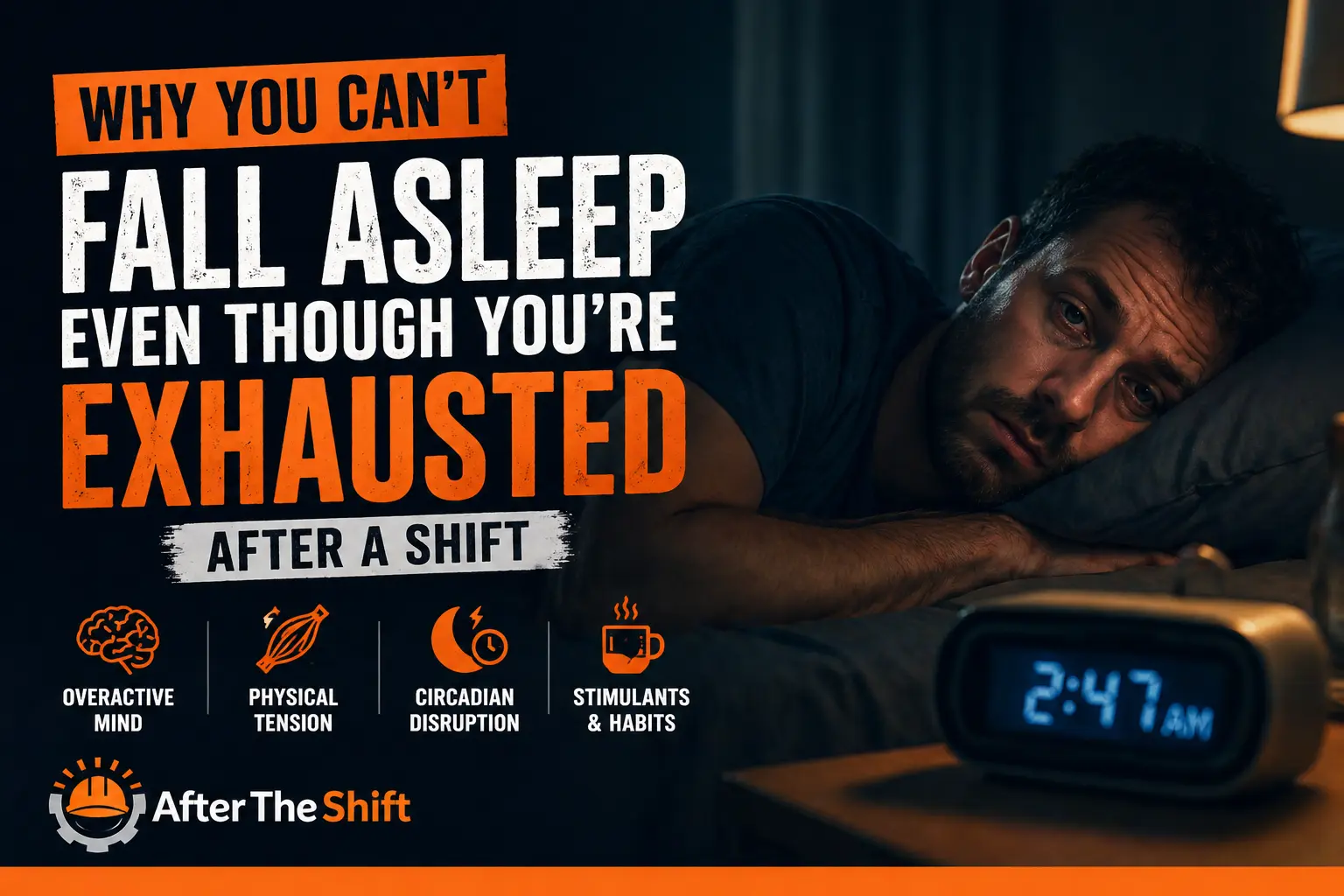
Your body is tired, but your nervous system is still on duty — here’s how to shut it down faster.
You cannot fall asleep after a shift because your body can be physically exhausted while your nervous system is still alert, hot, stressed, hungry, overstimulated, or hormonally “on.” The fix is not forcing sleep harder. The fix is lowering body activation in the right order: cool down, eat lightly if needed, reduce stimulation, unload pain, and use a repeatable shutdown routine.
- Cool your body before bed
- Eat a light recovery snack if hungry
- Dim screens and lights after work
- Use the same 20–40 minute shutdown routine
- Lying in bed angry that you are not asleep
- Heavy meals right before bed
- Scrolling until your eyes burn
- Using alcohol as a sleep tool
If you feel exhausted but mentally alert, treat it as body activation first, not lack of tiredness — forcing sleep usually makes the alertness worse.
Fast Answer for Busy Readers: When you are exhausted but cannot sleep after work, the most common reason is “wired tiredness.” Your muscles are drained, but your brain, stress hormones, body temperature, pain signals, digestion, or light exposure are keeping your system awake. This usually applies to warehouse, construction, delivery, cleaning, kitchen, factory, and night-shift workers. It does not apply to chest pain, severe breathing trouble, fainting, or sudden neurological symptoms — those need medical help.
| If you… | Most likely cause | Do first tonight | Risk |
|---|---|---|---|
| Feel sleepy on the sofa but awake in bed | Bed pressure + racing thoughts | Leave bed for 10–15 minutes, dim lights, reset | Low |
| Feel hot, restless, and sticky after work | High core temperature | Lukewarm shower, cool room, light bedding | Low |
| Wake up hungry or shaky | Under-fueled shift | Small protein + carb snack | Moderate |
| Have pain that gets louder when lying down | Inflammation or nerve irritation | Unload the painful area and reduce pressure | Moderate |
| Cannot sleep for many nights in a row | Shift sleep disruption or insomnia pattern | Track timing and speak to a clinician if persistent | High |
- Why exhaustion does not always create sleep
- How your job type changes the sleep problem
- Symptom → cause → fix matrix
- Decision tree: what should you do tonight?
- The 4 stages of wired tiredness
- Mini-test: how activated are you after work?
- What actually fixes it by phase
- Sleep fixes compared
- Printable after-shift sleep checklist
- FAQs
Why exhaustion does not always create sleep
Being exhausted means your energy is low; being able to sleep means your nervous system feels safe enough to power down. Those are not the same thing.
After a physical shift, your body may still be running a work-mode signal: raised alertness, warm body temperature, sore joints, hunger, caffeine, bright light, noise, stress, or pressure to “fall asleep now.” That is why you can feel destroyed but still lie there wide awake.
Wired tiredness after work happens when physical fatigue and nervous-system alertness overlap. Your muscles want rest, but your brain and body are still responding as if the shift is not finished.
| Sleep blocker | What it feels like | Why it keeps you awake | Fastest lever |
|---|---|---|---|
| Heat load | Hot, restless, sweaty | Sleep is harder when the body cannot cool down | Cool room + lukewarm shower |
| Pain load | Aches get louder in bed | Pain is an alert signal | Unload joints and use gentle mobility |
| Stress load | Thinking about work, money, tomorrow | The brain keeps scanning for problems | Write the problem list outside bed |
| Fuel load | Hungry, shaky, craving food | Low fuel can feel like alertness | Small carb + protein snack |
| Light load | Eyes tired, brain awake | Bright light tells the brain it is daytime | Dim lights after shift |
This usually applies to tired workers who are alert, restless, sore, overheated, hungry, or mentally wired after a shift. This does not apply to severe chest pain, sudden confusion, fainting, severe shortness of breath, or new one-sided weakness. Those are not normal sleep problems.
How your job type changes the sleep problem
Your job decides which sleep blocker is most likely: heat, pain, adrenaline, light timing, hunger, or mental overload. The same “can’t sleep after work” feeling can come from different shift patterns.
| Job type | Main sleep blocker | Compounding factor | Best first fix |
|---|---|---|---|
| Warehouse picking | Leg and back fatigue | Long walking + concrete floors | Feet up, calves unloaded, light food |
| Construction | Pain + heat | Sun, tools, lifting, kneeling | Shower, hydration, joint unloading |
| Scanning/packing | Neck, wrist, and eye strain | Repetition + screens | Dim light, wrist rest, neck reset |
| Kitchen or cleaning | Adrenaline + heat | Rushing until the final minute | Slow transition before bed |
| Night shift | Light timing | Morning sun exposure after work | Dark route home + blackout room |
If your main issue is full-body fatigue more than insomnia, pair this post with why you feel exhausted after work even when you did not do much.
Symptom → cause → fix matrix
The fastest way to fix post-shift insomnia is to match the fix to the signal your body is giving you. Do not use the same routine for hunger, pain, heat, caffeine, and stress.
| Symptom after shift | Likely cause | Fix tonight | Red flag |
|---|---|---|---|
| Racing thoughts | Stress carryover | Write tomorrow’s problems on paper before bed | Panic, chest pain, or severe fear |
| Hot body, cold tired brain | Poor cool-down | Lukewarm shower, breathable bedding | Fever or heat illness signs |
| Aches louder in bed | Inflamed tissue or pressure | Pillow support, gentle mobility, reduce pressure | Numbness, weakness, severe swelling |
| Hungry but too tired to eat | Under-fueling | Small snack: yogurt, banana, toast, eggs, or oats | Dizziness, fainting, uncontrolled shaking |
| Sleepy until phone use | Light + stimulation | Phone out of bed, dim mode, no scrolling | None unless insomnia persists |
The mistake is treating every bad night like a motivation problem. If the real cause is pain, heat, hunger, caffeine, or light timing, “trying harder to sleep” does almost nothing.
Decision tree: what should you do tonight?
Use this if you are exhausted right now and need a simple route. Choose the closest answer, not the perfect answer.
Are you physically tired but mentally alert?
The 4 stages of wired tiredness after work
Post-shift insomnia usually starts as temporary activation, but it can become a learned pattern if bed turns into the place where you struggle. The earlier you interrupt the pattern, the easier it is to fix.
| Stage | What it feels like | What is happening | Action |
|---|---|---|---|
| Stage 1 | Tired but slightly restless | Normal shift activation | Basic shutdown routine |
| Stage 2 | Sleepy until bed, then alert | Bed pressure begins | Leave bed if awake too long |
| Stage 3 | Repeated bad nights | Body expects struggle | Strict sleep window and routine |
| Stage 4 | Insomnia affects work and mood | Recovery debt builds | Get medical guidance |
If your body feels worse after rest days too, read why days off can feel worse than workdays.
Mini-test: how activated are you after work?
This score estimates how much your after-shift routine is keeping your body awake. It is not a diagnosis. It is a decision tool.
Choose one answer for each question.
1. After work, I feel hot or restless.
2. I use my phone in bed.
3. I drink caffeine late in the shift.
4. Pain gets louder when I lie down.
5. I go to bed hungry or shaky.
6. I lie in bed worrying about tomorrow.
7. My sleep time changes a lot between workdays and days off.
8. I rush from work mode straight into bed.
9. I stay in bed for a long time trying to force sleep.
10. Bad sleep is affecting my work, mood, or safety.
What actually fixes it — by phase
The best fix starts before you get into bed. Bed should be the final step, not the place where you start trying to recover.
Before bed
Cool down, eat lightly if needed, dim lights, and stop work-related problem-solving.
In bed
Use bed only for sleep. If you are awake too long, reset outside bed under dim light.
Next day
Adjust caffeine, food timing, and light exposure so the next night is easier.
For the full recovery framework, use the physical work recovery guide as your main hub, then come back to this sleep routine for nights when your body will not switch off.
Sleep fixes compared
Most sleep fixes work only when they match the reason you are awake. A supplement will not fix a hot room, nerve pain, or a phone habit.
| Fix | Best for | Avoid if | Cost/time |
|---|---|---|---|
| Lukewarm shower | Heat and sweat after work | You use very hot water right before bed | 10 minutes |
| Small recovery snack | Hunger, shakiness, under-eating | You turn it into a heavy meal | 5 minutes |
| Phone out of bed | Scrolling awake | You need phone alarm; place it across room | Free |
| Pillow support | Shoulder, back, knee, wrist pain | Pain is severe, worsening, or neurological | Free–low cost |
| Sleep supplement | Occasional timing problems | You are mixing with alcohol or medication without advice | Varies |
Get medical help if sleep loss is causing dangerous driving, repeated near-misses at work, severe mood changes, chest pain, breathing trouble, fainting, or new neurological symptoms. Also get help if insomnia persists for weeks despite routine changes.
Printable after-shift sleep checklist
This checklist works because it lowers activation in layers: heat, fuel, pain, light, and thoughts. Complete the basics before looking for advanced sleep hacks.
Bottom line
The best choice is a boring, repeatable shutdown routine that lowers body activation before bed. Do it if you are tired but wired after physical work. Avoid relying only on supplements, alcohol, or willpower if the real problem is heat, hunger, pain, light, or stress. Your next move is to identify your main blocker tonight, then run the checklist for 7 shifts.
For most physical workers, the fastest practical sleep fix is not a stronger sleep hack. It is reducing activation: cool the body, stop bright input, handle hunger, unload pain, and make bed a sleep cue again.
FAQs
These answers cover the common edge cases: pain, night shift, caffeine, supplements, and when to get help.
Related links that complete the answer
Use these next if your sleep problem is connected to soreness, stiffness, fatigue, or poor recovery.
- Physical work recovery guide — the main recovery hub.
- Rest vs recovery: why sleeping is not fixing you — for workers who sleep but still wake up wrecked.
- Waking up stiff after physical work — for morning stiffness after hard shifts.
- Too sore to sleep after work — for pain that gets louder when lying down.
- Fatigue hijacking your mood and decisions — for sleep loss affecting your head, not just your body.
- What real recovery looks like after physical work — for building the full recovery routine.
Next steps
Do not try to fix everything tonight. Pick the main blocker and run the matching fix for one week.
- Tonight, identify your main blocker: heat, hunger, pain, light, caffeine, or stress.
- Use the decision tree and checklist before getting into bed.
- Track sleep quality for 7 shifts, not one random night.
- If pain is the blocker, read the soreness and stiffness posts linked above.
- If sleep loss affects driving, work safety, or mood, get proper help instead of pushing through.
Save this before your next hard shift.
When you are exhausted at midnight, you will not want to think. Bookmark this checklist and use it like a shutdown script.
This article is general recovery education, not a diagnosis or a substitute for care from a qualified clinician. Stop and get medical help for severe pain, numbness, weakness, chest pain, sudden swelling, fever, or symptoms that keep worsening.
Log in to leave a comment.