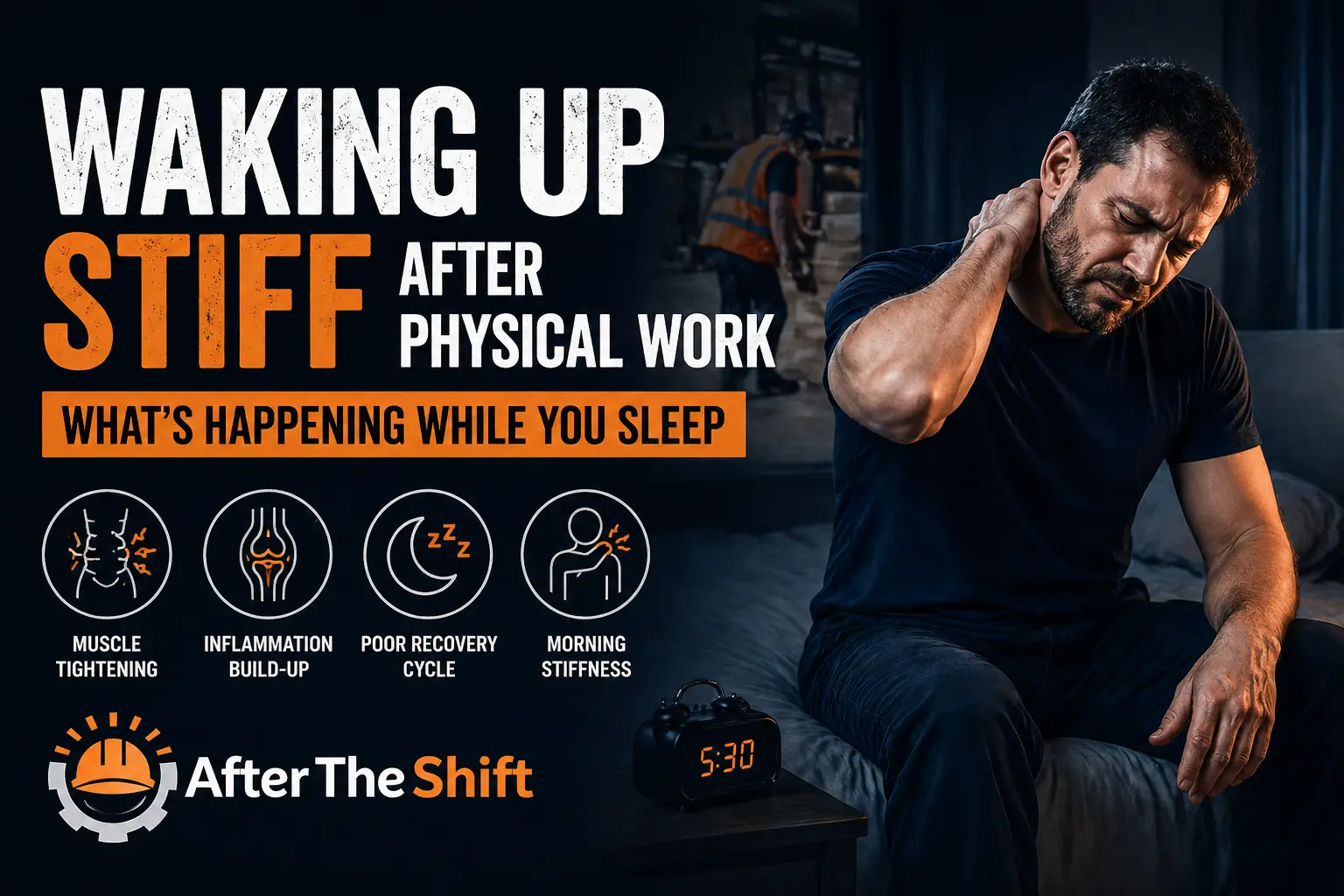
Morning stiffness after hard shifts usually means your body cooled down, tightened up, and failed to fully recover overnight.
Home → Recovery → Waking Up Stiff After Physical Work
Waking up stiff after physical work usually happens because tired muscles, irritated joints, and loaded connective tissue cool down and lose fluid movement while you sleep. It is common after lifting, standing, bending, kneeling, scanning, or overhead work, but stiffness that gets worse each week is not “normal recovery.”
✓ Do
- Move gently for 5–10 minutes after waking.
- Check if stiffness improves once warm.
- Reduce the repeated motion that triggered it.
- Use heat before movement if you feel locked up.
✗ Avoid
- Explosive stretching first thing in the morning.
- Ignoring stiffness that lasts over 60 minutes.
- Training hard on top of a bad shift pattern.
- Calling sharp, spreading, or numb pain “just stiff.”
If morning stiffness improves within 10–30 minutes of easy movement, treat it like recovery debt; if it lasts, sharpens, spreads, or returns worse every morning, treat it like an injury signal.
Fast Answer for Busy Readers: Morning stiffness after physical work is usually caused by overnight cooling, reduced circulation, joint fluid thickening, muscle guarding, and inflammation from repeated loading. This usually applies to warehouse workers, construction workers, cleaners, drivers, pickers, packers, and anyone doing repetitive physical work. It does not apply to severe pain, numbness, weakness, fever, major swelling, or stiffness after an accident.
| If you… | Most likely issue | Risk | First move |
|---|---|---|---|
| Feel stiff but loosen up in 10–20 minutes | Normal recovery debt | Low | Gentle walk, heat, light mobility |
| Wake up locked after bending, lifting, or standing | Back/hip muscle guarding | Moderate | Walk before stretching hard |
| Have stiffness plus numbness or tingling | Nerve irritation | High | Stop guessing and get checked |
| Feel worse every morning for 2+ weeks | Accumulated fatigue or overload injury | High | Reduce load and check red flags |
- Why you wake up stiff after physical work
- How your job type changes the stiffness pattern
- Symptom → cause → fix matrix
- Morning stiffness decision tree
- The 4 stiffness stages
- Mini-test: how serious is your stiffness?
- What actually fixes morning stiffness
- Treatment options compared
- Printable morning stiffness checklist
- FAQs
Why You Wake Up Stiff After Physical Work
You wake up stiff because sleep removes movement from a body that was already overloaded, irritated, or under-recovered from work.
During a shift, muscles stay warm because you keep moving. After work, your body cools down. While you sleep, joint fluid moves less, tissues hold tension, and irritated areas can feel thicker or tighter by morning. That is why stiffness often feels worse after lying still than it did while working.
Morning stiffness after physical work is usually not caused by sleep itself. Sleep reveals the load from the shift because your body stops moving, cools down, and stiff tissues lose their temporary warm-up effect.
| Overnight change | What it feels like | Most common after | Best first fix |
|---|---|---|---|
| Reduced movement | Locked hips, back, shoulders | Standing, driving, packing | 5–10 minute easy walk |
| Muscle guarding | Tight, protective feeling | Bending, lifting, twisting | Heat, slow range of motion |
| Inflammatory irritation | Deep ache, puffy joint feeling | Kneeling, gripping, overhead work | Load reduction, not aggressive stretching |
For the bigger recovery pattern, use the physical work recovery guide as the main hub.
How Your Job Type Changes the Stiffness Pattern
The area that feels stiff in the morning usually matches the position your job forces you to repeat most.
| Job type | Repeated angle | Morning stiffness risk | Compounding factor |
|---|---|---|---|
| Warehouse picking | Bend, reach, twist | Lower back and hips | Speed pressure |
| Construction | Kneel, lift, carry | Knees, back, shoulders | Heavy load plus vibration |
| Scanning and packing | Neck down, wrist repeat | Neck, wrists, upper back | Low force, high repetition |
| Driving after work | Hip flexion, rounded back | Lower back stiffness | Cooling down while seated |
The problem is usually not one bad movement. It is repeated low-level loading that your body cannot fully clear before the next shift.
Symptom → Cause → Fix Matrix
Use the symptom pattern to separate normal stiffness from a warning sign.
| Symptom | Likely cause | Fix first | Red flag? |
|---|---|---|---|
| Stiff back that loosens after walking | Overnight muscle guarding | Walk, heat, hip mobility | Usually no |
| Stiff fingers after gripping | Tendon irritation or swelling | Reduce gripping load, gentle hand opening | Maybe |
| Stiff neck after scanning or packing | Static neck position | Screen/bench height change, chin tucks | If headaches or arm symptoms |
| Stiff knee with swelling | Joint irritation | Reduce kneeling, compression, monitor swelling | Yes if persistent |
| Stiffness with numbness, tingling, or weakness | Possible nerve involvement | Medical check, stop aggravating position | Yes |
If your hands go numb at night, use this related guide: why your hands go numb at night after physical work.
Morning Stiffness Decision Tree
Answer these in order to decide whether to treat stiffness as recovery debt, overload, or a red flag.
Step 1: Does the stiffness improve within 30 minutes of easy movement?
The 4 Morning Stiffness Stages
Morning stiffness becomes more serious when it lasts longer, needs more time to warm up, or starts changing how you move at work.
| Stage | What it feels like | What is happening | Recovery window | Action |
|---|---|---|---|---|
| 1 | Stiff but gone fast | Normal recovery debt | 1–3 days | Move, sleep, hydrate |
| 2 | Needs 30–60 minutes to loosen | Accumulated fatigue | 7–14 days | Reduce trigger load |
| 3 | Returns daily and changes movement | Tissue irritation | 2–6 weeks | Modify work and get assessed if worsening |
| 4 | Sharp, swollen, numb, weak, or constant | Possible injury or nerve issue | Depends on cause | Stop guessing and get help |
Mini-Test: How Serious Is Your Morning Stiffness?
This score ranks your stiffness by duration, pattern, and warning signs, not by toughness.
Choose the answer that fits most mornings.
1. Stiffness lasts longer than 30 minutes?
2. It is worse after repeated shifts?
3. You change how you bend, walk, lift, or grip?
4. You feel numbness, tingling, or weakness?
5. One joint looks swollen or warm?
6. The stiffness returns every morning for 2+ weeks?
7. Stretching hard makes it worse?
8. Pain wakes you up at night?
9. You need painkillers just to start the day?
10. It started after a fall, twist, or sudden sharp pain?
What Actually Fixes Morning Stiffness
The fastest fix is not one magic stretch; it is controlling load before work, reducing repeated strain during work, and using gentle movement after waking.
Before Sleep
- Do 5 minutes of easy mobility.
- Use heat if muscles feel guarded.
- Avoid collapsing straight from work to bed.
During Work
- Change repeated angles when possible.
- Switch hands or stance during repetitive tasks.
- Break the same-position trap every 30–60 minutes.
After Waking
- Walk before deep stretching.
- Use slow range of motion.
- Stop if pain sharpens or spreads.
If stiffness is part of a bigger crash pattern, compare it with why sleeping is not the same as recovery.
Treatment Options Compared
Choose the option based on stiffness pattern, not on what feels intense.
| Treatment | Best for | Skip if | Cost/time |
|---|---|---|---|
| Easy walking | General morning stiffness | Pain worsens with steps | Free / 5–10 min |
| Heat | Muscle guarding | Fresh swelling or heat in joint | Low / 10–20 min |
| Gentle mobility | Back, hips, shoulders, neck | Sharp pain or nerve symptoms | Free / 5–8 min |
| Load reduction | Recurring stiffness | One-off mild soreness only | Work setup dependent |
| Medical assessment | Weakness, numbness, swelling, constant pain | Mild stiffness that clears quickly | Varies |
Printable Morning Stiffness Checklist
Use this checklist for one week before deciding whether your stiffness is improving or escalating.
What This Applies To — And What It Does Not
This guide applies to stiffness that appears after physical work and is affected by workload, repetition, sleep, and morning movement.
Warehouse work, construction, cleaning, delivery, packing, assembly, scanning, standing on concrete, repetitive gripping, lifting, kneeling, and overhead work.
Severe pain after trauma, sudden weakness, spreading numbness, fever, unexplained swelling, chest pain, loss of bladder or bowel control, or stiffness that does not improve at all with movement. Those need proper medical attention.
Related Guides That Complete the Answer
Morning stiffness is often part of a bigger recovery or injury pattern. Use the guide that matches your main symptom.
- Lower back stiffness in the morning after physical work
- Too sore to sleep after work
- Accumulated fatigue from physical work
- Work pain vs injury: how to tell the difference
- What real recovery looks like after physical work
Bottom Line
Morning stiffness after physical work is usually a recovery signal, but the pattern decides how seriously to treat it.
If stiffness loosens quickly, use gentle movement and improve recovery. If it lasts longer, worsens weekly, changes your movement, or includes numbness, weakness, swelling, or sharp pain, stop treating it as normal soreness.
FAQs
These answers are written for physical workers dealing with morning stiffness after shifts.
Next Steps
- Tomorrow morning, time how long stiffness takes to loosen.
- If it improves within 30 minutes, use the checklist for 7 days.
- If it lasts longer or gets worse, identify the repeated work trigger.
- If you also have numbness, weakness, swelling, sharp pain, or night pain, get assessed instead of pushing through.
- Use the work pain vs injury guide to decide whether this is still safe to self-manage.
Save this for your next bad morning.
Bookmark it, pin it, or send it to a coworker who keeps waking up locked after shifts.
This article is general recovery education, not a diagnosis or a substitute for care from a qualified clinician. Stop and get medical help for severe pain, numbness, weakness, chest pain, sudden swelling, fever, or symptoms that keep worsening.



Log in to leave a comment.