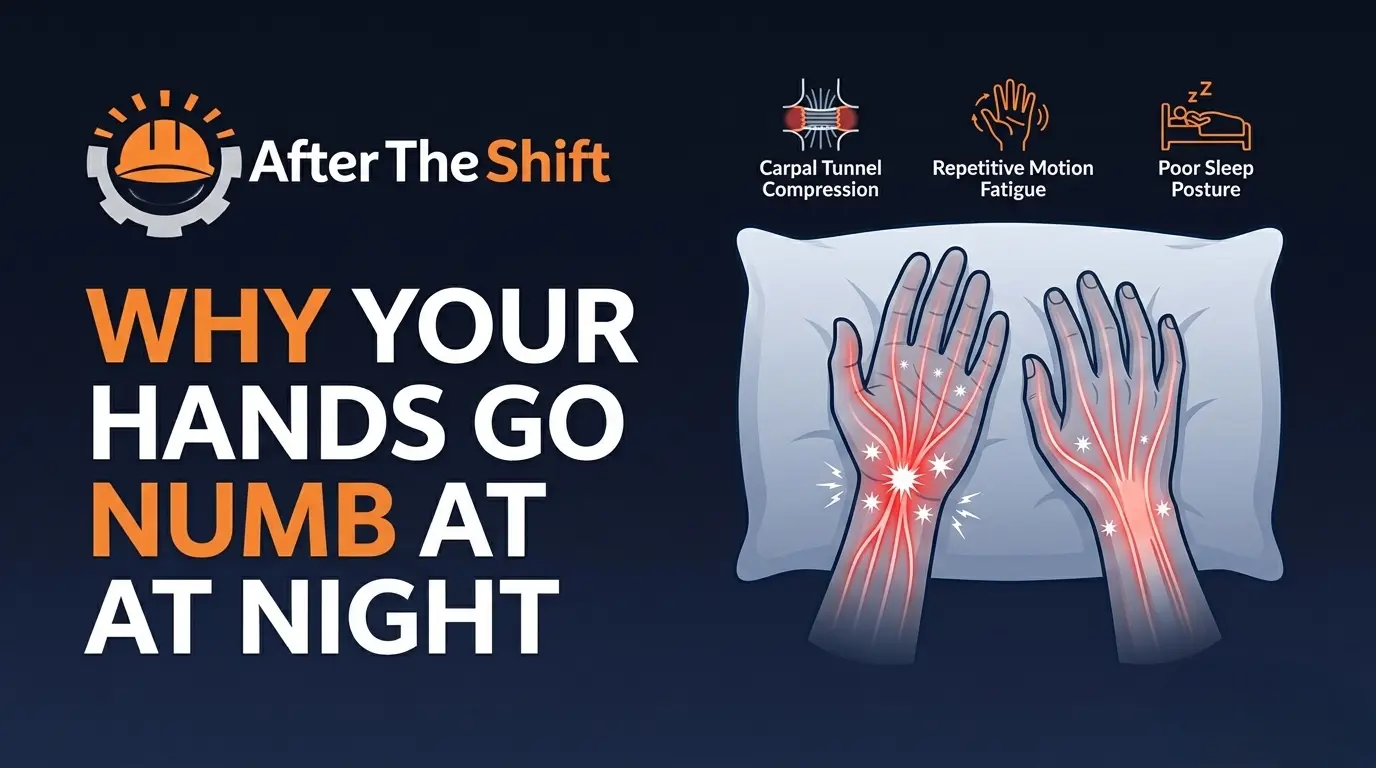
Night hand numbness after warehouse, construction, or tool work usually means irritated nerves or overloaded wrist tendons — and the fix depends on which pattern you have.
If your hands go numb at night after physical work, the most common reason is irritated nerves being compressed after a full day of gripping, bending the wrist, vibrating tools, or swelling around the hand and forearm. In workers, the usual patterns are carpal tunnel, cubital tunnel, or grip-heavy tendon irritation. It is more likely when numbness wakes you up, affects the thumb/index/middle fingers, or gets worse after long shifts. It does not usually apply to sudden full-arm numbness, facial droop, or new one-sided weakness.
Night hand numbness after physical work usually means your nerves are getting crowded when you sleep after being stressed all day. The fastest useful move is to match the numbness pattern to the likely nerve, reduce wrist or elbow bend at night, and stop assuming it will “wear off” on its own.
- Notice which fingers go numb
- Keep your wrist neutral during sleep
- Unload grip-heavy work for a few days if possible
- Get checked sooner if weakness starts
- Sleeping with bent wrists under your pillow
- Ignoring numbness that wakes you nightly
- Using more grip force “to push through it”
- Waiting if you are dropping tools or losing thumb strength
If numbness wakes you at night more than a few times a week, or you also have weakness, treat it like nerve compression instead of “normal soreness” — because once strength starts dropping, recovery usually gets slower and harder.
| If you… | Most likely pattern | What to do first | Risk/flag |
|---|---|---|---|
| Wake up with thumb, index, and middle finger numbness | Carpal tunnel pattern | Keep wrist straight at night and cut high-force gripping | Moderate |
| Ring and little finger go numb, especially with bent elbow | Cubital tunnel / ulnar nerve irritation | Stop sleeping with elbow fully bent | Moderate |
| Hand tingles after vibrating tools or long gripping | Grip overload with nerve irritation | Reduce force, rotate tasks, unload forearms | Low to moderate |
| Numbness plus dropping objects or thumb weakness | Advanced nerve compression | Get assessed soon | High |
| Whole arm is numb with neck pain or shooting symptoms | Neck-related nerve irritation | Do not assume it is just the wrist | High |
- Why your hands go numb at night after work
- What this applies to — and what it doesn’t
- How your job type changes the pattern
- Symptom → cause → fix matrix
- Decision tree: what pattern are you dealing with?
- The 4 damage stages
- Mini-test: how serious is your pattern?
- What actually fixes it by phase
- Treatment options compared
- Night numbness recovery checklist
- FAQs workers actually ask
Why your hands go numb at night after work
Night numbness usually happens because irritated nerves get less room once you lie down, swell slightly, and sleep with bent wrists or elbows. Physical work loads the tissues all day; sleep posture is what often turns daytime irritation into nighttime numbness.
The median nerve is the usual problem in workers who grip, scan, lift, twist, or use tools. The ulnar nerve becomes more likely when you sleep with a bent elbow or lean on the elbow a lot during breaks and driving. This is more likely when your shift includes repetitive gripping, vibration, forceful pinch, or long periods of wrist flexion.
If your hand numbness is worst at night, think nerve crowding after daytime overload, not just tired muscles. Thumb/index/middle finger numbness points more toward the wrist. Ring/little finger numbness points more toward the elbow. Weakness, dropping objects, or constant numbness are the signs that move this out of the “watch it” category.
| Load source | What it does | Why night is worse |
|---|---|---|
| Hard gripping | Swells tendons and tightens forearm flexors | Less space for the nerve when you sleep with bent wrists |
| Vibrating tools | Irritates nerves and small hand tissues | The irritated nerve becomes more sensitive overnight |
| Repetitive wrist bend | Narrows nerve space repeatedly | Sleeping bent keeps the pressure going for hours |
| Bent elbows / leaning on elbows | Irritates the ulnar nerve | Common sleep posture keeps the elbow compressed |
This usually applies to warehouse workers, construction workers, assemblers, packers, drivers, cleaners, mechanics, and anyone doing repetitive physical work with grip, wrist bend, or elbow flexion.
This does not fully explain sudden whole-arm numbness with chest pain, facial droop, severe neck trauma, major swelling after an injury, or numbness that appears out of nowhere without any clear hand, wrist, elbow, or neck pattern.
This is more likely when numbness follows the same finger pattern, gets worse after workdays, or improves somewhat when you shake the hand out.
You are dropping tools, losing pinch strength, seeing thumb muscle shrink, waking with constant numbness, or feeling numbness spread into the whole arm with neck pain. Those patterns are less likely to resolve by just “resting a bit.”
How your job type changes the pattern
The job matters because different tasks crowd different nerves. Grip-heavy work loads the wrist more. Bent-elbow work loads the ulnar nerve more. Neck-forward work can fake both.
| Job type | Common angle/load | Main nerve risk | Compounding factor |
|---|---|---|---|
| Warehouse picking / scanning | Repeated grip + wrist flex/extend | Median nerve | High repetition with little recovery |
| Construction / tools | Vibration + forceful grip | Median or mixed irritation | Long tool sessions without rotation |
| Assembly / packaging | Small repetitive pinch tasks | Median nerve | High cycle count |
| Driving / machine operation | Bent elbows + grip on wheel/controls | Ulnar nerve | Static posture for long periods |
| Neck-forward bench work | Rounded shoulders + forward head | Can mimic hand nerve issues | Upper-back stiffness hides the source |
If your work also gives you wrist pain from scanning packages or hand pain from gripping tools all day, the numbness pattern becomes more suspicious for nerve irritation instead of simple soreness.
Symptom → cause → fix matrix
The fastest way to narrow this down is to match the numbness pattern, not the pain level. Pain can be vague. Finger distribution is usually more useful.
| Symptom | Likely cause | Fastest fix | Red flag |
|---|---|---|---|
| Thumb + index + middle finger numb at night | Carpal tunnel pattern | Neutral wrist during sleep, unload repetitive grip | Starts happening every night |
| Ring + little finger numb | Cubital tunnel / ulnar nerve compression | Avoid bent elbows while sleeping | Hand clumsiness or finger spreading weakness |
| Whole hand tingles after long tool use | Vibration and grip overload | Rotate tasks and reduce force | Symptoms lasting into next day |
| Numbness with neck pain or arm shooting pain | Neck-related nerve irritation | Check neck position, not just the wrist | Progressive weakness |
| Numbness plus dropping objects | More advanced nerve compression | Get assessed instead of guessing | Urgent pattern |
The best simple clue is which fingers go numb. Workers often focus on pain level, but finger pattern is usually the cleaner decision tool.
Decision tree: what pattern are you dealing with?
Use this to sort the most likely direction. It will not diagnose every case, but it is good at separating common work-related patterns.
1) Does the numbness mainly hit the thumb, index, and middle fingers?
The 4 damage stages
Night numbness usually moves through stages. The earlier stages are more position-dependent. The later stages start spilling into the day and into strength loss.
| Stage | What it feels like | What is happening | Recovery outlook | Action |
|---|---|---|---|---|
| Stage 1 | Only occasional night tingling | Early irritation, mostly posture-dependent | Usually good if caught early | Change sleep position and reduce load |
| Stage 2 | Wakes you multiple nights weekly | Repeated nerve crowding | Still reversible in many cases | Act now, not later |
| Stage 3 | Daytime numbness or clumsy grip | More constant nerve compression | Slower recovery | Get assessed and modify work |
| Stage 4 | Weakness, dropping objects, visible muscle loss | Advanced nerve compromise | Harder and slower | Do not delay evaluation |
Mini-test: how serious is your pattern?
This score does not diagnose the exact nerve, but it does estimate how far the problem may be moving away from simple overload.
What actually fixes it — by phase
The fix depends on timing. Before work is about reducing baseline irritation. During work is about not feeding the problem. After work is about giving the nerve more room before sleep.
- Warm the forearms and hands for 3–5 minutes
- Start with lighter grip when possible
- Avoid starting stiff and cold
- Reduce unnecessary grip force
- Switch hands or rotate tasks
- Break long tool sessions when possible
- Do not sleep with wrists curled under you
- Do not sleep with elbows jammed tight
- Calm down swelling before bed
For most workers, the highest-return change is night positioning plus less pointless grip force during the shift. Fancy recovery steps matter less if you keep feeding the same compression pattern every day.
If your overall recovery is poor, start with the physical work recovery guide. If the pattern feels part of a bigger breakdown, read work pain vs injury: knowing the difference matters and how repetitive work quietly damages joints and tissues.
Treatment options compared
Not every option deserves equal weight. The best option is the one that matches the likely compression site and the stage you are in.
| Treatment | Best for | Skip if | Cost / effort |
|---|---|---|---|
| Night wrist positioning | Median nerve / carpal tunnel pattern | The issue is clearly neck-driven or elbow-driven | Low |
| Night elbow positioning | Ring/little finger numbness | Thumb/index/middle finger pattern dominates | Low |
| Task rotation / reduced grip force | Workload-driven symptoms | Symptoms are constant regardless of work | Medium effort |
| Forearm mobility / nerve-calming work | Early overload phases | Weakness is already obvious | Low to medium |
| Professional assessment | Night waking, daytime symptoms, weakness, unclear source | Never truly a “skip” if red flags exist | Higher |
Night position correction if the numbness is clearly wrist- or elbow-patterned and still mainly at night.
Task modification and grip reduction because it costs nothing and attacks the daily trigger.
Proper assessment when numbness is frequent, daytime, or combined with weakness.
Night numbness recovery checklist
This checklist is for workers who want a simple plan they can actually follow for the next 7 days.
FAQs workers actually ask
These are the questions that usually decide whether a worker keeps ignoring the problem or finally handles it properly.
Related links that help you finish the answer path
Use these next if you are trying to narrow down whether this is a wrist, hand, or broader recovery problem.
- Physical work recovery guide
- Carpal tunnel in warehouse workers — the early signs everyone misses
- Wrist pain from scanning packages — why repetition beats weight every time
- Hand pain from gripping tools all day — when “just tough hands” becomes nerve damage
- Thumb pain from repetitive gripping — the tendon injury that doesn’t heal on its own
- Work pain vs injury — knowing the difference matters
Best choice: correct the likely compression pattern fast — wrist at night for thumb/index/middle finger numbness, elbow at night for ring/little finger numbness.
Who should do this now: workers with repeated night waking, same-finger numbness, or symptoms after repetitive grip or tools.
Who should avoid guessing: anyone with weakness, daytime numbness, dropping objects, or neck-related symptoms.
What to do next: track the pattern for 7 days, change sleep position tonight, reduce grip overload this week, and escalate sooner if strength is slipping.
Next steps
- Figure out which fingers actually go numb.
- Change the sleep position that matches the likely nerve pattern tonight.
- Reduce unnecessary grip force and long repetitive sessions this week.
- If symptoms are frequent or spilling into the day, stop calling it “normal soreness.”
- If weakness, clumsiness, or constant numbness shows up, get assessed.
Save this page. If your hands go numb again tonight, use the finger pattern, the decision tree, and the checklist instead of guessing from memory.
This article is general recovery education, not a diagnosis or a substitute for care from a qualified clinician. Stop and get medical help for severe pain, numbness, weakness, chest pain, sudden swelling, fever, or symptoms that keep worsening.



Log in to leave a comment.