A 10-minute night plan + 5-minute morning unlock routine (with a score test, decision tree, and fix matrix)
Home → Sleep After Shifts → Lower back stiffness in the morning
Lower back stiffness in the morning after physical work — what’s locking up overnight
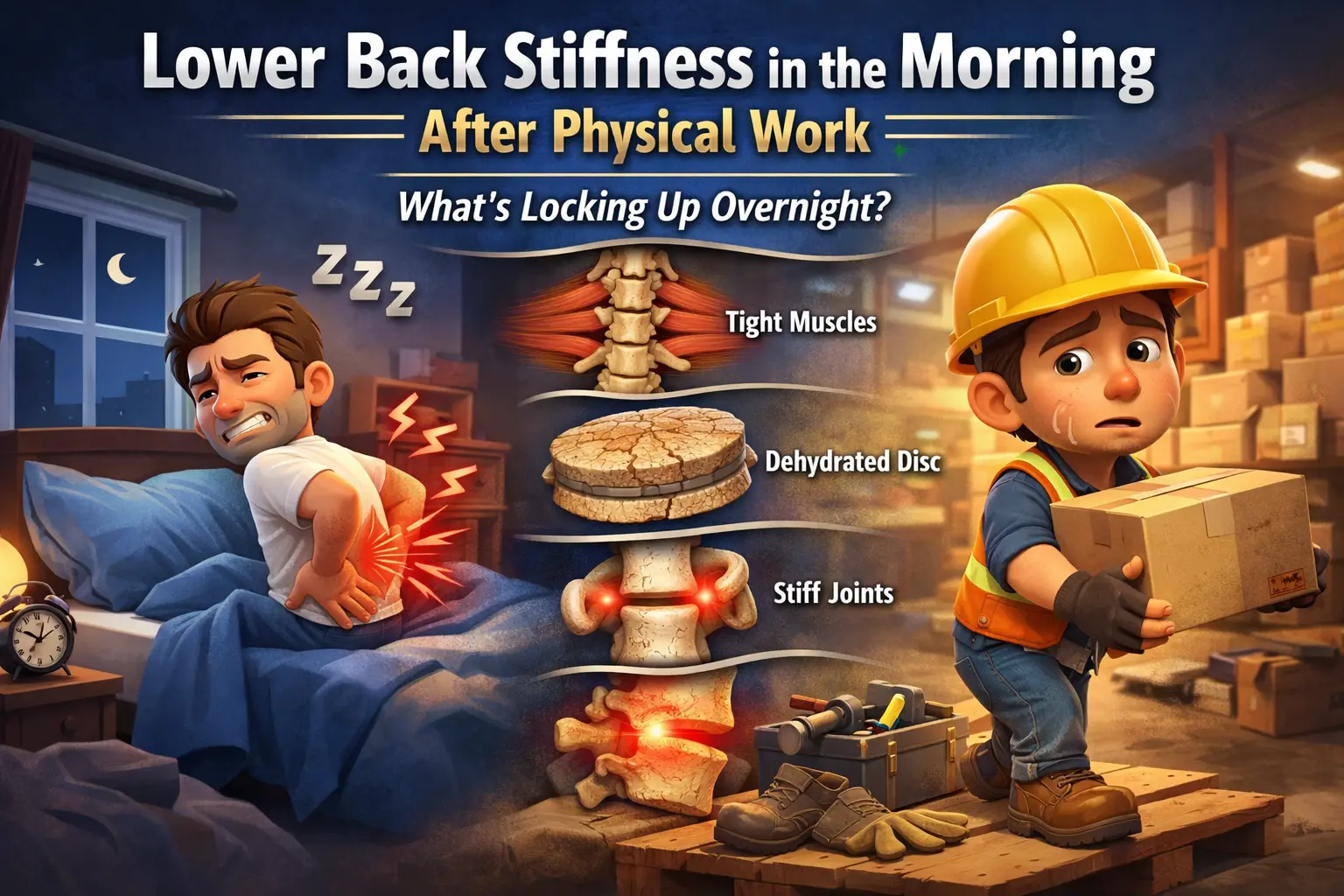
If your lower back feels locked up when you wake up after a shift, you’re not “getting old.” You’re usually waking up to a temporary stiffness system (discs + joints + muscle guarding) that builds overnight and releases once you move.
Blunt rule: If your stiffness improves within 10–20 minutes of easy movement, treat it like overnight lock-up (fix your night setup + morning ramp). If it doesn’t improve, or you have leg weakness/numbness or other red flags, skip “mobility hacks” and get assessed.
Quick Answer
Morning stiffness after physical work is usually your spine and hips “re-setting” overnight: discs rehydrate, joints get stiff, and tired muscles guard the area. The fix is a night plan (reduce guarding) + a morning ramp (reintroduce load gradually).
- Do: 8–10 min night decompression + gentle hips/hamstrings + hydration.
- Do: Morning “ramp” (walk + hinge practice) before bending/lifting.
- Do: Sleep alignment (pillow under knees or between knees).
- Avoid: First-thing heavy bending, twisting, or max stretches.
- Buy/try: body pillow or knee pillow; small lumbar roll (rolled towel works).
- Skip: aggressive “cracking” routines if pain shoots down the leg.
| If you… | Most likely lock-up | Do this today |
|---|---|---|
| Loosen up after 10–20 min moving | Overnight stiffness + muscle guarding | Night plan + morning ramp (below) |
| Feel “pinchy” on one side when you extend (arch) | Facet/low-back joints irritated | Sleep alignment + avoid hard extension first hour |
| Stiff + tight hips/hamstrings; back feels “pulled” | Hip stiffness driving lumbar load | Hip flexor + glute activation sequence |
| Pain shoots down leg, numbness, or weakness | Nerve irritation (not just stiffness) | Stop self-testing. Use red-flag section + get checked |
Jump to
What’s locking up overnight (plain English)
After physical work, your back isn’t “broken.” It’s usually running a protection program:
- Discs rehydrate overnight: more fluid = more internal pressure and stiffness first thing in the morning.
- Joints get “sticky”: low-back and SI joints hate long stillness, especially after a loaded day.
- Muscle guarding: tired spinal muscles clamp down to keep you safe (feels like a lock).
- Hip stiffness shifts load to the back: tight hip flexors/hamstrings force your lumbar spine to do the motion.
- Sleep position adds torque: twisting, stomach sleeping, or a saggy mattress can keep tissues irritated all night.
The giveaway is behavior: lock-up usually improves with movement; injury patterns often worsen with specific movements and don’t “melt” quickly.
2-minute mini-test: Morning Stiffness Score
Score each 0–2. Total it. Then follow the matching plan.
| Question | 0 | 1 | 2 |
|---|---|---|---|
| How fast do you loosen up? | <10 min | 10–30 min | >30 min |
| Is stiffness worse after long sitting/lying? | No | Sometimes | Yes, reliably |
| Any leg symptoms (tingle/numbness/weakness)? | None | Mild/rare | Frequent or worsening |
| Does one position trigger it (arch, twist, bend)? | No | A little | Yes, sharp/clear |
Interpretation
- 0–3: normal stiffness. Do the morning ramp + basic sleep alignment.
- 4–6: accumulated load/guarding. Do the full night plan for 7–10 days.
- 7–8: likely irritation pattern. Use the decision tree + matrix; limit triggers.
- Any “2” on leg symptoms: treat as possible nerve irritation and follow the red-flag section.
Decision tree: route yourself fast
Start here
- Do you have leg weakness, new numbness/tingling, saddle numbness, or bowel/bladder changes?
- Yes → stop DIY. Get medical assessment.
- No → continue.
- Does stiffness reduce within 10–20 minutes after walking + gentle movement?
- Yes → do Night Plan + Morning Ramp.
- No → continue.
- Does one motion spike it sharply? (bend/twist/arch)
- Bend pain → hinge-training + avoid first-hour loaded bending.
- Arch pain → reduce extension; fix sleep alignment; keep mornings neutral.
- Twist pain → stop sleeping twisted; use knee pillow/body pillow.
Symptom → likely cause → fix matrix (use this like a mechanic)
| Symptom you feel | Most likely cause | Fast fix (today) | Real fix (7–14 days) |
|---|---|---|---|
| “Rusty” stiffness that melts after moving | Overnight disc/joint stiffness + guarding | Walk 3–5 min, then gentle hip mobility | Night plan + consistent sleep alignment |
| Pinch on one side when you arch | Facet irritation + compressed posture | Stay neutral; avoid hard extension | Better hip extension + glute strength; sleep setup |
| Back tight + hips feel locked | Hip flexor stiffness shifting load to lumbar | Hip flexor stretch (gentle) + glute squeezes | Daily hip routine + step count after shift |
| Stiffness worse after sleeping on stomach/twisted | Night torque + asymmetry | Side sleep with knee pillow/body pillow | Pillow strategy + mattress support upgrade |
| Pain down leg, tingling, weakness | Possible nerve irritation | Avoid aggravators; get evaluated | Clinician-guided plan (don’t brute-force it) |
Save this: bookmark this page. The matrix above is the fastest way to stop guessing.
The 10-minute night plan (reduces guarding before you sleep)
Your goal at night is not “stretching harder.” It’s telling your nervous system: we’re safe, so it stops clamping your back while you sleep.
Checklist (copy/paste)
- 2 minutes: easy walk around the house (nasal breathing if possible).
- 2 minutes: warm shower OR heat on low back/hips (not “burning hot”).
- 3 minutes: gentle hip flexor + hamstring mobility (no forcing, no pain).
- 2 minutes: glute squeezes (10 reps) + slow bodyweight hip hinges (5 reps).
- 1 minute: water + pinch of salt if you sweat heavily on shift.
Mid-post soft CTA: If you want a simple weekly plan, start with what real recovery looks like after physical work and build your own “minimum effective recovery.”
The 5-minute morning unlock routine (your back’s “warm-up lap”)
Morning is when your spine is often stiffer. Treat the first minutes like the first reps in the gym: ramp up, don’t jump to max load.
- Minute 1: stand up, breathe slow, then walk 60–90 seconds.
- Minute 2: pelvic tilts (gentle) + 5 slow cat-cows (no end-range forcing).
- Minute 3: hip hinges to a wall (5 reps). Feel hips move, not your back folding.
- Minute 4: glute bridge holds (3 x 10 seconds) or glute squeezes (10 reps).
- Minute 5: “test bend” to mid-shin only. If tight → stop there, don’t chase the floor.
Rule for the first hour: avoid heavy bend + twist combos. If your job forces it, do 60 seconds of walking + 5 hinges before your first lift.
Sleep setup that reduces morning stiffness (best for / avoid if)
| Option | Best for | Avoid if | Cost level |
|---|---|---|---|
| Pillow between knees (side sleep) | Pelvis twist, SI tightness, one-sided stiffness | You can’t stay on your side at all | € |
| Pillow under knees (back sleep) | General low-back stiffness, tight hip flexors | Reflux issues that worsen flat | € |
| Small lumbar roll (rolled towel) | Back sleepers who feel “flat-back strain” | It increases arch/pinch pain | € (free) |
| Body pillow | People who roll/twist at night | Overheats you / ruins sleep | €€ |
| Mattress topper (if too firm) | Pressure points that wake you up stiff | Your bed is already saggy (needs support, not softness) | €€ |
Best pick (most people)
A knee pillow (side sleepers) or under-knee pillow (back sleepers) + the 5-minute morning ramp.
Best budget
Use a rolled towel as a lumbar roll and a normal pillow between knees. Spend €0, fix alignment tonight.
Best upgrade
A body pillow if you twist/roll + a supportive sleep surface (fix sag before you buy “softer”).
Common mistakes that keep you locked up
- Morning hero stretch: max-range bending right after waking.
- Crack-chasing: forcing pops instead of building tolerance with a ramp.
- Sleeping twisted: one knee up, one down = pelvis torque for hours.
- Only “resting”: zero walking after shift, then 8 hours stillness = stiffness combo.
- Ignoring hips: tight hips make the lumbar spine take the motion.
When to worry (don’t gamble with these)
- Weakness in the leg/foot, new or worsening numbness/tingling.
- Bowel/bladder changes or numbness in the groin/saddle area.
- Back pain with fever, unexplained weight loss, or severe night pain that doesn’t change with position.
- Pain after significant trauma, or pain that is constant and escalating.
Related (keep reading)
FAQs
Why is my lower back stiffer in the morning than after work?
Overnight stillness makes joints stiff, and spinal discs tend to rehydrate while you lie down, which can increase morning stiffness. After work you’re warmed up; in the morning you’re “cold-starting.”
How long should morning stiffness last before I worry?
If it improves within 10–20 minutes of easy movement, it’s usually mechanical stiffness. If it regularly lasts over 30–60 minutes, keeps worsening, or comes with leg symptoms, get assessed.
Is it safe to stretch my hamstrings first thing in the morning?
Gentle is fine, aggressive is not. Avoid max-range bending right after waking; do a short walk + hinge ramp first, then mobility that doesn’t spike symptoms.
What sleep position helps most with morning low-back stiffness?
Most people do best either on their side with a pillow between knees, or on their back with a pillow under knees. Avoid sleeping twisted or on your stomach if it reliably worsens symptoms.
Can a bad mattress cause this even if my back is fine during the day?
Yes. A sagging surface can hold you in poor alignment for hours and you wake up stiff, then movement “resets” you. Fix support first; softness alone can backfire if the bed is already saggy.
What’s the biggest mistake physical workers make with morning back stiffness?
Doing heavy bend + twist work immediately after waking (or jumping straight into max stretching). The fix is a 5-minute ramp before you load the spine.
How fast can I fix this?
Many people feel a difference in 3–7 nights with alignment + a morning ramp. If it’s been months, give it 10–14 days of consistency before judging.
What are the red flags that mean “doctor now”?
New/worsening leg weakness, significant numbness, bowel/bladder changes, fever, unexplained weight loss, severe night pain that doesn’t change with position, or major trauma.
Is cracking my back in the morning a good idea?
If it’s gentle and doesn’t increase symptoms, it’s not automatically “bad,” but it’s also not the fix. The fix is reducing guarding and improving alignment + ramping load capacity.
Next steps (pick one)
- Mostly stiffness: do the 10-minute night plan for 10 days.
- Mostly posture/position: fix sleep setup tonight (knee/under-knee pillow).
- Mostly work mechanics: read the bend-reach-twist lifting pattern guide.
Hard CTA: Save this page and run it for 10 days. If your mornings don’t improve, stop guessing and get a proper assessment.
Log in to leave a comment.