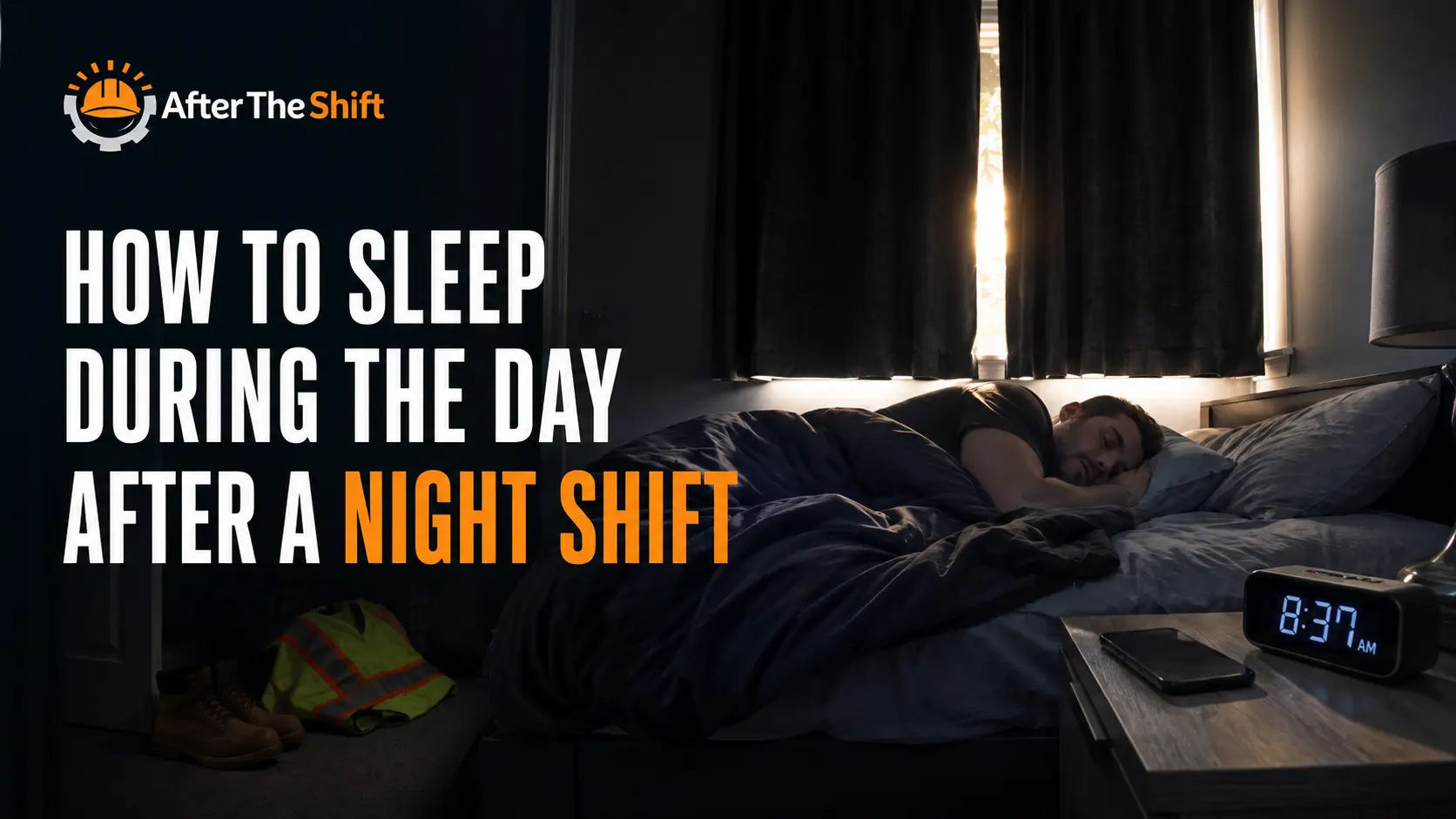
A practical routine for getting longer, deeper daytime sleep—even when daylight, noise and a racing mind fight against you.
Daytime sleep is harder because your body clock is sending an “awake” signal while daylight, noise and household activity reinforce it. This routine is for night workers who need a practical way to fall asleep sooner, stay asleep longer and wake with enough time to become alert before the next shift.
To sleep during the day after a night shift, protect one repeatable sleep window and begin controlling light, caffeine, food and stimulation before the shift ends. Travel home without unnecessary stops, keep the bedroom dark, quiet and comfortably cool, eat only a light meal if hungry, silence interruptions and allow roughly seven to nine hours for sleep when your schedule permits. Consistency matters more than creating a perfect routine.
Your realistic target is not to force sleep the moment you arrive home. Build a predictable 30–60 minute landing routine, then protect enough time for one main sleep block.
- Use the same sleep window after most night shifts
- Reduce bright light during the journey home
- Make the room dark, quiet and comfortably cool
- Leave enough time to wake fully before driving or working
- Caffeine during the final several hours before sleep
- Shopping, chores and scrolling after arriving home
- Heavy, greasy or spicy meals immediately before bed
- Using alcohol or random sleep aids to knock yourself out
If you want to sleep soon after a night shift, start protecting that sleep before you leave work—because bright light, late caffeine and post-shift errands can delay the entire sleep block.
| If you… | Most useful first change | Test it for | Priority |
|---|---|---|---|
| If you cannot fall asleep for over 30–45 minutes | Move the caffeine cutoff earlier and reduce morning light | 3–5 shifts | Moderate |
| If you wake after only 3–5 hours | Block noise, light, calls and household interruptions | 3–7 shifts | Moderate |
| If you sleep enough but remain dangerously sleepy | Stop driving when sleepy and arrange medical assessment | Do not wait to test it | High |
| If you work occasional nights only | Use a recovery plan instead of fully reversing your schedule | One rotation | Low |
| If household noise wakes you | Set a protected household quiet window | Immediately | Low |
This guidance usually applies to adults sleeping after overnight work in warehouses, construction, healthcare, transport, security, factories and similar jobs. It does not diagnose shift work disorder, sleep apnoea, depression, medication effects or another medical condition. Persistent severe sleepiness, breathing pauses, loud gasping, near-miss accidents or falling asleep involuntarily need professional assessment.
- Why daytime sleep is harder
- How your night-shift pattern changes the routine
- Sleep problem → likely cause → first fix
- Daytime-sleep decision tree
- The four stages of night-shift sleep loss
- Daytime-sleep routine quiz
- A realistic routine before, during and after work
- Sleep options compared
- Daytime-sleep checklist
- Frequently asked questions
Why Is Sleeping During the Day After a Night Shift So Hard?
Daytime sleep is usually shorter and easier to interrupt because it competes with the body’s circadian alerting signal and a brighter, noisier environment.
Your circadian rhythm is the roughly 24-hour timing system that helps regulate sleepiness, alertness and hormone release. Working overnight does not instantly reverse that system. When morning arrives, light tells the brain that the biological day has begun—even if your shift has just ended.
Sleep pressure is different. It is the need for sleep that builds the longer you remain awake. A night worker can therefore feel exhausted from high sleep pressure while still receiving a strong biological signal to remain awake. That conflict helps explain why someone can be physically drained but unable to switch off.
| Sleep pressure | What raises it | Why sleep still fails | Useful response |
|---|---|---|---|
| High after the shift | Being awake and working overnight | Morning light increases alerting signals | Reduce unnecessary bright-light exposure |
| High but overstimulated | Physical work, stress and a fast journey home | The mind and body remain activated | Use a short, repeatable wind-down |
| Partly masked | Caffeine late in the shift | Stimulation continues into the sleep window | Move the final dose earlier |
| Interrupted after sleep starts | Normal overnight wakefulness | Heat, light, deliveries and household noise | Protect the whole room, not only the bed |
Being exhausted does not guarantee immediate daytime sleep. Sleep pressure may be high after a night shift, but morning light, caffeine, stress and the circadian alerting signal can still delay sleep. The fastest practical response is to control those competing signals before arriving home.
How Should Your Routine Change for Different Night-Shift Patterns?
The best daytime-sleep routine depends on whether night work is permanent, rotating, occasional or split across irregular start times.
| Job pattern | Best sleep angle | Main risk | Compounding factor |
|---|---|---|---|
| Permanent nights | Keep the main sleep and wake times as stable as life allows | Social schedule conflict | Switching completely on every day off |
| Several nights in a row | Use the same post-shift sequence throughout the block | Accumulating sleep loss | Delaying bed further each morning |
| Rotating days and nights | Protect recovery sleep without trying to permanently reverse the body clock | Repeated timing changes | Poorly timed long naps |
| Occasional night shift | Use a planned pre-shift nap and post-shift recovery block | Short disruption | Staying awake all day beforehand |
| Driving or machinery work | Add protected wake-up time before safety-critical tasks | Drowsy driving or errors | Leaving bed and driving immediately |
Best for permanent night workers: preserve at least part of the same sleep window on days off. Avoid if rotating rapidly: forcing a complete schedule reversal every few days, because the next rotation may arrive before adaptation does.
Daytime Sleep Problem → Likely Cause → First Fix
Match the fix to the point where sleep is failing: falling asleep, staying asleep, waking safely or recovering between shifts.
| Sleep problem | More likely cause | First fix to test | Red flag |
|---|---|---|---|
| Tired but mentally wired | Late caffeine, bright light or work stress | Earlier caffeine cutoff plus a low-stimulation landing routine | Severe agitation, panic or marked mood change |
| Wake after 3–5 hours | Light, noise, warmth, bladder or body-clock alerting | Audit the room and limit large drinks immediately before bed | Regular choking, gasping or breathing pauses |
| Wake with pain or stiffness | Workload, sleep position or an unsuitable pillow/mattress setup | Adjust support and address the painful area separately | Weakness, spreading numbness or loss of bladder/bowel control |
| Sleep through several alarms | Severe sleep debt or alarm placement | Increase sleep opportunity and use a backup alarm away from bed | Falling asleep involuntarily during normal activities |
| Cannot stay alert driving home | Acute sleepiness at the biological low point | Do not drive; arrange a lift, taxi, public transport or safe nap | Any microsleep or near miss |
Do not drive or operate machinery if you are fighting to keep your eyes open, missing sections of the journey or experiencing microsleeps. Stop somewhere safe and arrange another way home. Repeated dangerous sleepiness despite adequate sleep opportunity warrants a GP or occupational-health assessment.
What Should You Change First? Use This Decision Tree
Start with the first point of failure instead of changing your entire routine at once.
Are you dangerously sleepy while driving home, working or operating machinery?
The Four Stages of Night-Shift Sleep Loss
The danger is not one poor daytime sleep; it is repeated short sleep that begins affecting mood, reaction time, safety and recovery.
| Stage | What it feels like | What is accumulating | Likely recovery | Action |
|---|---|---|---|---|
| 1: Disrupted | One short or broken sleep | Temporary sleep pressure | Often improves after protected sleep | Protect the next sleep opportunity |
| 2: Accumulating | Heavy eyes, irritability, cravings | Sleep debt across several shifts | May require more than one sleep period | Remove optional demands and stabilise timing |
| 3: Impaired | Mistakes, slow reactions, poor judgement | Functional impairment and incomplete recovery | Uncertain without reducing exposure | Escalate safety controls and seek support |
| 4: Unsafe or persistent | Microsleeps, near misses or involuntary sleep | Serious safety risk or possible sleep disorder | Needs assessment, not guesswork | Stop driving when sleepy and obtain help |
A single long sleep does not always erase several shifts of accumulated sleep loss. If your reactions, mood or physical recovery remain worse, treat that as unfinished recovery—not proof that you simply need more caffeine.
How Much Is Your Current Routine Working Against You?
This ten-question mini-test scores modifiable routine problems, not a medical diagnosis. Give yourself one point for every “yes.”
A Realistic Night Worker’s Routine: Before, During and After the Shift
A workable routine uses three phases: prepare before work, manage alertness during work and protect the landing after work.
Before the shift
- Wake with enough time to become fully alert
- Get useful light after waking
- Eat a normal meal before the busiest work period
- Use a planned nap if it reliably improves alertness
- Prepare the bedroom before leaving home
During the shift
- Use caffeine early enough that it does not collide with sleep
- Prefer lighter meals or snacks overnight
- Stay hydrated without loading fluids just before bed
- Take permitted breaks before performance collapses
- Plan transport home before extreme sleepiness starts
After the shift
- Go home without unnecessary stops
- Reduce bright-light exposure where safe
- Have a light meal only if hunger would keep you awake
- Use the same short wind-down sequence
- Enter a dark, quiet room and silence interruptions
Example for a shift ending at 7:00 a.m.
7:00–7:30: travel home safely with no optional errands.
7:30–8:00: small meal if hungry, wash, prepare alarm and silence notifications.
8:00–8:15: low-stimulation wind-down; no work messages in bed.
About 8:15: begin the main sleep block.
About 3:30–4:00 p.m.: wake, allow grogginess to clear, then eat, hydrate and obtain light before the next shift.
This is an example, not a mandatory timetable. Commute length, childcare, shift start and individual sleep need change the clock times. The decision criteria are more important: enough sleep opportunity, minimal delay after work, controlled light and noise, and time to wake fully.
If your current routine is chaotic, do not rebuild everything tonight. Choose one protected sleep window and one caffeine cutoff, follow both for several comparable shifts, then fix the room if light or noise still ends sleep early.
If exhaustion continues despite adequate sleep time, compare your pattern with why eight hours of sleep may not fix physical-work fatigue. If you lie down exhausted but remain awake, use the separate guide to why you cannot fall asleep after a demanding shift.
Use the After The Shift Routine Builder to turn your actual finish time, commute and next shift into a repeatable recovery plan.
Daytime Sleep Options Compared: What Is Actually Worth Trying?
Environmental and scheduling changes are usually the safest first options; medicines and supplements need individual advice because timing, side effects and job risks matter.
| Option | Best for | Skip or get advice if | Typical cost |
|---|---|---|---|
| Opaque curtains or eye mask | Morning light enters the room | The mask is uncomfortable or unsafe for your situation | Low to moderate |
| Earplugs or steady masking sound | Traffic or household noise wakes you | You must hear an emergency alarm, child or dependant | Low |
| Earlier caffeine cutoff | You feel tired but wired in bed | Change gradually if heavy use causes withdrawal | Free |
| Planned short nap | Pre-shift alertness or occasional night work | Naps delay your main sleep or leave prolonged grogginess | Free |
| Melatonin | Selected cases after professional advice | You take interacting medicines, are pregnant, have relevant conditions or must remain alert | Varies by country and prescription rules |
| Sedating sleep aids | Only short-term situations after pharmacist or doctor advice | You drive, use machinery, mix substances or need a long-term solution | Low to moderate, but risks matter more than price |
Do not combine alcohol, sedating antihistamines, sleeping tablets, melatonin or other sleep products without checking compatibility. Ask a pharmacist or doctor before using a sleep aid when you take other medicines, have a medical condition, are pregnant, or must drive or operate machinery after waking.
Daytime-Sleep Checklist for Your Next Night Shift
Complete the highest-impact actions first: sleep opportunity, caffeine timing, light, noise and safe transport.
Bottom Line: The Best Daytime-Sleep Strategy
The best strategy is a protected main sleep block supported by an earlier caffeine cutoff, reduced morning light, a dark and quiet room, and a repeatable post-shift landing routine.
- Best choice: stabilise sleep timing before buying anything.
- Best budget fix: silence interruptions and block light with what you already have.
- Best upgrade: improve window coverage and noise control if the environment wakes you.
- Who should use this: adults whose daytime sleep is disrupted mainly by night-work timing and environment.
- Who should get help: anyone with recurring microsleeps, near misses, breathing pauses or severe sleepiness despite adequate sleep opportunity.
Sleep cannot repair every consequence of a demanding job by itself. The broader physical-work recovery guide explains how sleep, workload, food, pain and recovery habits interact. Workers waking sore should also check whether their sleep position is worsening work-related pain.
Frequently Asked Questions About Sleeping After a Night Shift
These answers cover the most common timing, safety, cost and recovery questions from night workers.
Related Sleep and Recovery Guides
Choose the guide that matches what is still going wrong after you fix your basic daytime-sleep routine.
- Why you cannot fall asleep even though you are exhausted after a shift
- Why eight hours of sleep does not always fix physical-work fatigue
- How sleep position can make work pain and recovery worse
- How accumulated fatigue builds before workers recognise it
- More sleep guidance for shift workers
Next Steps
Use the next three to five comparable shifts as a controlled test instead of changing the routine randomly every day.
- Write down your shift end, caffeine cutoff, bed time, estimated sleep time and wake time.
- Choose one protected sleep window that fits your actual commute and next shift.
- Fix the two biggest leaks identified by the quiz or decision tree.
- Keep those changes stable for several comparable shifts.
- If severe sleepiness continues, take the record to a GP or occupational-health professional.
Build the routine around your real shift—not an imaginary perfect day.
Start with the After The Shift Routine Builder, then use your sleep record to decide what needs changing next.
Save this routine before your next block of night shifts.
Bookmark or share the page so you can run the checklist when tiredness makes the plan harder to remember.
This article is general recovery education, not a diagnosis or a substitute for care from a qualified clinician. Stop and get medical help for severe pain, numbness, weakness, chest pain, sudden swelling, fever, or symptoms that keep worsening.



Log in to leave a comment.