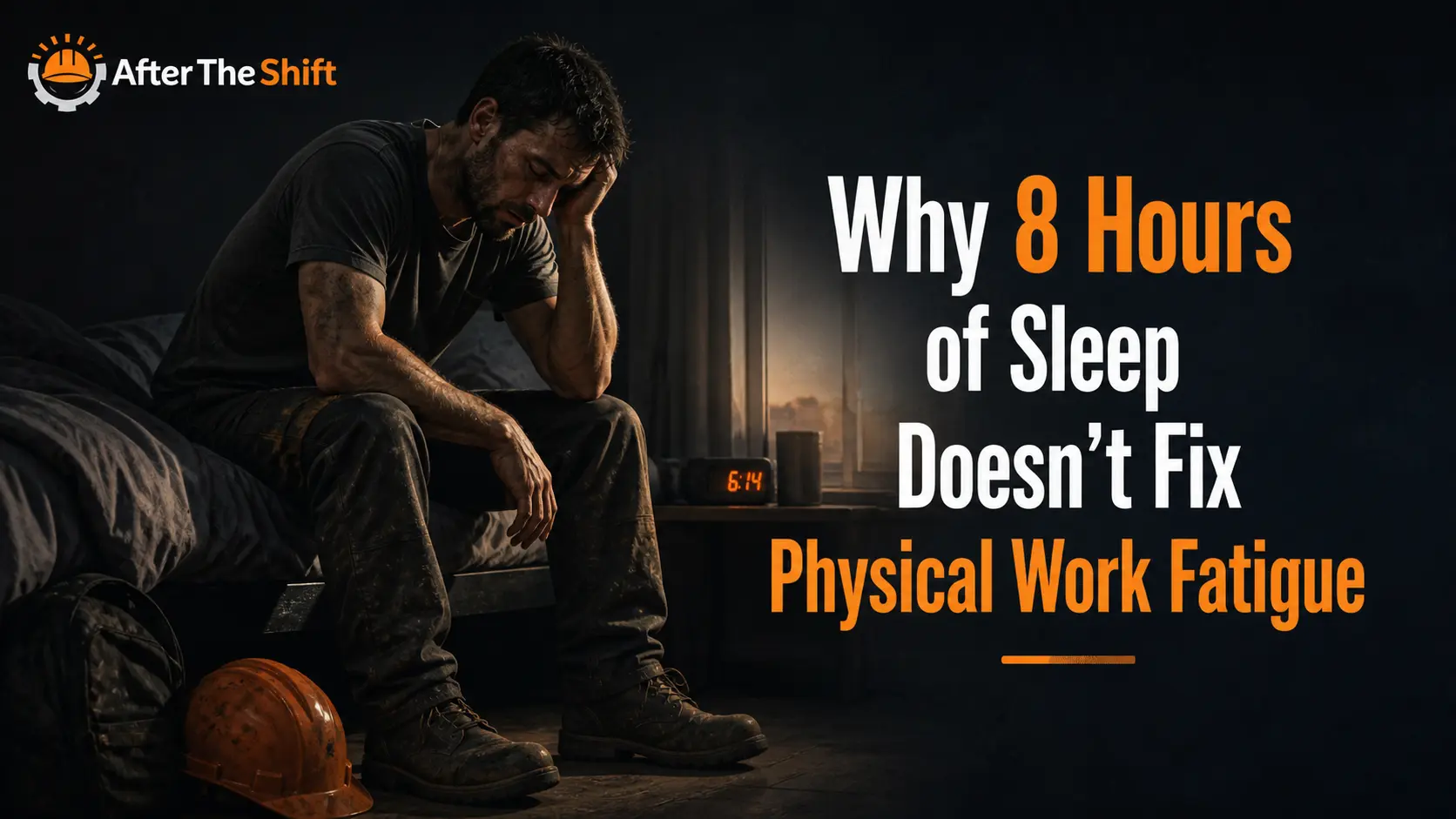
Eight hours in bed is not enough if your body is still overloaded, under-fueled, inflamed, or recovering from repetitive strain.
Home → Recovery Guide → Why 8 Hours of Sleep Doesn’t Fix Physical Work Fatigue
Eight hours of sleep does not automatically fix physical work fatigue because sleep is only one part of recovery. If your muscles, joints, nervous system, hydration, food intake, and workload are still out of balance, you can wake up tired even after a full night. This usually applies to warehouse workers, construction workers, cleaners, packers, drivers, pickers, scaffolders, and anyone doing repeated physical effort for long shifts.
If 8 hours of sleep does not fix physical work fatigue, your problem is probably not just sleep length. It is usually accumulated load, poor recovery quality, inflammation, low fuel, dehydration, or pain keeping your body in a stressed state overnight.
- Judge recovery by how you feel 60 minutes after waking, not only by hours slept.
- Eat enough protein, carbs, and salt after hard shifts.
- Use light movement before bed if stiffness is the main issue.
- Track patterns across 7 days before blaming one bad night.
- Assuming “8 hours” means your body fully recovered.
- Using caffeine late to cover fatigue that keeps repeating.
- Doing hard gym sessions when work already crushed your legs or back.
- Ignoring numbness, swelling, sharp pain, or fatigue that keeps getting worse.
If you sleep 7–9 hours but wake up heavy, stiff, sore, or mentally flat for more than 3 mornings in a week, treat it as a recovery problem, not a laziness problem.
| If you… | Most likely issue | Risk / flag | Do first |
|---|---|---|---|
| Sleep 8 hours but wake up stiff | Tissue stiffness, joint irritation, poor sleep position | Moderate | Add 8–12 minutes of easy mobility after work and before bed. |
| Wake up tired but not sore | Sleep quality, stress load, caffeine timing, under-eating | Moderate | Fix food, hydration, caffeine cutoff, and wind-down timing for 7 days. |
| Wake up with swelling, numbness, or sharp pain | Possible nerve, tendon, joint, or inflammatory issue | High | Reduce aggravating work patterns and get medical advice if it persists. |
| Feel better on workdays than days off | Weekend crash, delayed fatigue, too little active recovery | Moderate | Keep one light movement anchor on days off instead of full collapse. |
| Need more sleep every week to feel normal | Accumulated fatigue exceeding recovery capacity | High | Lower total load for 3–7 days and track morning fatigue. |
- Why 8 hours is not the same as recovery
- What this applies to — and what it does not
- How job type changes fatigue
- Symptom → cause → fix matrix
- Decision tree: what kind of fatigue is this?
- The 4 fatigue stages after physical work
- Mini-test: how overloaded are you?
- What actually fixes it by phase
- FAQs
- Next steps
Why 8 Hours Is Not the Same as Recovery
Eight hours of sleep can refill basic tiredness, but it may not repair the load created by repetitive lifting, walking, gripping, bending, standing, vibration, heat, cold, stress, and pain.
Sleep is the repair window. It is not the repair material. Your body still needs enough calories, protein, carbohydrates, fluid, salt, circulation, low pain signals, and enough time away from the same movement pattern.
Eight hours of sleep may not fix physical work fatigue when the worker’s total load is higher than their recovery capacity. The common causes are accumulated muscle damage, joint irritation, nervous system stress, poor fuel intake, dehydration, pain-disrupted sleep, and repeating the same strain again before the body finishes repairing.
| Recovery system | What physical work drains | Why sleep alone may not fix it | Best first fix |
|---|---|---|---|
| Muscles | Repeated contractions, eccentric lowering, carrying, stairs | Repair needs food, blood flow, and lower next-day load. | Protein + carbs + light movement. |
| Joints | Compression, awkward angles, kneeling, reaching | Irritated joints can stay sensitive overnight. | Change angles and reduce repeated pressure. |
| Nervous system | Noise, pace, scanning, targets, night shifts, stress | The body may stay wired even while you are in bed. | Caffeine cutoff + wind-down routine. |
| Energy stores | Long walking, lifting, sweating, missed meals | You can sleep but still wake under-fueled. | Post-shift meal with carbs, protein, and salt. |
| Sleep quality | Pain, heat, alcohol, late caffeine, irregular hours | Time in bed can look normal while deep recovery is poor. | Cool room, pain control, consistent sleep window. |
If you feel rough when you wake up but noticeably better after breakfast, hydration, and 10 minutes of movement, your fatigue is more likely recoverable load than a serious injury. Still track it if the pattern repeats.
What This Applies To — And What It Does Not
This guide applies when you sleep a normal amount but still feel physically drained after manual work, shift work, warehouse work, construction, cleaning, delivery, retail stock work, or repetitive production tasks.
This usually applies to repeated fatigue after physically demanding work. It does not replace medical advice for chest pain, fainting, unexplained severe weakness, fever, sudden swelling, one-sided numbness, breathing problems, major injury, or fatigue that appears without a clear workload reason.
The key distinction is simple: normal tiredness improves when you reduce load and improve recovery. Accumulated fatigue keeps stacking even when you technically sleep enough.
| Fatigue type | Best for | Avoid if | What changes the recommendation |
|---|---|---|---|
| Normal post-shift tiredness | One hard day, no sharp pain, improves after sleep | Fatigue returns earlier each shift | Add food, hydration, and light mobility. |
| Accumulated fatigue | Several hard shifts in a row | You also have red-flag symptoms | Needs workload reduction, not just more sleep. |
| Pain-disrupted recovery | You wake when rolling, turning, or changing position | Pain is sharp, spreading, or worsening | Fix the pain driver before chasing sleep length. |
| Medical fatigue | Unexplained exhaustion not matching workload | Do not self-diagnose serious symptoms | Needs professional assessment. |
How Job Type Changes Physical Work Fatigue
Different jobs create different fatigue patterns, so the fix depends on what your shift repeatedly asks your body to do.
A picker walking 25,000 steps has a different problem than a packer looking down for 9 hours or a builder kneeling on concrete. The sleep number can be the same, but the recovery demand is not.
| Job type | Main fatigue angle | Risk | Compounding factor |
|---|---|---|---|
| Warehouse picker | Steps, stairs, carrying, time pressure | Leg and foot overload | Poor shoes, concrete floors, missed meals |
| Packer / scanner | Repetition, wrist angle, neck flexion | Nerve and tendon irritation | No variation, high scan targets |
| Construction laborer | Lifting, kneeling, carrying, weather exposure | Whole-body fatigue | Cold, heat, awkward surfaces |
| Cleaner | Bending, twisting, pushing, shoulder repetition | Back and shoulder irritation | Rushed pace, poor tool length |
| Driver / delivery worker | Sitting, loading, unloading, stairs | Back stiffness + leg fatigue | Long sitting after heavy lifting |
Do not copy recovery advice from someone with a different job. A gym recovery plan is not the same as recovery from 8–12 hours of repeated bending, walking, gripping, reaching, or standing on concrete.
Symptom → Cause → Fix Matrix
The fastest way to understand post-shift fatigue is to match the symptom pattern to the recovery gap.
| Symptom after 8 hours of sleep | Likely cause | Fix first | Red flag |
|---|---|---|---|
| Heavy legs in the morning | Walking volume, standing load, poor circulation recovery | Elevate legs, hydrate, light walk, check footwear. | One-sided swelling or calf pain |
| Whole body feels crushed | Accumulated fatigue, under-eating, poor recovery days | Reduce load for 48–72 hours and increase food quality. | Fever, dizziness, unexplained weakness |
| Back locks up when getting out of bed | Repeated bending, drive-home stiffness, sleep position | Use easy hip/back mobility before bed and after waking. | Pain down leg with numbness or weakness |
| Hands numb at night or morning | Wrist position, gripping, nerve irritation | Neutral wrist sleep position and reduce repetitive grip strain. | Weak grip or constant numbness |
| Tired but wired at bedtime | Stress hormones, late caffeine, high-paced shift | Caffeine cutoff 6–8 hours before sleep and a low-light wind-down. | Insomnia lasting weeks |
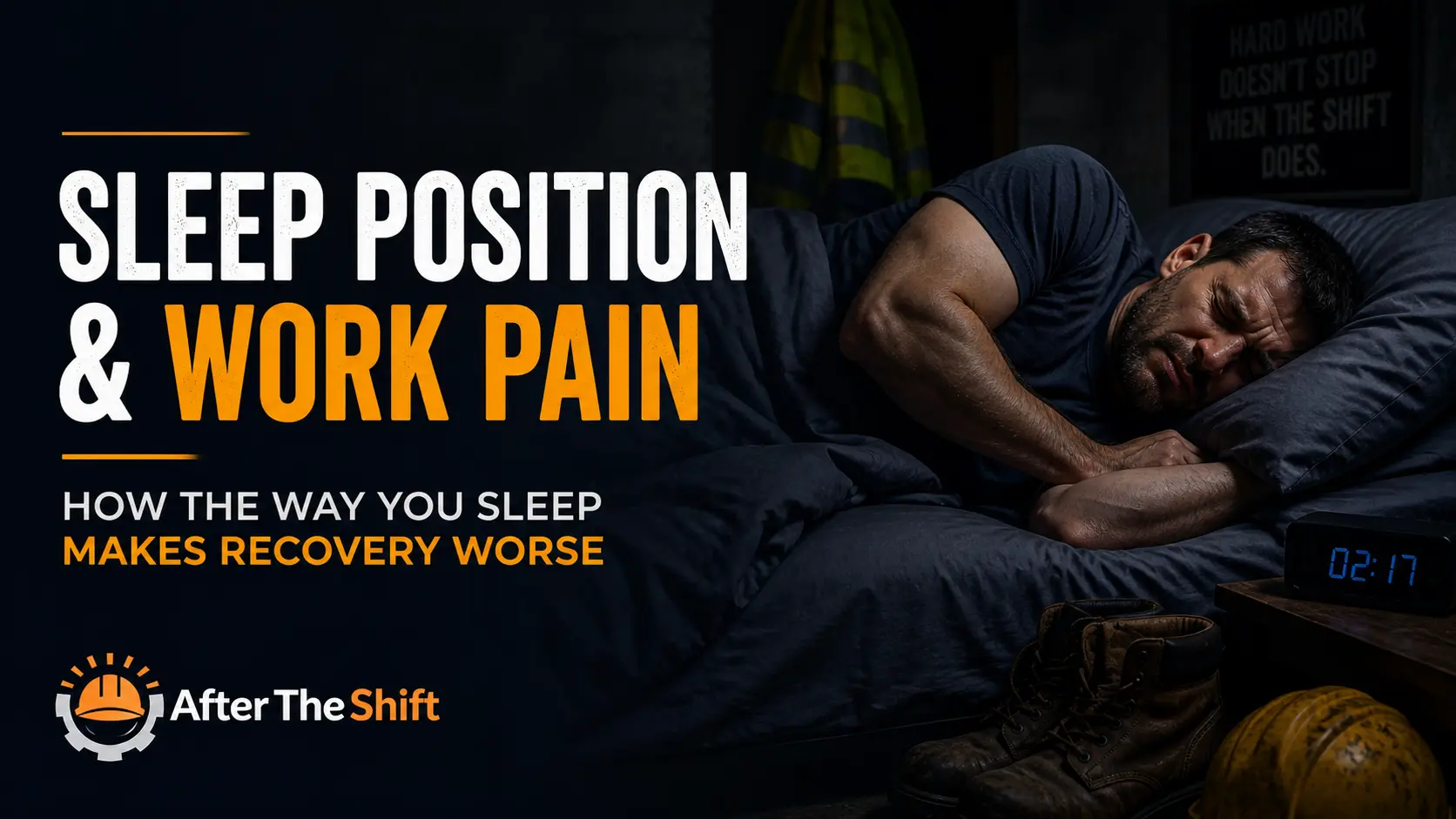
| Soreness gets worse when lying down | Inflammation, compression, poor sleep position | Change sleep position and use gentle decompression before bed. | Pain waking you repeatedly |
For more detail on pain that gets worse in bed, use the guide on why pain gets worse when you lie down after work.
Decision Tree: What Kind of Fatigue Is This?
Use this decision tree when you slept enough but still feel physically wrecked after work.
After 7–9 hours of sleep, do you have sharp pain, swelling, numbness, weakness, chest symptoms, fainting, or severe unusual fatigue?
The 4 Fatigue Stages After Physical Work
Physical work fatigue usually becomes a problem in stages: first you recover slower, then stiffness appears earlier, then pain interrupts sleep, then performance drops.
| Stage | What it feels like | What is happening | Recovery need | Action |
|---|---|---|---|---|
| Stage 1 | Tired after shift, better after sleep | Normal fatigue | Food, water, sleep | Keep routine stable. |
| Stage 2 | Wake stiff despite 8 hours | Recovery lag | Mobility + load control | Add active recovery and fix work angles. |
| Stage 3 | Pain, poor sleep, fatigue builds weekly | Accumulated fatigue | Lower total load | Reduce aggravating tasks where possible for 3–7 days. |
| Stage 4 | Weakness, numbness, swelling, major performance drop | Possible injury or medical issue | Assessment | Stop guessing and get help. |
A worker who sleeps 8 hours but wakes up worse across the week is likely dealing with accumulated fatigue. The deciding sign is not one bad morning. It is a repeating pattern where soreness, heaviness, stiffness, or mental flatness starts earlier, lasts longer, and needs more rest to improve.
For the bigger pattern, see accumulated fatigue and the damage you do not feel yet.
Mini-Test: How Overloaded Are You?
This 10-point test estimates whether your tiredness is normal, building, or already interfering with recovery.
Choose yes or no. Score is based on how many fatigue flags you have.
1. Do you wake up tired after 7–9 hours of sleep at least 3 times per week?
2. Does stiffness last longer than 30–60 minutes after waking?
3. Do you need caffeine just to feel normal before work?
4. Does fatigue get worse across consecutive shifts?
5. Do your days off feel like a crash instead of recovery?
6. Do you wake because of pain, numbness, or pressure?
7. Are you eating less than your workload probably needs?
8. Do your feet, knees, back, shoulders, or hands feel worse every month?
9. Do you skip mobility, stretching, or easy movement because you are too tired?
10. Do you feel mentally flat, irritable, or slow after workdays?
What Actually Fixes It — By Phase
The fix is not “sleep more forever.” The fix is to reduce the recovery debt before, during, and after the shift.
Before shift
- Eat a real meal before hard work.
- Hydrate before sweating starts.
- Warm up the stiff area for 3–5 minutes.
- Prepare better shoes, gloves, or supports if needed.
During shift
- Change grip, stance, or reaching angle when possible.
- Drink before thirst gets heavy.
- Use micro-breaks for the area doing the most work.
- Do not let pain become the normal background noise.
After shift
- Eat protein and carbs within a realistic post-shift window.
- Do 8–12 minutes of easy mobility, not a hard workout.
- Cut caffeine early enough to protect sleep quality.
- Fix sleep position if pain gets worse lying down.
The best low-cost fix is a repeatable post-shift recovery routine: eat, hydrate, move lightly, cool down, then sleep. Do it for 7 days before deciding that sleep length is the only problem.
If you cannot fall asleep even when exhausted, use the related guide on why you cannot fall asleep after an exhausting shift.
Treatment Options Compared
Most workers do not need one magic treatment; they need the correct recovery lever for the correct problem.
| Option | Best for | Skip if | Cost / time |
|---|---|---|---|
| More sleep time | Short sleep, long shifts, night shift recovery | You already sleep 7–9 hours but wake sore | Free; needs schedule control |
| Better food after work | Heavy legs, low energy, skipped meals | Fatigue has red flags | Low cost; daily habit |
| Light mobility | Morning stiffness, back/hip tightness, sore shoulders | Movement creates sharp pain | Free; 8–12 minutes |
| Footwear / insoles | Concrete floors, foot pain, leg heaviness | Pain is nerve-like or swollen | Medium cost; replace when worn |
| Workload reduction | Accumulated fatigue, worsening weekly symptoms | You only had one hard day | Harder to control; often most effective |
| Medical assessment | Red flags, persistent pain, unexplained fatigue | Mild normal tiredness that quickly improves | Varies; worth it for risk signs |
Post-Shift Recovery Checklist
Use this checklist for 7 days if you keep waking tired after 8 hours of sleep.
Bottom Line
The best fix is not always more sleep. The best fix is matching the recovery action to the fatigue pattern.
If 8 hours of sleep does not fix physical work fatigue, start with the recovery basics: enough food, hydration, light movement, earlier caffeine cutoff, better sleep position, and reduced repeated strain for several days. Seek help if fatigue comes with swelling, numbness, weakness, sharp pain, chest symptoms, dizziness, or unexplained decline.
- Best choice: 7-day recovery reset with food, water, light mobility, caffeine control, and task-pattern tracking.
- Best for: workers who sleep enough but wake stiff, heavy, sore, or flat after physical shifts.
- Avoid relying on sleep alone if: symptoms are getting worse weekly or pain is interrupting sleep.
- Do next: use the checklist, track your score, then follow the relevant related guide below.
FAQs
These are the common search questions workers ask when 8 hours of sleep still does not fix physical fatigue.
Related Links
Use these next if one specific part of the fatigue pattern matches you.
- Physical work recovery guide for warehouse, construction, and shift workers
- Rest vs recovery: why sleeping is not fixing you
- Why you cannot fall asleep even though you are exhausted after a shift
- Waking up stiff after physical work: what happens while you sleep
- Sleep position and work pain: how the way you sleep makes recovery worse
- Why days off can feel worse than workdays
- What real recovery looks like after physical work
Next Steps
Do not try to fix everything at once. Use the pattern, then choose the next action.
- If you wake tired but improve after food and water: fix your post-shift meal and hydration for 7 days.
- If you wake stiff: add 8–12 minutes of easy mobility before bed and after waking.
- If pain wakes you: fix sleep position and the work task that irritates the area.
- If fatigue builds across shifts: reduce repeated strain and skip hard extra training for 3–7 days.
- If symptoms include numbness, swelling, sharp pain, weakness, dizziness, chest symptoms, or unexplained decline: get medical advice instead of treating it as normal tiredness.
Save this post before your next hard shift.
Use the decision table, quiz, and checklist for one full week. One morning can lie. A 7-day pattern tells the truth.
This article is general recovery education, not a diagnosis or a substitute for care from a qualified clinician. Stop and get medical help for severe pain, numbness, weakness, chest pain, sudden swelling, fever, or symptoms that keep worsening.
Log in to leave a comment.