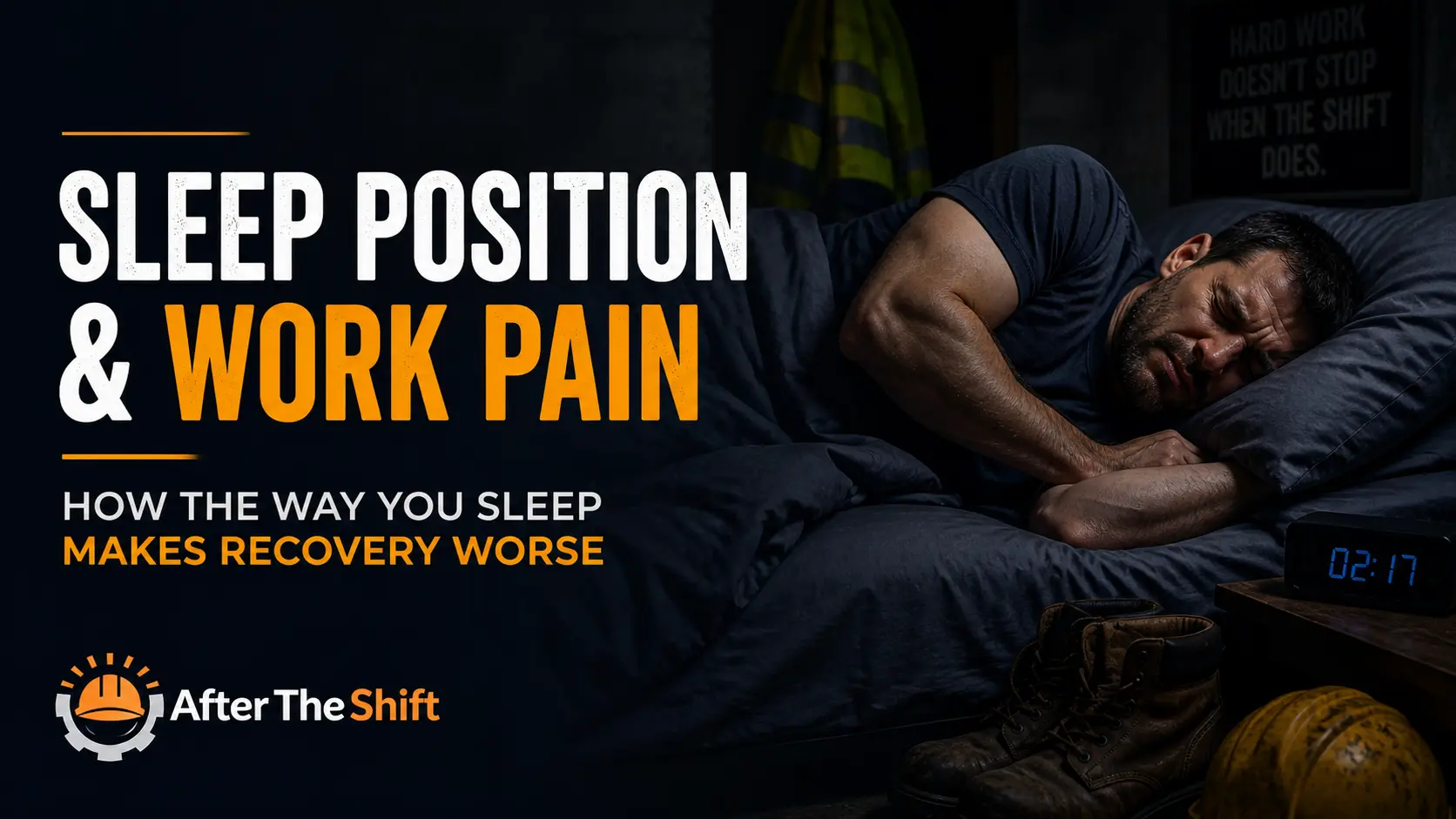
If you wake up tighter than when you went to bed, your sleep position may be loading the same joints your shift already irritated.
If you wake up tighter, numb, sharper, or more locked up after sleeping, your sleep position may be keeping irritated joints under pressure for hours. This guide shows physical workers how to match sleep position to the body part that hurts, what to stop doing tonight, and when pain is no longer just “bad sleep posture.”
Bad sleep position does not usually create work pain from nothing, but it can make existing shoulder, back, hip, neck, wrist, and knee irritation worse by holding tissue compressed or twisted for 6–8 hours. The fix is not one perfect posture. The fix is removing pressure from the sore structure and supporting the gaps your body collapses into while asleep.
- Sleep with the painful joint supported, not stretched.
- Use pillows to fill gaps: neck, waist, knees, arms.
- Change one position variable for 3 nights before judging.
- Track morning pain, numbness, and stiffness separately.
- Sleeping directly on the painful shoulder or hip.
- Stomach sleeping with the neck twisted all night.
- Letting wrists curl under the pillow or body.
- Assuming more sleep fixes pain if the position keeps loading it.
If pain is worse in the first 10 minutes after waking than it was when you went to bed, your sleep position is probably loading the irritated area overnight — fix the position before adding more stretches, creams, or supplements.
Fast answer for busy readers: Sleep position makes work pain worse when it keeps a sore joint compressed, twisted, stretched, or unsupported for hours. This usually applies to workers with repetitive reaching, lifting, scanning, kneeling, gripping, standing, or driving pain. It does not apply to sudden severe pain, new weakness, chest pain, loss of bladder control, fever, or major trauma — those need medical help, not sleep-position experiments.
| If you… | Most likely overnight problem | Try tonight | Flag |
|---|---|---|---|
| Wake with shoulder pain on one side | Sleeping on compressed shoulder or arm pulled across body | Hug a pillow and keep sore shoulder off the mattress | Moderate |
| Wake with lower back stiffness | Spine sagging, hips rotated, or knees pulling pelvis | Side sleep with pillow between knees or back sleep with pillow under knees | Low |
| Wake with hand numbness | Wrist bent, elbow compressed, or arm under body | Keep wrist neutral; avoid sleeping with arm under pillow | High if repeated |
| Wake with neck pain or headache | Pillow too high, too flat, or stomach sleeping with neck twisted | Keep nose, chin, and chest facing same direction | Moderate |
| Wake with sharp new pain, weakness, or spreading numbness | May be more than position irritation | Stop self-testing and get assessed | High |
- Why sleep position makes work pain worse
- What this applies to — and what it does not
- How your job type changes the best sleep position
- Symptom → cause → fix matrix
- Decision tree: choose your sleep setup tonight
- The 4 overnight damage stages
- Mini-test: is your sleep position blocking recovery?
- What actually fixes it — before, during, and after sleep
- FAQs
- Next steps
Why sleep position makes work pain worse
Sleep position makes work pain worse when it removes movement but keeps load on the same irritated tissue for hours. During a shift, pain often comes from repeated movement. During sleep, pain often comes from sustained position: pressure, stretch, compression, rotation, or poor support.
A sleep position is bad for recovery when it keeps the painful area at end range or under pressure. A sore shoulder does not recover well if you sleep on it. A sore lower back does not recover well if the pelvis twists all night. A numb hand does not recover well if the wrist stays bent under your body.
Physical work creates a “loaded tissue” problem before you even lie down. Lifting, gripping, reaching, scanning, kneeling, standing on concrete, and driving home can leave joints irritated. Sleep either gives that tissue a low-load recovery window or turns the same irritation into an all-night hold.
| Overnight load type | What it means | Common body part | Typical morning sign |
|---|---|---|---|
| Compression | Body weight presses into sore tissue | Shoulder, hip, elbow | Deep ache on waking |
| Stretch | Joint held too far open or pulled across body | Shoulder, neck, lower back | Tightness and sharp first movement |
| Rotation | Spine or pelvis twists while the rest of body stays still | Back, neck, hips | Locked-up feeling after getting out of bed |
| Nerve pressure | Wrist, elbow, shoulder, or neck position irritates nerves | Hands, fingers, forearm | Tingling, numbness, dead-hand feeling |
For a wider recovery framework, start with the physical work recovery guide. This post focuses only on the sleep-position part of that recovery system.
What this applies to — and what it does not
This usually applies to pain that is worse after sleep, improves after moving around, and connects to a repeated work position. It is most useful for workers who already know their job irritates a body part but cannot understand why sleep fails to calm it down.
- Morning stiffness after lifting, standing, kneeling, or reaching.
- Shoulder ache from sleeping on the same side.
- Back tightness that eases after walking.
- Hand tingling linked to wrist or elbow position.
- Major trauma, falls, or sudden severe pain.
- New weakness, foot drop, or spreading numbness.
- Fever, unexplained swelling, or severe night pain.
- Chest pain, breathing symptoms, or bladder/bowel changes.
Do not treat new numbness, weakness, severe spreading pain, or pain after a fall as a pillow problem. Sleep position can aggravate irritated tissue, but it should not be used to explain neurological symptoms that are getting worse.
How your job type changes the best sleep position
Your best sleep position depends on what your shift overloaded first. A scanner, picker, roofer, driver, and warehouse loader may all have “work pain,” but the overnight fix changes because the irritated tissue changes.
| Job type | Work angle | Sleep risk | Compounding factor |
|---|---|---|---|
| Warehouse picker / loader | Bend, reach, twist, lift | Lower back and shoulder compressed overnight | Drive home locks hips before bed |
| Scanner / packer | Repeated wrist, thumb, neck angle | Wrist curls under pillow; neck rotates | Small movements repeated thousands of times |
| Construction / roofing | Kneeling, carrying, overhead work | Shoulder, knee, and hip pressure | Fatigue makes you collapse into one side |
| Standing concrete work | Foot, calf, knee, hip load | Legs stacked unevenly; hips rotated | Lower body already stiff before bed |
| Driving / delivery | Seated hip flexion and neck tension | Back arches or hips twist overnight | Low movement before sleep |
If your issue is mostly stiffness after sleep rather than pain during the shift, pair this guide with why physical workers wake up stiff after sleep.
Symptom → cause → fix matrix
The fastest way to fix sleep-position pain is to match the morning symptom to the overnight load. Do not start with “what pillow should I buy?” Start with what part is being compressed, twisted, stretched, or bent.
| Symptom in your words | Likely sleep-position cause | Fastest fix tonight | Red flag |
|---|---|---|---|
| “My shoulder kills when I wake up.” | Side sleeping directly on irritated shoulder | Sleep on the other side; hug pillow so top arm does not fall forward | Weakness lifting arm |
| “My lower back is locked in the morning.” | Pelvis rotated or spine sagging unsupported | Pillow between knees on side or under knees on back | Pain down leg with numbness |
| “My hands go numb at night.” | Wrist bent, elbow bent hard, or arm compressed | Keep wrist straight; avoid hands under pillow or body | Numbness lasts after waking |
| “My neck hurts from sleeping wrong.” | Neck rotated or side-bent for hours | Use pillow height that keeps nose centered with chest | Severe headache or arm weakness |
| “My hip burns on the side I sleep on.” | Direct pressure on outer hip after standing work | Avoid sore side; place pillow between knees to stop top leg dropping | Unable to bear weight |
Change the pressure point first, not the mattress first. Most physical workers should test pillow support, side choice, wrist position, and knee support for 3 nights before spending money on a new mattress.
For hand symptoms specifically, use this with why hands go numb at night after physical work.
Decision tree: choose your sleep setup tonight
Use this decision tree to choose one sleep-position change tonight instead of changing everything at once. One clean change gives you a clearer signal by morning.
Where is the main pain or numbness when you wake up?
The 4 overnight damage stages
Sleep-position pain usually moves from stiffness to repeat irritation before it becomes a real recovery blocker. The earlier you catch the pattern, the less you need to change.
| Stage | How it feels | What is happening | Recovery signal | Action |
|---|---|---|---|---|
| 1. Morning stiffness | Tight for 5–20 minutes | Low movement and mild compression | Improves quickly after walking | Support gaps with pillows |
| 2. Position-triggered ache | Pain mostly on one side | Same joint loaded every night | Better if you avoid that side | Change side and arm/leg support |
| 3. Recovery blocked | Pain carries into the shift | Work irritation never fully calms overnight | Worse after hard shifts | Fix sleep + reduce aggravating work angles |
| 4. Nerve or injury signs | Numbness, weakness, sharp spreading pain | Possible nerve involvement or worsening injury | Does not settle after changing position | Get assessed |
Mini-test: is your sleep position blocking recovery?
This test ranks how likely your sleep setup is making work pain worse. It is not a diagnosis. It is a practical filter for deciding whether to change your sleep position tonight.
Answer yes or no:
What actually fixes it — before, during, and after sleep
The fix is not “sleep perfectly.” The fix is reducing the overnight load enough for irritated tissue to calm down. Use three phases: unload before bed, support during sleep, and test the morning result.
Before bed
- Walk 3–5 minutes after sitting or driving.
- Do not aggressively stretch sharp pain.
- Choose the one body part you are protecting tonight.
- Place pillows before you are half-asleep.
During sleep
- Keep neck neutral, not twisted.
- Keep wrists straight, not curled.
- Keep top knee supported when side sleeping.
- Keep sore shoulder or hip off direct pressure.
After waking
- Rate pain before checking your phone.
- Note numbness separately from soreness.
- Move gently before loading the painful area.
- Repeat the same setup for 3 nights before judging.
Save this page and test one setup for 3 nights. If the morning pain drops by even 20–30%, sleep position was part of the problem. Then use the recovery guide to fix the rest of the pattern.
Treatment options compared: what to try, what to skip
Most workers should start with cheap position fixes before buying expensive sleep gear. The best option is the one that removes the exact overnight load causing your morning symptom.
| Option | Best for | Skip if | Cost/time |
|---|---|---|---|
| Pillow between knees | Side sleepers with lower back or hip stiffness | It increases hip pain or feels unstable | Free–cheap, test tonight |
| Hug pillow | Shoulder pain from top arm falling forward | Neck still twists with pillow height | Free–cheap, 3-night test |
| Neutral wrist brace | Repeated night hand numbness from wrist curling | Numbness spreads or grip weakens | Low cost, use at night only if tolerated |
| New pillow | Neck pain from obvious height mismatch | Pain is mainly shoulder compression | Medium cost, only after height test |
| New mattress | Whole-body sagging, old mattress, persistent support failure | One joint hurts from sleeping on it | High cost, last step |
Pillow support based on symptom. It is cheap, reversible, and tells you whether position is part of the pain pattern.
Use pillows you already own. One between knees, one hugged at the chest, or one under knees can change load immediately.
Upgrade pillow or mattress only after testing position. Buying gear before identifying the load often wastes money.
Printable checklist: the 8-point sleep-position reset
Use this checklist before bed on hard shift days. It is designed for workers who are too tired to think through posture once they are already in bed.
Bottom line
The best sleep position for work pain is the one that removes pressure from the irritated structure, keeps joints neutral, and lets you wake up less stiff than when you went to bed. Side sleeping is not automatically bad. Back sleeping is not automatically best. Stomach sleeping is usually the worst choice when neck, shoulder, or back pain is already present.
For most physical workers, the safest first sleep-position fix is side sleeping with the painful shoulder or hip off the mattress, a pillow between the knees, and another pillow supporting the top arm. Back sleepers should support the knees. Workers with hand numbness should prioritize neutral wrists and avoid sleeping on the arm.
If pain gets worse when you lie down, also read why pain gets worse when you lie down after work.
FAQs
These are the common sleep-position questions physical workers ask when pain feels worse after rest. Use them to separate normal position irritation from patterns that need more attention.
Related links that complete the answer
Use these next if your pain pattern points to a specific body part or recovery problem. Sleep position is one part of recovery, not the whole system.
- Full physical work recovery guide for warehouse, construction, and shift workers
- Why you cannot fall asleep even though you are exhausted after a shift
- What is happening when you wake up stiff after physical work
- Why pain gets worse when you lie down after work
- Why your hands go numb at night after physical work
- Lower back stiffness in the morning after physical work
- Work pain vs injury: knowing the difference matters
Next steps
Do not try ten fixes tonight. Run a clean 3-night test. That gives you a useful answer instead of guessing.
- Pick the main morning symptom: shoulder, back, hip, neck, wrist, or hand numbness.
- Match it to the matrix: pressure, twist, stretch, or nerve position.
- Change one thing tonight: side choice, knee pillow, hug pillow, wrist position, or pillow height.
- Repeat for 3 nights: do not judge from one awkward night.
- Escalate if needed: worsening numbness, weakness, severe pain, or symptoms after trauma need assessment.
Next, open the physical work recovery guide and build the rest of your after-shift system: warm-down, sleep setup, pain tracking, and next-shift protection.
Save this before your next hard shift.
Use the checklist tonight, then compare tomorrow morning’s pain to today’s. Recovery is easier to fix when you catch the pattern early.
This article is general recovery education, not a diagnosis or a substitute for care from a qualified clinician. Stop and get medical help for severe pain, numbness, weakness, chest pain, sudden swelling, fever, or symptoms that keep worsening.


Log in to leave a comment.