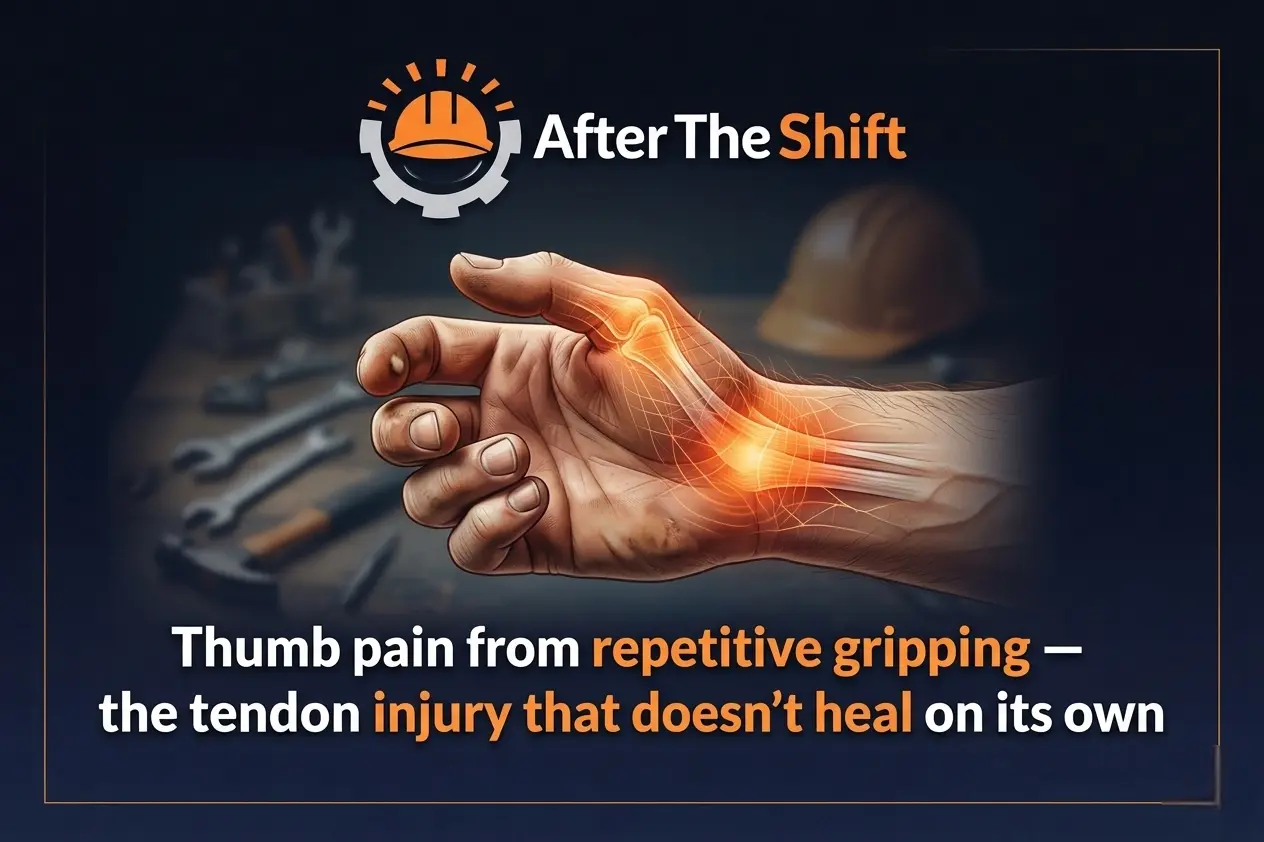
If your thumb hurts every time you grip, pinch, twist, or lift, this will help you tell tendon overload from a “just sore” hand problem and show what to change before it turns chronic.
Thumb pain from repetitive gripping usually means the tendons around the base of the thumb are getting overloaded faster than they recover. That is common in warehouse work, tool use, packing, scanning, assembly, and any job with constant pinching, twisting, squeezing, or awkward thumb angles. It usually improves only when the load changes. It often does not calm down if you keep doing the exact same work and just wait.
Thumb pain from repetitive gripping is usually a tendon overload problem, especially when it hurts during pinching, opening jars, scanning, squeezing tools, or lifting with the thumb spread away from the hand. If you keep doing the same motion at the same intensity, it often drags on for weeks or months instead of “healing by itself.”
- Reduce repeated pinching and wide-thumb gripping early
- Use a brace or support during flare-ups if it helps
- Change how you grip before pain becomes constant
- Get help fast if you feel clicking, sharp pain, or weakness
- Pushing through sharp thumb-base pain every shift
- Stretching hard into pain during an active flare
- Assuming “light objects” cannot cause tendon damage
- Waiting months because the pain comes and goes
If thumb pain shows up every time you grip, pinch, twist, or lift for more than 7 to 14 days, treat it like a tendon problem and change the load now, not after it becomes your new normal.
| If you… | Most likely issue | What to do next | Risk |
|---|---|---|---|
| Feel pain at the thumb base when pinching or gripping | Thumb tendon overload | Reduce pinch load, change grip, monitor 7 days | Moderate |
| Get a sudden jab when twisting caps, tools, or boxes | Irritated tendon sheath | Stop forcing twist-heavy work, brace if needed | High |
| Only feel mild soreness after an unusual day | Temporary overload | Watch it, recover, avoid repeating the same spike | Low |
| Have swelling, clicking, or weakness that keeps returning | Ongoing tendon injury | Get assessed; do not keep “testing” it at work | High |
- Why thumb gripping pain happens
- What this applies to — and what it doesn’t
- How job type changes the risk
- Symptom → cause → fix matrix
- Decision tree: is this a “watch it” problem or a “stop now” problem?
- The 4 damage stages
- Mini-test: how far has this gone?
- What actually fixes it by phase
- Treatment options compared
- Shift checklist, FAQs, and next steps
Why thumb gripping pain happens
This usually happens because the thumb tendons and their sheath are being loaded thousands of times in a pattern they do not recover from well enough between shifts.
The problem is rarely “one heavy lift.” It is usually repetition + awkward thumb position + not enough recovery + pain ignored too long. That is why workers get thumb pain from light scanning devices, tape guns, cutters, pliers, box opening, package pinching, bagging, sorting, or repeated phone and scanner use.
A thumb tendon injury becomes stubborn when the tendon is irritated every day before it has settled from the last shift. Repeating the same pinch or twist keeps the tissue in a cycle of re-irritation, so “resting later” often fails unless the work pattern changes too.
| Load factor | What it does to the thumb | Why it compounds |
|---|---|---|
| Repeated pinching | Compresses and strains the thumb-side tendons | Usually done hundreds or thousands of times |
| Wide thumb spread | Loads the tendon at a bad angle | Often happens with tools, boxes, and scanners |
| Twisting with force | Irritates the tendon sheath quickly | Small twist-heavy tasks add up fast |
| No real deload between shifts | Prevents the irritation cycle from settling | Pain returns earlier each week |
What this applies to — and what it doesn’t
This applies most to workers with pain around the base of the thumb or the thumb-side wrist that gets worse with grip, pinch, twist, lifting, or thumb motion.
Packaging, warehouse picking, assembly, scanning, construction hand tools, cleaning work, food prep, carrying bags or boxes by pinch grip, or any shift where the thumb is repeatedly spread and loaded.
A thumb that is numb all the time, clearly dislocated, badly bruised after trauma, or stuck after a fall. Those cases can involve nerve injury, joint injury, fracture, or ligament damage and should not be treated as “just tendon irritation.”
Get checked fast if the thumb is visibly swollen, suddenly weak, clicking hard, locking, numb, or painful enough that you cannot hold objects safely. Also get checked if symptoms keep coming back after several weeks of trying to reduce the load.
How job type changes the risk
Job type matters because the thumb gets stressed differently by force, angle, speed, and repetition.
| Job type | Main thumb angle | Risk | Compounding factor |
|---|---|---|---|
| Warehouse picking / scanning | Pinch + repeated thumb press | Moderate to high | Speed targets and no grip variation |
| Assembly / packaging | Fine pinch + twist | High | Thousands of low-force reps |
| Construction hand tools | Power grip + thumb spread | High | Vibration and forced grip |
| Cleaning / squeezing bottles / wringing | Twist + compress | Moderate | Long shifts with little rest |
| Food prep / knife and pinch work | Pinch stabilization | Moderate to high | Cold environment and repetition |
If your work looks “light” but requires speed and constant thumb use, you are still in a real risk group. That is the same pattern behind wrist pain from scanning packages and other repetition injuries that workers underestimate.
Symptom → cause → fix matrix
Use this table to separate ordinary soreness from the pattern that usually needs actual load changes.
| Symptom | Likely cause | Fastest fix | Red flag |
|---|---|---|---|
| Pain when pinching or opening jars | Thumb tendon overload | Reduce pinch intensity and frequency | No |
| Pain with twisting, wringing, or cutting | Tendon sheath irritation | Cut twist-heavy tasks first | If it spikes sharply every time |
| Thumb feels weak holding objects | Pain inhibition or worsening tendon load | Unload early, brace if useful, get assessed if persistent | Yes |
| Clicking or catching near the thumb base | More irritated tendon movement | Stop testing it with repeated grips | Yes |
| Mild soreness only after unusual work | Short-term overload | Recover and avoid another spike day | No |
| Pain spreading into thumb-side wrist | Broader tendon track irritation | Deload sooner and consider medical review if it keeps escalating | Sometimes |
The main cause is usually not total weight. It is repeated thumb loading in the same angle until the tissue stops tolerating even normal work. That is the same logic behind hand pain from gripping tools all day and related overuse patterns.
Decision tree: is this a “watch it” problem or a “stop now” problem?
Use this if you are not sure whether you are dealing with normal soreness, an active flare, or a problem that needs faster action.
Step 1: Does the thumb hurt during gripping, pinching, twisting, or lifting on most workdays?
The 4 damage stages
Thumb tendon problems usually move through stages. The exact timeline varies, but the pattern matters more than the label.
| Stage | What it feels like | What is happening | Recovery outlook | Action |
|---|---|---|---|---|
| Stage 1 | Mild soreness after a spike day | Load exceeded tolerance briefly | Usually settles fast | Monitor and avoid another spike |
| Stage 2 | Pain during work but settles later | Active irritation cycle | Good if you unload early | Change grip pattern now |
| Stage 3 | Pain shows up earlier and lingers | Tissue tolerance has dropped | Slower recovery | Deload hard and get guidance |
| Stage 4 | Pain, weakness, clicking, or constant aggravation | Chronic irritation pattern | Often long if ignored | Stop guessing and get assessed |
Most workers wait until Stage 3. That is when the pain starts earlier in the shift, lasts into the evening, and shows up during ordinary tasks like opening a bottle or pulling up socks.
Mini-test: how far has this gone?
Answer yes or no. Count one point for each “yes.” This is not a diagnosis. It is a quick severity screen based on persistence, irritability, and function loss.
What actually fixes it — by phase
The best fix depends on whether you are trying to calm an active flare, get through a shift with less irritation, or rebuild tolerance after symptoms settle.
Before work
Best for: active pain or morning stiffness.
- Know which tasks trigger the pain fastest
- Use support if it reduces flare-ups
- Do not “warm it up” with hard thumb stretching
- Plan grip changes before the shift starts
During work
Fastest fix: reduce repeated pinch and twist exposure.
- Alternate grip type whenever possible
- Use the whole hand instead of thumb-only pinch
- Break up high-speed thumb tasks
- Stop “testing” painful motions again and again
After work
Main goal: let irritation settle instead of refiring it.
- Avoid more thumb-heavy chores right after shift
- Track whether pain settles by next morning
- Rebuild gradually once symptoms are calmer
- Escalate if function keeps dropping
The most effective first move is usually not a stretch or gadget. It is cutting the exact motion that spikes symptoms fastest: repeated pinch, wide-thumb grip, or repeated twist.
If you keep ignoring pain signals, the pattern starts to look less like simple soreness and more like the broader injury cycle described in why pushing through work pain makes injuries worse and work pain vs injury — knowing the difference matters.
Treatment options compared
These options are not equal. Some reduce symptoms. Some reduce re-irritation. The best choice depends on how active and how stubborn the problem is.
| Treatment | Best for | Avoid if | Cost / time trade-off |
|---|---|---|---|
| Load reduction / task change | Almost every stage | You refuse to change anything at work | Best value, hardest to enforce |
| Thumb/wrist brace | Flare-ups and repetitive days | It makes work impossible or increases bad grip habits | Low cost, symptom control only |
| Exercises / reload plan | After pain becomes less irritable | You are still flaring it hard every day | Good long-term option, needs consistency |
| Medical assessment / physio | Persistent, worsening, or unclear cases | You only had one mild sore day | Higher cost, better clarity |
| Painkillers alone | Short-term symptom relief only | You think they solve the actual cause | Cheap short-term, poor long-term by itself |
Load reduction plus better grip strategy is the best first-line option for most workers because it addresses the cause, not just the pain.
A basic brace plus task changes can reduce flare-ups cheaply, but it will not solve a bad work pattern by itself.
An assessment with a clear reload plan is the best upgrade when pain has lasted weeks or keeps returning the moment work intensifies.
Shift checklist: what to change this week
Use this as a practical reset. The goal is not to be perfect. The goal is to stop repeating the exact pattern that keeps the tendon irritated.
FAQs workers actually search
These answers are written to stand alone, so they still make sense if someone lands here from search or an AI answer quote.
Related links that help you finish the answer path
Use these next if you want to understand the bigger pattern behind work-related hand and wrist overload:
- Physical Work Recovery Guide — the main recovery hub for physical workers
- Carpal tunnel in warehouse workers — the early signs everyone misses
- Wrist pain from scanning packages — why repetition beats weight every time
- Hand pain from gripping tools all day — when “just tough hands” becomes nerve damage
- Wrist pain from repetition, not weight
- Work pain vs injury — knowing the difference matters
Bottom line
Thumb pain from repetitive gripping usually improves when the aggravating load changes early. It usually drags on when workers keep pinching, twisting, and gripping through the same pain pattern and hope time alone will fix it.
Change the exact thumb motion that spikes pain fastest, then rebuild tolerance after symptoms settle.
Workers with thumb-base pain during gripping, pinching, lifting, or twisting that repeats across shifts.
Anyone with weakness, clicking, swelling, worsening pain, or symptoms lasting past 1 to 2 weeks.
Next steps
- Identify the one thumb motion that hurts most: pinch, twist, wide-thumb grip, or forceful squeeze.
- Reduce that motion first, even if the object itself is light.
- Track whether symptoms settle by the next morning or keep returning earlier.
- If pain lasts more than 7 to 14 days, or function is dropping, stop guessing and get assessed.
- Use the related guides above to compare thumb pain with carpal tunnel signs and repetition-based wrist pain.
Save this. If your thumb pain keeps showing up after gripping tasks, bookmark this page now and use the decision table, quiz, and checklist after your next shift.
This article is general recovery education, not a diagnosis or a substitute for care from a qualified clinician. Stop and get medical help for severe pain, numbness, weakness, chest pain, sudden swelling, fever, or symptoms that keep worsening.



Log in to leave a comment.