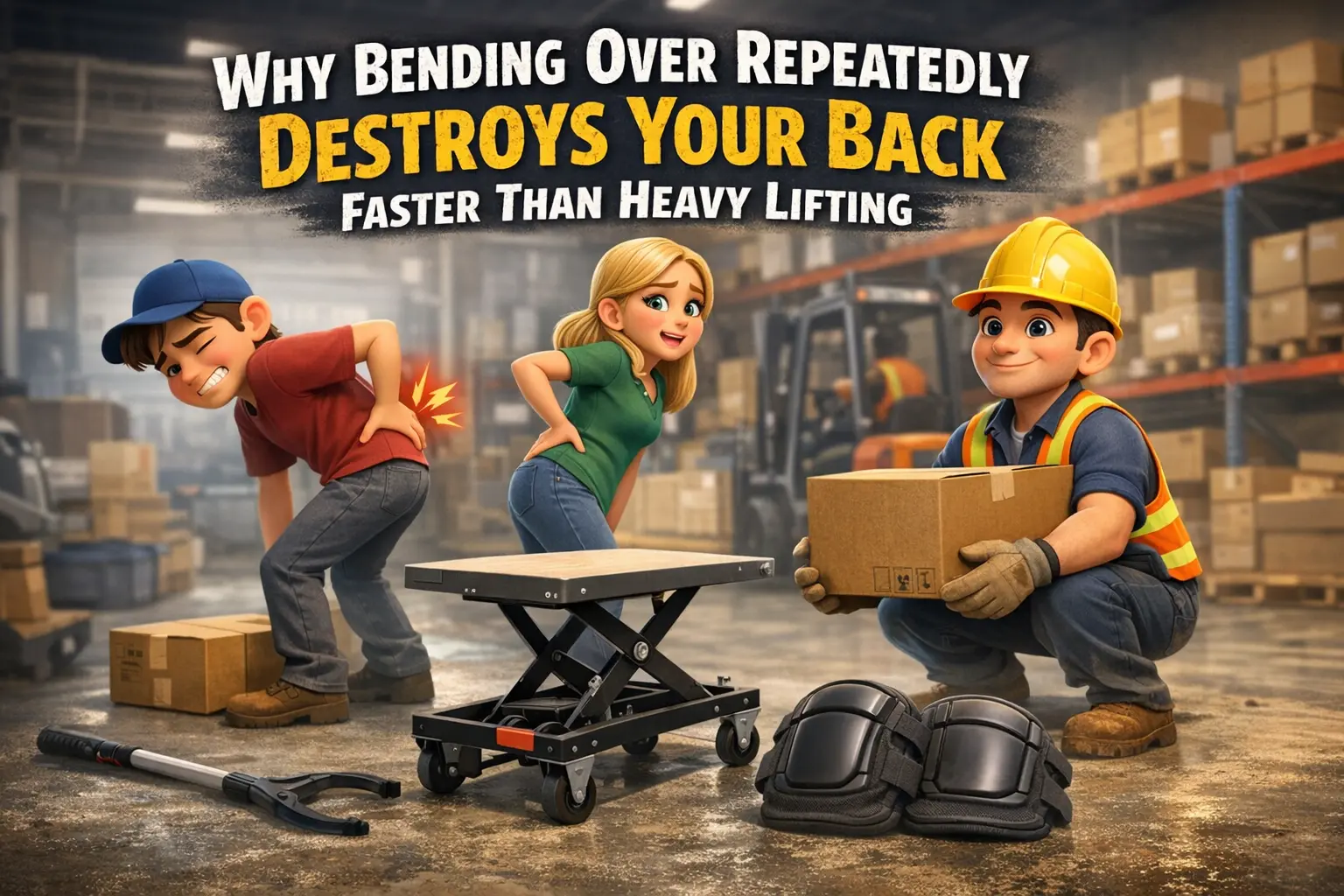
The problem isn’t “weak core.” It’s flexion + reach + repetition. Use the Bend Load Score + decision tree to fix the station (not just your form).
Home → Injuries & Prevention → Why bending over repeatedly destroys your back faster than heavy lifting
Most backs don’t fail from one heavy lift. They fail from hundreds of “small” bends that keep the spine flexed, the load far away, and the tissues fatigued. If your job is bend → grab → stand → repeat, the fix is not “brace harder.” It’s reduce Bend Load with smarter setup, smarter reps, and planned resets.
Blunt rule that decides most cases: If you’re bent forward more than 30 seconds at a time or you bend 150+ times per shift, you need station changes + reset rules. Technique alone won’t hold.
Quick answer
Repeated bending is often worse than heavy lifting because it stacks flexion fatigue (time bent) with bad leverage (reaching) and no recovery (repetition). Your back doesn’t get one big warning moment—it just accumulates damage until the “tightness” becomes pain.
- Do: raise the work, bring the load close, hinge at hips, reset every 10–20 bends.
- Avoid: bending + reaching (hands far), twisting while bent, and long bent holds.
- Fast win: stage items into the “hip pocket zone” (hand height near hips) before doing reps.
- If you want gear: use these 3 picks (kept intentionally minimal).
- Save this: screenshot the Bend Load Score section and re-check after 7 days.
Fast decision table (30-second diagnosis)
| If you… | Most likely cause | Do this today |
|---|---|---|
| Bend 150+ times per shift | Volume + flexion fatigue | Raise work 10–30 cm + add reset rule |
| Reach forward while bent | Long lever = higher load | Pull items close first, then lift |
| Twist while bent | Shear + rotation on fatigued tissue | Pivot feet; face the load; move containers |
| Pain ramps up across the shift | Accumulated fatigue, not “one bad rep” | Task rotation every 30–60 min + resets |
| Numbness/weakness or pain down the leg | Nerve irritation (needs caution) | Stop provoking positions; consider medical assessment |
Table of contents
- Why repetitive bending beats heavy lifting (in the worst way)
- Mini-test: Bend Load Score (2 minutes)
- Decision tree: the right fix for your station
- Symptom → cause → fix matrix
- The 5-part fix system (setup, pattern, resets, rotation, capacity)
- Weighted scoring rubric: pick the best fix
- 3 gear picks (affiliate, minimal)
- Mistakes that keep you injured
- FAQs
- Next steps (internal links)
Why repetitive bending beats heavy lifting (in the worst way)
1) Time bent = tissue creep, then fatigue
When you stay bent forward, tissues that help stabilize the spine gradually deform. That means less “natural support,” more muscle guarding, and higher sensitivity. Then you repeat the same position again—and the tolerance drops rep by rep.
2) The lever is the hidden multiplier (reach while bent)
Most job bending isn’t a clean hip hinge. It’s round + reach. Your hands are far from your body, which makes even light loads expensive. This is why “it’s not heavy” is still enough to wreck you.
3) Heavy lifts usually come with setup and breaks; bending usually doesn’t
Heavy lifts often have natural pauses: reposition, grip, walk, rest. Repetitive bending is rhythm work—low-grade stress with almost no recovery. That’s how you get the classic “fine early, cooked by hour 6” pattern.
Big attention: If you reduce reach and bend volume, your pain often drops faster than any “core routine.” Your station is the primary program.
Mini-test: Bend Load Score (2 minutes)
This is your “calculator-lite.” It turns chaos into a number you can actually fix. Add points and interpret the score.
Step 1 — Bends per shift
- 0 points: < 50
- 2 points: 50–150
- 4 points: 150–300
- 6 points: 300+
Step 2 — Position penalties
- +2: you reach forward while bent (hands away from thighs)
- +2: you twist while bent (even “small” twists)
- +2: bent holds last > 30 seconds
- +2: you feel back “pump/tightness” building during the shift
Step 3 — Recovery penalties
- +2: no resets (you never stand tall for 10–15 seconds)
- +2: same bend task > 60 minutes without rotation
- +2: pain spikes on the drive home
Interpretation
- 0–4: technique + small tweaks usually enough
- 5–10: you need station changes + reset rule
- 11–16: high Bend Load → redesign task or expect flare-ups
- 17+: your setup is built to injure you; escalate changes
Method note (trust signal): This score is based on what actually drives irritation in real shifts: volume, leverage (reach), rotation (twist), and recovery gaps. Reduce any one of these and symptoms usually calm down.
Decision tree: the right fix for your station
- If you have numbness/weakness, severe radiating pain, or bowel/bladder changes:
Stop provoking bends, keep loads close, and consider medical assessment. Don’t “test it” with more reps.
- If your Bend Load Score is 11+:
Fix setup first (raise work, reduce reach, stop twisting). Technique-only fixes won’t survive a full shift.
- If you reach while bent:
Make “pull close first” a rule. Slide/pull items to your shins, then lift. Consider a grabber for the worst reaches.
- If you twist while bent:
Turn your feet first. Reposition containers so the work happens in front of you, not off to the side.
- If the task is low all day:
Choose the least damaging option: raise the target (best) → kneel with protection (good) → hinge with strict resets (acceptable).
Symptom → cause → fix matrix
| Symptom (your language) | Likely cause | Fix that actually sticks |
|---|---|---|
| “My back gets tight and angry” mid-shift | Guarding from sustained flexion | Reset rule: stand tall 10–15s every 10–20 bends |
| Pain spikes when I straighten up | End-range flexion tolerance exceeded | Stop deep bends; raise targets; hinge with load close |
| One-sided pain (always same side) | Asymmetry: twist + one-hand reaches | Square stance; alternate sides; move the bin, not your spine |
| Fine at work, worse on the drive home | Flexion work + flexion sitting = spike | 2-minute decompression + short walk before driving |
| Morning stiffness after bend-heavy days | Accumulated irritation + poor recovery inputs | Cut Bend Load + end-of-shift reset routine |
The 5-part fix system
1) Setup: move work into the “hip pocket zone”
The highest ROI fix is boring: raise the work and shorten reach. If your station forces you to fold in half, you will eventually pay.
- Raise bins/parts 10–30 cm with staging (extra tote, platform, cart height).
- Put the most frequent items at the front and higher (reduce repeated deep bends).
- Keep containers close enough that your hands stay near your thighs.
2) Pattern: hinge + keep the load close
- Hips back, ribs stacked, eyes 2–3 meters ahead (not straight down).
- Hands stay close. If arms extend, load “gets heavier” instantly.
- Turn with feet first. Don’t rotate the spine in a fatigued bend.
3) Resets: the 10–20 bend rule
Every 10–20 bends (or every 2–3 minutes), you earn a micro-reset:
- Stand tall, lightly squeeze glutes, take 2 slow breaths.
- Optional: 1–2 small hip hinges (tiny range) to “re-stack” posture.
4) Rotation: stop one tissue from taking every rep
If you can rotate tasks every 30–60 minutes, do it. If you can’t, rotate how you do it: alternate stance, alternate side, kneel for the lowest tasks, and keep resets consistent.
5) Capacity: make your back harder to irritate off-shift
You don’t need a “core program.” You need tolerance: hinges (RDL pattern), carries, and basic trunk stability 2–3×/week. Keep it controlled. You’re building durability, not ego.
If you want the fastest symptom drop, start with raising the work. If you can’t, use kneeling protection or a reach tool for the worst reps. (See the 3 minimal picks.)
Weighted scoring rubric: pick the best fix (not the coolest fix)
Most people “try random things.” This rubric forces a decision based on what reduces Bend Load.
| Option | Bend reduction (×3) | Reach reduction (×2) | Twist reduction (×2) | Compliance (×3) | Total (max 50) |
|---|---|---|---|---|---|
| Raise the work (cart/staging) | 0–5 | 0–5 | 0–5 | 0–5 | 0–50 |
| Kneel for low tasks (pads) | 0–5 | 0–5 | 0–5 | 0–5 | 0–50 |
| Reach tool (grabber) | 0–5 | 0–5 | 0–5 | 0–5 | 0–50 |
| Technique only (no setup change) | 0–5 | 0–5 | 0–5 | 0–5 | 0–50 |
How to use this rubric (fast)
- Pick 2–3 realistic changes you can do this week.
- Score each line 0–5 per column, multiply by weights, total it.
- Choose the highest total. That’s the change most likely to reduce pain and stick.
3 gear picks (affiliate, intentionally minimal)
These are here because they directly reduce Bend Load (not because “gear is cool”). Keep affiliate links minimal to protect trust, speed, and readability.
| Pick | What it fixes | CTA |
|---|---|---|
| Lift table cart (best pick) | Raises work height → fewer deep bends + less reach. | Check price |
| Knee pads (best budget) | Lets you kneel for low tasks instead of folding your spine all day. | Check price |
| Grabber (best upgrade) | Cuts “reach-while-bent” reps (worst leverage position). | Check price |
How to choose: If you can change only one thing, choose the lift table cart. If tasks are low, add knee pads. If reach is the killer, add the grabber.
Save this: bookmark this page and re-score your Bend Load Score after 7 days. If the score didn’t drop, your setup didn’t change—so your pain won’t either.
Mistakes that keep you injured
- Trying to “perfect form” in a station that forces deep bend + reach. Setup beats willpower.
- Waiting for pain to start resets. Resets work best before you flare up.
- Twisting because it’s faster (until it isn’t). Pivot feet; place containers in front.
- Doing aggressive stretching right after bend-heavy work when tissues are irritated. Calm first; don’t chase end-range.
- Ignoring the drive home (more flexion after flexion). That’s where many “mystery spikes” come from.
Printable checklist (copy/paste)
- I raised the work or staged items closer to hip height.
- I reduced reaching: pull close first, then lift.
- I stopped twisting while bent (feet first).
- I used the 10–20 bend reset rule consistently.
- I rotated task/stance every 30–60 minutes.
- I avoided slumped sitting right after shift (especially driving).
- I re-scored Bend Load after 7 days.
FAQs
Is bending really worse than lifting heavy?
Often, yes—because bending is high-volume and usually includes reach and twist. Heavy lifting can be safer when it’s occasional, close to the body, and done with breaks.
What if I bend all day but the items are light?
Light loads still become expensive when your hands are far away and you repeat the rep all shift. Leverage + repetition is the problem, not the label on the box.
Should I squat instead of bend?
Squatting can reduce spinal flexion, but doing it all day can irritate knees. The best sequence is: raise the target → kneel for low tasks → hinge with strict resets.
How long until I feel better after changing the setup?
Many people feel changes within 3–10 shifts if Bend Load drops meaningfully. If exposure stays the same, symptoms usually return even if you “train your core.”
Is a belt a good idea?
A belt can help awareness and short-term tolerance, but it doesn’t fix the driver: repetitive flexion + reach + rotation. Use it only as a temporary aid while you reduce Bend Load.
What are the red flags that mean I shouldn’t push through?
Numbness, weakness, severe radiating pain, or bowel/bladder changes. Those are not “normal work pain.” Stop provoking positions and consider medical assessment.
Why does the drive home make it worse?
Because you stack flexion sitting on top of flexion work. A short walk and a quick posture reset before driving can prevent that spike.
What’s the most common mistake people make?
They keep the station the same and try to “move better.” That works for 20 minutes. Then fatigue wins. Reduce bend volume and reach first.
Next steps (internal links)
Keep yourself on-site and fix this faster:
- The bend–reach–twist–lift pattern behind most warehouse back injuries
- Lower back pain from lifting boxes all day: the 3 positions that wreck your spine
- Why your lower back hurts more on the drive home than during the shift
- Lower back stiffness in the morning after physical work
- Work pain vs injury: knowing the difference matters
- Lower back pain after shifts: what’s actually happening (self-check style guide)
- AfterTheShift home (browse Recovery + Prevention)
Don’t “stretch it and hope.” Cut Bend Load this week. Start with raising the work, then lock in resets. Your back will follow your station design.
This article is general recovery education, not a diagnosis or a substitute for care from a qualified clinician. Stop and get medical help for severe pain, numbness, weakness, chest pain, sudden swelling, fever, or symptoms that keep worsening.



Log in to leave a comment.