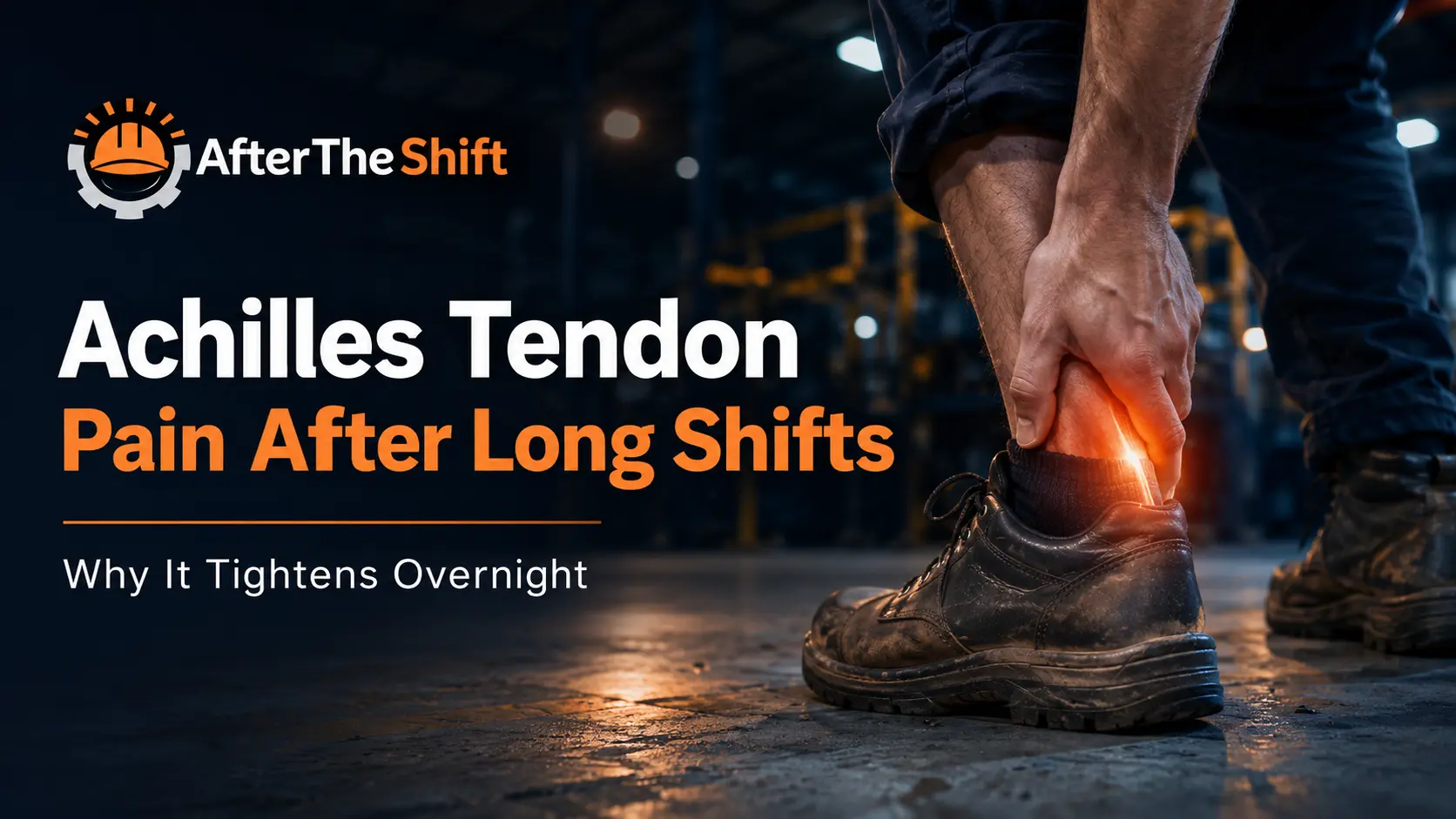
If the back of your ankle feels like a tight rope on the first steps after sleep, your shift may be loading the Achilles faster than it is recovering.
Home Injuries & Prevention Achilles Tendon Pain After Long Shifts
If the back of your ankle aches after a long shift and feels noticeably stiffer when you first get out of bed, the Achilles tendon may be struggling with repeated walking, standing, stairs, ladders or push-off load. This guide is for physical workers with gradual Achilles pain — not a sudden traumatic injury.
Achilles tendon pain can feel worse in the morning because a tendon that was heavily loaded during the previous day often becomes stiff after hours of relative rest. The first few steps reload it suddenly, so it may feel tight, sore or wooden before movement gradually loosens it. Repeated morning stiffness is a useful workload signal, but a sudden pop, major weakness or inability to push off is a different problem and needs prompt assessment.
Achilles pain that is worst on the first steps after sleep often points to a tendon that is not fully tolerating your current work load. The fastest useful response is usually to reduce the aggravating load temporarily while rebuilding calf and Achilles capacity progressively — not to stretch the tendon aggressively or stay completely inactive for weeks.
- Track morning stiffness day to day.
- Reduce unnecessary stairs, hills and extra walking during a flare.
- Use supportive work footwear that does not rub the tendon.
- Build calf strength progressively as symptoms allow.
- Ignoring symptoms that worsen every week.
- Aggressive stretching into sharp tendon pain.
- Suddenly adding running, hills or jumping on days off.
- Trying to work through a sudden pop or major push-off weakness.
If your Achilles is getting stiffer each morning instead of returning toward baseline, treat that as a load warning — do not keep increasing the same walking, stair, ladder or overtime load and expect the tendon to catch up.
| If you… | Pattern | Risk / flag | What to do next |
|---|---|---|---|
| Feel stiff for the first few steps, then loosen up | Common load-sensitive tendon pattern | Lower | Track it and start load management. |
| Loosen up at work but ache again after sitting or sleeping | Rest-stiffness pattern | Moderate | Reduce peaks in load and begin progressive strengthening. |
| Notice symptoms worsening week after week | Capacity is not catching up | High | Modify work/exercise load and consider a physiotherapy assessment. |
| Hear a pop and suddenly cannot push off normally | Possible Achilles tear or rupture | Urgent | Stop loading it and seek prompt medical assessment. |
This usually applies to gradual pain or stiffness at the back of the ankle in workers who spend long hours walking, standing, climbing or repeatedly pushing off the foot. It does not diagnose Achilles tendinopathy, and it does not apply to a sudden traumatic injury, major bruising, a new tendon gap, severe calf swelling or sudden loss of strength.
- Why does the Achilles tighten overnight?
- Which work tasks load it most?
- Symptom → likely cause → next fix
- Should you work, modify or get checked?
- The 4 workload stages
- 10-question Achilles load test
- What actually helps before, during and after work?
- Treatment options compared
- Shift recovery checklist
- Achilles pain FAQs
Why Does Your Achilles Tendon Feel Tighter After Sleeping?
The short answer: your Achilles has gone from thousands of loaded steps during the shift to hours of relative rest, then is suddenly asked to accept force again when you stand up.
The Achilles tendon connects the calf muscles to the heel bone and transfers force whenever you push the ground away — walking, climbing stairs, rising onto your toes, stepping onto a ladder or pushing a loaded trolley.
When that daily load is higher than the tendon is currently prepared for, symptoms can become load-sensitive. A common pattern is pain or stiffness after rest, especially first thing in the morning, followed by some easing once the ankle has moved for several minutes.
Your Achilles usually is not literally “shrinking” overnight. Morning tightness is better understood as a load-sensitive tendon becoming stiff after rest. If it loosens after several minutes but returns after every long shift, the useful question is not “How hard should I stretch?” but “What daily load is repeatedly exceeding my current tendon capacity?”
Why the first steps hurt more than lying in bed
During sleep, you are not repeatedly moving the ankle through walking motion. The moment you stand up, the calf-Achilles unit has to accept body weight and create push-off force again.
That transition from rest to load is why someone can feel almost nothing while lying down, then experience a sharp increase in stiffness during the first trip to the bathroom.
Why it can feel better halfway through the shift
A tendon can temporarily feel easier once it is warmed up and repeatedly moving. That does not automatically mean the problem is gone.
If the same tendon aches after the shift, stiffens again after sitting, and is worse the following morning, the temporary warm-up effect may be hiding the fact that total daily load remains too high.
| Work exposure | Achilles demand | Why it compounds | Useful adjustment |
|---|---|---|---|
| Long standing | Low movement, repeated static support | Few unloading periods | Short movement/change-of-position breaks |
| Continuous walking | Repeated push-off | High total step volume | Reduce unnecessary extra walking during flare-ups |
| Stairs and ladders | Higher calf demand | Repeated forceful push-off | Batch trips where practical |
| Heavy carrying | More force each step | Load rises without fewer steps | Use carts, team lifts or smaller loads where possible |
| Hard floors | Long repetitive exposure | Often paired with old or rigid footwear | Review footwear and total shift load together |
Do not judge the tendon only by how it feels after warming up. The next-morning response is often the more useful workload check. A shift that feels manageable today but produces progressively worse stiffness tomorrow may still be too much.
Which Physical Jobs Load the Achilles Tendon the Most?
Jobs become Achilles-heavy when they combine high step volume with repeated push-off, stairs, ladders, carrying, hard floors or limited recovery between shifts.
You do not need to be a runner to overload an Achilles tendon. A worker can accumulate a large amount of tendon load simply by taking thousands of steps while wearing rigid footwear and carrying equipment for eight to twelve hours.
| Job type | Main ankle demand | Typical risk pattern | Compounding factor |
|---|---|---|---|
| Warehouse picker | Continuous walking and turns | High cumulative push-off | Concrete floors + target pressure |
| Construction / trades | Ladders, uneven ground, carrying | Variable high-force steps | Heavy safety boots + tools |
| Retail / hospitality | Standing plus frequent short walks | Long exposure with few recovery periods | Flat or minimally supportive shoes |
| Delivery driver | Repeated vehicle exits, steps and carrying | Stop-start loading | Tendon cools between stops |
| Factory / assembly | Prolonged standing | Low variation | Restricted work position |
If concrete is a major part of your shift, see what standing on concrete all day does as exposure accumulates. If pain is spread around the ankle rather than clearly along the Achilles, compare it with ankle pain after walking on concrete all day.
The hidden load: what you do after clocking out
A physically demanding job may already be your main training session. Adding a long run, football match, hill walk or hard leg workout on a day off can turn an otherwise manageable weekly load into a spike.
Count work and exercise as one total Achilles workload. Ten hours of warehouse walking plus an evening run is not “work plus recovery”; from the tendon’s perspective, both add load.
Achilles Symptoms: What Pattern Fits and What Should You Do?
Location, timing, progression and loss of function matter more than pain intensity alone. Use this matrix to decide what the symptom pattern should change about your next shift.
| Symptom | Possible pattern | Useful fix | Red flag? |
|---|---|---|---|
| Stiff for several minutes after waking | Load-sensitive Achilles | Track morning response; adjust cumulative load | Usually no by itself |
| Pain 2–6 cm above the heel | Mid-portion Achilles pattern | Progressive calf/Achilles loading after assessment if persistent | Not automatically |
| Pain exactly where tendon meets heel | Insertional Achilles pattern | Avoid forcing deep heel-drop positions early; use flat-ground loading | Needs different loading strategy |
| Tender thickened area that is worsening | Persistent tendon irritation | Reduce peaks; consider physiotherapy assessment | Moderate |
| Pain spreads into calf | Calf-Achilles overload or another cause | Compare calf symptoms and seek assessment if unexplained | Depends on swelling / redness / cause |
| Sudden pop, snap or kicked-in-the-calf sensation | Possible tendon rupture | Stop and seek prompt assessment | Yes |
| Sudden inability to push off or stand on toes normally | Possible major tendon injury | Stop loading and get assessed promptly | Yes |
If the soreness is mostly in the calf rather than the tendon itself, use the separate guide to calf pain after standing all day. Pain underneath the heel, especially with the first steps after rest, can also overlap with problems covered in heel pain from standing all day.
A sudden pop or snap followed by sharp pain, swelling, difficulty walking, or a major loss of push-off strength is not the normal overnight-stiffness pattern. Do not repeatedly test it with heel raises. Seek prompt medical assessment.
Decision Tree: Should You Keep Working, Modify the Load or Get Checked?
Use this tree to route your next action based on trauma, function and trend — not just your pain score.
Think about the moment symptoms began, not how painful they are right now.
The 4 Achilles Workload Stages: From Morning Tightness to “Stop Pushing”
These are practical workload stages, not medical grades of tendon damage. Their purpose is to decide how aggressively you should respond as symptoms become more persistent or function begins to change.
| Stage | What it feels like | What may be happening | Recovery pattern | Action |
|---|---|---|---|---|
| 1 — Load warning | Mild morning tightness after unusually long days | Workload temporarily exceeds normal exposure | Returns to baseline quickly | Manage load and monitor |
| 2 — Irritable pattern | Morning stiffness most workdays; tenderness after shift | Tendon capacity is not matching repeated exposure | Improves with movement but returns after rest | Reduce peaks + start progressive loading |
| 3 — Persistent capacity gap | Longer stiffness, pain earlier in shift, reduced heel-raise ability | Symptoms are becoming persistent and function is affected | No longer fully resets between shifts | Professional assessment becomes more useful |
| 4 — Acute red flag | Pop, sharp pain, major weakness, difficulty pushing off | Possible tear or another acute injury | Not a normal work-fatigue response | Stop and seek prompt assessment |
Trend beats today's pain number. A tendon that stays at 3/10 but becomes stiff for 20 minutes every morning is giving you more useful information than one random painful day that disappears completely afterward.
If you are unsure whether the symptom has crossed from ordinary work soreness into an injury pattern, use the broader guide to work pain versus injury.
10-Question Achilles Load Test
This quiz estimates how strongly your current pattern suggests a workload/recovery mismatch. It does not diagnose a tendon injury. If you had a sudden pop, major weakness or acute traumatic injury, skip the quiz and use the red-flag route above.
Give yourself 1 point for each “Yes.”
What Actually Helps Achilles Pain From Long Shifts?
The long-term target is not simply making the tendon feel loose; it is getting its capacity high enough to tolerate your real workday. That usually means managing excess load while progressively strengthening the calf-Achilles system.
Before the Shift
- Walk around for a few minutes before demanding stairs or ladders.
- Use gentle ankle pumps if the tendon feels stiff after waking.
- Wear supportive footwear that does not press directly into the painful area.
- Avoid beginning the day with aggressive calf stretching into tendon pain.
During the Shift
- Batch unnecessary stair or ladder trips where possible.
- Use carts or mechanical help instead of carrying every load manually.
- Change position when prolonged static standing is aggravating symptoms.
- Watch for limping — compensation is a sign the plan needs changing.
After the Shift
- Do not automatically add another high-load leg session.
- Use symptom-guided calf strengthening on appropriate days.
- Record how long morning stiffness lasts the next day.
- Adjust weekly load based on trend, not one isolated evening.
1. Progressive calf and Achilles loading
For typical mid-portion Achilles tendinopathy, progressive tendon-loading exercise is a first-line rehabilitation strategy. The exact program should match your current function and irritability rather than copying the hardest heel-drop routine you can find online.
A progression may start with controlled two-leg or seated heel raises, then move toward single-leg and heavier loading as tolerance improves. A physiotherapist can individualize the load if symptoms are persistent, severe or difficult to classify.
If pain is directly at the heel attachment, repeatedly dropping your heel far below a stair can increase compression at the insertion. Early loading is commonly better started on a flat surface rather than forcing maximum ankle dorsiflexion.
2. Use tomorrow morning as your feedback loop
A rehabilitation session does not need to feel completely effortless to be useful, but the tendon should not spiral into progressively worse symptoms afterward.
A simple worker-friendly rule is to compare the next morning with your recent baseline. If stiffness suddenly lasts much longer, pain appears earlier in the next shift, or your walking changes, reduce the last increase in exercise or work-related load.
3. Temporary load reduction is different from complete rest
Cutting out unnecessary hill walking, running, repeated stairs or extra calf training can help settle an irritable period without putting the entire leg into weeks of inactivity.
Complete rest can reduce symptoms temporarily but does not automatically rebuild the capacity required for another ten-hour shift.
For gradual Achilles overuse, “rest until it never hurts” is often less useful than relative rest plus progressive strengthening. The goal is to remove enough aggravating load for symptoms to settle while preserving and rebuilding the calf-Achilles capacity your job requires.
4. Check the boots, but do not blame everything on the boots
Footwear can affect comfort and tendon loading, especially if the heel counter rubs the painful area or the boot is extremely flat, rigid, worn out or poorly fitted.
But replacing boots without changing an excessive workload often produces only temporary relief. For a broader footwear breakdown, see why good work boots can stop feeling supportive over time.
If your problem is not just the Achilles, use the After The Shift Routine Builder to organize recovery around the areas your job actually loads instead of collecting random stretches.
Achilles Treatment Options Compared: What Is Worth Trying?
Progressive loading and sensible workload modification address the capacity problem most directly; most other options are supporting tools rather than substitutes for rehabilitation.
| Treatment | Best for | Skip / modify if | Cost level | Role |
|---|---|---|---|---|
| Workload modification | Recent flare or load spike | Do not turn it into prolonged total inactivity | Free | Reduces excess exposure |
| Progressive heel-raise loading | Rebuilding calf/Achilles capacity | Modify range for insertional symptoms; avoid if acute tear suspected | Free–low | Core rehabilitation tool |
| Supportive footwear | Rigid, worn or rubbing footwear | Do not expect shoes alone to rebuild capacity | Moderate | Comfort / load management |
| Temporary heel lift | Selected load-sensitive or insertional cases | Poor fit, balance issues or symptoms worsening | Low | Temporary symptom/load tool |
| Ice | Short-term pain relief after an irritable day | Skin sensitivity; never apply ice directly | Low | Comfort, not capacity building |
| Physiotherapy | Persistent, worsening or uncertain symptoms | Choose a plan with progressive exercise, not passive treatment only | Moderate | Diagnosis, progression and load planning |
| Shockwave therapy | Selected persistent cases after structured rehab | Not a first replacement for basic load rehabilitation | Higher | Second-line option in some cases |
Who should consider buying something?
Consider spending money when a specific product solves a specific mechanical problem: your boot rubs the painful tendon, the footwear is genuinely worn out, or a clinician recommends a temporary heel lift or support strategy.
Who should skip the purchase?
Skip buying random braces, insoles or recovery gadgets if you have not addressed the obvious load problem. No accessory can make a tendon indefinitely tolerate rapidly increasing overtime, stairs, walking volume and weekend sport without enough capacity.
Achilles Shift Recovery Checklist
Use this checklist for one week and compare your morning stiffness at the beginning and end of the week.
Bottom Line: What Should You Do Tomorrow?
If Achilles tendon pain appeared gradually after long shifts and is mainly stiff after sleep or rest, your first goal is to stop the workload from outrunning the tendon’s capacity.
- Best first move: reduce avoidable load peaks while staying reasonably active.
- Best long-term move: progressively strengthen the calf-Achilles system.
- Best metric: whether morning stiffness and function improve across one to two weeks.
- Avoid: aggressive stretching, random gadgets and suddenly testing the tendon with hard exercise.
- Get assessed: if symptoms persist, worsen, change your walking or reduce strength.
- Urgent route: sudden pop, acute sharp pain or major loss of push-off ability.
Morning Achilles stiffness is useful because it gives you a repeatable recovery marker. If the first-step stiffness becomes shorter and easier across several mornings, the current workload is more likely to be tolerable. If it becomes longer, stronger or begins affecting normal walking, your current work-plus-exercise load needs reassessment.
Achilles Tendon Pain After Work: Frequently Asked Questions
These answers cover the most common worker questions about morning stiffness, stretching, work, recovery time and safety.
Related Guides for Foot, Ankle and Shift-Load Pain
If your Achilles is only one part of the problem, these guides help separate the surrounding causes.
- Physical Work Recovery Guide — the main recovery hub for workers dealing with accumulated load.
- Ankle pain after walking on concrete all day — useful when pain is around the ankle rather than clearly on the Achilles.
- Calf pain after standing all day — for symptoms higher in the lower leg.
- Heel pain from standing all day — compare first-step heel pain with Achilles symptoms.
- Standing on concrete all day — understand how exposure accumulates over months and years.
Next Steps
Do these in order instead of trying five treatments at once.
- Tomorrow morning: record how many minutes the Achilles feels noticeably stiff after getting up.
- During your next shift: identify the two biggest load drivers — steps, stairs, ladders, carrying, hard-floor standing or overtime.
- For the next 7 days: reduce one avoidable load peak rather than stopping all activity.
- Start rebuilding capacity: use appropriately progressed calf/Achilles loading if no acute injury is suspected.
- Compare the trend: judge the plan by morning stiffness, walking and strength — not only by how loose the tendon feels after warming up.
- If symptoms keep worsening: arrange a physiotherapy or medical assessment instead of increasing treatment intensity yourself.
- If you need a complete recovery plan: build one with the After The Shift Routine Builder.
Do not wait until the tendon hurts all day to change the plan. If morning stiffness is already becoming more frequent, use that early signal to reduce the workload spike and rebuild capacity while normal walking is still intact.
Bookmark the checklist and compare your morning stiffness again in seven days — the trend tells you more than one good or bad shift.
This article is general recovery education, not a diagnosis or a substitute for care from a qualified clinician. Stop and get medical help for severe pain, numbness, weakness, chest pain, sudden swelling, fever, or symptoms that keep worsening.

Log in to leave a comment.