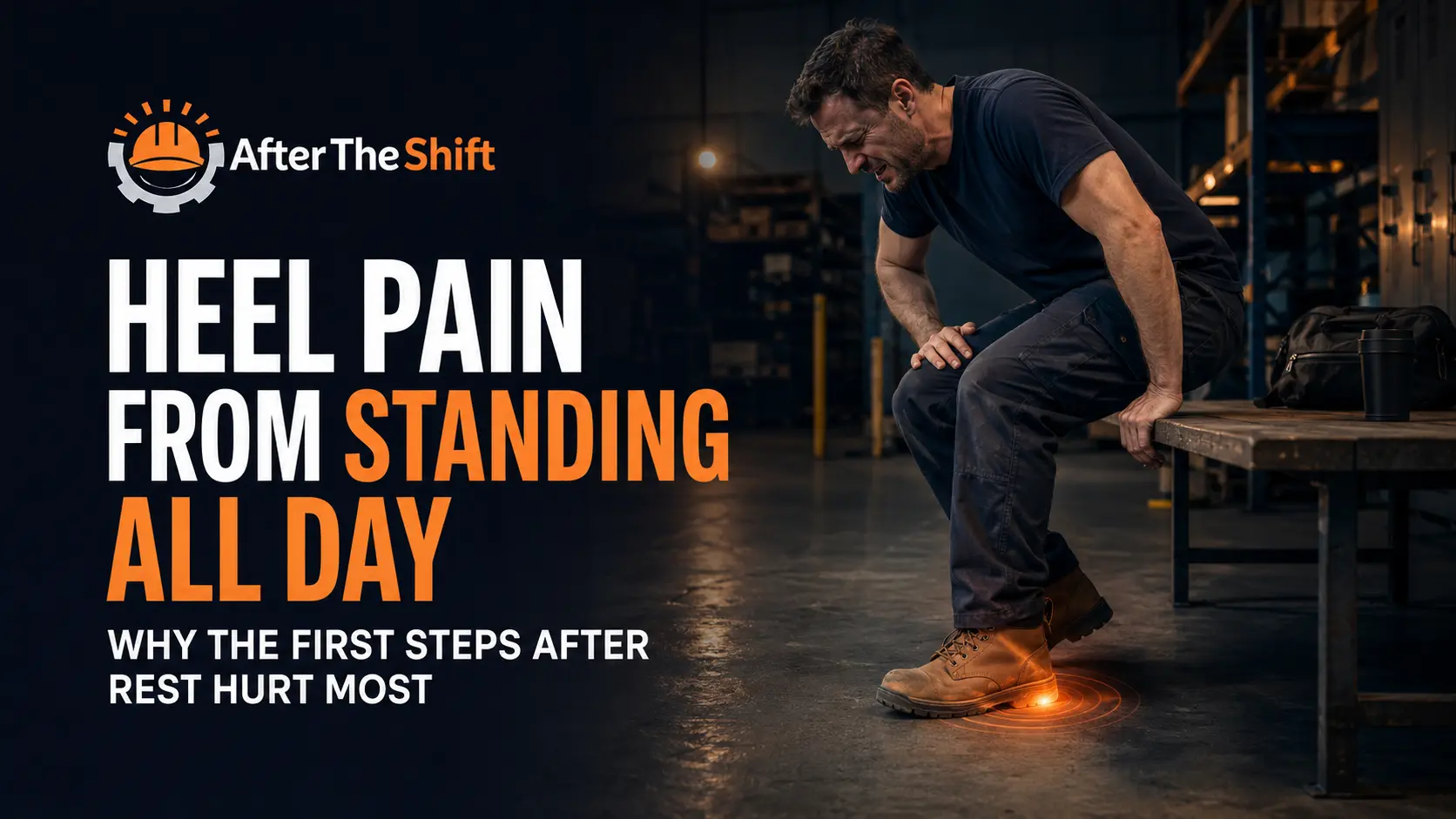
Your heel may loosen up once you walk, but that first-step pain is the warning to change how you load, support, and recover your feet.
Heel pain from standing all day often hurts most on the first steps after sitting or sleeping because the irritated tissue under the foot stiffens while unloaded, then is suddenly tensioned when you stand. Pain that eases after several minutes can fit plantar heel pain, but it is not proof of plantar fasciitis and should not be ignored if it keeps returning.
Reduce the load spike before your first step, improve support during the shift, and rebuild calf-and-foot capacity instead of relying on cushioning alone.
- Move your ankle and toes before standing
- Wear supportive shoes from the first morning step
- Break up long, static standing blocks
- Track first-step pain for 7–14 days
- Walking barefoot on hard floors
- Deep, painful rolling directly on the heel
- Stacking thick insoles and heel cups in tight boots
- Calling every heel pain case plantar fasciitis
If first-step pain returns every day, treat the whole workday as the load problem—not just the painful five minutes after rest.
| If you… | Most useful first move | What to buy | Flag |
|---|---|---|---|
| Hurt under the heel mainly on first steps | Pre-step mobility + load changes | Supportive insole or heel cup—not both by default | Self-care trial |
| Hurt at the back of the heel | Check Achilles loading and boot collar pressure | Do not assume an arch insole is the answer | Different pattern |
| Have burning, tingling, or numbness | Check footwear pressure; seek assessment if persistent | Skip random inserts until the cause is clearer | Nerve flag |
| Cannot bear weight or have major swelling/redness | Stop loading it and get prompt medical help | Buy nothing first | High |
Why do the first steps after rest hurt most?
The first steps can hurt because the plantar fascia and nearby heel tissues stiffen while unloaded, then receive a fast stretch and body-weight load when you stand. After a few minutes, the foot warms and movement becomes easier, so the pain may fade. That temporary improvement does not mean the tissue has recovered; the same pain may return after another break or after a long standing block.
Plantar fascia means the strong band of connective tissue running from the heel toward the toes along the sole. Plantar heel pain is a symptom pattern, not a diagnosis you can confirm from one sign. “Plantar fasciitis” is commonly used, but persistent cases may involve tissue overload and degeneration rather than simple inflammation alone.
Heel pain that is worst on the first few steps after sleep, driving, or a meal break is more likely to involve the plantar side of the heel when the pain sits under or slightly inside the heel and loosens with walking. Pain at the back of the heel, numbness, or pain that stays severe at rest points to a different problem and needs a different plan.
| Load moment | What the heel experiences | Useful response |
|---|---|---|
| Sleeping or sitting | No body-weight load; ankle often rests pointed down | Move ankle and toes before standing |
| First 5–20 steps | Sudden stretch plus full body weight | Use shorter, slower steps in supportive shoes |
| Long static standing | Sustained pressure with little load variation | Alternate stance, walking, and brief unloading |
| End of shift | Accumulated load may exceed current capacity | Reduce the next load spike; recover without aggressive pressure |
This guide usually applies to gradual heel pain in adults who stand or walk for long shifts and can still bear weight. It does not cover a fresh fall, puncture wound, suspected fracture, severe infection, diabetic foot wound, or sudden Achilles rupture. Those need professional assessment rather than an insole experiment.
How does your job change heel-pain risk?
The job title matters less than the combination of hard flooring, total standing time, step count, carried load, footwear, and how rarely the heel gets a change of position. Static standing can be as aggravating as walking because the same tissues stay loaded without variation.
| Job type | Typical heel load | Risk | Compounding factor |
|---|---|---|---|
| Cashier / machine operator | Static, one-sided stance | Moderate | Few position changes |
| Warehouse picker | High steps + turns + concrete | High | Fast pace and loaded carts |
| Construction worker | Uneven ground + ladders + carried weight | High | Heavy safety boots |
| Assembly / packing | Static stance with short repeated reaches | Moderate | Twisting from one planted foot |
| Delivery driver | Repeated rest-to-load transitions | Moderate | Jumping down and rushed steps |
If concrete is part of your shift, compare your pattern with the standing-on-concrete damage timeline. If the pain peaks only after clocking out, the parking-lot foot-pain test helps separate accumulated load from poor boot support.
Symptom → likely cause → first fix
Location, timing, and the presence of nerve or injury signs are more useful than pain intensity alone. Use this matrix to choose a route, not to diagnose yourself.
| Symptom | More consistent with | First fix | Red flag? |
|---|---|---|---|
| Sharp pain under/inside heel on first steps | Plantar heel pain pattern | Pre-step mobility, supportive shoes, load pacing | Usually no |
| Pain at back of heel, worse with stairs or push-off | Achilles tendon or boot-collar irritation | Reduce aggravating push-off; check boot fit | Assess if persistent |
| Bruised feeling in center of heel | Heel-pad overload | Cushioning, shorter steps, reduce hard impacts | If worsening |
| Burning, electric pain, tingling, numbness | Nerve irritation or compression | Loosen pressure; arrange assessment if it persists | Yes if weakness/numbness |
| Pinpoint bone pain that worsens with loading | Possible stress injury | Stop impact loading and seek assessment | Yes |
| Hot, red, swollen heel with fever or wound | Infection or inflammatory problem | Prompt medical care | Yes |
Seek urgent or prompt medical help after a pop or sudden injury, if you cannot bear weight, if the foot is deformed, or if there is marked swelling, redness, heat, fever, spreading numbness, weakness, or an open wound—especially with diabetes or poor circulation. Persistent night pain or steadily worsening pain also needs assessment.
Interactive heel-pain decision tree
This decision tree separates red flags, pain location, and first-step timing so you do not buy support for the wrong problem.
Did the pain start with a pop, fall, puncture, or sudden injury—or can you not bear weight?
The four heel-irritation stages
Stage is defined by how long pain lasts, how easily it is triggered, and whether work ability is changing—not by a scan-free claim about “damage.” The earlier stages usually allow more self-management; later stages deserve faster professional input.
| Stage | What it feels like | Likely load state | Expected direction | Action |
|---|---|---|---|---|
| 1: Early warning | Mild first-step ache; settles quickly | Capacity is being tested | Often improves when load changes early | Fix footwear and standing blocks now |
| 2: Repeating | Daily first-step pain; returns after breaks | Work load repeatedly exceeds recovery | Needs consistent 7–14-day plan | Pace load + support + exercise |
| 3: Spreading | Pain lasts into shift; walking pattern changes | Compensation and reduced capacity | Slower; diagnosis matters more | Arrange clinician/physio/podiatry assessment |
| 4: Function loss | Cannot walk normally, rest/night pain, or red flags | May not be simple plantar heel pain | Do not guess | Prompt medical assessment |
10-question heel load-risk quiz
This quiz measures modifiable work-load and recovery factors; it does not diagnose plantar fasciitis. Score one point for every “Yes.”
What actually fixes heel pain—by phase
The useful plan has three parts: soften the first load spike, vary load during work, and rebuild capacity after work without provoking a flare. No single stretch or insert replaces all three.
Before work or standing
- Do 10 slow ankle pumps.
- Gently pull the toes back for 15–20 seconds.
- Stand in supportive shoes, not barefoot.
- Take short steps for the first minute.
During the shift
- Change stance or walk briefly every 30–60 minutes when possible.
- Use an anti-fatigue mat at fixed stations if allowed.
- Avoid repeatedly hanging weight on one hip and heel.
- Loosen footwear if toes tingle or the upper feels compressed.
After work
- Use gentle arch rolling for 3–5 minutes.
- Cold therapy may reduce symptoms; protect skin.
- Progress calf raises only within tolerable pain.
- Reduce the next day's load if pain is clearly escalating.
Mild discomfort during exercise may be acceptable when it settles and next-morning pain is not worse. If pain becomes sharp, changes your gait, or first-step pain is clearly higher the next morning, reduce the range, repetitions, or load. Do not “push through” a worsening trend.
For a broader plan, use the physical-work recovery guide or build a repeatable sequence with the After the Shift routine builder.
Treatment options and products compared
Choose products by job problem and shoe fit: a full-length insole changes support, a heel cup adds local cushioning, a roller helps symptom management, and a night splint targets prolonged rest stiffness. More products do not automatically mean more relief.
Affiliate disclosure: If you buy through an Amazon link below, After the Shift may earn a commission at no extra cost to you. Product links are convenience options, not medical prescriptions.
| Option | Best for | Who should skip | Cost level | Pick |
|---|---|---|---|---|
| Work comfort insole | Budget cushioning for long shifts | Very tight or already unstable shoes | $ | Dr. Scholl’s Work All-Day Insoles |
| Firm support insole | More structure; overpronation support | Feet that dislike firm arch pressure | $$$ | PowerStep Pinnacle Maxx |
| Heel cup | Central bruised-heel feeling; impact cushioning | Boots that become cramped or unstable | $$ | Tuli’s Heavy Duty Heel Cups |
| Foot roller | Gentle post-shift arch massage | Pinpoint bone pain or aggressive pressure habits | $ | TheraFlow Foot Massager |
| Calf stretcher | Controlled calf mobility | Sharp pain or balance difficulty without support | $$ | ProStretch Plus |
| Night splint | Strong morning first-step pain despite daytime changes | Poor circulation, numbness, skin problems, or wrong size | $$ | Vive Night Splint |
Dr. Scholl’s Work All-Day if the main problem is tired, hard-floor feet and the current shoes have removable space.
PowerStep Pinnacle Maxx when firmer control is wanted and your feet tolerate a stronger arch.
Daytime load changes first; consider the Vive splint only if morning pain remains prominent and the listed size fits.
Do not automatically wear a full-length insole and heel cup together. The stack can raise the heel, crowd the toes, increase boot-collar pressure, or make the foot unstable. Remove the shoe’s original liner when the replacement insole is designed to take its place, and stop if numbness, rubbing, or new pain appears.
The linked Vive night-splint listing is the Small variation: men’s up to size 5 and women’s up to size 6.5 according to the supplied product title. Confirm the selected Amazon variation and current sizing before ordering.
If your boots once felt good and now feel dead, use the guide to what breaks down inside work boots before spending money on another insert. The broader eight-hour standing foot-pain guide covers arch and forefoot patterns too.
Seven-day heel-pain checklist
Complete the load and footwear checks before judging whether one recovery tool works. A product test is meaningless if the boot is too tight or the shift load keeps rising.
Heel pain from standing all day: FAQs
These answers cover the timing, safety, cost, and product mistakes workers search most often.
Bottom line
The best first move for typical first-step heel pain is a 7–14-day test combining supportive footwear, pre-step mobility, less uninterrupted standing, and progressive calf/foot loading. Choose a work insole when overall support and hard-floor comfort are the problem; choose a heel cup when local impact cushioning is the main need. Skip product testing and get assessed when pain is constant, neurological, traumatic, or function-limiting.
Next steps
Start with measurement, then change one support variable at a time.
- Record tomorrow morning’s first-step pain from 0–10 and mark the exact pain location.
- Inspect your current work shoes for collapse, crowding, and uneven wear.
- Complete the seven-day checklist while keeping workload changes as consistent as possible.
- If buying, choose one product category that matches the table—do not stack everything.
- Escalate to a clinician, physiotherapist, podiatrist, or occupational-health service if pain worsens, changes your gait, or fails to trend down.
Use the routine builder to turn the before-work, during-shift, and after-work actions into one repeatable plan. Recheck first-step pain after seven days before changing another variable.
Save this before your next shift.
Bookmark the decision table and seven-day checklist so you can compare tomorrow morning’s first steps with next week’s—not just guess from memory.
This article is general recovery education, not a diagnosis or a substitute for care from a qualified clinician. Stop and get medical help for severe pain, numbness, weakness, chest pain, sudden swelling, fever, or symptoms that keep worsening.
Log in to leave a comment.