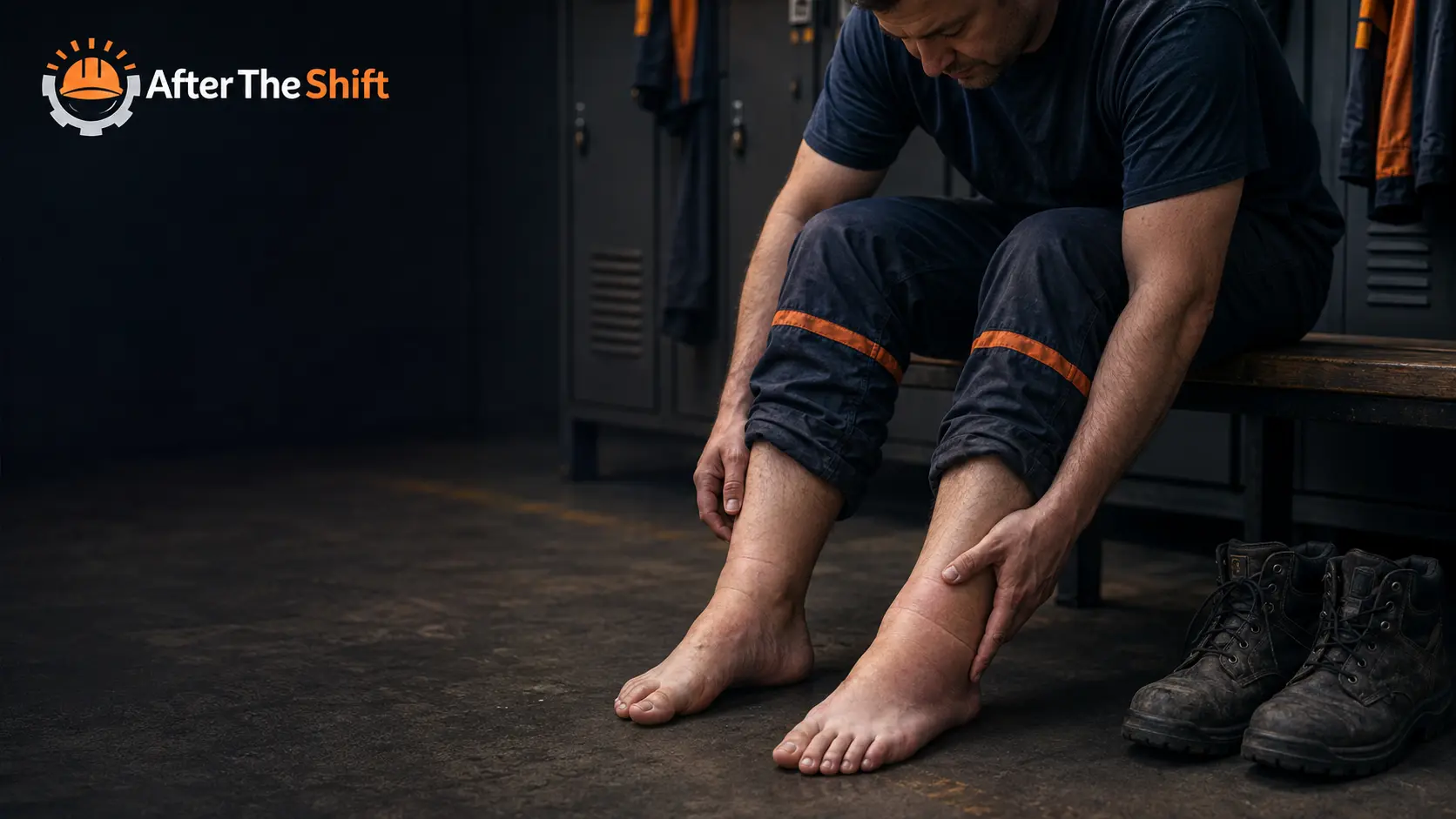
Learn the fast difference between ordinary end-of-shift swelling and the signs that mean your feet need more than rest.
This guide is for workers whose shoes feel tighter and ankles look puffy after a long standing shift. You will learn how to separate a common gravity-and-fatigue pattern from swelling that needs medical assessment, then choose the safest work and recovery changes.
Swollen feet and ankles after standing all day are often caused by fluid pooling when the calf muscles do not move enough to pump blood and fluid upward. Mild swelling in both feet that improves with walking, elevation, or overnight rest is more consistent with ordinary dependent swelling. Sudden, painful, red, warm, one-sided, persistent, or breathlessness-linked swelling is not a normal workday pattern and needs medical assessment.
Both feet mildly puffy after a long shift, with clear improvement after movement or overnight rest, usually fits standing-related fluid pooling. One-sided, sudden, painful, hot, red, rapidly worsening, or persistent swelling does not.
- Compare both feet and ankles
- Walk or pump the ankles every 30–60 minutes
- Elevate the legs for 20–30 minutes after work
- Track whether swelling clears by morning
- Assuming all swelling is “just standing”
- Massaging a painful, hot, one-sided swollen calf
- Starting compression before checking contraindications
- Using water tablets or supplements without medical advice
If swelling is sudden, mainly on one side, painful, red, or warm—or comes with chest pain or trouble breathing—stop treating it as normal standing fatigue and get medical help.
| If you… | Likely route | What to do now | Flag |
|---|---|---|---|
| Have mild swelling in both feet only after long shifts | Standing-related pooling is more likely | Move, elevate, check again by morning | Lower |
| Wake with swelling still present or get it most days | A medical or vein-related cause needs consideration | Arrange a GP or clinician review | Moderate |
| Have sudden one-sided swelling, calf pain, warmth, or redness | A clot or infection must be ruled out | Seek urgent medical assessment today | High |
| Have swelling plus chest pain, sudden breathlessness, faintness, or cough blood | Possible emergency involving the lungs or heart | Call emergency services now | Emergency |
- Why standing makes feet and ankles swell
- Which job setups raise the risk
- Symptom → cause → action matrix
- Interactive decision tree
- The four swelling stages
- 10-question risk-pattern quiz
- What helps before, during, and after work
- Treatment and product options compared
- Shift checklist
- Frequently asked questions
Why Do Feet and Ankles Swell After Standing All Day?
The main mechanism is gravity plus too little calf-muscle pumping: fluid pressure rises in the lower legs while you remain upright, especially when you stand nearly still.
Your calf muscles act like a pump. Each step and ankle movement helps push blood back upward. Static standing keeps gravity working while the pump barely moves. Some fluid then shifts into nearby tissue, creating soft puffiness called dependent edema—swelling that develops in the lowest part of the body because of position and gravity.
| Work factor | What it changes | Useful counter-move |
|---|---|---|
| Standing still | Reduces calf-pump activity | Short walks and ankle pumps |
| Long unbroken shifts | Adds more time under downward fluid pressure | Break standing into movement blocks |
| Heat | Widens blood vessels and can increase pooling | Cooler breaks and breathable footwear |
| Tight boot openings | Compresses already-swollen tissue | Correct width and non-restrictive lacing |
Walking can reduce standing-related ankle swelling better than simply remaining upright because walking activates the calf-muscle pump. If your job requires one spot, 20–30 ankle pumps or a one-minute walk every 30–60 minutes is a practical test: swelling that responds supports a pooling pattern, but it does not rule out disease.
Which Jobs Make Standing-Related Swelling Worse?
Static standing stations usually create more pooling than jobs that include frequent walking, even when both workers are upright for the same number of hours.
| Job type | Usual stance | Relative pooling risk | Compounding factor |
|---|---|---|---|
| Checkout, machine, or security station | Mostly fixed | Higher | Few natural steps |
| Packing or assembly | Fixed with short reaches | Moderate–higher | Hard floor and long blocks |
| Warehouse picking | Frequent walking | Moderate | Heat, load, tight boots |
| Construction or trades | Mixed walking, kneeling, climbing | Variable | Boot pressure, heat, injury |
Hard concrete adds foot fatigue but does not directly explain every case of fluid retention. Use the separate guide to standing on concrete all day if pain and fatigue—not visible swelling—are the main complaint.
Swollen Feet Symptom → Cause → Action Matrix
The most useful decision criteria are side, speed, pain, skin changes, breathing symptoms, and whether the swelling clears with rest.
| Symptom pattern | Possible explanation | Best next action | Red flag? |
|---|---|---|---|
| Both ankles mildly puffy late in the day | Dependent pooling from prolonged standing | Movement, elevation, morning recheck | Usually no, if it clears |
| Sock marks with no pain or skin heat | Mild fluid pooling or restrictive sock band | Change fit; track duration and recurrence | Watch pattern |
| One ankle swollen after a twist or impact | Local injury | Injury assessment if severe, unstable, or unable to bear weight | Depends on injury |
| Sudden one-sided calf or leg swelling with pain/warmth | Possible blood clot | Urgent same-day assessment; do not massage | Yes |
| Red, hot, tender skin, possibly feverish | Possible skin infection | Urgent medical review | Yes |
| Both legs repeatedly swollen, skin changes, veins, or heaviness | Vein problems or another ongoing condition | Book clinician review before self-prescribing compression | Needs assessment |
| Swelling with breathlessness, chest pain, faintness, or coughing blood | Possible heart/lung emergency or pulmonary embolism | Call emergency services immediately | Emergency |
This guide usually applies to adults who develop mild foot or ankle puffiness after prolonged standing. It does not diagnose blood clots, infections, injuries, heart, kidney, liver, vein, or lymphatic disease. Pregnancy, recent surgery or travel, new medication, known circulation disease, diabetes-related numbness, wounds, or major medical conditions lower the threshold for professional advice.
Is My Ankle Swelling Normal? Interactive Decision Tree
This decision tree routes by urgency; it cannot identify the exact cause.
Do you have chest pain, sudden trouble breathing, faintness, or coughing blood?
The 4 Swelling Stages: From Normal Fatigue to Warning Sign
Swelling should be staged by pattern and recovery, not by size alone; a smaller one-sided hot swelling can be more concerning than two mildly puffy feet.
| Stage | What it feels/looks like | What may be happening | Recovery pattern | Action |
|---|---|---|---|---|
| 1 — Temporary | Mild, equal puffiness; tight shoes late in shift | Dependent pooling | Improves with movement/elevation; gone by morning | Self-care and track |
| 2 — Recurrent | Returns most shifts; heavier legs; deeper sock marks | Work setup, medication, or vein factors may contribute | Clears, but keeps returning | Change setup; book review if persistent |
| 3 — Persistent | Present on waking, worsening, skin changes, or unexplained weight gain | Ongoing medical cause needs evaluation | Does not fully reset overnight | Medical assessment |
| 4 — Urgent | Sudden one-sided pain/heat/redness, or breathing/chest symptoms | Clot, infection, or heart/lung problem must be ruled out | New or rapidly worsening | Urgent or emergency care |
10-Question Swelling Pattern Quiz
This quiz counts features that make “just standing” a less complete explanation; it is not a diagnostic score. Any chest pain or breathing trouble is an emergency regardless of score, and sudden one-sided painful warmth needs urgent assessment.
What Actually Helps Swollen Feet Before, During, and After Work?
The fastest work-safe plan combines calf movement during the shift with pressure control in footwear and elevation afterward.
Before work
- Check whether yesterday’s swelling cleared
- Use socks and boots that do not cut into the ankle
- Ask a clinician/pharmacist before compression if you have medical risks
- Plan movement breaks at fixed stations
During work
- Walk briefly or perform ankle pumps every 30–60 minutes
- Shift weight instead of locking the knees
- Use a standing mat where allowed
- Loosen restrictive lacing if safe
After work
- Elevate legs for 20–30 minutes
- Take an easy walk before collapsing on the sofa
- Cool sore tissue briefly; protect skin
- Compare both sides and recheck in the morning
For mild, equal, end-of-shift swelling with no red flags, take a short easy walk, then elevate both legs so the ankles are above heart level for 20–30 minutes. The useful outcome is not instant perfect ankles; it is clear improvement and a return toward normal by the next morning.
Compression Socks, Elevation, Insoles, Mats, and Cold Wraps Compared
No product can make unexplained swelling safe; products are for lower-risk standing-related patterns after red flags and contraindications are checked.
Affiliate disclosure: If you buy through an Amazon link below, After The Shift may earn a commission at no extra cost to you. Product availability and prices can change.
| Option | Best for | Who should skip or ask first | Cost level | Verdict |
|---|---|---|---|---|
| Vive 15–20 mmHg open-toe compression socks | Mild, bilateral standing-related swelling when compression is appropriate | Unexplained/sudden swelling, suspected clot, significant artery disease, neuropathy, wounds/skin infection, severe swelling, or heart-failure concerns | $ | Best prevention aid for the right person |
| TranquilRelax adjustable single-leg elevation pillow | Comfortable elevation after work or surgery guidance | People needing both legs supported at once may prefer a wider wedge; do not delay assessment of one-sided swelling | $$ | Best recovery upgrade |
| FEATOL anti-fatigue standing mat | Fixed indoor stations where a mat is allowed | Walking jobs, wet areas, trip-risk zones, or sites that prohibit loose mats | $$ | Best fixed-station change |
| Scholl GelActiv Work Insoles | Foot pressure and standing fatigue inside roomy work shoes | Boots already too tight; insoles do not treat fluid retention or medical swelling | $ | Best comfort add-on, not a swelling treatment |
| REVIX ankle and foot cold wrap | Short-term cooling of sore feet or a clinician-cleared minor injury | Poor circulation, numbness, fragile skin, or unexplained hot/red swelling; never place directly on skin | $ | Optional comfort, not a cause-fix |
| Short walks + ankle pumps | Nearly every fixed-standing job | Stop and seek help if movement triggers severe pain, breathlessness, or instability | Free | Best budget starting point |
Do not self-treat sudden, one-sided, painful, red, warm, or unexplained swelling with compression. Ask a clinician or pharmacist first if you have peripheral arterial disease, reduced foot sensation, diabetes complications, fragile or infected skin, ulcers, severe swelling, or heart failure. Correct sizing matters; stop if socks cause pain, numbness, colour change, or worsening symptoms.
Buy only for a defined job problem: a mat for a fixed station, insoles for pressure and fatigue, an elevation pillow for easier recovery positioning, or clinician-approved 15–20 mmHg socks for mild standing-related swelling. Skip all five as a substitute for assessment when swelling is new, unexplained, one-sided, persistent, rapidly worsening, or paired with skin, chest, or breathing symptoms.
If pain is concentrated under the heel rather than visible puffiness around the ankle, use the separate guide to heel pain after standing all day. If the whole foot aches without visible swelling, compare causes in foot pain after an eight-hour shift and check whether worn work boots have stopped supporting you.
Printable Swollen-Feet Shift Checklist
Use this checklist only after urgent warning signs are excluded; its purpose is to test and reduce a standing-related pattern.
Call 112 or 999 in Ireland for swelling with sudden breathing difficulty, chest or upper-back pain, faintness, pain when breathing, or coughing blood. Seek urgent same-day assessment for sudden one-sided swelling, especially with calf pain, warmth, or redness, and for rapidly spreading hot/red skin or fever. Do not wait for the next shift to see whether these patterns settle.
Frequently Asked Questions
These answers cover common standing-related patterns; urgent warning signs always override general self-care advice.
Bottom Line
Mild swelling in both feet after standing that improves with walking, elevation, and overnight rest is more consistent with normal workday fluid pooling. Start with free movement breaks and elevation; add a mat, roomy footwear support, or medically appropriate compression only for the specific problem they solve. Skip product experiments and get medical help when swelling is one-sided, sudden, painful, hot, red, persistent, worsening, or linked to breathing or chest symptoms.
Related Guides for Standing Workers
Choose the next guide by your dominant symptom: swelling, heel pain, general foot pain, or whole-body recovery.
- Physical Work Recovery Guide — the main hub for building a sustainable recovery system.
- Knee swelling after shifts — when swelling is centred around the knee rather than the feet.
- Why feet hurt worse after leaving the warehouse floor — for delayed post-shift foot pain.
- After-work routine builder — turn the steps above into a repeatable plan.
Next Steps
Your next move depends on today’s pattern, not how tough you are or how busy the shift is.
- Run the red-flag check now. Emergency symptoms mean emergency care; sudden one-sided painful warmth means urgent assessment.
- If the pattern is mild and equal, test it for one shift. Add movement every 30–60 minutes, check footwear pressure, elevate afterward, and compare again in the morning.
- If it persists or recurs, arrange medical advice. Bring a short record of when it starts, whether both sides match, what improves it, medications, and any breathlessness or weight change.
- Choose gear only after the cause route is clear. Buy the one item that matches the bottleneck instead of stacking five products.
Safety thresholds are aligned with public guidance on swollen ankles, feet and legs (NHS), cellulitis (HSE), and emergency pulmonary-embolism warning signs (HSE). General education cannot replace an individual examination.
Bookmark the decision table and checklist so you can compare the swelling while the pattern is fresh—not three days later when your feet look normal again.
This article is general recovery education, not a diagnosis or a substitute for care from a qualified clinician. Stop and get medical help for severe pain, numbness, weakness, chest pain, sudden swelling, fever, or symptoms that keep worsening.
Log in to leave a comment.