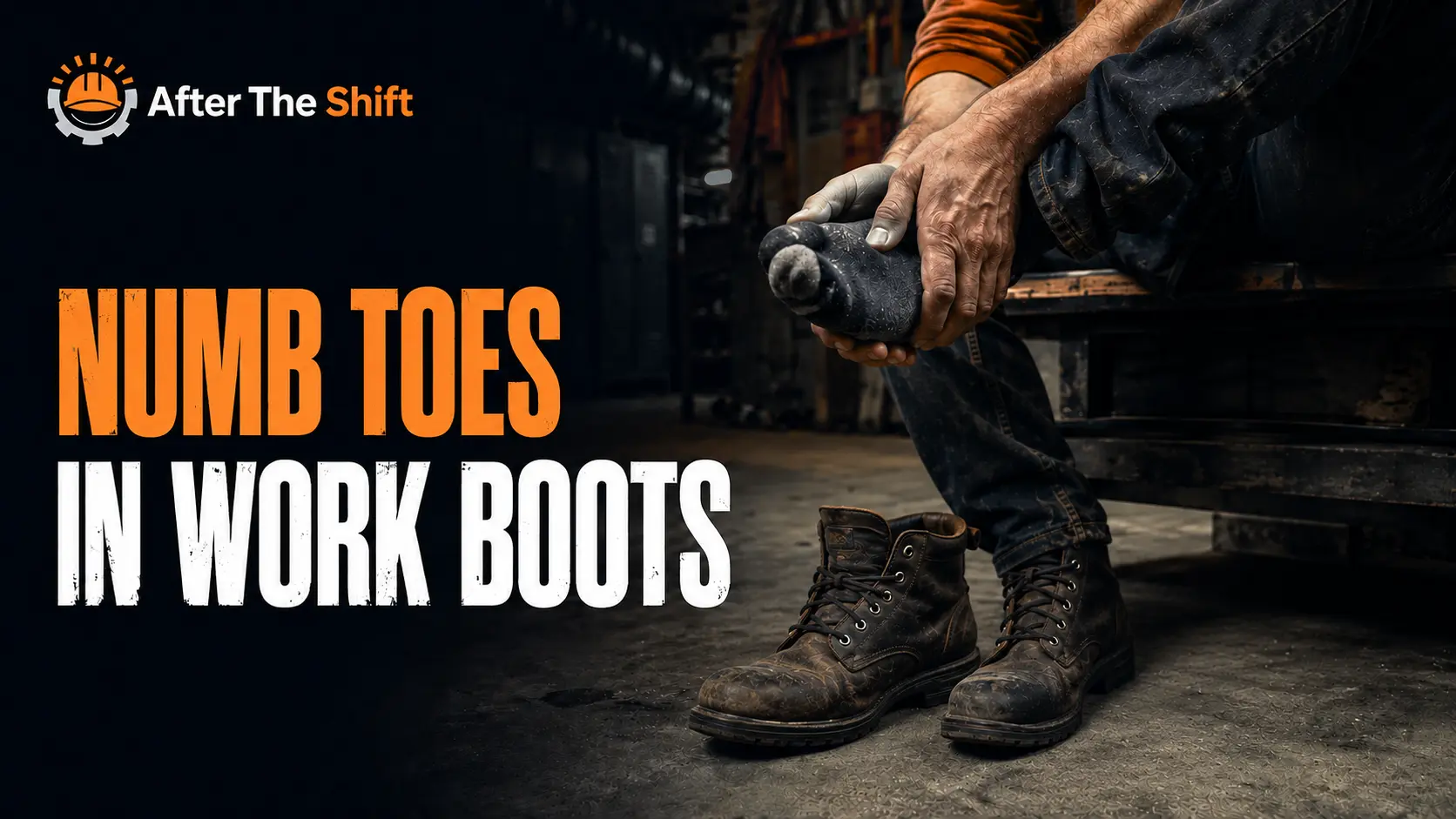
Learn whether your numb toes come from tight boots, forefoot pressure or a problem that changing footwear will not fix.
Learn whether your numb toes come from tight boots, forefoot pressure or a problem that changing footwear will not fix.
Numb toes in work boots usually mean that the toe box, safety cap, lacing or swollen foot is placing too much pressure on a nerve. If sensation returns soon after removing the boots, footwear compression is more likely. Numbness that persists, keeps returning, spreads, causes weakness or occurs away from work needs medical assessment rather than another insole.
Take numb toes seriously: remove the pressure first, then check whether normal feeling returns. A wider or deeper toe box may help footwear-related compression, but persistent numbness is not something to work through.
- Remove the boots and compare both feet
- Check toe-box width, depth and safety-cap position
- Loosen pressure across the forefoot
- Get recurring or lasting numbness assessed
- Working until the toes are completely numb
- Adding thick insoles to an already tight boot
- Assuming every case is poor circulation
- Using pain relief to hide worsening sensation loss
If your toes go numb inside the boots, remove the pressure immediately; if normal sensation does not return promptly or the numbness keeps returning, stop treating it as only a boot-fit problem.
| If you notice… | Most useful first check | What to do | Risk/flag |
|---|---|---|---|
| If you become numb only near the end of a shift | Foot swelling and toe-box volume | Test a wider/deeper boot later in the day | Moderate |
| If sensation returns after loosening the laces | Forefoot and instep pressure | Relace the boot and monitor closely | Lower, if temporary |
| If the third and fourth toes burn, tingle or feel like a pebble is under them | Forefoot nerve irritation | Use wider footwear and arrange an assessment if it continues | Moderate |
| If numbness remains after the boots come off | Duration, spread, weakness and medical causes | Stop using the boots and seek medical advice | High |
| If a toe becomes pale, blue, unusually cold or severely painful | Blood flow and acute injury | Remove pressure and obtain urgent medical help | Urgent |
This guide applies mainly to workers whose toe numbness starts or worsens inside work boots. It does not diagnose diabetes-related neuropathy, a back-related nerve problem, circulation disease, frostbite, fracture or another medical condition. Those possibilities become more important when numbness occurs outside the boots, affects both feet consistently, spreads upward or comes with weakness, wounds or colour change.
Why Do Work Boots Make Your Toes Numb?
Work boots can make toes numb when the boot compresses a sensory nerve directly or crowds the forefoot until normal nerve signalling is disrupted.
A nerve carries touch, temperature and pain signals from the toes. Compression can first feel like tingling, buzzing, burning or a “dead” toe. The problem may come from the boot’s width, internal depth, safety-cap shape, tight lacing, thick socks, a bulky replacement insole or swelling that develops during the shift.
Temporary compression is not automatically permanent nerve damage. However, repeatedly reproducing numbness is a sign that the current boot setup is not tolerating the load of your shift.
| Pressure source | What changes inside the boot | Typical clue | Best test |
|---|---|---|---|
| Narrow safety cap | Toes are pushed together | Side-to-side squeezing | Compare with a true wide-toe-box boot |
| Low toe-box depth | Upper presses down on toes | Marks on toe tops or nails | Remove a bulky insole and reassess space |
| Tight forefoot lacing | Instep and midfoot are compressed | Relief after loosening laces | Skip eyelets over the pressure area |
| Shift swelling | A morning fit becomes an afternoon squeeze | Symptoms appear late in the shift | Fit-test replacement boots after work |
| Bulky insert or sock | Usable internal volume decreases | Numbness began after changing gear | Return to the original setup briefly |
Which Jobs Make Work-Boot Toe Numbness More Likely?
Jobs increase numb-toe risk when they combine long boot wear with swelling, repeated forefoot loading, kneeling, ladders or fixed standing positions.
| Job type | Foot angle/load | Risk pattern | Compounding factor |
|---|---|---|---|
| Warehouse picking | Thousands of steps and push-off | Forefoot burning or tingling late in shift | Heat and swelling |
| Construction trades | Kneeling, ladders and uneven ground | Toe compression against safety cap | Rigid protective footwear |
| Assembly line | Fixed stance with limited movement | Gradual pressure and swelling | Hard floor and long stations |
| Delivery work | Driving plus repeated exits | Asymmetrical foot pressure | Tight lacing during ankle flexion |
| Cold outdoor work | Reduced movement and bulky layers | Cold, pale or numb toes | Extra-thick socks reducing boot space |
If foot discomfort peaks after the workday, compare your pattern with why warehouse feet can hurt more in the parking lot.
What Does the Location of the Numbness Suggest?
The location and timing of numbness can guide the next step, but they cannot confirm the diagnosis by themselves.
| Symptom | Possible cause | First fix/test | Red flag |
|---|---|---|---|
| All toes feel squeezed inside the safety cap | Toe box too narrow or shallow | Test wide/deep safety footwear | Numbness remains after removal |
| Third and fourth toes tingle with a pebble-like feeling | Possible interdigital nerve irritation | Reduce forefoot compression; get assessed if recurring | Progressive pain or permanent sensation change |
| Big toe becomes numb after tight lacing | Instep or local nerve pressure | Relace around the pressure point | Weakness lifting the foot or toe |
| Both feet tingle even in loose shoes or barefoot | Possible medical neuropathy or another systemic cause | Arrange a medical assessment | Weakness, balance problems or wounds |
| One foot is numb with back pain shooting down the leg | Possible nerve irritation above the foot | Seek clinical assessment | New bladder/bowel trouble or saddle numbness |
| Toe is pale, blue, cold or severely painful | Possible circulation restriction, cold injury or trauma | Remove pressure and obtain urgent help | Urgent now |
Is This a Boot-Fit Problem or Something More?
This decision tree separates likely footwear pressure from patterns that should be assessed medically.
Is the foot suddenly pale, blue, cold, severely painful, badly swollen or weak?
The Four Stages of Work-Boot Pressure
These stages describe symptom escalation, not a medical diagnosis or guaranteed damage timeline.
| Stage | What it feels like | What may be happening | Recovery pattern | Action |
|---|---|---|---|---|
| 1. Pressure warning | Crowding, rubbing or hot spots | Fit is loading one area | Settles after removal | Adjust before numbness starts |
| 2. Intermittent tingling | Pins, buzzing or brief numbness | Temporary nerve irritation is possible | Feeling returns after pressure ends | Stop reproducing the symptom |
| 3. Recurring numbness | Reduced feeling every shift | Repeated compression or another cause | Takes longer to settle | Replace the pressure source and get advice |
| 4. Persistent deficit | Numbness outside work, weakness or balance change | Ongoing nerve dysfunction must be considered | Does not promptly normalise | Medical assessment; do not rely on gear alone |
Is Your Work-Boot Setup Compressing Your Toes?
This mini-test measures footwear-pressure clues; it cannot rule out nerve disease or circulation problems.
Answer all 10 questions.
1. Does numbness begin while the work boots are on?
2. Is it worse near the end of the shift?
3. Do your toes feel squeezed sideways?
4. Does loosening the laces reduce the tingling?
5. Did symptoms begin after adding thicker insoles?
6. Did symptoms begin after changing to thicker socks?
7. Are there pressure marks over or beside the toes?
8. Does the safety cap touch your toes when kneeling?
9. Do your feet feel noticeably tighter after several hours?
10. Does a roomier pair avoid the same numbness?
What Actually Fixes Numb Toes in Work Boots?
The effective fix is to increase usable space and reduce pressure without sacrificing the safety certification required for your job.
Before the shift
- Choose width and depth, not only length
- Fit boots while wearing actual work socks
- Test them later in the day when feet are larger
- Confirm the safety rating meets job rules
During the shift
- Relace before tingling becomes numbness
- Remove debris and sock folds
- Use breaks to move the toes and inspect skin
- Stop if sensation or foot control changes
After the shift
- Record which toes were affected
- Note how long recovery took
- Compare both feet for marks and swelling
- Escalate recurring or persistent symptoms
For heat, sweat and burning that accompany numbness, use the separate guide to burning feet after standing in work boots. If swelling drives the late-shift squeeze, check the swollen feet and ankles warning-sign guide.
Which Products Help—and Which Can Make Tight Boots Worse?
The best product depends on the pressure source: wide boots address structural crowding, stretchers address limited material pressure, socks reduce seams, and insoles help only when sufficient volume remains.
Affiliate disclosure: As an Amazon Associate, After the Shift may earn from qualifying purchases at no extra cost to you. Product availability and specifications can change. Confirm sizing, workplace certification and return terms before ordering.
FitVille Wide Composite-Toe Work Boots
Best for: workers whose current safety cap squeezes the toes sideways.
Skip if: the certification does not match your workplace or numbness occurs outside footwear.
Check FitVille wide work-boot sizes on Amazon →HOUNDSBAY Cowboy Boot Stretcher
Best for: small width or pressure-point adjustments in compatible boot materials.
Skip if: the safety cap itself is narrow. A stretcher cannot safely reshape every protective toe.
Check the HOUNDSBAY boot stretcher on Amazon →Wrangler Ultra Dri Non-Binding Seamless-Toe Socks
Best for: workers irritated by toe seams or tight sock cuffs.
Skip if: the boot is already structurally too narrow.
Check Wrangler seamless-toe boot socks on Amazon →| Option | Best for | Skip if | Typical cost level |
|---|---|---|---|
| FitVille wide composite-toe boots | Narrow or shallow current toe box | Required safety standard is not confirmed | Higher |
| HOUNDSBAY boot stretcher | Minor pressure in stretchable material | Protective cap is the pressure source | Medium |
| Wrangler seamless-toe socks | Seam pressure and restrictive cuffs | Boot itself is too small | Lower |
| Thorlos 12-Hour Shift socks | Pressure cushioning when ample space exists | Thick socks make toes tighter | Lower to medium |
| PowerStep Pinnacle insoles | Support and cushioning in a spacious boot | Insert lifts toes into the upper or cap | Medium |
| Podiatry/medical assessment | Persistent, recurring or unclear numbness | Do not skip when red flags exist | Varies by location/coverage |
Before paying for another insert, check whether your current pair has structurally worn out using why good work boots stop helping after months of use.
Work-Boot Numb-Toe Checklist
Complete this checklist while wearing your real work socks and after your feet have experienced a normal day’s swelling.
A failed safety item matters more than the total score. Persistent numbness, abnormal colour, wounds or weakness should not be cancelled out by otherwise comfortable footwear.
Bottom Line
The best first move is to remove the pressure and confirm whether sensation fully returns.
- Best choice: a properly certified boot with enough toe-box width and depth.
- Best budget adjustment: reduce seam, lacing or minor stretchable-material pressure.
- Who should avoid self-treatment: anyone with persistent numbness, diabetes-related foot risk, weakness, wounds or colour change.
- What to do next: test the complete boot-sock-insole system, not each product separately.
Use the After the Shift routine builder to create a recovery plan around the symptoms your job actually produces.
Frequently Asked Questions
These answers cover the most common fit, recovery, cost and safety questions about numb toes in safety footwear.
Next Steps
Use this order so you do not spend money before identifying the pressure source.
- Remove the boots: check sensation, movement, colour, warmth and visible marks.
- Map the pressure: record which toes are affected and when symptoms begin.
- Test the complete setup: boots, work socks, insole, swelling and lacing together.
- Correct the cause: change width/depth, reduce internal bulk or address a compatible pressure point.
- Escalate when needed: arrange medical advice for persistent, recurring, spreading or unexplained numbness.
If the safety cap is structurally narrow, another insert will not create width. Compare a purpose-built wide composite-toe work boot and verify that its protection rating matches your job before buying.
Medical note: This article provides general educational guidance and does not diagnose the cause of numbness. Persistent tingling or loss of sensation in the feet, weakness, balance problems or a wound that is not healing should be assessed by a qualified healthcare professional.
This article is general recovery education, not a diagnosis or a substitute for care from a qualified clinician. Stop and get medical help for severe pain, numbness, weakness, chest pain, sudden swelling, fever, or symptoms that keep worsening.
Log in to leave a comment.