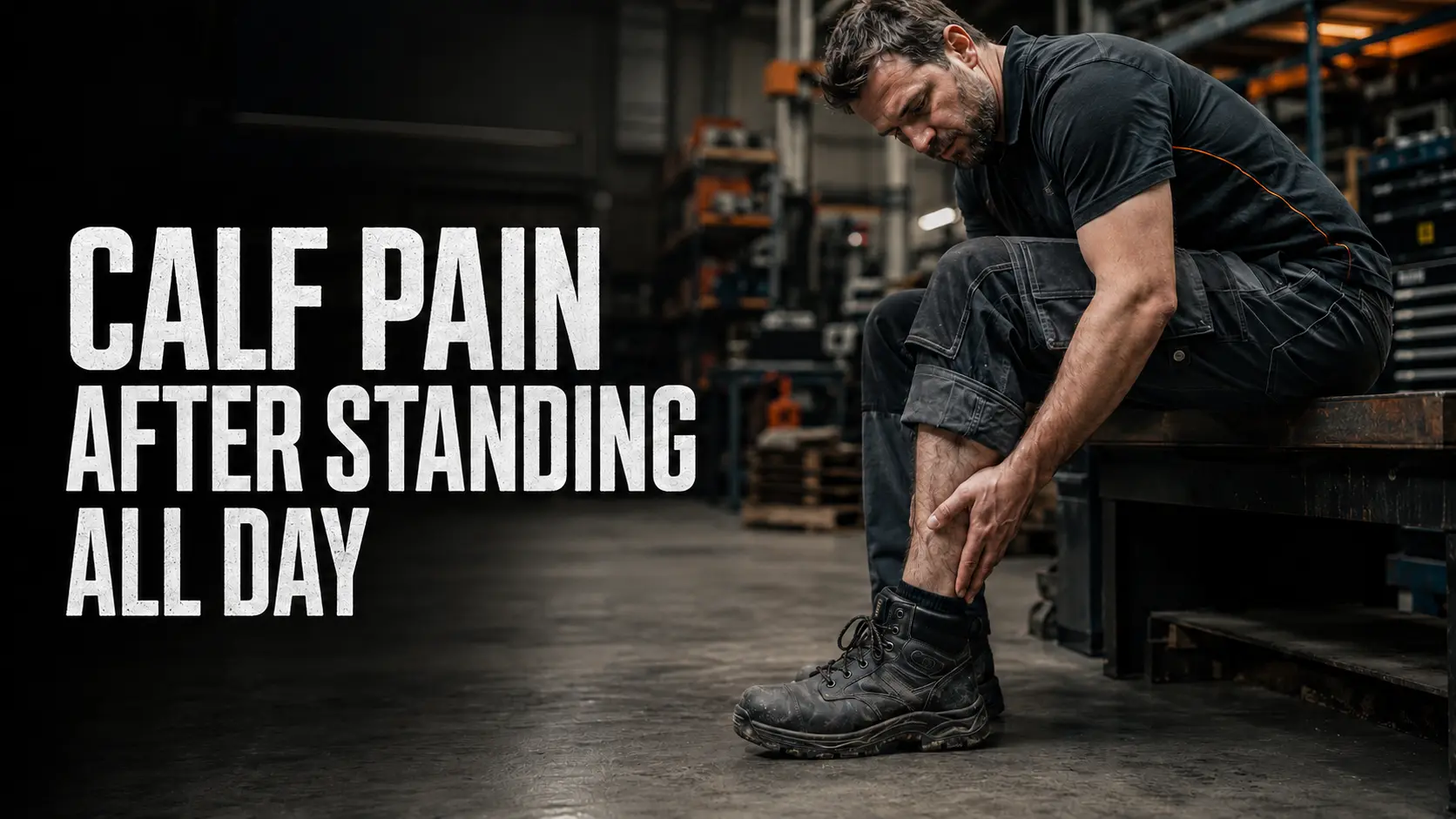
Learn whether your aching calves need movement, recovery, equipment changes or urgent medical attention.
Calf pain after standing all day usually comes from overworked muscles, limited movement or temporary fluid buildup in the lower legs. This guide helps warehouse, construction, retail and factory workers separate ordinary end-of-shift fatigue from a strain, nerve problem or possible blood clot.
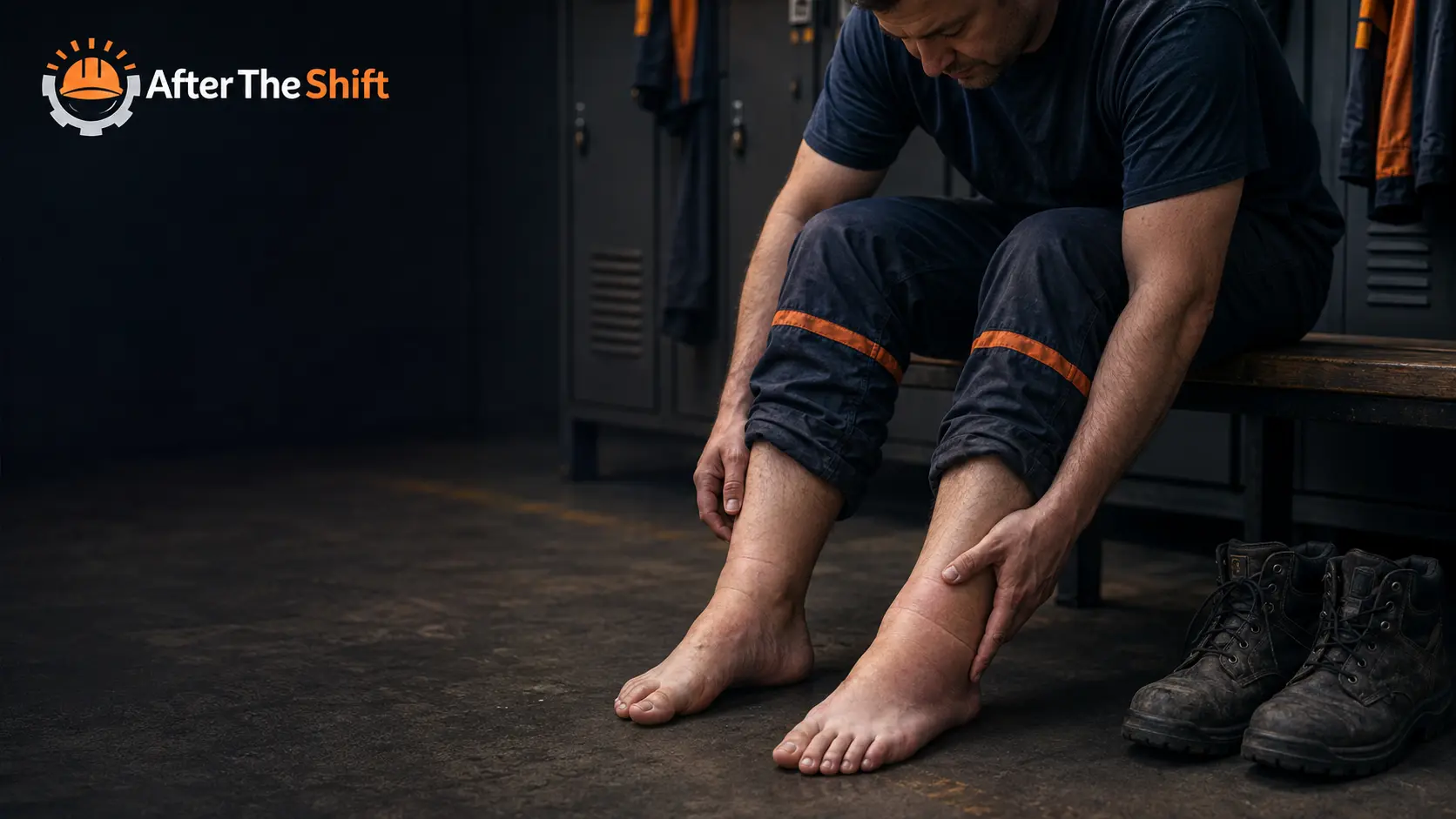
Both calves aching after a long standing shift and improving with walking, elevation or overnight rest usually points toward muscle fatigue or temporary fluid pooling. One-sided swelling, warmth, redness or unexplained tenderness needs prompt medical assessment.
- Compare both legs for swelling and color
- Use short walking or ankle-pump breaks
- Change position before pain becomes intense
- Track whether symptoms clear by morning
- Massaging a hot, swollen, unexplained calf
- Assuming every calf cramp is dehydration
- Using compression to hide worsening symptoms
- Pushing through sudden sharp pain or weakness
If both calves feel gradually tired after standing and recover with rest, start with movement and workload changes; if one calf becomes swollen, warm, discolored or unusually tender, stop self-treating and seek medical assessment.
| What you notice | More likely explanation | What to do | Flag |
|---|---|---|---|
| If both calves ache late in the shift | Muscle fatigue or static standing | Walk, change stance and recover overnight | Usually low |
| If both ankles also look mildly puffy | Temporary fluid pooling | Gentle movement and elevation; monitor | Monitor |
| If one spot hurts after a slip, push-off or lift | Possible calf strain | Reduce loading; assess if walking is difficult | Moderate |
| If one calf is swollen, warm, red or darker | Possible DVT or another urgent condition | Seek prompt medical assessment; do not massage | High |
| If calf pain comes with chest pain or breathlessness | Possible pulmonary embolism | Call emergency services now | Emergency |
Standing still keeps the calf muscles under low-level tension while reducing the regular muscle-pump action that helps move blood and fluid upward. That combination can cause aching, heaviness, tightness or mild swelling in both legs. Symptoms that are strongly one-sided, sudden, worsening or accompanied by warmth, discoloration, chest pain or breathlessness do not fit ordinary standing fatigue.
Why does standing all day make your calves hurt?
Prolonged standing can fatigue the calf muscles while allowing more fluid to collect in the lower legs, especially when you stand in one position rather than walking.
The calf is not passive while you stand. The gastrocnemius and soleus muscles constantly make small adjustments to keep you upright. Walking creates repeated contractions that help pump blood upward; static standing provides fewer strong pumping movements while the muscles still work.
| Work exposure | What it loads | Typical feeling | Useful response |
|---|---|---|---|
| Standing still | Postural calf endurance | Heavy, dull or restless calves | Short walking and ankle-pump breaks |
| Concrete flooring | Feet, ankles and lower-leg muscles | Ache that builds through the shift | Footwear review or standing mat |
| Repeated climbing | Calf force and Achilles tendon | Tightness during push-off | Reduce spikes and rebuild capacity |
| Long shift in worn boots | Foot control and calf compensation | Foot plus calf fatigue | Check tread, midsole and fit |
Ordinary standing-related calf fatigue is more likely when discomfort affects both legs, builds gradually, feels dull or tight, and improves after walking, elevation or sleep. It should not create major one-sided swelling, marked warmth, skin discoloration or sudden loss of strength.
Which jobs make calf pain worse?
Jobs become harder on the calves when they combine static standing with hard floors, awkward leaning, repetitive climbing, heavy footwear or limited chances to change position.
| Job type | Common stance or movement | Calf risk | Compounding factor |
|---|---|---|---|
| Assembly or packing | Mostly fixed stance | Fatigue and heaviness | Concrete floor |
| Warehouse picking | Walking, stopping and squatting | Repetitive load | Long distance and worn shoes |
| Construction | Ladders, uneven ground and carrying | Strain and tendon overload | Heavy safety boots |
| Retail or security | Long periods upright | Fluid pooling and fatigue | Few movement breaks |
| Delivery work | Driving followed by sudden loading | Stiffness plus load spikes | Repeated step-downs |
If hard flooring is part of the problem, compare your pattern with the standing-on-concrete damage timeline. If your boots feel flat or unstable, use the work-boot breakdown guide.
Calf pain symptom, cause and fix matrix
The location, timing, symmetry and associated symptoms are more useful than pain intensity alone when deciding what calf pain may mean.
| Symptom pattern | Possible cause | Best first response | Red flag? |
|---|---|---|---|
| Both calves feel tired near shift end | Muscle endurance fatigue | Movement breaks and workload adjustment | Usually no |
| Heavy calves with mild ankle swelling on both sides | Temporary fluid pooling | Walk, ankle pumps and elevate | Monitor |
| Sharp pain after pushing off, jumping or slipping | Possible muscle strain | Stop aggravating load; assess function | If severe |
| Burning, tingling or numbness | Possible nerve or footwear pressure | Check footwear; seek assessment if persistent | If persistent |
| Pain appears at a repeatable walking distance and eases with rest | Possible circulation problem | Arrange medical assessment | Yes |
| One calf is swollen, warm, red or discolored | Possible DVT or infection | Prompt medical assessment; no massage | Yes |
| Sudden breathlessness, chest pain, coughing blood or fainting | Possible pulmonary embolism | Call emergency services | Emergency |
Do not massage, aggressively stretch or cover unexplained one-sided calf swelling with compression. Seek prompt medical care for swelling, warmth, redness or discoloration in one leg. Call emergency services for sudden difficulty breathing, chest pain, coughing blood, a rapid or irregular heartbeat, lightheadedness or fainting.
This guide applies mainly to calf discomfort associated with standing and physical shifts. It cannot diagnose a blood clot, torn muscle, artery problem, infection, medication side effect or neurological condition. Pregnancy, recent surgery, cancer treatment, previous clots, prolonged immobility and some medicines can change the risk decision and justify earlier medical advice.
Should you recover at home or get calf pain checked?
Start by checking for emergency symptoms, then compare both legs and decide whether the pain followed a clear injury.
Do you have sudden breathlessness, chest pain, coughing blood, faintness or collapse?
The four calf-load stages
Calf discomfort becomes more concerning when it starts earlier, lasts longer, changes movement or continues despite reducing the original workload.
| Stage | How it feels | Likely load state | Recovery pattern | Action |
|---|---|---|---|---|
| 1: Shift fatigue | Late-shift dull ache | Capacity temporarily exceeded | Mostly gone by morning | Add movement and recovery |
| 2: Accumulating overload | Starts earlier each shift | Recovery no longer matches load | Morning tightness remains | Change job exposure and footwear |
| 3: Function affected | Limp, weakness or sharp pain | Possible strain or another condition | Persists on days off | Get assessed |
| 4: Red-flag pattern | One-sided swelling, warmth or systemic symptoms | Possible vascular or medical problem | Not safely judged by rest response | Urgent medical route |
Do not treat these as a guaranteed timeline. A sudden strain or blood clot can appear without passing through the earlier stages. For pain that keeps advancing despite recovery, use the guide to recognizing when work pain has crossed the too-late line.
Calf-pain risk quiz
This ten-question screen estimates how strongly your symptoms differ from ordinary end-of-shift fatigue; it does not diagnose the cause.
1. Is one calf noticeably more swollen than the other?
2. Is the painful area warmer, redder or darker than the other side?
3. Did the pain start suddenly without a clear muscular injury?
4. Is the calf tender even with light pressure?
5. Do you have pain at rest or pain that wakes you?
6. Are you limping or unable to push through the affected foot?
7. Does pain remain after a full night or day away from the exposure?
8. Is the pattern becoming earlier, stronger or more frequent?
9. Have you recently had surgery, prolonged immobility or a previous blood clot?
10. Do you have numbness, marked weakness or a cold/pale foot?
A low score cannot rule out a blood clot or other medical condition. Symptoms and risk factors overlap, and a clinician may need testing to determine the cause.
What actually helps calf pain from standing?
The most effective fix is usually to reduce uninterrupted standing, restore regular calf movement and correct the footwear or workstation factor that keeps recreating the load.
Before the shift
- Check boots for uneven wear or collapsed cushioning
- Warm up with easy walking and ankle movement
- Plan position changes before symptoms start
- Use compression only when medically appropriate
During the shift
- Walk briefly instead of locking into one stance
- Alternate which foot is slightly forward
- Use ankle pumps during unavoidable standing
- Use a standing mat at fixed workstations
After the shift
- Take an easy walk before sitting for hours
- Elevate both legs for mild bilateral swelling
- Use gentle massage only for ordinary muscle tightness
- Record recovery time and next-shift symptoms
For ordinary standing fatigue, the fastest workplace change is replacing long blocks of motionless standing with frequent short movement. A minute of walking or repeated ankle movement is usually more targeted than waiting until the end of the shift to perform one long stretch.
For a broader plan covering sleep, workload and after-work habits, use the physical-work recovery guide or build a personalized sequence with the After the Shift routine builder.
Recovery products compared: who should buy and who should skip?
Products can reduce an identifiable problem—static standing, ordinary tightness, limited ankle movement or mild bilateral swelling—but none can safely diagnose unexplained calf pain.
Affiliate disclosure: This section contains Amazon affiliate links. If you buy through one of these links, After the Shift may earn a commission at no extra cost to you.
| Option | Best for | Skip or ask first if | Cost level |
|---|---|---|---|
| Physix Gear Calf Compression Sleeves | Ordinary heavy or tired legs during standing | Unexplained one-sided swelling, suspected clot, severe arterial disease, skin problems or uncertain fit | $ |
| TriggerPoint STK Handheld Massage Stick | Controllable massage of ordinary muscle tightness | Swelling, warmth, redness, bruising, acute injury or unexplained tenderness | $$ |
| StrongTek Wooden Slant Board | Adjustable calf stretching when ankle movement is limited | Sharp pain, acute strain, unstable balance or stretching worsens symptoms | $$ |
| FEATOL Anti-Fatigue Mat | Standing at one workstation on a hard floor | Your job requires constant walking or the mat creates a trip hazard | $$ |
| REVIX XL Shin and Calf Ice-Pack Wrap | Short-term comfort after an identifiable overuse flare or minor injury | Reduced sensation, poor circulation, damaged skin or unexplained swelling | $$ |
| TranquilRelax Leg Elevation Pillow | Comfortable elevation after work or mild bilateral swelling | Elevation increases pain, causes numbness or delays assessment of one-sided swelling | $$$ |
Best when the exposure is a fixed workstation on concrete or another hard floor.
Physix Gear Compression Sleeves
Best for appropriate users with ordinary heavy-feeling legs—not unexplained one-sided symptoms.
TriggerPoint STK Massage Stick
Best for controlled pressure on familiar muscle tightness after red flags have been excluded.
Buy only when you can name the problem the product solves. A mat addresses hard-floor standing; a roller addresses ordinary tight muscles; a slant board provides controlled stretching; elevation supports recovery from mild bilateral swelling. Skip every product and seek medical guidance when symptoms are unexplained, strongly one-sided, worsening or associated with warmth, discoloration, breathing difficulty or chest pain.
Calf-pain shift checklist
Complete this checklist during the next several shifts to test whether position, footwear and recovery changes reduce the pattern.
Frequently asked questions about calf pain after standing
These answers cover the most common timing, safety, treatment and work questions that do not fit neatly into one symptom category.
Bottom line
The best first step for ordinary calf fatigue is frequent movement during the shift, not a harder recovery session after it. Workers at fixed hard-floor stations may benefit from an anti-fatigue mat, while appropriate users with familiar leg heaviness may consider correctly fitted compression. Avoid massage, aggressive stretching and self-treatment when one calf is newly swollen, warm, discolored or unusually tender.
Next steps
Use the symptom pattern—not the product list—to choose what happens next.
- Check for red flags now: compare both calves and screen for breathing or chest symptoms.
- If the pattern is ordinary fatigue: add movement breaks and adjust the standing setup for the next three to five shifts.
- Track recovery: note when pain begins, whether both sides match and whether it is substantially better by morning.
- Choose one targeted aid: match the product to the actual exposure instead of buying several recovery products at once.
- Escalate when needed: arrange assessment if pain persists, progresses, affects walking or does not behave like normal fatigue.
Ready to build a recovery plan that fits your shift?
Save this before your next shift.
Bookmark, pin or share this guide so you can compare your symptoms before and after work instead of relying on memory.
This article is general recovery education, not a diagnosis or a substitute for care from a qualified clinician. Stop and get medical help for severe pain, numbness, weakness, chest pain, sudden swelling, fever, or symptoms that keep worsening.
Log in to leave a comment.