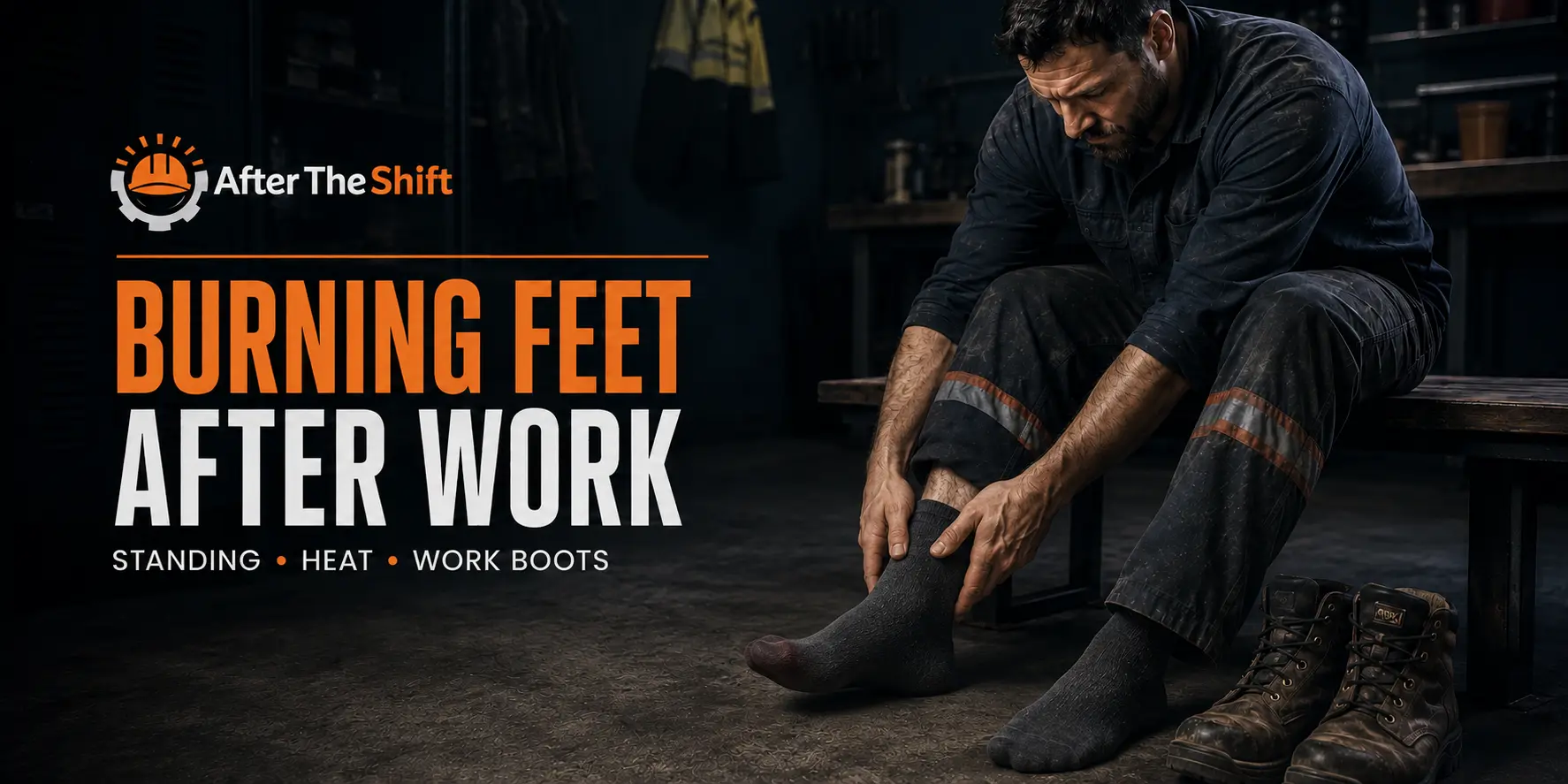
Find the pattern behind hot, burning feet and use the right fix before another shift makes it worse.
Home → Injuries & Prevention → Burning Feet After Work
If your soles feel hot, raw or electrically “on fire” after a warehouse, construction or trade shift, the pattern matters more than the pain label. Use the location, timing and visible skin signs below to separate pressure, heat, friction and moisture from symptoms that need medical assessment.
Burning feet after work often happen when hours of standing load the sole while tight, hot or damp work boots add pressure and friction. Symptoms that settle after removing the boots, cooling down and recovering overnight are more consistent with a work-triggered pattern. Burning that persists at rest, recurs without boots, spreads, or comes with numbness may involve nerve irritation or another medical cause and should be assessed.
First, remove the boots and inspect your feet. Match the pattern: broad sole burning points toward load and heat; local hot spots toward rubbing or pressure; itch, peeling or cracking toward a skin problem; tingling or numbness toward possible nerve involvement.
- Loosen or remove boots at the first safe break
- Change damp socks during long shifts
- Check fit, insole wear and pressure marks
- Track whether symptoms clear by morning
- Stacking two insoles inside a tight boot
- Applying ice directly to numb skin
- Ignoring cracks, blisters or open wounds
- Calling persistent burning “normal fatigue”
If the burning follows the boot and fades after the boot comes off, fix heat, moisture, fit and load first; if it stays, spreads or includes numbness, stop treating it as a gear-only problem.
| Your pattern | Most useful first move | Flag |
|---|---|---|
| If you burn only near shift end and improve after boot removal | Ventilate, change socks, check boot volume and worn cushioning | Lower concern |
| If you have one sharp hot spot under a toe, heel or edge | Find the rub point; adjust lacing or fit; protect intact skin | Moderate |
| Symptom includes itching, peeling, cracks or odor | Keep feet dry and ask a pharmacist/clinician about a skin or fungal cause | Moderate |
| Symptom persists at rest, wakes you, spreads or includes numbness | Arrange medical assessment; do not rely on insoles or powder | High |
| If one foot is suddenly red, hot, swollen, wounded or changing colour | Stop loading it and seek urgent medical advice | Urgent |
Why do feet burn after standing in work boots?
The usual work-triggered pattern is not one single injury: it is the combined load of standing, heat trapped by the boot, sweat-softened skin, friction and local pressure.
Standing keeps pressure on the heel, forefoot and outer sole for hours. A stiff safety boot limits how the foot spreads, while a compressed insole stops distributing load well. Heat and sweat make skin easier to rub. A narrow toe box or overfilled boot can then press on toes and small nerves, producing burning, stinging or pins-and-needles sensations.
| Load | What changes | Typical clue | Decision criterion |
|---|---|---|---|
| Static standing | Repeated pressure in the same zones | Broad sole ache/burn late in shift | Improves with walking, sitting or unloading |
| Heat and sweat | Skin stays warm, damp and friction-prone | Wet sock, odor, softened skin | Better after dry socks and ventilation |
| Tight fit | Toes and forefoot cannot spread | Marks, toe burning, edge hot spot | Worse with thick socks or extra insole |
| Worn cushioning | Impact and pressure spread less evenly | Boot once felt good; now burns earlier | Visible flattening or heel/forefoot imprint |
Fastest useful test: loosen or remove the boot, change into a dry sock and walk or sit for 20–30 minutes. Clear improvement supports heat, moisture, fit or standing load as contributors. No improvement does not prove nerve damage, but it weakens the case for a boot-only explanation.
Which jobs make burning feet more likely?
Jobs with hard floors, limited position changes, heat, waterproof footwear or repeated climbing create the strongest work-related pattern.
| Job type | Main angle | Risk | Compounding factor |
|---|---|---|---|
| Warehouse picking | Concrete plus high step count | High | Fast turns and old insoles |
| Construction/trades | Stiff boots and uneven surfaces | High | Waterproofing traps heat |
| Assembly/packing | Static standing | Moderate–high | Few natural position changes |
| Kitchen/factory heat | Hot environment | High | Sweat and slip-resistant uppers |
| Delivery driving | Pedal pressure plus repeated exits | Moderate | Swelling inside laced boots |
For the wider load picture, compare this pattern with what standing on concrete all day does over time and why work-boot cushioning stops helping.
Burning-feet symptom → cause → fix matrix
Location, timing and accompanying signs are the three named criteria that make the first action more useful. This matrix routes action; it does not diagnose disease.
| Symptom | More consistent with | First fix | Red flag |
|---|---|---|---|
| Whole sole burns only after long standing | Load, heat, flattened cushioning | Unload, cool, inspect insole and boot fit | Still burning next morning |
| One toe/edge feels raw or blister-hot | Friction or local pressure | Adjust fit/lacing; protect intact hot spot | Broken skin, pus or spreading redness |
| Burning with itch, peeling or toe-web cracks | Skin irritation or possible fungal infection | Dry carefully; pharmacist/clinician advice | Diabetes, wound or spreading infection |
| Ball-of-foot burn into toes in tight boots | Forefoot compression or nerve irritation | Wider fit; remove added volume | Persistent numbness or weakness |
| Both feet burn at night or without boots | Possible peripheral nerve or medical cause | Book medical assessment | Spreading symptoms or loss of sensation |
| One foot suddenly red, hot and swollen | Not routine standing fatigue | Take weight off and seek urgent advice | Urgent pattern |
This guide usually applies to adults whose symptoms appear during or after physical work. It does not diagnose neuropathy, infection, circulation problems, diabetes complications or a stress injury. People with diabetes, reduced sensation, poor circulation, immune suppression, an open wound or a recent foot injury should use a lower threshold for professional care.
Decision tree: is this boot burn, skin trouble or a warning sign?
Start with urgent signs, then test persistence, skin changes and boot dependence in that order.
Is one foot suddenly red, hot, swollen or wounded—or are you losing strength or sensation?
The four damage stages: when simple boot burn stops being simple
These four practical stages describe escalation, not a medical diagnosis: later onset and complete overnight recovery are less concerning than earlier onset, persistence, sensory change or skin damage.
| Stage | What it feels like | What may be happening | Recovery | Action |
|---|---|---|---|---|
| 1: Late heat | Warm, tired soles near clock-out | Load, heat and sweat | Clears after boot removal | Dry, ventilate, rotate position |
| 2: Earlier burn | Burn starts mid-shift or at one hot spot | Poor fit, worn cushioning, friction | Hours, but clear by morning | Fix boot volume and pressure now |
| 3: Persistent | Night burning, tingling or recurring numbness | Possible nerve/medical involvement | Not fully clear by morning | Book assessment |
| 4: Function/skin change | Weakness, lost feeling, wound, marked redness/swelling | Potentially serious condition | Unreliable | Urgent medical advice |
Seek urgent advice for a suddenly red, hot and swollen foot, spreading redness, a draining wound, major colour change, new weakness or rapidly worsening loss of feeling. Arrange a routine medical visit if burning continues for several weeks despite self-care, becomes more intense, spreads upward or starts causing numbness.
10-question burning-feet risk quiz
This mini-test measures persistence, sensory change, skin signs and how tightly the symptom tracks your work boots. It is a routing tool, not a diagnosis.
1. Burning starts before the final two hours of the shift.
2. It continues after your boots have been off for more than one hour.
3. It is still present the next morning.
4. You also feel numbness, electric shocks or pins and needles.
5. The burning occurs on days when you do not wear work boots.
6. Symptoms are becoming earlier, stronger or spreading upward.
7. You have peeling, cracks, a blister, rash or wound.
8. One foot becomes clearly redder, hotter or more swollen than the other.
9. You have diabetes, reduced foot sensation or known circulation trouble.
10. Pain changes how you walk or makes you feel weak/unsteady.
What actually fixes burning feet—before, during and after work
The strongest plan removes the trigger before the shift, interrupts exposure during it and checks whether recovery is complete afterward.
Before
- Use one correctly sized insole
- Leave enough toe and instep volume
- Start with fully dry boots
- Use dry moisture-managing socks
- Apply anti-friction balm only to intact hot spots
During
- Change damp socks
- Loosen laces safely if swelling builds
- Alternate standing with steps or sitting
- Use breaks to inspect hot spots
- Do not push through broken skin
After
- Remove boots and socks promptly
- Wash and dry, especially between toes
- Use gentle cooling, not direct ice
- Dry boots completely before reuse
- Record whether burning clears by morning
More cushioning is not always more room. Adding an insole on top of the factory liner can lift the foot into the toe cap and compress the forefoot. Remove the replaceable factory liner unless the new insole instructions say otherwise, then confirm your toes can move and the heel is stable.
If your main problem is first-step heel pain rather than heat or burning, use the separate guide to heel pain after standing all day. If swelling dominates, use the swollen feet and ankles red-flag guide.
Products and treatment options compared
Buy for the driver you identified—not for the word “burning.” Insoles target standing pressure, dry socks and powder target moisture, balm targets friction, and cooling socks target short-term after-work comfort.
Affiliate disclosure: As an Amazon Associate, After The Shift may earn from qualifying purchases at no extra cost to you. Availability and price can change.
| Option | Best for | Skip or ask first if | Cost level |
|---|---|---|---|
| Scholl GelActiv Work Insoles | Budget cushioning for broad sole fatigue | Boot is already tight or needs firm correction | $ |
| Timberland PRO Anti-Fatigue Insole | Upgrade for long standing and impact | Added thickness crowds toes/instep | $$ |
| Dickies Dri-Tech Moisture-Control Socks | Sweaty boots and mid-shift sock changes | Cuff constricts or thickness ruins fit | $ |
| Dr. Scholl’s Ultra-Sweat Absorbing Foot Powder | Moisture and odor control | Skin is broken; do not treat fungus by assumption | $ |
| Body Glide Foot Glide Anti-Blister Balm | Predictable friction hot spots on intact skin | Blister is open, infected or unexplained | $ |
| Reusable Cold Therapy Socks — Large | Brief after-work cooling for hot, tired feet | Reduced sensation/circulation, skin injury, cold intolerance; ask clinician | $$ |
Moisture-control socks if your socks are wet at clock-out. They change the trigger without shrinking the boot’s internal space much—provided thickness still fits.
A single work insole if the factory liner is flat and the boot has enough volume. Choose Scholl for budget cushioning or Timberland PRO for the heavier-duty upgrade.
Anyone with persistent, spreading or unexplained burning, numbness, weakness, a wound, infection signs or major one-sided redness/swelling. Assessment comes before gear.
How the options were ranked
The ranking uses four criteria: trigger match (does it address pressure, sweat or friction?), fit risk (could it crowd the boot?), safety constraints (broken skin, numbness or poor circulation), and reversibility (can you test it without masking a worsening pattern?). Products relieve contributors; none diagnoses or cures neuropathy, infection or circulation disease.
Printable burning-feet shift checklist
Complete this for three to five shifts so you can see whether the problem follows moisture, fit, duration or recovery.
Burning feet after work: frequently asked questions
These answers separate short-lived work triggers from patterns that should not be self-treated indefinitely.
Bottom line
Best first move: identify whether the trigger is pressure, moisture, friction or persistence. Workers whose feet are simply hot and damp at clock-out should start with dry socks, boot drying, position changes and a fit check. Workers with local rubbing should fix the contact point. Anyone with persistent burning, numbness, weakness, spreading symptoms, a wound or a suddenly red/hot/swollen foot should skip gear experiments and seek medical advice.
The NIOSH review of prolonged standing identifies dynamic movement as a useful risk-reduction approach. The NHS peripheral neuropathy guide lists burning, stabbing or shooting pain, numbness and tingling among symptoms. Mayo Clinic advises assessment when burning persists despite weeks of self-care, intensifies, spreads or causes lost feeling. This article provides general education, not diagnosis or individualized treatment.
Related guides
- Physical work recovery guide — build the full recovery system.
- Foot pain after standing eight hours — separate load fatigue from a worsening foot problem.
- Why feet hurt worse in the parking lot — understand delayed post-shift pain.
- After The Shift routine builder — turn the right fixes into a repeatable plan.
Next steps
- Tonight: inspect both feet and the inside of both boots; note skin, pressure marks, dampness and insole flattening.
- Next shift: change one variable only—socks, lacing/fit or insole—so you can tell what helped.
- For three to five shifts: record onset time, location and whether the burning clears within an hour and by morning.
- Escalate: book assessment if it persists, worsens, spreads or includes numbness; use urgent care for the red-flag patterns above.
Bookmark the symptom matrix and complete the checklist for three workdays—the pattern will tell you more than guessing at another insole.
This article is general recovery education, not a diagnosis or a substitute for care from a qualified clinician. Stop and get medical help for severe pain, numbness, weakness, chest pain, sudden swelling, fever, or symptoms that keep worsening.

Log in to leave a comment.