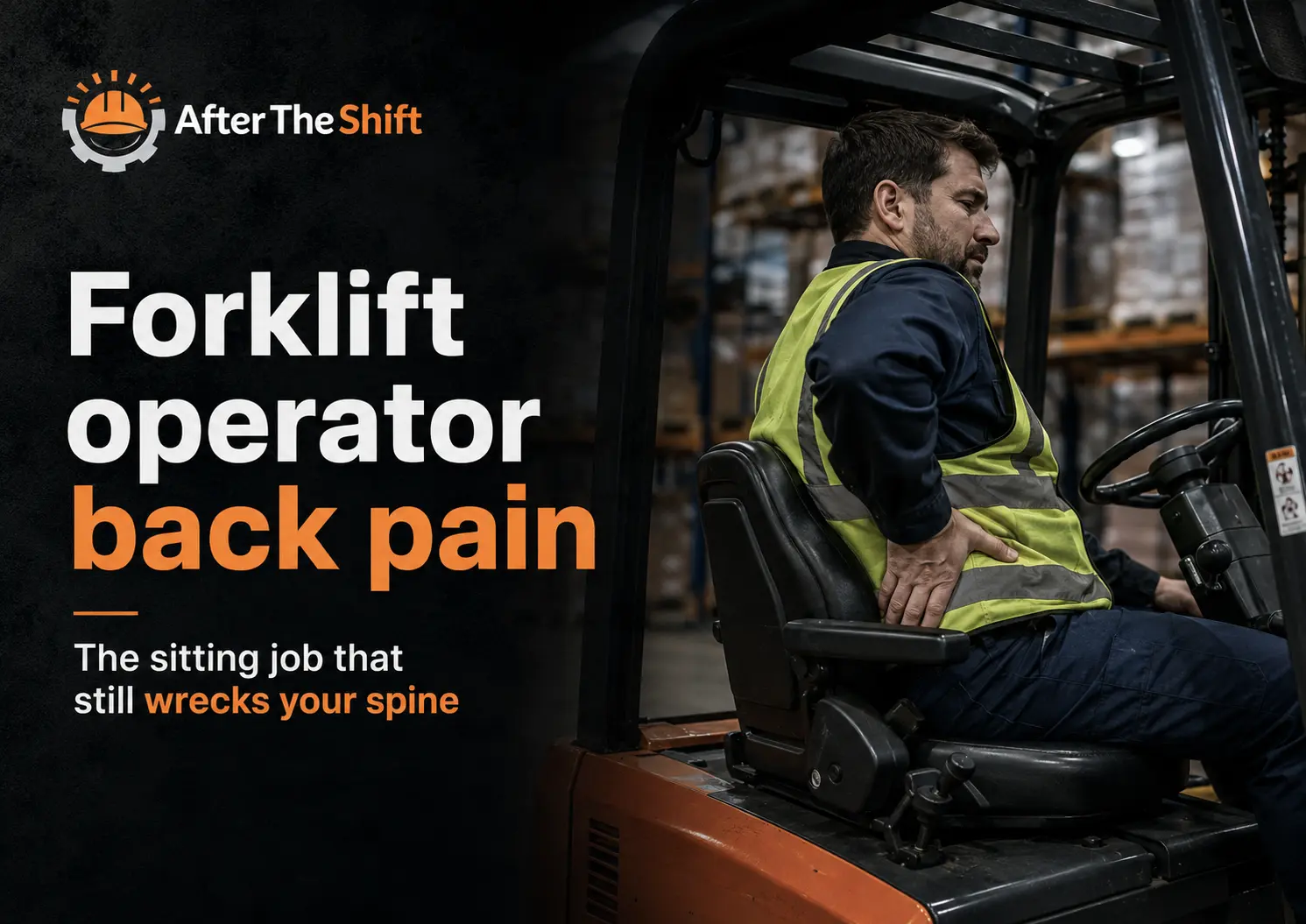
Forklift work looks easy until hours of sitting, twisting, vibration, and blind-spot checking start beating up your lower back.
Forklift operator back pain usually comes from sitting under vibration while repeatedly twisting to look behind you, reaching for controls, braking, and climbing in and out of the cab. It is not “just sitting.” It is loaded sitting plus rotation. This guide shows you how to spot the cause, adjust the setup, reduce flare-ups, and know when back pain is no longer normal work soreness.
Forklift operator back pain is usually caused by a mix of seat vibration, twisted driving posture, poor lumbar support, tight hips, and repeated cab entry/exit. The fastest fix is not one stretch. It is a better seat position, less twisting, short reset breaks, and a post-shift hip-and-back routine.
- Set the seat so your hips are level or slightly above knees.
- Use mirrors and full torso turns instead of neck-only twisting.
- Take 60–90 second standing resets when possible.
- Stretch hips, glutes, and hamstrings after the shift.
- Driving twisted for long aisles while looking backward.
- Keeping a wallet, phone, or tool in your back pocket.
- Ignoring numbness, leg pain, or weakness.
- Using only painkillers while the setup stays bad.
If your back pain gets worse during long seated driving, reverse driving, or after stepping out of the forklift, treat it as a posture-plus-vibration problem first; if pain runs below the knee, causes numbness, or changes strength, stop guessing and get checked.
| If you… | Most likely driver | Risk level | First move |
|---|---|---|---|
| Feel stiff after 2–4 hours in the seat | Static sitting, tight hips, weak trunk resets | Low | Add standing resets and hip mobility |
| Get sharp pain when reversing or checking behind | Repeated lumbar rotation under load | Moderate | Change mirror use and rotate through hips/torso |
| Feel worse after rough floors or long yard driving | Whole-body vibration through the seat | Moderate | Check seat suspension, tire/floor exposure, route time |
| Have numbness, tingling, or pain down one leg | Possible nerve irritation or disc-related issue | High | Stop self-diagnosing and get medical advice |
Why forklift operator back pain happens
Forklift back pain happens because the spine is held in a seated position while the body absorbs vibration, twisting, braking forces, and repeated cab movements.
A forklift job can look lighter than picking, loading, or construction work, but the load is different. Instead of one heavy lift, the back gets thousands of small irritations: seat bounce, hip compression, looking over the shoulder, leaning to see forks, reaching for controls, and climbing down stiff after hours of sitting.
Forklift work can cause back pain even though the operator is sitting because the spine is exposed to vibration, repeated twisting, poor seat angles, and long periods without movement. Pain is more likely when the operator drives backward often, works on rough floors, has weak seat suspension, or climbs in and out while stiff.
| Load source | What it does to the back | Common forklift example | Best control |
|---|---|---|---|
| Vibration | Irritates discs, joints, and muscles over time | Rough concrete, yard surfaces, old seat suspension | Seat suspension, route planning, slower rough-zone driving |
| Twisting | Loads the lower back while discs are compressed | Reverse driving and blind-spot checking | Use mirrors, rotate torso, avoid locked hips |
| Static sitting | Stiffens hips and reduces back circulation | Long pallet runs without getting out | Micro-breaks, hip flexor stretch, standing resets |
| Cab entry and exit | Adds step-down shock when the back is already stiff | Jumping down or twisting off the step | Three-point contact and controlled step-down |
What this applies to — and what it does not
This advice applies to work-related lower back stiffness, aching, and mild flare-ups linked to forklift driving posture, vibration, and shift patterns.
Lower back stiffness after long driving, soreness when stepping out, dull aching after reverse driving, and tight hips after sitting most of the shift.
The forklift has poor suspension, the floor is rough, the operator drives backward often, the seat is too low, or the worker skips movement breaks.
Major trauma, fall injuries, loss of bladder or bowel control, progressive leg weakness, fever with back pain, or severe pain after an accident.
Get medical help urgently if back pain comes with new bladder or bowel problems, numbness around the groin/saddle area, major leg weakness, fever, unexplained weight loss, or pain after a fall or crash.
How forklift job type changes the risk
The same forklift title can mean different back risks depending on whether you spend the shift reversing, stacking high, loading trailers, driving rough yards, or doing constant short runs.
| Job type | Main body angle | Back risk | Compounding factor |
|---|---|---|---|
| Warehouse pallet movement | Forward sitting with frequent side checks | Low to moderate | Long sitting blocks without resets |
| Trailer loading | Reverse driving and repeated checking | Moderate to high | Twisting while seated and compressed |
| Reach truck work | Neck extension, side sitting, upper-back tension | Moderate | Looking up and sideways repeatedly |
| Yard forklift driving | Seated bracing over uneven surfaces | High | Whole-body vibration and impact jolts |
| Mixed forklift + manual handling | Sitting, stepping down, bending, lifting | High | Cold stiff back followed by lifting |
For most forklift operators, the best first upgrade is not a brace. It is a seat and mirror setup that reduces twisting, plus a simple rule: stand and reset your hips before the back feels locked, not after.
Symptom → cause → fix matrix
Your symptom pattern tells you whether the likely problem is stiffness, vibration irritation, twisting overload, nerve involvement, or a setup issue.
| Symptom you notice | Likely cause | Fix to try first | Red flag? |
|---|---|---|---|
| Lower back feels locked after sitting | Hip flexor tightness and static posture | Hip flexor stretch, glute bridge, standing resets | Usually no |
| Pain spikes when checking behind | Twisting under spinal compression | Turn whole torso, adjust mirrors, avoid locked hips | Watch it |
| Aching after rough floor driving | Seat vibration and repeated jolts | Check seat suspension, slow rough zones, break up exposure | Watch it |
| Pain runs into buttock or thigh | Possible nerve or disc irritation | Reduce aggravating positions and get assessed if persistent | Yes if worsening |
| Numbness, tingling, or weakness | Possible nerve compression | Stop relying on stretches only; seek medical advice | Yes |
Back pain decision tree for forklift operators
Use this decision tree to separate normal stiffness from setup-driven irritation and possible nerve warning signs.
Step 1: Do you have numbness, tingling, weakness, pain below the knee, or bladder/bowel changes?
The 4 damage stages of forklift back pain
Forklift back pain usually moves from stiffness, to repeat flare-ups, to protective guarding, to nerve-like symptoms if the original exposure keeps repeating.
| Stage | How it feels | What is happening | Recovery window | Action |
|---|---|---|---|---|
| Stage 1 | Stiff after shift, better after moving | Static sitting and tight hips | Days to 2 weeks | Setup reset + mobility |
| Stage 2 | Pain starts during the shift | Repeated irritation from twisting/vibration | 2–6 weeks if exposure changes | Reduce triggers and add daily resets |
| Stage 3 | Pain changes how you move | Guarding, muscle spasm, poor tolerance | Several weeks or longer | Get assessed and modify duties if possible |
| Stage 4 | Leg pain, numbness, weakness | Possible nerve involvement | Depends on cause and severity | Medical advice, not guesswork |
The mistake is waiting until pain becomes part of the job. If forklift back pain starts earlier in the shift than it did last month, your tolerance is dropping. That is the time to change the setup, not the time to prove you are tough.
Mini-test: how serious is your forklift back pain setup?
This 10-point check scores your risk based on symptoms, setup, and exposure. It does not diagnose you, but it shows whether your current work pattern is likely feeding the pain.
1. Does your back feel worse after long seated driving?
2. Does reverse driving or looking behind trigger pain?
3. Do rough floors, yard surfaces, or old forklifts make it worse?
4. Do you step out of the cab feeling locked or bent forward?
5. Do you keep a wallet, phone, or tool in your back pocket while driving?
6. Does pain start earlier in the shift than it used to?
7. Do you skip movement breaks because the work is constant?
8. Do you have pain into the buttock, thigh, calf, or foot?
9. Does coughing, sneezing, or bending sharply increase the pain?
10. Have you had this for more than 2 weeks without improvement?
What actually fixes it — by phase
The fix works best when you split it into before-shift setup, during-shift exposure control, and after-shift recovery.
Before the shift
- Remove wallet or hard objects from back pockets.
- Set seat distance so pedals do not force reaching.
- Set mirrors before the first run, not after pain starts.
- Do 60 seconds of hip hinges and glute squeezes.
During the shift
- Stand for 60–90 seconds when the back starts to lock.
- Use whole-torso turns instead of only neck/lower-back twisting.
- Slow down over rough sections where possible.
- Do not jump down from the cab.
After the shift
- Walk 5–10 minutes before collapsing onto the sofa.
- Stretch hip flexors, glutes, and hamstrings.
- Use heat for stiffness, not numbness or swelling.
- Track if pain improves overnight or carries into morning.
If your back hurts more after driving home than during the shift, compare this with why lower back pain feels worse on the drive home. The pattern is similar: seated compression after the back is already irritated.
Treatment options compared
Most forklift back pain improves faster when you combine exposure control with basic recovery instead of relying on one passive treatment.
| Treatment option | Best for | Skip if | Cost/time |
|---|---|---|---|
| Seat and mirror adjustment | Twisting pain and poor driving posture | The forklift seat is broken or non-adjustable | Free, 5 minutes |
| Hip and glute mobility | Stiffness after sitting | Stretching causes leg symptoms or sharp pain | Free, 8–12 minutes/day |
| Lumbar support cushion | Seats with no lower-back support | It forces you too far forward or worsens symptoms | Low to moderate cost |
| Heat after work | Muscle stiffness and guarded movement | Numbness, swelling, new injury, or unexplained symptoms | Low cost, 15–20 minutes |
| Physio or medical assessment | Persistent pain, leg symptoms, weakness, recurring flare-ups | Mild stiffness that clearly improves with setup changes | Higher cost, best for unclear cases |
Seat setup + movement resets. Best for most operators because it attacks the actual cause: long seated compression plus repeated twisting.
Daily hip/glute routine. Free and useful, but it will not fix a broken seat, rough route, or constant reverse-driving posture by itself.
Proper assessment. Best if pain is persistent, spreading, or changing how you walk, lift, sleep, or drive.
Forklift back pain checklist
Use this checklist before a shift and after a shift to remove the easiest back pain triggers first.
Related links that complete the answer
Forklift back pain overlaps with lower-back stiffness, bending patterns, fatigue, and general work-pain warning signs. These related guides help you narrow the cause.
- Physical work recovery guide for workers who hurt after shifts
- Lower back pain after shifts and what is actually happening
- Lower back stiffness in the morning after physical work
- Why repeated bending destroys your back faster than one heavy lift
- The bend-reach-twist-lift pattern behind warehouse back injuries
- Work pain vs injury: knowing the difference matters
Bottom line
Forklift operator back pain is usually a sitting-plus-vibration problem, not proof that the job is easy or that your back is weak.
The best choice is to fix the forklift setup, reduce twisting, add short standing resets, and use after-shift hip/back recovery. This is best for operators with stiffness, aching, and posture-related flare-ups. Avoid self-treating if pain spreads down the leg, causes numbness, or changes strength.
FAQs about forklift operator back pain
These answers cover the common search questions: cause, time to improve, work safety, seat support, cost, and red flags.
Next steps
Do the next step based on your symptom level, not your pride.
- If pain is mild stiffness: fix seat position, remove back-pocket pressure, and add 60-second standing resets for one week.
- If pain is linked to reverse driving: adjust mirrors, rotate through the torso, and stop holding twisted positions for long aisles.
- If pain is linked to rough floors: check seat suspension, slow unavoidable rough zones where possible, and break up exposure.
- If pain carries into the morning: use the checklist and compare symptoms with morning lower-back stiffness after physical work.
- If pain spreads into the leg or causes numbness: stop treating it like ordinary soreness and get medical advice.
Bookmark the physical work recovery guide and use it as your main hub when pain moves from “normal soreness” into repeated shift damage.
Save this before your next shift.
Forklift back pain is easier to fix when you catch the pattern early: seat, twist, vibration, reset.
This article is general recovery education, not a diagnosis or a substitute for care from a qualified clinician. Stop and get medical help for severe pain, numbness, weakness, chest pain, sudden swelling, fever, or symptoms that keep worsening.

Log in to leave a comment.